

Sound analysis.
Everybody has their own personal sound preference, and after a while I almost gave up on being able to find one pair of in-ear monitors that going to come close to balancing out a warm natural sound and a more revealing reference sound. I always separate headphones into these two groups and analyze which one comes closer to my target preference signature. Here, Andromeda was able to close the gap with a nearly perfect yin-yang balance of revealing detailed sound wrapped in a blanket of smoothness and coherency.
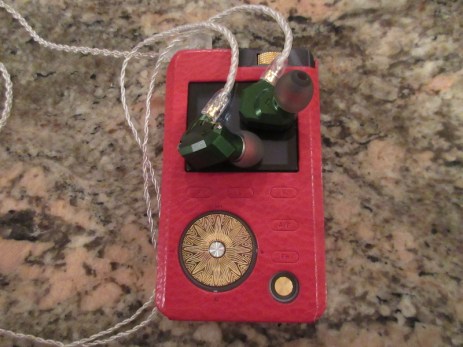
After a few weeks of continuous listening and going between PAW Gold and Opus#1 as my two primary sources, I found Andromeda to have a balanced revealing signature, with a slight hint of being mid-forward, and a very smooth natural tonal characteristic. The signature is actually a good example of W-shaped balanced sound where lows, mids, and highs stand out and equally grab your attention. You can easily shift your focus and effortlessly zoom in to distinct parts of the spectrum. But as I mentioned already, the most important characteristics of Andromeda sound quality is being able to successfully bridge the gap between warm smooth and revealing detailed tonalities, resulting in a perfection of a smooth organic transparent sound with an impressive clarity and retrieval of details.
Starting with a bass, you hear a bottomless low end extension with a visceral sub-bass rumble that has a warm textured quality. Here, the tuning doesn’t shy away from a slightly enhanced quantity, but surprisingly it doesn’t overpower the mid-bass or turns Andromeda into L-shaped basshead monitor. I hear a deep analog sub-bass layered underneath of a fast tight punchy mid-bass. Bass is well controlled with an excellent separation from the mids. In some cases, I found other multi-BA headphones with lows tuned like analog dynamic driver, while here it’s a combination of what sounds like a warm lush dynamic driver sub-bass with a fast balanced armature driver mid-bass – coherent and in unison.
Mids are another star of the tuning where lower mids have a natural organic body, not too lean but with a little bit of thickness and absolute zero muddiness. That was another pleasant surprise because in a number of other IEMs I tested in the past, bass enhancement with a little thicker lower mids can take away from sound clarity by introducing some muddiness. Here, it was carefully tuned without affecting sound clarity. And speaking of clarity, the details of upper mids are very impressive. It wasn’t exactly on a crunchy micro-detail level, but very close minus the crunchy part – very smooth and organic retrieval of details without a hint of harshness. I especially enjoyed the vocal performance, both male and female, which had such a natural and realistic tonality.
Treble is bright and clear, with an excellent definition, zero sibilance or graininess, not too crunchy or super airy, but it still extends nicely and has just a perfect amount of airiness to lighten up the upper frequencies. If you are a fan, for example, of extended crash cymbals, you are not going to hear the full extension of the decay. I guess something gotta give, and I’m perfectly fine with it, though Andromeda treble performance is still ahead of many other smooth signature IEMs I’ve tested. Again, as I stated before, I’m very impressed with clarity and transparency of these IEMs considering now smooth they sound.
The soundstage expansion is definitely on a whole other level with a real holographic 3D imaging where the width/depth/height parameters are way above the average performance. It results in a relatively accurate placement of instruments and vocals in space, but at the same time in a few of the tracks with extreme panning of sounds it felt even a bit overwhelming. Andromeda is great not just for listening to music but also for watching movies or playing video games with surround effects. It picks up every little nuance of the random noise, places it perfectly in space, and gives it a new dimension. Even so separation of instruments and vocals was really good, the layering was just Ok. But I still found the sound to be very dynamic and transparent.
Comparison.
Andromeda vs 64 Audio U12 – U12 soundstage width is a little narrower, while depth/height is the same. U12 has a bit less sub-bass quantity with B1 filter which actually gets closer to with S1 filter, mid-bass punch is very similar though Andromeda has a little more speed. Lower mids are very similar, while Andromeda upper mids are brighter and more detailed where U12 is warmer, and not as forward as Andromeda. Andromeda treble is a little brighter, with a slightly better definition and more airiness. One of the biggest differences here is Andromeda being more transparent, faster, and with a little better retrieval of details while U12 is smoother, more organic, more laid back, and warmer in comparison.
Andromeda vs Noble K10UA – soundstage is similar in depth/height, but Andromeda is noticeably wider. Andromeda has more sub-bass, while K10 has a faster mid-bass, both have a well controlled low end. K10 lower mids are leaner, while Andromeda upper mids are smoother and more organic in comparison to K10 which can get a bit harsher and brighter. K10 treble is brighter and has more crunch, and with a bit more airiness. Andromeda sounds more natural smoother, while K10 is more revealing.
Andromeda vs UM Maestro – Maestro width is a lot narrower, while depth/height are very close. Maestro sub-bass is more rolled off, while mid-bass punch is as fast but less aggressive. Lower mids are a little leaner, but not by a lot, upper mids in Maestro are brighter and little harsher in comparison. Treble in Maestro has better extension and also brighter and with more crunch and airiness, which could even feel a bit grainy in comparison. Both have a detailed clear sound, but Andromeda is a lot smoother (not warmer, but smoother) and has a more natural tonality without any graininess or harshness.
Andromeda vs Noble Savant – Savant soundstage width is a little narrower, while depth/height is the same. Savant sub-bass feels more attenuated and mid-bass punch is a lot less aggressive. Lower mids in Savant are just a touch leaner while upper mids are very similar, being detailed a little more forward, but also a little brighter in comparison. Treble has a similar definition and airiness, but Savant has a little more crunch. Overall Andromeda has definitive upper hand in bass, and sounds smoother and a little more organic in comparison.
Andromeda vs Westone ES60 – ES width is very close, but not 100% as wide, the height is the same but with a little less depth. Sub-bass and mid-bass in ES are more neutral in quantity and don’t extend as deep or punch as fast or have the same impact. ES lower mids are a bit leaner, but not by a lot, upper mids are very similar, maybe with Andromeda being a touch smoother and a bit more organic. Treble is also very similar, clear and well defined without too much airiness. Both have great transparency, but ES is more reference quality with a slight advantage in retrieval of details. Andromeda is more balanced and a little smoother, with a more lifted low end.
Andromeda vs Westone W60 – soundstage is similar in comparison but W60 is a bit narrower, while depth/height is the same. W60 bass is slower and looser with a bit of spillage into lower mids, and thicker lower mids and smoother/warmer upper mids, also less sparkle in treble. Andromeda is smooth, but faster, tighter, and with a more articulate bass and better control/separation from mids, leaner lower mids, more revealing detailed upper mids, and more sparkle/airiness in treble.
Andromeda vs Inear SD-4 – SD4 soundstage is narrower, while depth/height is the same. Due to a more mid-forward sig, it feels like SD4 sub-/mid-bass are lower in quantity, but it could be just the case of sound signature difference. With that in consideration, SD4 sub-bass is a little rolled off and mid-bass is not as fast. Lower mids are very similar, while upper mids are brighter, a little more revealing, though a bit harsher in comparison. SD4 treble is brighter, crispier, with a better extension and more airiness, but at the same time a little harsher, in some tracks even pushing closer to sibilance threshold. In general, Andromeda is more balanced, smoother, with a deeper low end impact, while SD4 is brighter and more analytical and with a more enhanced top end.
Pair up.
As I was going through a pair-up with different sources, the main focus of this test was to compare hissing level, overall soundstage expansion, general sound quality, and the quality of low end impact. I didn’t focus on more detailed aspects of the sound analysis, and instead chose what I found to vary the most between different sources.
LPG (Lotoo PAW Gold) – low hissing; the sound is very spacious, detailed, transparent, fast/punchy, with a natural tonality. I hear a strong mid-bass and textured sub-bass.
Micro iDSD (dac/amp) – no hissing due to a highly configurable gain setting (Micro rocks in this regard!); the sound is very spacious and detailed, has natural organic tonality, and excellent low end extension. Reminded me a lot of LPG performance, maybe even better.
Samsung Note 4 – some hissing; good soundstage, detailed, smooth, fast sound with surprisingly great natural tonality though a bit warmer in comparison to other sources, and the bass is not as articulate. Still, a good pair up on the go with a smartphone.
L&P L5Pro – some hissing; good soundstage, detailed punchy smooth sound, a bit bright and with rolled off sub-bass. Actually, I wasn’t too crazy about this pair up, kind of caught me by surprise.
theBit Opus#1 – low hissing; very spacious, detailed, highly resolving organic sound quality, beautifully textured bass with a nice mid-bass punch. Definitely among my favorite pair ups in this group.
iBasso DX80 – some hissing; good soundstage expansion, sound is warm, smooth, detailed, but not super resolving, more on a warmer analog side. I’m on a fence with this pair up, it was a bit too smooth for my taste.
A&K AK120ii – no hissing; very nice soundstage expansion, detailed, fast/punchy sound, slightly rolled off sub-bass, a bit more mid-forward signature. Zero-hiss sound in comparison to all of my other DAP sources, and I expect the same with other AK models.
FiiO X7 w/AM2 – faint hissing; not bad soundstage, very detailed balanced sound, smooth tonality, nice punchy mid-bass and good sub-bass extension.
Cayin N5 – hissing is high; good soundstage expansion, very balanced detailed sound, excellent low end performance, actually I found both sub-bass and mid-bass quantity/quality to be on a level of LPG, very punchy detailed sound. With an exception of hissing, this pair up was actually good.
FiiO X5ii – faint hissing; good soundstage, excellent low end performance (sub-bass and mid-bass quality is really good), excellent punchy sound. Definitely a pleasant surprise, X5ii pulled through with a really good pair up.
ThinkPad T430s laptop – pretty bad hissing; sound was too thin and bright with poor low end performance. I didn’t expect a miracle and only tested it because my laptop was paired up with Micro iDSD already. Straight from HO of my laptop, which has a generic sound chip, I found the pair up to be rather underwhelming.
Also, for the test purpose, I tried driving E12A and Q1 portable amps from LO and HO of LPG, and found E12A to be dead silent while Q1 yielded some hissing.
Conclusion.
I learned my lesson not to label any IEM/CIEM as the endgame headphones, because every time I think I found one – another review pair gets into my hands/ears and I have to eat my own words. One thing for sure, CFA Andromeda was the biggest surprise for me so far in 2016, and it will be a tough act to follow. With its warm, smooth, revealing tonality and a perfectly balanced sound signature, including the holographic soundstage expansion, Andromeda didn’t just get a checkmark next to all of my personal sound preferences, it quickly got to the top of my favorite in-ear monitors list. As a mentioned before, nothing is 100% perfect and there is some room for improvement, but it’s related to a combination of the fit and my personal ear anatomy. Once I found a pair of eartips that slightly extended the nozzle insertion, it resolved all the previous issues I had with a comfort of the fit. Now, I’m really curious what Ken is going to come up with next. If it took him less than 3 years to build flagship Andromeda and other CFA models, how can you top that? Hopefully, we will find out in a near future!

 Twister6 Reviews
Great and detailed review.
Really looking forward to your opinion about CFA Andromeda vs CA Harmony 8.2 ..thank you..
LikeLike
Of course, will be working on H8.2 review soon and will include the comparison!
LikeLike
Did you happen to listen to the Andromeda through AQ Dragonfly Red? I’m using the Dragonfly with my iPhone. Interested in an IEM of the class as the Andromeda, Westone ES60, or 80. The hissing you mentioned has me a little concerned. The headphones will be used mostly for air travel through this configuration. Currently using Etymotic’s and like the noise isolation they provide. I think I’ve read most of your reviews of headphones in this price range. I really like your work here. Suggestions?
LikeLike
Just tested with a regular DF, sorry don’t have Red. Using my aging T430s ThinkPad, with Andromeda connected directly I hear hissing, with DF hissing significantly attenuated but also sound is smother, warmer, and lost some top end sparkle. I guess it’s a tradeoff.
LikeLike
Hello twister
Do you know what is the best cable for Andromeda?
I have X8 silver plated copper plussound right now ‘do you thinking about silver cable?
I also use a qp1r DAP and my music preference electronic
Thx
LikeLike
I still like the original ALO spc cable, unlike other ones it adds a healthy amount of bass slam. Also, ALO ref8 new hybrid cable pairs up great with Andromeda.
LikeLike
hello , what do you think on weston um pro 50 in compression to Andromeda?
And what upgrade wire would you recommend for the um pro 50?
thanks and loving reading your reviews!
LikeLike
they have a similar bass, though Andro can go deeper; but the bigger difference is in mids/treble with Andro having a more upfront presentation with a brighter tonality, while UMPro50 is smoother and more organic. Andro treble is also crisper, while UMPro being well defined, but smoother and more controlled.
Regarding cables, I always preferred UMPro50 with pure silver (like TWag v3) – it just cleans up and tightens the bass and gives a little better resolution to upper mids.
LikeLike
awesome thanks for the fast detailed answer!
LikeLike
Twister, what is your favourite IEM out of your collections. I understand it’s all subjective but which one gets the most head-time?
LikeLike
Well, my review “collection” is a long term loan from manufacturers, and in reality I’m allowed to use it, compare it, test with different sources, but it’s not my property. Just want to clarify that 😉 So, taking the price out of the equation, 64 Audio U18 is probably the one which gets the most time, and lately I have been using it a lot to test DAPs. But I also like IT03 with CB13 cable, and the latest U4-SE is bloody good. Plus, I enjoy W80 and ES60.
LikeLike
Hello twister. Awesome reviews! I habe the shure846 and harmony 8.2.
I am looking for something with more sparkle, but no sibilance. I would love a great soundstage so Andromeda sounds highly attractive. I also consider the beyerdynamic t5p mkii.
Would you say the andromeda would be technical more proficient? Does it have the better soundstage( besting a fullsize would be incredible)?
LikeLike
It’s a big stretch between iem and full size 🙂 At the time when I reviewed Andromeda, I found it to have a big soundstage, but then later when I had a chance to review 64 Audio U18 and Fourte – those amazed me with holographic staging…. I only heard 846 briefly, but wasn’t too impressed since upper frequencies sounded artificial to my ears. I think Andromeda will be an upgrade, and so does something like W80. T5p2 is amazing, but you need a good source to drive those Tesla drivers. You can get them loud, they are low impedance, but with higher power they scale up in quality. If you are choosing between Andro and T5p2, I would go with T5p2, but that’s a matter of iem vs full size.
LikeLike
Hi, twister. I did run into the problem of tips not long enough. The foam tips have a great seal but I feel like it made the over all sound a bit dark. What tips do you recommend for Andros? Type? Brand? Thanks a lot.
LikeLike
Tips will be different for everyone, depending on your ear anatomy, changes from person to person 😉 I have dozens of eartips from different iems and the one I got from ebay and Penon Audio. Go to their website and get a bunch of those silicone tips with a color core. Good stuff and cheap. That’s why we call it tip rolling – going through different eartips to find the one which works better for you!
LikeLike
Hi!
I have the Campfire Solstice by now, and it is a bit more warm than the Andromeda, i search for a different cable since i use the Alo Reference 8, but is waay to uncomfortable.
I search a better cable for my Solstice…
Maybe cleopatra?
Or plussound tri silver?
Please help me with your wisdom
Regards
LikeLike
I’m not familiar with the sound of Solstice and not sure which way you want to finetune it with a cable, but have you considered their other cable, Super Litz (SPC)? And to make it even more comfortable, you can try to remove the memory wire (strip the heatshrink part and clip the metal wire – that’s what I do with all ALO/Campfire cables). Cleo and Tri-silver are great cables, but you can save money by trying Super Litz, though I do recommend the memory wire mod.
LikeLike
Thanks
I’ve al already have the super litz cable, and his sound is a little bit agressive with this IEM, i’m trying to return to the delicate sound of the original Andromeda, less warm sound, but without elevate the highs to a uncomfortable levels…this and the softness of the cable are what i want for this searching
LikeLike
Dita Oslo is maybe the one…
the pairing with the Andromeda give me a lot of hope (in your comments) and it’s not so expensive…
LikeLike