
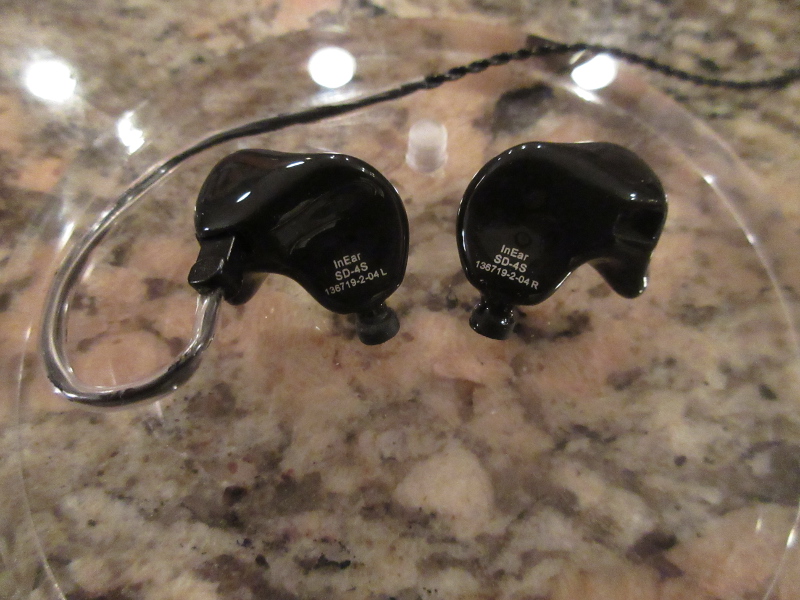
Sound analysis.
I don’t preach about burn-in, but simply state that I believe in what I hear. Even with multi-BA driver monitors there could be a burn-in effect of solder joints and miscellaneous crossover/filter components. The reason I’m bringing this up, out of the box I really liked how SD4s paired up with Linum BaX cable and even suggested to Musicteck who carries cables in addition to earphones, to sell it as a bundle. 75 hours later after a burn in where I left SD4s playing alone, the BaX made sound too bright for my taste, and I went back to a stock OFC cable. Now, with stock cable and TSX500 Comply tips while being driven from my “reference” Lotoo PAW Gold source, I was ready to analyze the sound.
I hear SD4s to have a slightly V-shaped sound signature with a bright revealing tonality. These are designed for performing artist where you typically find CIEM shell for the best fit and isolation, yet SD4s is able to accommodate all that with their universal shell design. Often with V-shaped signature you will find a sound tuning where the mids are scooped out too much, but in case of SD4Ss I hear it more like a boost in mid-bass region and also enhanced upper mids and treble. Actually, treble is not just lifted up but also extended pretty far to reach some piercing airy highs.
In more details, sub-bass is present and quite extended, but the rumble quantity is at a moderate level, maybe closer to a neutral level. The star of the low end is a tight punchy mid-bass with an overall articulate bass performance, always under control and never spilling into lower mids. In some songs I felt like upper mids/treble overpowered low end a bit, but I was still able to distinguish a tight punchy bass that always cuts through the mix with a fast attack/speed. With a supplied silicone tips, even the largest size pair, bass was lacking in quantity until I switched to Comply which improved the seal and brought up the low end performance.
Lower mids are on a thinner side, not much contribution to the body of the sound but rather contribution to v-shaped signature due to having a slightly recessed perception. Contrary to that, upper mids are bright, very detailed, quite revealing, and with plenty of crunch. When it comes to vocals the focus is not on natural organic full body performance, but rather accuracy and details. Those who prefer lush warm natural vocals need to look elsewhere since SD4s is not about that, at least not to my ears. As a result my perception of vocals was a bit on a grainy side which became slightly fatigue over an extended listening period while using silicone tips. Again, I strongly recommend Comply (T500) eartips which do the magic of smoothing out a few harsh peaks.
Treble is bright and clear, nicely extended, full of crunch and airiness, and very crisp. I’m not gonna lie, with the original silicone tips a few of the test tracks got close to a threshold of my sibilance tolerance, but Comply T500 set of eartips got everything under control. Being so used to warmer and smoother sounds of headphones I have been reviewing lately, this was quite a revelation of details that jumped right in my face, and thanks to foam eartips I was actually able to enjoy a longer listening session. As a disclaimer, take this with a grain of salt since we all have a different threshold for high frequency tolerance.
Soundstage expansion was impressive in all 3 directions. While not exactly on a holographic level, the width/height/depth were all above the average without any exaggeration. Here, I can also see the effect of treble extension with extra airiness which contributed greatly to separation and layering of instruments and vocals. There is absolutely no congestion of sound and everything could be easily distinguished. I also found imaging to have a good placement of instruments and vocals, very accurate position where I can pin-point everything.
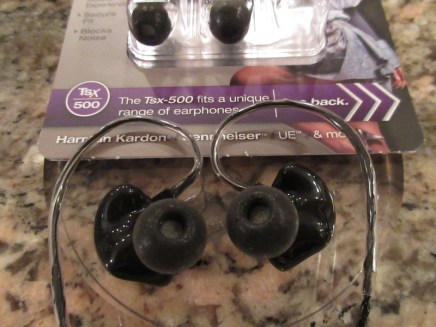
Last, but not least, InEar specs SD4s at 26dB of isolation which I’m not equipped to measure exactly but can definitely confirm – outside noise was attenuated significantly. Plus with Comply foam tips, were I actually prefer to use TSX500 that have a rounded comfortable shape, I felt the isolation to improve even further. Furthermore, with a lip around the tip of the SD4s nozzle, Comply tips always stayed on secure when taking SD4s in/out of my ears.
Comparison.
SD4s vs CFA Andromeda – Both have a very similar soundstage where depth/height are nearly the same, while Andro is a little wider. Andro sub-bass also a little higher in quantity and mid-bass has a slightly stronger impact, but the speed and the articulation of the low end is similar. SD4s lower mids are thinner and overall mids are a little recessed in comparison to a more balanced Andro signature. Also, SD4s upper mids/treble are more revealing and slightly brighter in comparison, but not as smooth or have the same natural body as Andro. SD4s treble extends further and has a little more airiness.
SD4s vs UM Maestro – the height of soundstage is similar, but SD4s has more width and more depth in comparison. Maestro has deeper sub-bass, while mid-bass is nearly identical with the same amount of punch and the same fast attack. Both have thinner lower mids, but SD4s is slightly more recessed in comparison. Upper mids in Maestro are a little smoother and have more body, making vocals sound more natural. Treble is very similar, bright and crisp with plenty of airiness, though SD4s has a slight edge in extension.
SD4s vs 64 Audio U6 – soundstage has the same depth and height, but SD4s is a little wider in comparison. U6 has a deeper sub-bass with more rumble, while mid-bass punch is nearly the same. U6 lower mids are thicker in comparison, and have more body. SD4s upper mids are more revealing and brighter, while U6 is smoother, warmer, and more organic in comparison. SD4s treble has a better extension, brighter, more crisp and with more airiness.
SD4s vs Sirius – soundstage has a similar depth and height, but Sirius is wider in comparison. Sirius sub-bass extends deeper and has more weight to it, while SD4s mid-bass has a faster punch and overall bass is tighter in comparison. Sirius lower mids are more balanced, warmer, and with more body, and Sirius upper mids are warmer and smoother and more organic in comparison to SD4s which is more revealing and brighter. SD4s treble extends further, more crisp and brighter, and has more airiness.

Pair up.
I suspect that due to its high 120dB sensitivity, there was some underlying hissing with most of the sources, but surprisingly it was mild and not too distracting. And with 22 ohm impedance it paired up well with all of my sources.
I found neutral-bright tuned sources to enhance the revealing nature of SD4s, though it can also make them sound a bit too bright. For example, it paired up great with LPG, Opus#1, X7 w/AM2, and N5 but could get a bit too bright with some of the tracks (based on my personal taste).
Contrary to that, going with warmer/neutral sources such as my Note 4, X3ii, and L5Pro made the sound more organic while still keeping it very revealing and detailed. Surprisingly, it also paired up great with my laptop which is my warmest source.
By far, the best pair up was with Micro iDSD where switching to ECO gain and High Sensitivity sub-gain reduction yielded the sound quality which actually became more balanced and even added some body. But the most important – the sound became more natural and organic.
Conclusion.
On their website InEar mentions the company works according to a principle of “for Musicians by Musicians”. I don’t think I could have said it better myself. Stage musicians need monitors that are comfortable to wear, have great isolation, and have a clear and detailed sound tuned for performance. That’s exactly what you’re getting with SD4s and their custom-like universal shell with a secure and comfortable over-ear wire fit, great sound isolation which can be enhanced with foam eartips, and a performance oriented sound tuned with a great low end impact and a clear detailed crisp highs. For an extended listening session where you are craving a smooth relaxed natural sound, these might not fit the bill exactly, but music enthusiasts who want to squeeze out more revealing details from their in-ear monitors will greatly appreciate SD4s tuning and will enjoy the comfort of their fit.

 Twister6 Reviews
I find the sibilance of sd4s a little bit too much (makes me uncomfort sometime), should i up grade it to the andromeda, or is there a better option with a similar sound signature. Im also wondering if i should get a ciem or not. thanks
LikeLike
Will be hard to match the exact signature. What is your budget? Also, have you tried to use foam tips? That was my solution. But yeah, Andromeda is the next logical step 😉
LikeLike
thanks for replying. i can go up to 2k, and yes i have try the comply tips but they are too big for my ear. do you think is a wise step to upgrade to any ciem?
LikeLike
Not a good idea in your case. If you don’t like the sound, will have a head tone selling it. Try Andro
LikeLike
lol, i went out and try andro today, and i really like it, then i bought it. thanks for the advise!
LikeLiked by 1 person