
Sound analysis.
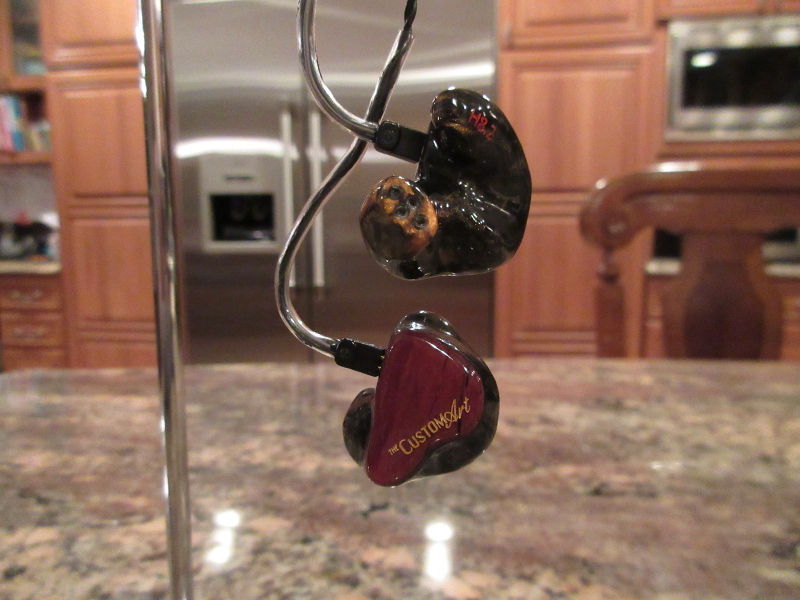
Even though H8.2 has 8 BA drivers, I still put them through 100hrs of burn in to condition and to bake all the solder joints, crossover components, and the cable. I have shared my earlier impressions about H8.2, but as it turned out due to a shorter nozzle and a slim CIEM shell (which I’m grateful for due to an anatomy of my ears/earcanal), I quickly realized that I didn’t have H8.2 shell pushed all the way into my ears thus some of my early impressions could have been a little off, especially when I originally assumed that silicone shell sound had a better bass and overall isolation. Once I realized what was going on, I confirmed that both silicone and acrylic versions of H8.2 had an identical sound performance.
I found H8.2 to have a nicely balanced signature with an excellent retrieval of details and a smooth natural tonality. I usually associate natural tonality with an organic non-fatigue quality which sometime lacks details in favor of a full bodied sound. Here Piotr managed to tune all 8 drivers of his flagship to sound in a coherent unison with a very natural smooth timbre and plenty of details. The details are not on micro-detail level and you shouldn’t expect an analytical level of clarity or a bright treble sparkle, but surprisingly you still get plenty of details. Another thing I found, H8.2 is quite forgiving even with low quality sources and doesn’t sacrifice the level of details, regardless if I’m playing from PAW Gold or my smartphone.
Starting with a low end, you get a decent sub-bass extension with a nice textured rumble, it doesn’t go very deep but has just enough oomph to add a nice weight under the mid-bass punch. Mid-bass punch is moderately elevated (but not too much), and has average speed and average decay. Overall, bass is well controlled, and doesn’t spill into the mids, but it’s not super tight or very articulate – I hear a natural bass performance typical of a dynamic driver, rather than a fast and snappy BA driver performance.
Lower mids are not too thick, but still have a nice body which adds to a natural tonality of the sound. Upper mids are smooth and detailed, not a single hint of harshness or graininess. Though overall sound is balanced, I think the smooth and slightly warm nature of the sound plays a bit of a role in pushing vocals slightly back. This doesn’t change sound signature and in no way I would call sound v-shaped, but upper mids are not exactly upfront in presentation. The organic nature of the sound makes both female and male vocals sound very realistic.
Treble is where things do start to roll off and it’s not as extended, but still has an excellent definition and clarity. There is not as much airiness and I wouldn’t call the treble being very crisp, but again – it’s extended just enough to paint the complete picture of the sound, and doesn’t accentuate the upper frequencies, making the sound more forgiving.
H8.2 soundstage is definitely above the average in width/depth/height, though I did find soundstage width to vary between the sources in a quite surprising revelation where my Note 4 smartphone actually outperformed LPG. I wouldn’t call it super expanded or reaching holographic level of expansion, but I think it goes along with a natural tonality and expectation of natural realistic soundstage expansion. Another thing I never took into consideration was the length of the nozzle relative to my earcanal resulting in a difference of the distance from drivers to my eardrums. Majority of my earphones are universal IEMs where I use long stem eartips. That creates a longer distance between the driver and my eardrum, while H8.2 is nearly flush with my ear and has a short nozzle which narrows that distance. Thus, under these circumstances my perception of soundstage will vary in comparison to other H8.2 users, so please take it with a GRAIN of SALT 🙂
I found the layering and separation of vocals and instruments to be average, since there is not as much airiness separating the sound layers, but the sound never gets congested or veiled, and that’s exactly what impressed me about H8.2 the most – being able to have a smooth natural tonality without sacrificing details or making sound too lush and congested. Imaging of H8.2 has a good placement of instruments and vocals, and in general it has a pretty convincing positioning of all sound elements, limited only by its soundstage expansion.
Comparison.
Before I started the comparison of H8.2 to other IEMs/CIEMs in my review collection, the first thing I was really curious about is how 6-BA design of Ei.xx stacks up against its big brother H8.2 with 8-BA drivers.
H8.2 vs Ei.xx – I found Ei.xx to have a slightly wider soundstage (coincidentally, Ei nozzle is slightly longer); Ei.xx bass is a little tighter and faster and has a noticeably bigger impact; lower mids are similar, while upper mids in H8.2 are pushed a little bit back in comparison to Ei and also have better retrieval of details, more transparency, and sounds more natural in comparison to Ei where upper mids are a bit thinner and less resolving; treble in both sounds very similar. H8.2 strikes you with a superior natural tonality and a smoother and more resolving sound.
H8.2 next to Ei.xx

H8.2 vs K10UA – K10UA soundstage has a bit more width/height; sub-bass extension and quality is very similar while K10UA has a little stronger punch with a faster attack; lower mids are similar, while K10UA upper mids are more forward, brighter, and grainier in comparison; K10UA also has a brighter, crispier treble with more airiness. I definitely hear a contrast of brighter crispier K10UA sound versus smoother and more organic H8.2.
H8.2 vs Andromeda – right away you notice Andromeda having a little more hissing in comparison, also Andro soundstage is more expanded in all three directions; Andro bass is tighter and more aggressive with stronger impact, not by a lot but definitely noticeable; lower mids are similar, but Andro upper mids are brighter, more revealing, more detailed; Andro treble is brighter, more crisp, and with a little more airiness. This is another example of a contrast with a smooth organic sound of H8.2 versus more colored and more revealing fun sound of Andromeda.
H8.2 vs U12 w/B1 – U12 soundstage is more expanded in all three directions; U12 sub-bass goes a little deeper and mid-bass has more impact and faster punch; lower mids are very similar and upper mids also have the same positioning and similar organic tonality, but to my surprise H8.2 with a stock OFC cable has slightly more natural and detailed upper mids (especially in vocals) in comparison to U12 w/TWau cable. This is actually a very interesting comparison because both of these have a natural smooth tonality, but with an exception of soundstage expansion, I found H8.2 to have a slight edge over U12, without even using aftermarket cables.
H8.2 vs ES60 – ES60 has more hissing in comparison, ES60 has a little wider soundstage; bass is very similar though ES60 is a bit faster and tighter and with a slightly stronger mid-bass punch; lower mids are very similar and the same goes for upper mids, very similar smooth natural tonality, but ES60 upper mids presentation is a little more forward; also ES60 treble has a better extension, a little brighter, and with more airiness. A lot of similarities in this comparison, but I still felt like H8.2 tonality was a bit smoother and more natural while ES60 wins in higher resolution and retrieval of details.
H8.2 vs Sirius – Sirius soundstage is more expanded in all 3 directions; also in this comparison bass is similar as well, but Sirius has a little stronger mid-bass impact; lower mids are similar while upper mids in Sirius are a bit brighter and a little more revealing; treble in Sirius is a bit brighter and with a little more airiness. If you want a little more excitement in your sound – Sirius has an edge, while if you want a more natural smooth and still detailed sound – H8.2 hits the right spot.
Overall, with all earphones used in this comparison nothing was really night’n’day when it comes down to the differences, but it really does stand out in upper mids where H8.2 has a very impressive natural tonality. Those who want more excitement in their sound might not appreciate it as much as I did, but I was drawn into the rich detailed smoothness of H8.2 tuning and fantastic pair up even with lower res sources.
H8.2 next to Ei.xx, Andromeda, Sirius, U12, K10UA, ES60

Pair up.
I wasn’t sure what to expect from H8.2 since I read about original H8 being picky when it comes to source pair up. Without a doubt, you can’t expect the same level of resolution from a smartphone as you would from a top tier DAP or a quality usb DAC, but I found H8.2 to be one of the few TOTL CIEMs that sounds excellent with a stock ofc cable even straight out of my smartphone.
Note 4 – no hissing, nice wide soundstage, smooth detailed balanced natural sound, punchy bass, clear detailed mids, well defined treble.
LPG – no hissing, nice soundstage expansion, smooth detailed balanced natural resolving sound, lots of clarity, punchy bass, clear detailed mids, well defined treble.
Opus#1 – no hissing, a bit wider soundstage, smooth detailed balanced natural sound, punchy bass with a nice sub-bass extension, clear detailed mids, well defined treble.
DX80 – very faint hissing, a little wider soundstage, smooth detailed balanced natural sound, punchy bass with a nice sub-bass extension, clear mids but some details are lost, well defined treble.
N5 – very faint hissing, a little wider soundstage, smooth detailed balanced natural sound, punchy bass with excellent sub-bass extension, clear and very detailed mids, well defined treble which became crisper.
X7 w/AM2 – no hissing, nice soundstage expansion, smooth detailed balanced natural sound, punchy bass good sub-bass though a little less rumble, clear and detailed mids, well defined treble with a little bit of additional airiness.
L5Pro – no hissing, nice soundstage expansion, smooth detailed balanced natural sound, punchy bass with a nice sub-bass extension, clear and detailed mids, well defined treble.
Micro iDSD – no hissing, a little wider soundstage, smooth detailed balanced natural very resolving sound, punchy bass with excellent sub-bass extension, clear detailed very smooth mids, well defined treble.
Conclusion.
Unlike so many of my other write-ups where the main focus is usually on a sound quality and a comparison to other earphones, this one end up with me gushing over how much I like the design and how much I learned about the design while talking to the man behind it. Don’t get me wrong, we are still dealing with quite an impressive natural smooth detailed sound and impressive bass performance, as well as a great pair up with most of the sources I threw H8.2 at. As a matter of fact, I was quite happy using H8.2 with a stock ofc cable and driving it straight from my aging Galaxy Note 4. The design, the finish, the material, all together really elevated the value of H8.2. Perhaps it’s not about super high resolution or sparkling highs, but the signature of this CIEM is more musical, natural, organic, without compromising the retrieval of details and the clarity of the sound. And along with an impressive sound tuning, you also get an equally impressive design with a choice of a rare silicone shell or a slim and super smooth acrylic shell that looks like a piece of art.
I’m sure many of you are probably familiar with exotic designs of Noble CIEMs and the handy work of the Wizard himself. Based on the review pair of H8.2 I received from Piotr, it will be hard to ignore the fact that he is not wasting his time and heading fast in the same direction. Just a few years ago Piotr was a regular head-fi visitor and reviewer with a passion for DIY CIEMs. Today, he is running his own well known CustomArt company and continuous to raise the bar not only in sound quality but also in the design.

 Twister6 Reviews