
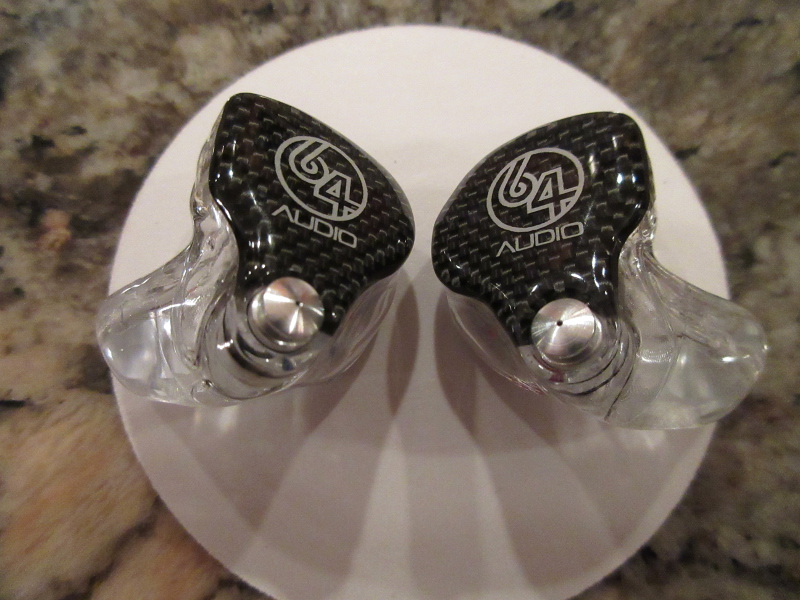
ADEL module.
I did talk about the basic principle of Stephen’s ADEL technology in the intro of my review, but in reality I have a feeling that a lot of people will overlook the benefit of ear health and will be interested only in sound improvement. It’s a sad reality where we don’t realize the irreversible effect of ear damage, and then wish we would have done something different when we had a chance. Fortunately, ADEL technology implemented in 64 Audio headphones doesn’t bring down A12/U12 to look like your grandparents hearing aid, and it’s actually a cool looking functional accessory that compliments the design of these TOTL monitors. At the same time, it can create some confusion because of wrongful expectation of what exactly it does.
Let’s start with a default ADEL auto-module. With a module out you have an open path from the faceplate of the shell through to a separate bore in the nozzle. Regardless of A12 or U12 design, with module removed the sound becomes an open back headphone with a significant low-shelf filter cut. Obviously, 64 Audio headphones were not intended to operate without ADEL module. With auto-filter back in, you get back the closed back isolation, and your bass performance – the sound goes back to normal. But what is normal? I will get into a more detailed sound analysis in the next section of the review. But in theory, the benefit of ADEL module can only be analyzed if you have side-by-side A12/U12 with and without a module and completely sealed path from the faceplate to the nozzle bore, or if you simply close the pinhole opening of auto-module.
With a default ADEL module I can only analyze a sound signature as is and can feel the subtle change in sound pressure as I put my finger over the pinhole opening. Also, I noticed that I can push the volume higher without feeling uncomfortable during the listening. A12/U12 are not bass shy, and usually pushing the volume higher with other similar sound signature IEMs will result in throwing off the balance of the sound, while in here I felt the change was more linear while still maintaining coherency of the tuning. At the same time while reading comments from other A12/U12 users, I quickly came to a conclusion that effect of auto-module might have a slightly different response depending on our ear anatomy. Just think about it, we have different ear canal shape, different level of acoustic reflex, different hearing sensitivity, etc., and in my opinion the response of ADEL module will vary accordingly.
And that is where the manual adjustment module (MAM) comes into a picture. I was fortunately to get a pair of MAM modules directly from ASIUS Tech, and that really opened up my ears and answered a lot of the questions. Now, instead of dealing with auto-module which going to respond to your individual ear canal anatomy, you are in control of fine tuning the effect. To my ears this effect varied a little bit between A12 and U12 because A12 has a perfect seal with maximum low end response, while U12 low end response was dependent on eartip selection. But in both cases, I can hear and confirm with my measurements that changes in both A12/U12 happen in sub-bass and mids bass region with sound being attenuated down as you start turning the MAM crown dial from closed position. Closed position gave me an exact sound as auto-module, but opening it up gives you a reduction in low end response as you’re getting closer to fully open position, and then bass goes a little back up as you get all the way down to a fully open position. Btw, the adjustment is done in a very clever way where left module is turned counter-clockwise and right module is turned clockwise so you are turning them both in the same direction when adjusting simultaneously.
The current MAM module has continuous tuning, and the sound change really takes at least a quarter or more of a turn to hear the difference, so there is no worry that you will throw off the tuning by accidental bump. Also, the audible change starts earlier in A12 versus more toward the end with U12, which I assume is due to a higher starting level of low end impact (due to superior A12 seal) where it creates a more noticeable tuning contrast. But the most important thing here, I’m NOT talking about EQ adjustment where you turn the knob to reduce a specific low frequency band, but the actual reduction of low end intensity where you no longer feel the bass pounding on your eardrums and instead hear an articulate low end response. With that change, sound becomes more transparent and more open (improved soundstage perception). It reminds me of a subtle effect of opening windows where the sound doesn’t feel as congested inside of your ear canal.
I don’t expect everybody to hear the difference on the same level because our ear anatomy and hearing perception is different, but after spending many hours with U12 (my adventure with A12 was much shorter) – I can confirm that it’s not a placebo effect of a new toy syndrome, this is a real deal. It got to the point where switching to other IEMs and CIEMs felt like something was missing, lacking some hidden dimension. The biggest effect of MAM module for me was in fine tuning of the low end response. If you are a certified basshead where you want to maximize the low end impact – stick to auto-module and either go for a perfect seal of A12 or switch to Comply foam tips with U12 (or just maximize your bass pleasure with A8/U8). But if you want a more balanced sound using A12/U12 – MAM module is the way to go, especially if you are using Universal U12 model where you can adjust the module and switch between different eartips to control the seal.
ADEL (auto-module)
ADEL (MAM: manual adjustment module)
Sound Analysis.
I let both A12 and U12 burn in for 70+ hours, though there wasn’t as much of a noticeable difference except for the first 10-15min out of the box. While using STOCK cable in both cases, I found A12 sound to be tilted a little toward L-shaped signature due to a tight seal having a noticeable effect on scaling up mid-bass quantity. U12 sounds more balanced due to a lesser bass quantity since a seal is controlled by selection of different eartips where I was never able to reach the same level as with a custom model. Both have a neutral smooth sound color leaning more toward warm natural tonality.
Both A12 and U12 have a deep textured sub-bass extension layer underneath a warm analog mid-bass punch in a perfect balance without overpowering each other. The bass is rounded, warm, with attack that is not super fast and decay that is long enough to turn the low end BA quad into a more dynamic driver performance. Bass has a nice control but not very tight. It provides a beefy slam with an authority not typical of BA performance. Bass has a well executed musical analog quality with layered details and natural timbre. Once you start adjusting the MAM module, you start to appreciate the effect where all of a sudden bass becomes more transparent and you no longer feel the visceral effect of the rumble but rather hear a multi-dimensional layered performance. When I took my measurements, I was definitely able to see the effect of bass reduction below 300 Hz which affected both sub-bass and mid-bass, and that was not a bass reduction typical of EQ adjustment but rather a reduction of bass intensity which sounds more relaxed to my ears, allowing me to raise or to lower the volume without affecting the linear coherency of the low end.
Mids didn’t vary much between A12 and U12, and also MAM module adjustment had a little effect except for adding a level of subtle transparency. Here, the lower mids have a full warm body that gives sound a lush analog feeling without being veiled or muddy. Upper mids are organic, smooth, open, and also very clear and detailed. This clarity and level of details is far from what I’m used to hearing from my other smooth/warm headphones. When it comes to mids, often manufacturers make a decision to either go for a brighter detailed tuning which can make sound harsher or to scale back with a smooth organic sound where retrieval of details can suffer. With A12/U12, 64 Audio kept mids balanced and linear, without any peaks or dips across mid-range frequency region. You will hear a high level of clarity and smooth organic details without a single hint of sibilance or harshness. Vocals are smooth, natural, full of energy, and come through with a high level of details despite an overall neutral-warm tonality.
Treble is definitely not the biggest star of the tuning due to it being scaled down, but it’s done in such a tasteful way where it’s still clear and has a great smooth definition, just not very crisp or bright. Often when other manufacturers go for a smooth organic sound where they chose to roll off treble, you will notice right away muted details in upper frequencies. Here, 64 Audio completely avoided the sibilance region, and instead put emphasis (slight boost) into upper treble to add transparency and airiness to the sound. Don’t expect long extended crashes or resonating percussions, but all the instruments sound natural with a very realistic timbre.
I don’t usually listen to a lot of acoustic music, but I made an extra effort to analyze how effortlessly A12/U12 delivers the audio details where thanks to the texture and the rumble of the bass the sound has a full organic body, where thanks to a smooth detailed mids the vocals, both male and female, sound very natural and full of energy, and thanks to a clear well defined smooth treble the instruments timbre was accurately represented without missing anything. I often wonder if extra drivers really add to the tuning or just part of the marketing hype. There are some great IEMs/CIEMs that take full advantage of their dual or triple or even quad driver configuration. And there are some others where 5 or 6 driver tuning could have probably been as accurate using fewer drivers. Here, while listening to A12/U12 and analyzing sound details, you can zoom into every region of the frequency range to hear how layered, accurate, and articulate it sounds thanks to a 3-way crossover partitioning of quad lows, quad mids, and quad highs working together in one perfect harmony with a great coherency between the drivers.
The sound is very dynamic, and has a high level of transparency. For a smooth sound with neutral warmish tonality I was quite surprised to find an excellent level of separation with a distinct layering effect between instruments and vocals. From my experience, warm smooth signature often results in some sound congestion, especially when it comes to a more complicated music passages. Here, any music genre I threw at A12/U12, regardless if it’s pop, rock, EDM, jazz, instrumental – everything retained a perfect separation and layering. The soundstage was another star of the show with a holographic expansion in all 3 directions. The imaging was definitely on a 3D level with a very convincing placement of instruments and vocals with a nearly perfect pin-point positioning. Again, I would have expected this kind of a performance from an analytical type of tuning, so it came as a big surprise from a smooth and warmish tuned pair of monitors.
Comparison to other IEMs/CIEMs.
U12 vs Maestro: Maestro bass is not as articulate, sub-bass texture is not as well defined, lower mids are leaner, and upper mids are brighter and harsher and not as organic, treble is brighter and crispier, a little more splashy and with more airiness. Soundstage is narrower, while depth/height is the same. Overall, U12 sounds smoother, more analog, and more transparent, while Maestro is harsher and more analytical, and less organic. They both have the same level of detail retrieval, but U12 is more natural.
U12 vs ES60: ES has a very similar smooth detailed organic tonality, but low end is not as tight as U12 and has less impact with more rolled off sub-bass, lower mids are similar and upper mids are a touch brighter in ES. Also ES treble is a little bit brighter and has a slightly better definition, but overall has the same level of airiness. The transparency and the level of layering and separation are very similar. ES soundstage is a little narrower, while depth/height is similar. The main difference here is ES being a little more neutral and with less low end definition, while U12 having a far superior bass in both sub-bass extension and texture and mid-bass impact and also a wider soundstage. Another thing to keep in mind is that you can have A12/U12 in either universal or custom fitment, while ES60 only comes in custom.
K10U comparison will come soon; review sample wasn’t available during this write up. Also, it made no sense to compare to any of my other IEMs since for example W60 is smooth and warm, but sounds veiled in comparison, doesn’t have the same low end impact, not as transparent or dynamic, and can’t match layering and separation due to sound being a bit too lush. UM Pro 50 has a great low end impact, but fails to match details of mids and extension of treble, and nowhere near the soundstage expansion. Ei.xx has a great smooth sound and excellent bass impact, but it wasn’t as tight or as articulate, and mids were far from being as detailed, sounding more veiled in comparison, and the same with treble lacking airiness. Miracle wasn’t able to match the low end impact or the organic smoothness of mids, though it was more superior in treble, but overall not as transparent or detailed.
Pair up.
PAW Gold – reference quality dynamic detailed sound with excellent retrieval of details, amazing soundstage expansion, and very articulate low end. LPG was my main source during sound analysis of A12/U12 and comparison to other IEMs/CIEMs.
L5 Pro – excellent pair up with a dynamic smooth layered sound, great low end impact (among the best in this case), impressive soundstage expansion, excellent retrieval of details. Also tried it briefly with the new L3 in balanced mode and soundstage holographic expansion just explodes in 3D quality.
X7 – the sound is very dynamic, crisp, and with high level of detail retrieval. It does take away a bit of an analog smoothness in comparison to PAW Gold, but the overall sound was a bit more balanced, especially with a stock cable. w/AM2 module sound has more body, regains some of the smoothness, and improves soundstage expansion.
DX80 – smooth detailed sound, deep low end extension with an excellent sub-bass texture and tight mid-bass punch, amazing soundstage expansion. I was quite surprised with this pair up, especially enjoyed the soundstage expansion.
X3ii – warm detailed punchy sound, surprisingly a decent soundstage expansion, deep textured sub-bass, not as high level of transparency or layering/separation, but still great pair up. It serves as a good example that you don’t need $3k+ source to make A12/U12 shine.
While in so many situations DAP can make headphones shine, here I found an opposite phenomenon where U12 actually made some of my DAPs shine. Regardless if it was summit-fi or mid-fi DAP, the sound was always smooth and detailed and expanded to the maximum potential of the source. I can even go as far as saying that despite their detailed tuning, A12/U12 are quite forgiving where I was listening to a few poorly recorded songs on my Galaxy Note 4, and they didn’t sound half bad.
Pair up (A12 + L5Pro, U12 + LPG)
Conclusion.
We all know that listening to music is good for your body, your soul, and your spirit. Now, you can also add to this list – your ears! Before receiving A12/U12, I have done my homework reading about ADEL technology and Stephen Ambrose research work. If you have a minute, search YT for videos of how he helped some people with deaf ear to hear for the first time. I was a bit fixated on the effect of this technology before I put these monitors in my ears. But once I hit Play, it was all about the genius of Vitaliy and his tuning of A12/U12 flagship. I forgot about ADEL module until I was ready to test MAM – that’s when I discovered the effect of Stephen’s diaphonic lens tuning. Will A12/U12 sound good without ADEL? In my personal opinion, there are dozens of flagship IEMs/CIEMs that sound good without ADEL technology and you would probably never find out what’s missing when you take their sound tuning as is. Would 64 Audio have a hit without ADEL module? I have no doubt they would, because it’s all about sound tuning and A12/U12 got it with a driver coherency where all 12 BAs melt into a sound of one large dynamic driver with a smooth high resolution performance and spatial details that will sound great from most of the sources, even your smartphone. But adding ADEL module to this equation is like going from Universal to Custom where the sound is fine tuned and customized to YOUR ears specifically, and it makes listening to music not only enjoyable but also safe. At the end of the day, you get the benefit of both and if you compare 64 Audio prices to their competitors (or wait for holiday specials when they offer up to 20% discount) – you will quickly realize that ADEL technology comes as a free bonus with these first class TOTL monitors.

 Twister6 Reviews
hi twister,
I want to buy aftermarket cable for my U12? Can you recommend which one should I buy which have best synergy with U12? Thanks.
LikeLike
for the original U12, the best one is ALO Ref8.
LikeLike
Hi, many thanks for your reply.. I tried to search the Alo ref8 but its difficult to send it to my country. Do you have alternative cable besides alo ref8 for U12?
Thanks.
LikeLike
If you don’t mind 2.5mm balanced termination, you can get very close with iBasso CB12 cable, search for it on Penon audio 😉
LikeLike
Ok with CB12 right? Not CB13.. I looked on their website only available with mmcx pin, so I need to reter again with 2 pin right? How far is the quality compare with alo ref8 since the price gap is big.
Thanks.
LikeLike
You are correct. Then, try Oriveti Affinity cable, offers both 2pin and mmcx and either 2.5, 3.5, or 4.4 termination.
LikeLike
Hi, the affinity is with angle 2 pin and not straight. is there going to be any problem fitting angle 2 pin with U12? I see the ref8 is also using angle 2pin.
Please advise. Thanks.
LikeLike
don’t see that as a problem with 64audio iems. Even their new premium cable has angled 2pin connector housing (take a look at the picture of my U12t/Trio review).
LikeLike
Hi, my friend own affinity and he said the cable character is warm. Does it make the U12 become more warmer?
LikeLike
U12 is warm to begin with, so it just enhances its characteristics. Also, U12 is tuned for higher impedance sources. Adding impedance adapter can bring up treble more. Keep in mind, U12 is discontinued, they have U12t now, read my review on the blog. U12t uses Tia driver, it’s brighter and has a more vivid tuning.
LikeLike