
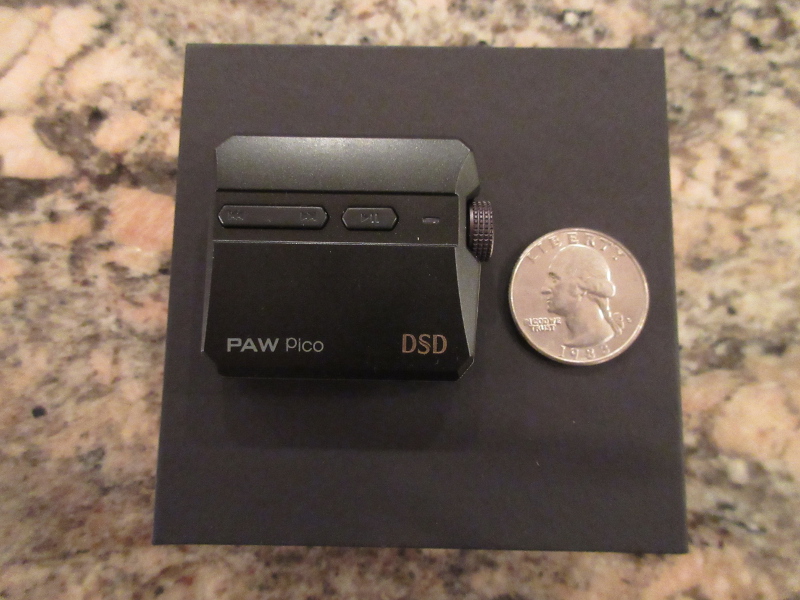
Sound analysis.
I gotta be honest with you, I approached Pico as an Activity Tracker with a bonus audio playback, and prior to listening – my curiosity was more about its tiny footprint. I love gadgets, and thought it will be another cute piece. But I was very surprised when I started to listen to Pico. Don’t take this as “OMG” hype. We are still talking about $130 DAP (current price on some Chinese websites) which lacks many common features found in traditional DAPs. But my focus here is on a tiny little audio player with a big sound performance that can go against some mid-fi and summit-fi players if you are looking for a reference quality sound sig.
After two weeks of testing, I hear a neutral-revealing signature with a transparent reference sound quality. The retrieval of details is excellent, including a surprisingly high level of clarity which I didn’t expect. For sure, the sound is leaning more toward the brighter side, but still stays close to neutral. Sub-bass has a decent quality but more on a leaner side and not as deeply extended, mid-bass has a nice snappy punch; mids are neutral, revealing, with a good level of transparency, maybe a little on a colder drier side, and slightly pushed forward; treble has a very nice sparkle and plenty of airiness.
Soundstage is wide, expanded, and still very realistic, along with a rather good precision of instrument placement.
Background is black, no hissing what so ever. Also, dynamic expansion of the sound is very good, never felt compressed or congested. Also, I hear a good layering of the sound, which I attribute to treble airiness that spreads between instruments and vocals.

Pair-up.
This test was a lot of fun, especially with full size cans where earcups are 3-4 times the size of the DAP itself. It’s hard to imagine people using Pico with big headphones on a regular basis since it’s more appropriate for a portable use on the go. But it was still nice to see how far I can push its performance to find the limit. Also, keep in mind that due to its reference lean type of sound signature, not all the bright thinner sound headphones will have the best synergy with this tiny DAP.
ATH-R70x (open back, 470ohm) – I had to push it to the max volume, but still drove these with authority and no distortion in sound (of course not worrying about overdriving R70x, but rather making sure that at max volume a sound remains clear). Overall, an expanded very detailed sound. Not an organic detailed like I hear R70x in other pair ups, but more revealing which I actually enjoyed.
PM3 (planar magnetic) – It had some volume headroom left, didn’t have to push it to the max. Pico drove it with an authority of a punchy bass, clear detailed mids, and sparkly treble. PM3 usually sounds warmer and more congested with other sources, but not in this case. It literally took a layer of veil off the sound.
T5p 2nd gen (tesla drivers) – Right away noticed a wide soundstage, and enough volume headroom. I hear a very good sub-bass rumble, slightly rolled off but I can still hear it well, and a very nice mid-bass punch. Mids are neutral, detailed, revealing, and I hear a nice well defined treble sparkle. A very enjoyable pair up.
Zeus XRA (14xBA, high sensitivity) – NO hissing!!! Yes, absolutely ZERO. Very detailed revealing sound with a great level of transparency and separation. Bass has a tight fast punch, and not too much difference in sub-bass performance in comparison to other sources since Zeus bass is about quality rather than quantity. Also, I hear a revealing detailed mids, and nice treble extension with lots of airiness and sparkle. Soundstage was wide and expanded in all directions.
W900 (9-way hybrid) – I hear a little less sub-bass rumble but still a deep impact with a weighty powerful mid bass punch. Smooth detailed revealing mids and a nice sparkly treble extension. This is one of those examples where a smoother tuned IEM can shine with a more revealing source. Very wide and still natural soundstage expansion. Great pair up.
UERR (3way BA) – I hear a very neutral revealing sound with a wide soundstage. Tight mid-bass punch, very accurate revealing mids, well defined treble sparkle. With UERR’s neutral bass, I didn’t lose any sub-bass extension or quantity, so it was another example of a great pair up with a neutral revealing source.
VEGA (dynamic driver) – I hear a spacious expanded sound. As expected, I found a slightly rolled off sub-bass but still with a powerful mid-bass punch. Neutral revealing mids, with upper mids being a little on a brighter side but never crossing the threshold of sibilance. Great treble extension filled with airiness. I was a bit nervous with this pair up because neutral revealing source can tip the brightness scale, but it did great in this case.


Comparison.
I know it makes more sense to compare Pico to P5k due to the same DAC/amp chip. It probably sounds crazy to even consider the comparison of Pico to LPG, but I do hear more sound resemblance to LPG rather than P5k.
Pico vs LPG – nearly the same soundstage expansion, though LPG is a little wider. LPG has a little more sub-bass rumble, and mids have a little more body, uppers mids/vocals are a little smoother, treble has a very similar definition, sparkle, extension. Of course, LPG is technically superior, but I don’t hear it being too far ahead in transparency and resolution.
Pico vs P5k – P5k soundstage is a bit narrower, P5k is a little warmer/smoother, while Pico is more revealing, brighter. P5k bass is warmer, and so does the mids – being warmer and smoother. In comparison, Pico is a little brighter, airier, and with a better resolution.
So in terms of sound quality, I found Pico to be somewhere between LPG and P5k, actually leaning more toward LPG signature. But I didn’t stop there and decided to compares Pico to a few other flagships.
Pico vs X7 w/AM3 – X7 has a touch wider soundstage, and you hear a little more rumble in sub-bass, but the sound is close in comparison.
Pico vs DX200 – DX200 soundstage is wider, and you get a little more rumble in sub-bass, mids are very close in tonality, though DX200 is a little more transparent and with a better layering.
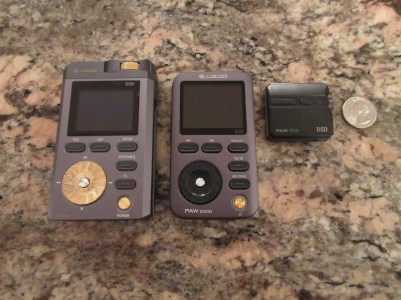
Conclusion.
I originally wanted to write a short mini-review covering my first impression of Pico. After all, the fw is still work in progress and app hasn’t been released yet. But once I started to plan my write up, I realized that in terms of audio performance and playback functionality there shouldn’t be any drastic changes in the future. Thus, I ended up writing a full review of Pico. Overall, I found it to have a dual personality with individual attitudes. The tiny size, the minimalistic design, the limited controls, and the clip attachment all scream loud and clear – I got a sport attitude! But once you start listening to this Pico-size audio player, your ears tell you that Pico inherited audiophile attitude from its bloodline of PAW DAPs. If you are in the market to buy your first audio player, I wouldn’t necessary say this is a must have purchase. Pico is intended for audiophiles and audio enthusiast who want to take their music on the go with a basic playback functionality and without sound quality compromises. And when I say “on the go”, it doesn’t have to be just while working out, running, biking, hiking, etc. So many times I hear people saying they feel uncomfortable bringing PAW Gold or other pricey DAPs with them on a bus or a subway while commuting to work. With Pico this shouldn’t be a problem. Or if you are just a fan of cool little audio and electronic gadgets, this could make one heck of a conversation piece.
But Pico doesn’t just look “cute”, it has a mature reference sound quality and pairs up nicely with neutral and warmish IEMs, while also giving more revealing details to your analytical IEMs. You can even use it to drive a number of full size headphones where I had no issues driving some planar magnetic and even 470 ohm cans. You get up to 10hrs of playback time with random or sequential playback. Despite the lack of screen, it’s rather easy to navigate and to control the playback, and it’s firmware upgradeable where Lotoo already released an update which was easy to install. It supports majority of high res formats, though limited 32GB internal storage makes it only practical for high bit rate mp3s and FLAC files. And as a bonus, you can play around with Sport Mode when Lotoo updates bi-lingual support and releases its tracking app.

 Twister6 Reviews