

Sound analysis.
I usually find a sound signature of the DAP is easier to describe when talking about its comparison to other sources or pair up with different headphones. But you can still come to a reasonable conclusion about individual sound performance of the DAP, derived from these comparisons.
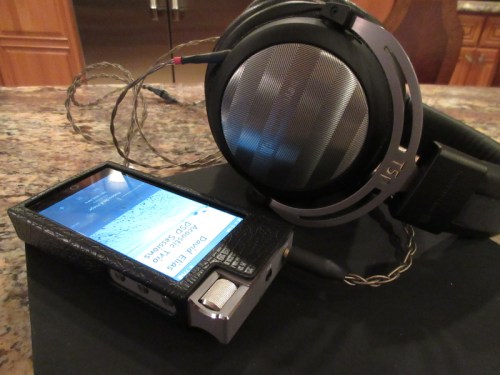
N5ii tonality, though closer to neutral, leans more toward a brighter and a more revealing side. Don’t expect a big bass impact or mids with a warmer fuller body. The sound is lean and a little on a colder side. It certainly is crisp and detailed with a wide soundstage, a nice dynamic expansion, and a sense of air between the layers of the sound. It pair ups great with neutral and warmer tuned headphones, and at the same time doesn’t make brighter tuned one’s sound too harsh, though there were a few exceptions I mentioned in my pair-up analysis section of the review.
One interesting observation I found is between 3.5mm Single Ended vs 2.5mm Balanced outputs of N5ii. When comparing these outputs, though not necessary night’n’day difference, I do hear BAL output to be a little leaner in tonality, especially in lower mids, including a little less mid-bass impact and more sparkle in treble. This difference in tonality gives you an option to fine-tune the sound which comes in handy when dealing with different sound signature headphones and trying to find the best pair up synergy.
Comparison.
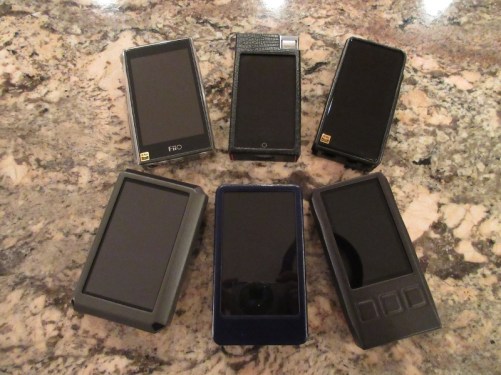
In the following comparisons, I put N5ii against other DAPs in similar price/performance categories. While using different IEMs for my analysis, I always try to volume match between sources.
N5ii vs i5 – when comparing the soundstage, I hear N5ii SE to be very close to i5, but when you switch to N5ii BAL, the soundstage has a wider expansion. When comparing sound tonality, need to take SE vs BAL into consideration as well. N5ii BAL is more neutral in tonality with a leaner low end and lower mids and more revealing upper mids and airier sparkly treble when compared to a fuller body i5 with a smoother upper mids/treble where you also have a little stronger mid-bass impact. But when you compare N5ii SE to i5, N5ii is closer in tonality because it has a little more body in lower mids and a touch stronger bass impact, through it’s still more revealing in upper mids and has a little more sparkle in treble. Also, N5ii background is blacker with a minimum hissing when it comes to sensitive IEMs, while i5 has more hissing. Both have identical GUI interface, touch screen, support of BT and WiFi, and access to Google Play store and apps. From hw perspective, N5ii has 2x uSD cards (vs one in i5) and a balanced output (vs only SE in i5). N5ii also has smaller footprint.
N5ii vs N5 – based on comparison of BAL outputs, ii has a wider soundstage expansion and overall sound is more transparent, more layered, and with better dynamics. Also, ii blacker background with nearly zero hissing is a big step up from the original N5 where noise floor with sensitive iems was always an issue. In terms of overall tonality, N5ii has a more neutral leaner sound while N5 has more body and sounds smoother in tonality, also with a little less airiness in sound. While tonality improvement is a subjective thing, perhaps if you want a stronger bass impact and a smoother fuller body sound, you might prefer the original N5, but in terms of the design there is no question that N5ii is head’n’shoulders above its original predecessor where instead of small screen and all physical button and wheel navigation now you have a responsive touchscreen with external hw playback controls, a physical volume wheel, BT with wireless headphones support and WiFi with access to Google Play and various streaming apps. The footprint of N5ii is smaller and you also have 32GB of internal memory in addition to 2x uSD, while N5 only has dual uSD cards.


N5ii vs Opus#1S – 1S soundstage is just a tiny bit wider in comparison to N5ii; both are hiss-free and have a solid black background with a low noise floor; 1S tonality is even more neutral while N5ii has a little more body in comparison; in terms of a dynamic expansion, I hear 1S just a tiny bit better, but it’s a very small gap. Both have the same internal 32GB storage and external dual uSD, and both have a balanced 2.5mm. While the sound quality is close, the biggest difference is N5ii having Bluetooth (wireless headphones connection) and WiFi with access to Play store and streaming apps. The gap between N5ii and the original Opus#1 is a lot bigger, while #1S closed the gap in sound quality, but still behind in features where N5ii has an edge.
N5ii vs X5iii – N5ii soundstage is a little bit wider, but the first thing you notice right away is a black hiss-free background in comparison to a rather noisy and hissing background of X5iii when testing with sensitive iems. There are also differences in tonality with N5ii being more neutral, more transparent, more layered, and having a better dynamics expansion in comparison to a smoother, fuller body, more musical, and slightly more compressed in dynamics sound of X5iii. Both have the same internal storage and dual uSD expansion, volume wheel and hw playback controls, as well as support of BT/wireless and WiFi with Google Play support. Besides sound quality difference where N5ii has an upper hand, another big difference is FiiO offering a full open Android experience with a bigger higher quality display and a typical Android-smartphone type of navigation, while N5ii still has Android experience that feels as an add-on, “hidden” out of sight.
N5ii vs M3S – Here the gap in sound quality is not too far off. While testing and comparing BAL outputs, I hear N5ii to have just slightly wider soundstage and a little better dynamic expansion. In terms of tonality, N5ii is just a little leaner while M3S has a bit fuller body, but in general they are very close. With sensitive IEMs, I hear a bit more hissing with M3S, but it’s not too bad. While M3S only has one external uSD card, N5ii offers internal memory and 2 uSD cards. Both have BAL output and external hw playback controls as well as a physical volume wheel. Also, both have Bluetooth for pair up with wireless headphones, plus M3S has access to HibyLink. One big difference is N5ii having a touch screen while M3S doesn’t. Plus, N5ii supports WiFi and Android along with Google Play store which gives you access to apps, including streaming apps while M3S can only “stream” music by means of HibyLink connection to a smartphone.
N5ii vs DX80 – It has been awhile since I used DX80, figured will be an interesting comparison with N5ii. Here, I hear N5ii having a little wider soundstage expansion and a more neutral tonality while DX80 has a little fuller body, north of neutral, with a little smoother tonality, though both have a similar presentation of sparkly airy treble. Also, N5ii has a little better dynamic expansion. With sensitive iems, there is a lot more hissing when it comes to DX80, while N5ii has a blacker background. While DX80 has a touch screen, physical playback buttons, and a dual uSD card, N5ii adds an internal memory, volume wheel, BT/wireless support, BAL out, and WiFi with Android and app support.
N5ii vs R6 – I have been asked by a few people about this comparison, so why not. Obviously, the big difference here is output impedance where the sound will be affected if you are using some multi-BA IEMs, like, for example, U18t I was using in my sound test. It’s not a showstopper since an impedance adapter, such as iEMatch, does a great job to “correct” R6, and that’s what I have been using in this comparison. When you even out the output impedance ground, it makes an interesting comparison where I found tonality to be similar, including a very similar soundstage expansion and black hiss-free background. Of course, there will be some variations depending on pair up with different iems and full-size headphones, but if you add iEMatch into the equation, I found a lot of similarities in tonality and sound presentation, though R6 has a little edge in layering, separation, and transparency of the sound. Besides output impedance, the biggest difference here is Android interface where R6 feels like a smartphone with a higher quality display and a very snappy Android performance. In contrast, N5ii presents itself as DAP first and Android device with Google Play and streaming capability second, like an add-on. Also, N5ii has an advantage of a dual uSD versus a single card in R6.
Pair up.
In this test I only used a medium gain setting, and noted Volume level. In the below write up, please pay attention to SE (3.5mm) vs BAL (2.5mm) since BAL has a higher gain, thus a lower volume.
Audio-Technica ATH-R70x (open back, 470 ohm), SE v81 – very crisp detailed sound with an expanded soundstage. It took me by surprise, since I’m used to hearing a smoother sound when it comes to R70x. Here is was faster, righter, sharper, crisper. I did notice a little less sub-bass, and faster attack of mid-bass, neutral revealing mids, crisp airy treble.
Audeze EL8C (planar magnetic), SE v70 – no metallic sheen!!! that’s the first thing I look for when pairing up EL8C, the sound is crisp but there is no metallic sheen, sub-bass extends deep with a moderate rumble quantity, mid-bass is fast, lower mids are neutral, upper mids are revealing yet sound natural, and treble is crisp (a little too crisp) but not sibilant and with a good airy extension.
Beyerdynamic T5p 2nd gen (full size tesla drivers), BAL v45 – very detailed tight fast sound with a wide/deep soundstage. Nice sub-bass rumble extension, fast mid-bass attack, well controlled articulate bass, neutral lower mids, revealing upper mids approaching micro-detailed level, crisp airy well-defined treble.
Oppo PM3 (planar magnetic), BAL v53 – smooth detailed balanced sound with a wide soundstage expansion. Well controlled laidback bass with a nice sub-bass rumble (not too much) and slower mid-bass punch. In many pair ups, PM3 bass spills into lower mids, here it had a good control, though lower mids are still full bodied and north of neutral. Upper mids are detailed, smooth organic. Treble is well defined, not too crisp or too airy, these cans don’t have the best upper end extension, but it wasn’t too prematurely rolled off either. Actually, pretty good pair up since PM3s are picky.
VE ZEN earbuds (320 ohm), SE v67 – wide/deep soundstage expansion, very balanced tuning with a sound signature that is more revealing than I’m used to with Zen. Overall sound is faster, tighter, more detailed, bass is leaner and faster, more articulate, mids are neutral, detailed, natural, treble is very well defined, crisp and airy. Overall sound is more neutral and revealing than usual.
64 Audio U18t, BAL v33 – revealing transparent sound with a wide soundstage expansion, deep sub-bass expansion with moderate quantity rumble, fast mid-bass punch, overall a tight articulate bass, micro-detailed natural tonality mids, crisp well defined airy treble.
64 Audio Fourte, BAL v33 – very crisp revealing sound on analytical level of detail retrieval, deep sub-bass rumble, average speed mid-bass, lean lower mids, micro-detailed upper mids, very crisp airy treble, sizzling with crunch, a bit too much in this pair up. Wide/deep soundstage.
Sennheiser IE800S, BAL v41 – a more balanced (W-shaped) detailed sound with a deep sub-bass rumble, slower laid back mid-bass, neutral lower mids, natural detailed upper mids, crisp airy treble. Upper frequencies are a little brighter, but not harsh or sibilant. Wide soundstage with more out of your head stage expansion.
HiFiMAN RE2000, BAL v46 – very revealing bright sound with a good soundstage width and depth. Bass has a good extension and a fast speed, but a little more neutral quantity. The same with lower mids, being very lean. Upper mids are thin and analytical, on micro-detail level. Treble is very bright and crisp and very airy. Upper mids/treble are thinner and more artificial in this pair up, sounds a little harsh.
Campfire Audio VEGA, BAL v32 – a v-shaped sound signature with a wide soundstage expansion. Bass is very powerfully, deep, tubey, loose, not very well defined or controlled, spilling into lower mids. Upper mids are clear and detailed, pushed more back, have natural tonality. Treble is crisp, bright, a little sibilant. Not the best pair up.
Ultimate Ears UERR, SE v42 – very neutral more revealing tonality with a wide (but not very wide) soundstage expansion. It’s brighter than other pair ups. Neutral extended bass, here we are talking about quality rather than quantity, average speed, good control. Neutral lower mids, very natural detailed upper mids with improved retrieval of details, well defined clear treble, moderate amount of crisp airiness, not too much. Overall sound it a little more mid-forward, bass is more neutral than other pair ups, sub-bass rumble is rolled off here.
Beyerdynamic Xelento, SE v36 – very balanced sound signature with a wide expanded soundstage. Bass is north of neutral, still with a nice slam and textured sub-bass rumble, but quantity is reduced in comparison to some other pair ups. Bass is very articulate, well controlled. Lower mids are neutral, upper mids/vocals are very detailed and natural. Treble is crisp and airy, with a nice natural definition.


Conclusion.
I get a lot of questions from my readers, often asking what is the best DAP. And my reply is always the same with a follow up question about their budget. Once you know your budget, the next step is to figure out your requirements, do you need touch screen or not, do you want to stream audio or OK with a playback from internal storage, how much internal storage do you need, do you care about Bluetooth pair up, what headphones are you planning to use and how much output power do you need, etc. Unlike headphones where the sound signature has a higher priority, DAP search often starts with a price and a list of features to narrow down the available choices, and then to figure out the sound and pair up synergy. That’s why you hear more often about headphones recommendations, rather than DAPs, when trying to upgrade the sound quality.
When it comes to N5ii, Cayin clearly did their homework when they introduced this $369 DAP with every feature you can imagine. I usually don’t focus too much on the price of the DAP, but here it represents an impressive price/performance ratio. Touch screen – check! Internal storage and two uSD cards – check! Balanced output – check! Mechanical wheel and external hw controls – check! Compact size and decent batter life – check! Bluetooth – check! WiFi with Google Play and app support – double check! The sound quality is pretty good for a mid-fi DAP, a little more on a leaner brighter side, but it pairs up well with many iems and full size headphones.
I know its fw is still work in progress with some bug fixes and further optimization, and Cayin is about to release their 2nd major fw update (actually, fw3.1 became available as I was finalizing this review). I’m not exactly a power user who spends many hours a day every day with a single DAP. Instead, I’m a power reviewer who multitasks with many DAPs on daily basis, and I haven’t encounter any fw showstopper issues preventing me from enjoying N5ii playback. N5ii is a very versatile compact DAP to enjoy your music on the go, and it does represent and combines the best of N5 and i5 designs.

 Twister6 Reviews
Hey, thanks for review. Have you tried n5ii with Pinnacle p1? To me, it was very harsh, very unpleasant pairing (only tried with SE though). Also, very interesting how pairing wiil be with ibasso it01.
LikeLike
P1, yes, harsh. Will try it01 a little later. Will let you know.
LikeLike
Hey Mr. Twister, I have a question. How does N5II in (bal mode) compare with an old Fiio X7 (single ended). Is it better to buy a newer player with balanced mode as opposed to buying an older, 3.5mm player of a more expensive league?
LikeLike
Old X7 was a nice try, but I wouldn’t recommend it, unless you can get one dirt cheap and use it as a transport with an external dac/amp or external portable amp. Plus, they never resolved some of the firmware issue, just moved on to x7ii. I think prices on x7ii came down, including used ones. It’s certainly their best DAP to date, and don’t even bother with x5iii either.
LikeLike
IT01 pair up is golden! Warm smooth bass, nice impact, mids and treble are relatively balanced, though overall signature is more toward L-shaped. Mids/treble are detailed, natural, not harsh at all, and treble has a nice level of natural sparkle. Not too smooth or rolled off. definitely non-fatigue.
LikeLike
Thanks for detailed answer! Will definitely consider them.
LikeLike
Hi,
I have read a few things about the underwhelming amp-section inside the Fiio X5III. In your opinion does adding an amp like a Cayin C5 or Schiit Fulla 2 to the X5iii’s line out bring out a drastic improvement in sound quality. Or is the Cayin N5ii alone better than X5III+amp. My headphone set up is Sennheiser HD 598 and I don’t use single ended.
LikeLike
you want your dap stack to be portable, no cross fulla 2 out. C5 is a great amp, and yes it will improve X5iii sound, and it will be noticeable. N5ii is great, though probably, though probably won’t overtake x5iii+C5, and keep in mind since Cayin replaced it already with N5iiS, oriignal new N5ii is cheaper now (seen it on MusicTeck discounted already).
LikeLike
Hello, can I use n5ii as a transport to ext dac like ifi nano from its usb out to ifi nano female usb in?
LikeLike
You should, just like I used N5ii as a transport to drive HA-2, and I’m sure it can drive C5DAC or any other usb DAC/amp. The problem is to find the right cable. I used before cheap eBay usb-c to micro usb cables, as well as micro-usb to micro-usb with usb-c adapter – and some didn’t work. That shanling L2 cable did the trick.
LikeLike
Thank you.
I live in India where the prices for N5II are still high so I will in sometime just upgrade to the X5iii and Cayin C5 hoping the combination sounds better than N5II standalone.
LikeLike
Shanling L2 is a different type of cable. For IFI Micro IDSD, or IFI Nano, usb type-c male to usb female cable is needed. There are some cables on Amazon one of which is made by Anker. Which one would you prefer for type-c to female USB cable?
LikeLike
Sorry, wasn’t familiar with Nano, thought maybe, unlike, Micro it’s more portable with micro USB digital input. For Micro I used cayin coax cable. For nano, try that anker cable, these guys always build quality cables. I just don’t recommend using cable+adapter, but a direct short cable (usb-c to USB a female) in theory should work. Please, reply back once you try it.
LikeLike
Alex, thanks for another great review and especially DX80 comparison. Guess they’re also in the same league, just different tonality.
Also, do you plan Opus #1S review? Is it close to DX80 soundwise?
LikeLike
Opus #1 vs #1s are so identical in design, I will have a very short comparison write up. Plus, in this N5ii review and comparisons you can extrapolate how they compare. In tonality it will be close but there is a big difference with opus#1s having blacker background and higher SNR in comparison to dx80. All that improves resolution and transparency of the sound.
LikeLike
Sounds really good! #1S may be a good idea for an upgrade, be their difference not too dramatic. I’d appreciate if you could include the comparison into your write up.
LikeLike
this is really off-topic since it’s under N5ii review :), but in terms of DX80 vs Opus#1S – #1S has wider soundstage (noticeably wider), blacker background, less hissing (with sensitive iems), but overall tonality is similar.
LikeLike
Sorry for an off-topic 🙂 Speaking of N5-II, it’s really impressive how pocketable it is. Just around 150g and 10+ hrs working time – that is great! Not sure if it’s possible to transfer files wirelessly, but in any case both convenience and feature set are very nice.
LikeLike
Great review, as usual!
I currently use a DX80 with Westone W60s. I tried the N5ii at CanJam last weekend and was pretty blown away. It seemed more accurate and detailed than my DX80. I actually thought it was a “summit-fi” DAP and was pretty surprised when I learned of the price! Did you happen to listen to it with W60s? I’m curious if you thought they were a good pairing.
LikeLike
Would have been funny if we were there at the same time in Cayin’s room (on Saturday). I wanted to check out all those full size cans with my DAPs, while Andy had only cables terminated for his amps 😦 But anyway. You are right, DX80 is smoother and less resolving in comparison to N5ii, so your perception of W60 is correct. Btw, did you check out Westone table? W80 or UMPro50v2? We can continue Westone discussion on head-fi in W80 or W-series thread, if you wish.
LikeLike
Hi!
could you please compare it with The AK120II +Andromeda and U4SE in sound quality terms?
Is more transportable than the AK120II??
Very good review as usual!!👍👍
Regards ✌️
LikeLike
N5ii and AK120ii are identical in size, and from a distance look nearly alike. In terms of sound quality, ak120ii is warmer and smoother, so both Andro and U4SE will be more musical, more natural/organic, while N5ii will change the sound to be more revealing, more detailed.
LikeLike
Ok
Then it’s an excellent portable alternative to me
Thanks for your time 👍
An SP1000 review is coming soon??🤔
LikeLike
yeah, at some point, too many reviews in queue. but Sp1k is in a totally different category 🙂
LikeLike
Hey,
Just wondering what are your thoughts on the differences between the M1s and the N5ii. Am trying to figure out whether it would be worth an upgrade.
LikeLike
don’t use M1s, just collecting dust. The sound is warmer/smoother in M1s, more neutral/revealing in N5ii. But with everything else, N5ii is head and shoulders above M1s in terms of functionality, storage, usability, etc. So, definitely an upgrade.
LikeLike
Thanks for the reply. That’s interesting, I’m not too sure whether we’re talking about the same M1s, am talking about the Aune M1s, which to me doesn’t sound warm at all to begin with.
LikeLike
i meant it relative to N5ii, just to give you an idea. if you read my M3s review I posted a week ago, I went into comparison of M1s, opus#1, x5ii, n3, good for a relative comparison.
LikeLike
what about the 3.5m headphone jack? there is information that is plastic and that is not reliable
LikeLike
Many manufacturers use such plastic jacks so it doesn’t make contact with metal chassis of the DAP to pick up noise/static. The only issue I’m aware of, an early batch when N5ii was released had a few units where 2.5mm jack wasn’t soldered good enough and it went inside when headphone jack was pushed in. I’m pretty sure they took care of that problem. Haven’t seen any recent complains on HF.
LikeLike
ok I come from the fiio x5iii but I found that the sound did not have body or weight and lack of power … before I had the cayin i5 and I liked it a lot
LikeLike
Hey Twister,
Thanks for your time with reviews
was going through your reviews
Help me please I’m not sure what to buy M3s or N5ii or any other suggestion you have
my budget is between 400-500 US$ and could you also suggest nice balanced IEMs around 250$
Thank you
Rvy
LikeLiked by 1 person
too many daps, and they are all good, with their pros and cons. Try to figure what is your requirements, do you need steaming? how much storage? do you care about touch screen or not? bluetooth wireless headphones? do you need extra power to drive demanding headphones (thus a need for balanced output)? Once you figure out your requirements, it iwll be a lot easier to narrow down the dap choice. In that price range they all sound good, not outstanding like flagship WM1Z or SP1000, but just good 🙂 At the price range of iems you are looking for (under $300), you can get a nice EN700Pro or IT03 or even IT01. You can actually get both EN700Pro and IT01 for $250. EN700Pro is a good all-rounder, IT01 and IT03 are more fun. Read into my reviews as well.
LikeLike
I am very much interested in a buying a Cayin N5 ii, but I would like to get clarification about two features.
(I am sorry) I am an Apple addict and I was so far using iPod Classic devices; I loved them but the last one died recently and I am not interested i switching to iPod touch, because I use iPhone devices and they are just not suitable as music players.
My questions are :
1) I there an easy way to synchronise the Cayin N5ii with an iTunes library ?
2) it is possible to stream from the Cayin N5ii to an AirPort device ? All my speaker and HiFi devices are AirPlay compatible and I would like to be able to steam music wireless from my normal player.
LikeLike
I’m the total opposite of you, having zero experience with iOS, only Android devices 😉 With syncing iTunes, unless there is some kind of an app in Google play store to do that, the answer is no. As a matter of fact, many of my readers have to use Commander One program to copy files from Mac to Android daps because otherwise they are not always recognized when connected to Mac. AirPort is part of a specific wireless protocol which needs a hw to support it, so no in this regard as well.
LikeLike
Thank you for your quick feedback.
It is possible the export Tunes libraries to android devices. I ever had an Android phone and I managed to move manually my files and playlists, but it was not easy at all, because I had frequent errors interrupting the copy of files to the SD card. I had to start over and it took ages until I managed to copy my entire library (about 110 Go). Therefore it someone could advise an effective script or app to automatise the process, I would be grateful…
Regarding AirPlay, there are apps allowing to stream from Android devices to AirPlay speakers, e.g. Streambels, Allcast or Allstream. But here again, I would appreciate users feedback that such solutions actually work with a Cayin N5ii. On my Android phone I used DoubleTwist, and it was fine, because this music player app allows to steam music to AirPlay. However, on the Cayin, I want to use the native player application because I am sceptical that a third part player app would take all the advantages of the audiophile hardware architecture… Therefore I need confirmation that apps such as Streambels, Allcast or Allstream work.
LikeLike
this is a case where I know so little about the subject – you are more of an expert than me 🙂 and I can probably use your reply as a reference when people ask me about MAC compatibility 😉 If you have some experience with Android phones, you will be familiar with N5ii, though it’s slower than a typical android phone (not the fastest processor and not as much RAM). If you want a true android DAP experience, go with Hiby R6, though keep in mind you will probably need iEMatch adapter.
LikeLike
Thank you for your answers. Your reviews are great. I will try to identify another user forum to get feedback from a mac user who adopted the Cayin N5ii. All the best.
LikeLike
Head-fi is where you can ask other users, hundreds of them, all in one place 😉 Here is a direct link to the thread: https://www.head-fi.org/threads/cayin-n5ii-android-based-master-quality-digital-audio-player.862763/
LikeLike
Nice review, thanks!
I’m looking for a <400$ DAP to pair up mostly with my Pinnacle P1 and occasionnaly with my AKG K712 pro and Beyerdynamic Custom Studio. From what I read in your review, N5ii could be a bit too harsh and cold with the Pinnacle P1… I am also considering the Shanling M3s, do you think it could be a better pairing than the N5ii with the Pinnacle P1? Which DAP (around 400-500$) do you think could be a sure bet with the P1?
LikeLike
yes, M3s will be better since it has a warmer tonality, but don’t be surprised if you will have to tweak the EQ for P1. Years ago when I firsr tested it, I was OK with its revealing sound, now it’s too harsh to my ears, have to use foam eartips or tweak EQ to smooth out the top end.
LikeLike
Ok, thanks!
So, do you think it would be better for me to go for the M2s instead of M3s, considering that the M2s is a tad warmer… Is the M2s is a big downgrade in terms of power, soundstage and layering from M3s?
LikeLike
M2s is a downgrade in sound quality (compared to M3s) and also it has high output impedance, so if down the road you will get lower impedance multi BAs – their sound will be off.
LikeLike
I use the Player with AKG Y 50 all around the sound is balanced and open, lots of details revealed
Second in line Sound Magic E50S pretty good considering what they cost on certain music they sound better then the AKG guess no surprise as each headphone has +and — however when using the NAD VISO 50 the player really shine/great soundstage and separation plenty of bass with the right music .This player is quiet revealing and one must considering the quality of Music used (recording ) .I do have some very old CD’S WHICH WERE NOT RECORDED WELL AND THE PLAYER IS BRUTAL HONEST WITH THAT “kind of it is what it is “. Before I used DX I basso 50 that was not as revealing as the Cayin Player more smooth kind of pleasing .I listen to the Pioneer and Onkyo both of them sounded to Digital to my ears . I think for this Price The Cayin is a great player and has all the extras one can ask for .Yes I know they are many other more expensive so called better sounding player but aim not sure if you pay 3 times more that you get 3 times better sounding Music?
LikeLike
That’s why it’s called “diminishing returns”, you don’t guaranteed to double the quality just because you paid double the price 😉 If you are happy, that’s all that matters!
LikeLike
Thanks for you’re reply .It seems some time people are intimidate by label/brands ? As I worked in the hospitality industry I notice when we had blind wine tasting people choose the wine they liked and many times it was the lower costing wines .I know it is a bit of the topic but I found similar comparison in the Audio industry .Would be nice if they would have more blind hearing sessions ! Aim a life long Audio guy (over 50 years ) and it is a never ending story ! You absolutely right you have to like it that what counts !
LikeLike
Hello Twister,
Can the device charge itself across CS 30TCR Type-C to RCA Coaxial digital Cable from the output device ? I’m thinking of to buy this expensive cable using Cayin as a standalone digital source for a Vincent SV-237MK2, but can I charge Cayin from the amp via the cable ? (Actually 3.5mm analog jack is used as line out to amp and USB for charging)
Thank you for your help
LikeLike
don’t think you can charge Cayin daps with it. That cable is for Cayin daps only, and it connect extra usb-c pins to a coax output, not the power pings.
LikeLike
Do you think Earsonics S-EM9 will be good match with N5ii ?,
LikeLike
Pair up is OK, but it can get a little bright in lower treble, all depends on your ear sensitivity. This pair up works better with a stock cable. If you have silver or silver plated cables, it could get a bit harsh (to my ears, due to 7k peak).
LikeLike
Actually is use N5ii with Velvet V2 in Balanced with NA Silver Lune Cable and i not have problem with treble but with S-em9 maybe Eros II cable will be better.
LikeLike
Sure. If you try it (Eros II), please let me know in the reply, for others to benefit. Eros II is the only EA cable I haven’t tried yet.
LikeLike