

Comparison.
As I mentioned already, for all sound evaluation, comparison, and pair up testing, I kept MS3 with silver side of the cable and sub-bass full engaged using dB-Go module. The volume was matched in every comparison. I also noted which cable, if aftermarket one was used.
MS3 vs 64 Audio U18t w/Horus – Soundstage width is very similar, while U18t extends a little bit further, one extra row in staging depth. With dB-Go on, MS3 has a little deeper and beefier sub-bass in comparison to U18t, but when off – it’s more neutral than U18t. U18t mid-bass punch is a little stronger and feels a little faster in comparison to MS3, though I suspect here the presence of extra sub-bass is slowing down the attack of MS3. Lower mids in U18t are a little more neutral in comparison to MS3 which has a touch more body in comparison. Upper mids of U18t are brighter and more revealing in comparison to a little smoother and more natural upper mids of MS3. The same with treble, where TIA driver of U18t gives the sound more crunch and more air. In comparison, MS3 treble is still crisp and well defined, but under more control, though with a little better extension as I hear it. In this comparison, the main difference is in upper mids/lower treble where MS3 is a little smoother and more natural in tonality while U18t is more revealing and crisper.
MS3 vs 64 Audio Fourte w/Redcore – In this comparison Fourte has a wider and deeper soundstage, more holographic expansion, while MS3 is wide (a little less in comparison to Fourte) and gives you a feeling of being closer to the stage. Fourte sub-bass goes deep, even deeper than MS3, but it has less quantity than MS3. MS3 also has a bit stronger and faster mid-bass in comparison to Fourte. Fourte lower mids are south of neutral, while MS3 is the opposite way, with a little more body in a relative comparison. And again, upper mids and treble is where you will hear the biggest difference in sound, with MS3 being smoother, more natural, still very detailed, while Fourte is more analytical, brighter, and even more forward in comparison. MS3 treble is under more control and less harsh in comparison to a brighter and crisper treble of Fourte which also has more airiness. In both cases, with U18t and Fourte, if you want a more revealing, a more micro-detailed upper frequency sound with more emphasis around 6k and 12k peaks, 64 Audio is a better choice but if you want a more natural, smoother, and more neutral sound tuning, MS3 is the way to go.
MS3 vs UM Maestro w/Tri-copper – Both have a very similar soundstage depth, while MS3 is a little wider. In this comparison I hear Maestro bass having a little more sub-bass quantity while mid-bass quantity is similar, though MS3 bass is faster and tighter. Lower mids is where I hear the most difference where MS3 is more transparent and with a better retrieval of details in comparison to a thicker fuller body lower mids in Maestro which, relatively speaking, makes vocals sound a touch more congested. Upper mids are more neutral and more transparent in MS3, while Maestro is smoother and warmer. Treble tonality and presentation is very similar, well defined and under control, though MS3 feels like it extends further. Here, the transparency and thickness of notes in mids is what stands out the most to my ears, where I personally prefer MS3.
MS3 vs Noble K10UA – Here MS3 has a little wider soundstage while the staging depth is nearly identical. With bass, both have a similar balance between sub- and mid-bass and the same overall speed, but K10UA has a little stronger punch, while MS3 is a little more neutral in comparison. Both have a tight articulate bass. Lower mids have a lot of similarities as well, being neutral and transparent, while there is more difference in upper mids and treble. K10UA is brighter and a little more analytical in comparison to a smoother and more natural upper mids of MS3. With treble, K10UA has more crunch and a little more airiness, while MS3 has a little more control with a little less sparkle. Overall, MS3 tuning is more balanced with a more natural tonality while compared to K10UA, that one adds more “fun” in the lower and the upper end of the spectrum.
MS3 vs Sennheiser IE800S – IE800S soundstage has a little more width and depth, making it more holographic in comparison to MS3 which is still wide but doesn’t have the same out-of-your-head soundstage experience. With bass, IE800S goes deeper with more elevated sub-bass and stronger mid-bass punch, which makes MS3 bass to sound a little more neutral in comparison. MS3 bass is faster, tighter, more articulate, and better controlled though. IE800S lower mids have a little more body in comparison to a more neutral MS3 lower mids. Upper mids here really set them apart with MS3 being smoother, more natural and still detailed, while IE800S is brighter, thinner, and even more revealing in comparison. Also, MS3 mids are presented a little more forward in comparison to IE800S. With treble, IE800S will be brighter, crisper, and a little harsher in comparison to a more controlled yet still well-defined MS3 treble. This is another example where upper mids/lower treble sets these two pairs apart.
MS3 vs Ultimate Ears UERR – MS3 soundstage has a little more width, but the depth is very similar. MS3 has an upper hand with bass presentation where you have more sub-bass rumble and stronger mid-bass punch, while UERR has a similar balance between sub-/mid-bass, but the quantity is more neutral. Lower mids have some similarities, though MS3 is still a little more neutral while UERR has a little more body. Upper mids in MS3 are more forward, more revealing, with better retrieval of details and transparency, while UERR is smoother and warmer and more neutral in tonality. Treble is nearly identical between both, with a very good definition and nicely controlled crunch and airiness. While I can sense some resemblance, and you can tune MS3 closer to UERR by attenuating sub-bass and switching to copper cable to make sound fuller and smoother, I feel like going back to silver cable and turning the bass on, scales up the MS3 performance beyond UERR tuning.
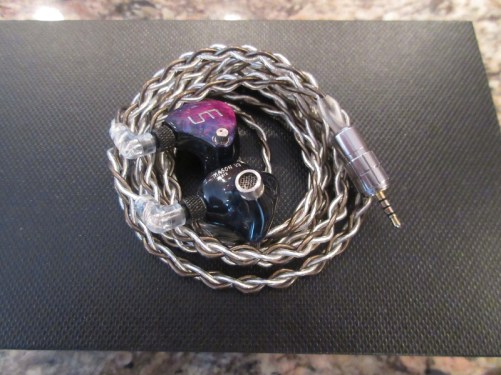
Pair up.
Wit 24-ohm impedance these IEMs are very easy to drive, though with 104 dB sensitivity I had to turn the volume a few clicks higher. Here is how MS3 pairs up with various audio sources. I will also note if I hear any hissing.
Cowon Plenue 2 mk2 – expanded balanced sound with a revealing natural tonality. The sound is very dynamic and has a good sense of natural smoothness without affecting retrieval of details.
Sony WM1Z – wide soundstage with a little more staging depth. Balanced revealing sound, though in this pair up I hear a little more sub-bass texture and stronger mid-bass impact. Mids are revealing but a little smoother and treble is a little brighter and with more crunch.
A&K SP1000 SS – expanded balanced sound with a more revealing transparent tonality. I hear mids in this pair up to be a little more forward and maybe a touch brighter. The same with treble, a little more crunch. Another noticeable improvement is better layering and separation of the sound.
Lotoo PAW Gold – just a touch of hissing, wide soundstage with a little more depth, balanced revealing sound. Bass is tight, articulate, with a little more mid-bass impact. Mids are a little more forward, great retrieval of details, treble has a little more crunch.
iBasso DX200 w/amp4 – very wide soundstage with a balanced revealing tonality. Great sub-bass rumble and punchy mid-bass impact. Mids are more revealing and a little more forward. Treble is crisp and airy, well under control.
FiiO X7ii – just a touch of hissing, very wide soundstage with a balanced revealing tonality. Excellent sub-bass rumble and punchy mid-bass, the bass is tight and articulate. Mids are very transparent, layered, with an excellent retrieval of details. Treble is crunchy and airy, extended and under control.
FiiO X5iii – noticeable hissing, sound is balanced but dynamics is flatter, and layering not as good. Bass is also not as articulate, though fast. Mids are a little more forward, clear and detailed. Treble is brighter and even has a hint of sibilance. Wasn’t too crazy about this pair up at all.
Hiby R6 – wide expanded soundstage, balanced revealing tonality, very good sound dynamics. Nicely textured sub-bass rumble with a punchy mid-bass. Transparent, layered mids with a hint of natural smoothness and excellent retrieval of details. Very well defined crunchy extended treble. One of my favorite pair up. Excellent sound, doesn’t need iEMatch. With iEMatch, upper mids are a little bit forward, but I still like the pair up directly from R6.
theBit Opus#2 – expanded balanced sound with a little more forward mids. Bass has a little more sub-bass rumble; mid-bass is tight with a nice fast punch. Mids are clear, detailed, slightly forward. Treble is crunchy, airy, and under control.
iFi Micro iDSD BL – wide expanded balanced sound. Deep sub-bass rumble with a fast, punchy mid-bass, tight articulate bass. Very transparent, layered mids with a touch of smooth tonality and excellent retrieval of details. Crunchy, airy extended treble with an excellent control. In this pair up bass hits a little harder.
Smartphone, Samsung Note 4 – slightly narrower soundstage, though still above the average, bass hits a little harder, mids are clear and detailed, but have a bit less transparency (I hear a little coloring), and I hear mids being a touch forward, treble is crisp, airy, extended.


Conclusion.
When it comes to flagship IEMs, it’s hard to find bad ones since every manufacturer puts their best effort into design and tuning. Usually it comes down to a preference of sound signature and being able to afford the asking price. And speaking of price, which usually comes up in all flagship discussions, when you factor in how much money people spend combined on various flagships and cables to get to their ideal sound, sometimes it worth investing extra to hit that sweet spot you’ve been looking for.
UM Mason V3 is not tuned for those seeking an enhanced low-end impact or an extra treble energy. This IEM is focused on delivering an accurate uncolored natural neutral tonality, and its transparent resolving balanced sound is enhanced with dB-Go bass module to give you more tuning flexibility at sub-bass level and a very unique Dual-Tone cable design to fine tune the tonality of mids. When it comes to flagship releases, every manufacturer is focused to stand out from the crowd, and in my opinion Unique Melody did accomplish that successfully with Mason V3.

 Twister6 Reviews
One thought on “Unique Melody UM Mason V3”