
Design.
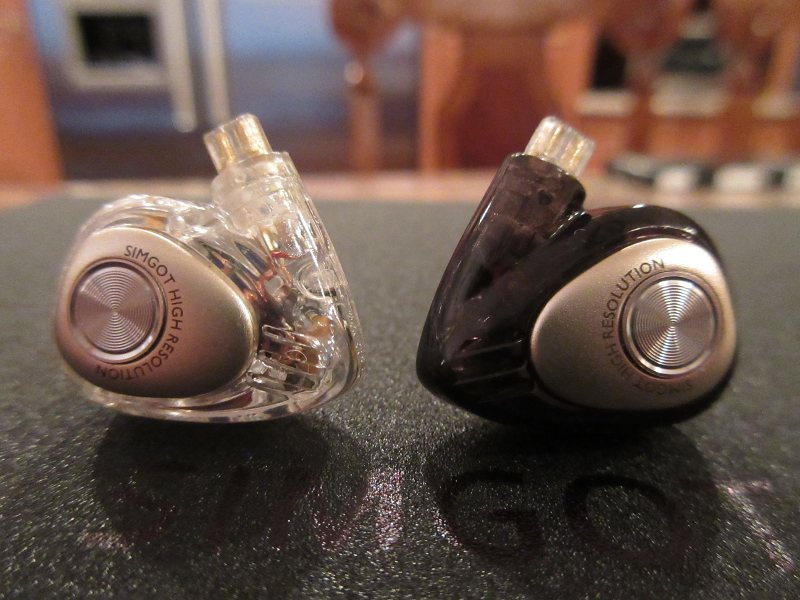
When the original EN700 was released, many referred to it as HiFiMAN HE1000 mini clone. That all metal shell had an eye-catching design and high-quality build. In my opinion, EM series stepped it up to a whole new level with a new original design where this time it’s not going to be mistaken for any clone.
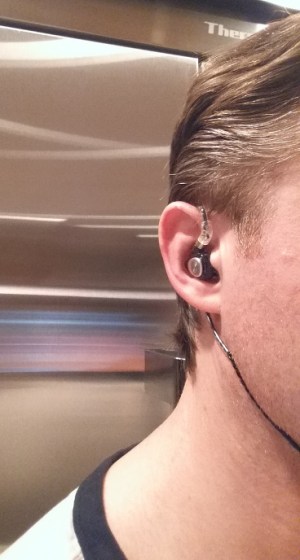
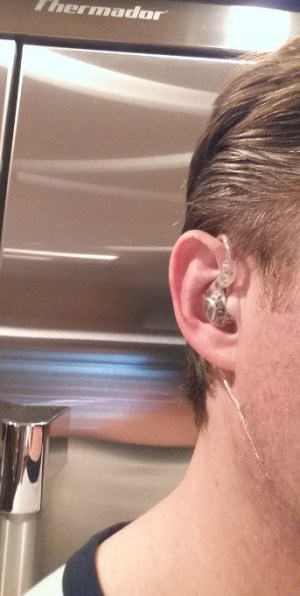
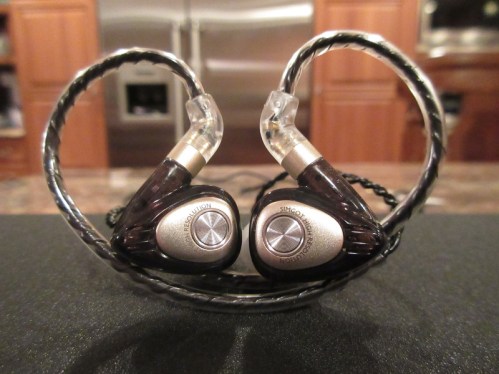
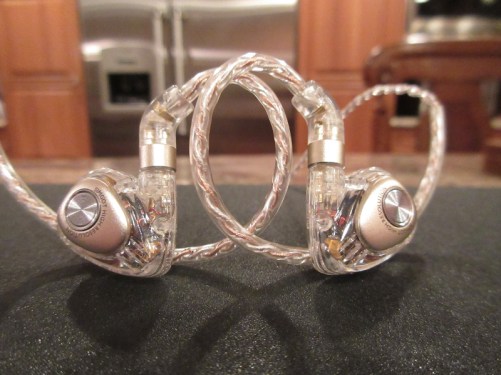
Both have shells with a very similar shape, reminding me a little bit of slim guitar pick teardrop, with 2pin connector extension piece attached at the top. They both have the same layered faceplate insert, in a scaled down shape of the shell and a round metal circle on top. And similarly, facing-in you have a DD venting port. Both shells are plastic, with EM3 being dark brown with a little bit of transparency and EM5 being clear and fully transparent. Both have a gold-plated nozzle which feels like a lightweight aluminum material (it’s colder to the touch than a plastic shell, thus I assume it’s metal), and a mesh covering the tip of the nozzle.
Simgot certainly tried to distinguish one model from the other with EM3 having a dark shell, black cable, and eartips with a black core, while EM5 has a transparent plastic shell, transparent cable sleeve, and eartips with a white core. On the inside, you will find some similarities as well, plus additional drivers in EM5 model.
EM3 is a hybrid IEM with 10mm dynamic driver and dual Knowles TWFK-30017 balanced armature drivers. EM5 is also a hybrid IEM with the same 10mm dynamic driver and dual Knowles TWFK-30017 BAs and on top of that dual Knowles SWFK-31736 BAs. Both have the same 101dB sensitivity and 16ohm impedance. When I measured EM3 vs EM5, I found a very similar FR response up to 5kHz and only the variation in lower/mid treble with EM5 having more accentuated peaks, suggesting that’s where the energy of additional SWFK Knowles drivers is focused on. I will discuss this in more details in Sound analysis section of the review.
EM3 design.


EM3 fit.
EM5 design.


EM5 fit.
Sound analysis.
Let me first start with EM3 sound analysis which I find to be like a baseline core of EM5 tuning. Then, I will go into more details of EM5 sound which I feel was derived from the original EM3 tuning where they share the same DD and dual BA drivers. In my sound description I used multiple sources to make sure my analysis is consistent.
Also, following tracks were used while analyzing and comparing these iems: Agnes Obel “The curse”, Avicii “Lonely together”, C-Bool “Never go away”, Ed Sheeran “Shape of you”, Galantis “Hunter”, Iggy Azalea “Black widow”, Indila “Boite en argent”, Robin Schultz “Oh child”, David Elias “Vision of her”, Michael Jackson “Dirty Diana”, and Counting Crows “Big yellow taxi”.
EM3 sound analysis.
EM3 is tuned to have a mid-forward signature that has a more revealing upper frequencies tonality. It has a very good retrieval of details with a nice level of clarity. The sound is on a brighter side, not exactly as smooth and musical as the previous EN700Pro tuning, instead being leaner and more revealing. EM3 doesn’t color the sound much, keeps the mid-bass at a neutral quantity level with a deep sub-bass rumble, whips lower mids into a leaner shape, and pushes upper mids more forward while keeping treble well defined, extended, and under control.
The sound separation and layering is pretty good, keeping instruments and vocals distinguished and easily identified within a mix.
Soundstage has a surprisingly good width and depth, with more depth which pushes sound a little more out of your head, giving you more space in front of the stage. It’s not exactly at full holographic level, but has a good imaging with a convincing placement of instruments.
In more details, bass has a good deep extension with a deep velvety rumble. Mid bass is fast and punchy, not too aggressive but punches through the mix well. Despite a hybrid design with DD bass driver, this is a fast driver with faster attack and shorter decay, articulate, and very controlled without any spillage into lower mids. Both sub-/mid-bass are relatively balanced, though there is more tilt toward sub-bass. Despite having a mid-forward tuning, in my experience other similar iems compromise sub-bass by rolling it off and keeping mid-bass neutral and boring. Here, maybe the quantity is more neutral relative to mids, but the quality shines with a nice rumble.
With mids, lower mids take a little dip to accentuate more the upper mids, which makes them sound leaner. As a result, EM3 tuning lacks some body which goes along with a more revealing mid-forward signature of these iems. Upper mids are the focus and the shining star of EM3 tuning where you have a linear continuous lift between 2k and 5k. Mids are nicely layered and very transparent. Also, surprisingly, despite a leaner tuning, vocals rendition is pretty good, not as organic, but very clear, detailed, and focused.
Treble has a very good extension, typical of some high-end IEMs, but in case of EM3 the treble peaks are more subdued (but not rolled off), giving the sound just enough airiness and precise definition, but keeping it more controlled and less fatigue.
EM5 sound analysis.
Surprisingly, up to a lower treble, EM5 is tuned very close to EM3. And this is not something that I just hear, but also able to confirm it in my measurements with Veritas coupler. It’s quite impressive how the focus of 2 additional drivers went into improving the treble performance with crisper definition and higher level of airiness and clarity.
The signature is still mid-forward and tonality is even brighter and more revealing, but the focus here is shifted to upper mids and treble, thanks to a more prominent 12k peak. As a result, I feel like there is more air between the layers, and the retrieval of details is closer to analytical level. At the same time, it makes sound a little colder and dryer, but brings more crunch and airiness with improved retrieval of details. With that shift, low end impact feels a little more neutral.
I also noticed a perception of soundstage expanded a little wider. The depth is the same, but width has improved, now giving the sound a feeling closer to holographic expansion.
Bass, both sub-bass and mid-bass, are closer to EM3, thus my EM3 description is still very much applicable. Lower mids are also nearly identical: lean and scooped out a bit. Upper mids follow the same EM3 DNA with a similar mid-forward presentation but as I mentioned already, the sound feels a little more layered, more analytical, and as a result a little colder.
Treble is where you have the most noticeable difference with 12k peak pushing higher, giving the sound a sharper definition, more brightness, and more crunch. Also, I hear more airiness. If you are sensitive to brighter upper frequencies, as myself, the side effect of this improvement will result in a little harsher tonality. It’s not sibilant or too fatigue, but after extended listening I personally preferred a more balanced treble tuning of EM3 which took some edge off the upper end. If you want more treble energy and crisper details, EM5 is the way to go over EM3.

 Twister6 Reviews
How compared Em3 with oriveti New Primacy? Which one achieves the best match with the cayin n3?
Regards,
Juan Luis.
LikeLike
I just updated Comparison section of the review and added comparison of EM3 to Oriveti New Primacy, Hi-Fi Boy OS v3 2pin, and DUNU DN-2000J.
LikeLike
Could you please do a Comparison to the IT04? Or in other words, do you think the IT04 is worth the money?
LikeLike
already did in my IT04 review here: https://twister6.com/2018/06/29/ibasso-it04/3/
LikeLike