

Sound analysis.
D6 has a rather unique sound signature due to a dual vent design where depending on the nozzle vent, either closed or open, the low-end response of the sound will vary significantly. With vent open, when eartips are not pushed all the way in, you have a mid-forward sound signature where depending on pair up the bass will either be neutral-flat or neutral-balanced. With vent closed, when eartips are pushed all the way to the back, the sound sig is more balanced with a fuller body due to an elevated bass impact. In either case, the overall tonality is more natural and revealing due to presentation and rendering of mids, but it’s not too bright or harsh. Even with vent closed and bass being elevated, the retrieval of details is pretty good, and you get a decent separation and layering of sounds for an entry level model.
Soundstage has a very good width and depth, way above the average width, a more typical oval shape with a sound slightly out of your head. Positioning and imaging of the sounds is good, not the greatest, but pretty good. With vent open and more emphasis on mids, I heard a better imaging, while with vent closed and more bass impact, for some reason positioning of some of the instruments where closer to the center.
In more details, bass is very much controlled by a vent in the nozzle. When it’s open, bass is neutral flat, with a slight variation between pair ups where it could get a little bit lifted. It has a good extension, but closer to a neutral quantity. As soon as you close that vent, the mid-bass slam scales up significantly and the sub-bass rumble also gets a boost in quantity. It feels like someone flipped a bass switch on. With a “neutral” bass, there is more control and shorter decay with an average attack, while the “elevated” bass has a little bit of spillage into lower mids, giving it more body without muddying it.
Lower mids can vary from neutral to being slightly below neutral due to vent being open/closed. With vent closed, you can certainly sense more body in the sound. With upper mids, when vent is open you have more emphasis and a little less body, so they take a front stage with all the focus, becoming more layered, more separated, with a great retrieval of details, but not on micro-detail level, keeping it still natural. With vent closed, upper mids get a little more organic tonality and some additional warmth.
Treble is consistent between vent closed/open, being well defined, crisp, very extended, with a natural airiness. Depending on pair up, the level of crunch can vary, and I even heard a hint of sibilance found paired up with R6 which has 10ohm output impedance, but with iEMatch it got smoother. With many other sources, lower treble was under control. Treble has plenty of clarity and a very good extension. When I did quick measurements, as expected, I saw a peak around 12k (gives a nice clarity and definition to a treble), and then further up there was another peak in treble extension.
Comparison.
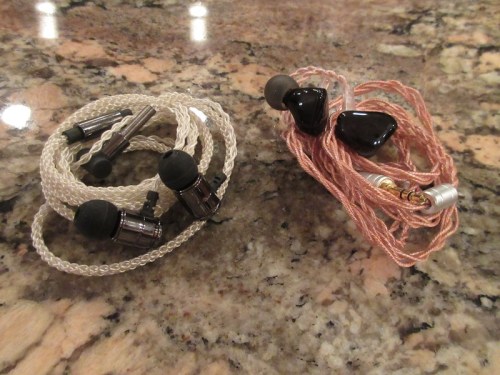
In these comparisons, I stacked up D6 against a few other IEMs in a similar price/performance category, and made a note of the effect of nozzle vent open/closed position. In every case IEMs were volume matched, and I tried to focus on a technical and sound breakdown comparison.
D6 vs Oriveti Basic – D6 has a wider soundstage, both in width and depth, while Basic soundstage expansion is more intimate. When it comes to sound signature, Basic is L-shaped with a serious low-end slam, especially with a focus in mid-bass. D6 with its vent closed has a noticeable bass lift, but it’s more balanced across FR, giving a sound more tasteful v-shaped signature, instead of shifting the attention to low end. With vent open, D6 bass is significantly more neutral in comparison to Basic. In lower mids, Basic is north of neutral since bass does spill in there, while D6 with vent closed has more neutral lower mids and with vent open even a bit south of neutral. Upper mids are smoother and warmer in Basic, while D6 is more layered, more revealing, still organic but not as warm and more transparent. Treble has more sparkle and better definition and extension in D6 as well.
D6 vs Simgot EN700 Pro – D6 has just a slightly wider soundstage, while both have the same staging depth. When it comes to overall signature, EN700 Pro is right between the D6 with vent closed and open. 700Pro bass is more elevated than neutral bass of D6 with vent open, yet 700Pro mid-bass doesn’t have as much slam in comparison when D6 vent is closed, though sub-bass extension is similar. With lower mids, both have neutral presentation (with D6 vent closed). Upper mids in EN700 Pro are pushed a little back, a little brighter and less natural in comparison to a more balanced (when vent is closed) mids of D6 which also sound more natural and more layered. Treble definition, crunch, and extension is similar between these two.
D6 vs iBasso IT01 – Another very interesting comparison. While IT01 soundstage is wider, both have a similar depth expansion, a little more out of your head. With a sound signature, IT01 is a classic example of v-shaped tuned IEM, while D6 even with a vent closed has a more balanced signature across FR. IT01 bass hits a lot harder in mid-bass, while D6 w/vent closed does have a nice slam but it’s rather polite in comparison. Both have a similar sub-bass extension, though IT01 has a little more rumble. D6 with vent open is night’n’day in comparison when it comes to bass since it’s too neutral. IT01 lower mids are little more recessed in comparison to more neutral D6. Upper mids have some similarities in tonality, being natural, layered, and still very detailed, but in IT01 – upper mids are pushed more back, while D6 has them more forward, with a more balanced presentation. Both have a very well defined crunchy treble with a nice extension and airiness, but IT01 has a little more sparkle while D6 is more natural in that regard. I think those who find IT01 bass slam a bit overwhelming and want mids to be more forward, will enjoy D6 with a vent closed.
Pair up.
With impedance of 16 ohm and sensitivity of 105dB, D6 is very easy to drive, maybe just needs a few extra clicks of volume since sensitivity is a bit on a lower side. Also, I didn’t hear any hissing in any of my pair up examples.
A&K SP1000 SS – Very wide soundstage with excellent depth as well. Sound signature is more balanced with vent closed, where I hear a deep sub-bass rumble, punchy elevated mid-bass; neutral lower mids, forward upper mids with a great layering and separation, and transparent natural tonality, and great retrieval of details; treble is crisp and well defined, extended with a nice airiness, and overall having a natural crunch without being too harsh or splashy. With vent open, bass is flat neutral, extended but has a neutral quantity; lower mids a little south of neutral, upper mids are more forward, brighter, very natural, layered, excellent retrieval of details; and treble is crisp, airy, and extended. With vent open it has a more mid-forward signature, but a little smoother at the top.
Cayin N5ii – Very wide soundstage expansion with a nice out of your head depth. As expected, sound sig is more balanced with vent closed and more mid-forward with vent open. With vent open the bass is flat, and when it’s closed – the mid-bass slams even harder. Mids have excellent retrieval of details, nice layering and separation, and have a more natural tonality. Treble in this pair up has more sparkle, more crunch, higher definition, still very extended and airy. This pair up is a little brighter in tonality.
iBasso DX150 – Very wide soundstage expansion with an excellent depth. With vent closed, sound signature is balanced, though pushing a little close toward the L-shaped due to a deeper and stronger sub-bass and more mid-bass impact. With vent open, bass is neutral, but a little more elevated with a more noticeable sub-bass rumble in comparison to other pair ups. Lower mids are neutral, while upper mids have a very natural organic transparent tonality with an excellent retrieval of details and nice layering and separation. Treble is well defined, with a moderate crunch, great extension, and polite airiness. This pair up is a little smoother.
Shanling M0 – I hear a wide soundstage with an excellent depth. With vent closed, sound signature is a little more L-shaped, though still closer to balanced, but I do hear a little more sub-bass rumble. Mid-bass impact is strong for sure. With vent open, bass is neutral, but not exactly flat, still has a nice sub-bass extension with a textured rumble and a bit of a punch in mid-bass. Lower mids are neutral with either vent open or closed. Upper mids are natural, detailed, not as layered as in other pair ups, but sound does have a good separation. Treble is well defined, crisp, a little on a brighter side, but not harsh or splashy.
Hiby R6 – Very wide soundstage with an excellent depth. Was very curious about this pair up due to 10ohm output impedance, which in theory shouldn’t affect a single dynamic driver iems. With vent open, the sound is more mid forward, but bass has a nice extended sub-bass with a tight mid-bass punch, above neutral level. With vent closed, the sound signature is more balanced, but the bass is not as elevated as I heard it with other DAPs. It’s above the neutral, has a deeper sub-bass with more rumble and stronger mid-bass punch, but it’s more balanced against the rest of the spectrum. Lower mids in either case are neutral, and upper mids are very layered, nicely separated, excellent retrieval of details, and slightly brighter tonality. Treble is bright, crisp, airy, very extended. It’s not harsh or splashy, but it does have a little bit of sibilance with a few of the tracks. When adding iEMatch in series, there is hardly any change in tonality, but that hint of sibilance was absolutely gone.
Conclusion.
Lately I got a few pings from people with a collection of flagship C/IEMs who are looking for something “budget” to use on the go. I know, “budget” is a relative term, especially when you look at $1k-$3k flagship prices. Also, “budget” means cutting some corners to meet that budget. With D6, I don’t think Alpha & Delta had any intentions to cut corner, they tuned it to a specific sound signature, made a durable design backed by 3-year warranty, included a high quality permanently attached cable so there is no fiddling with connectors, and provided a set of cool accessories. And on top of that, obviously unintentionally, gave D6 the ability to mod the sound by sliding the eartip to cover the front vent. As a result, you get a fun little “budget” IEM in sub $100 price range. It’s a nice choice to consider if you want to give your TOTL a break or if you can’t decide between mid-forward signature or balanced sound with more emphasis on low end.

 Twister6 Reviews
Hi.when you want to review dx150?
Please review it.thanx
LikeLike
It’s in a queue to be reviewed, very good DAP, probably among the best value android daps under $500
LikeLike