

Quantum Pad.
For this test I used 2 identical Cayin N5iiS DAPs. Each one was set at high gain and the same volume level while I was playing the same song which I managed to start at the same time on both DAPs. Each DAP was connected to LineP A985 audio switch using the same short 3.5mm interconnect cable. I ran this test multiple times, in different locations of the house, with and without pleather case, using 64 Audio U18t and oBravo RA C CU iems to monitor the sound.
The only difference here was a quantum pad under one DAP and no pad under the other one. I found it important to use a switch since I can toggle very quickly between outputs of these identical DAP setups. I did hear the difference in sound and the results were consistent, which I’m going to describe in the follow up Result section of the review.


Quantum stickers.
Again, in this test I used a pair of N5iiS with the same setting and playing the same song, applying 5 stickers in the middle of the back panel of one of the DAPs. Stickers are thin enough and stay securely attached when you slide N5iiS into the case. Once the case is on and you shuffle the units, there is no way to see which N5iiS has stickers. I literally shuffled them around and switched between each one using U18t and RA C CU for monitoring, this time using 2.5mm DAP output (the reason why I didn’t use LineP switch with its 3.5mm ports).
This was a true A/B blind test, and again, I was able to hear the difference which was consistent with quantum pad results. In every round of testing, I was able to pick the DAP with stickers, and will go over the results in the next section of the review.


Quantum ball.
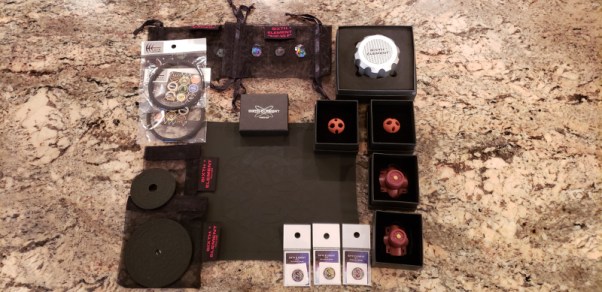
There are different ways to attach these small orange balls which look like Xmas ornaments. The balls have 4 drilled holes (2 larger for headphone cables and 2 smaller for IEM cables) with a side slit to get the cable securely inside. You can get as creative as you want to, attaching each to Left/Right sides of the cable, placing it above y-splitter, or wrapping it around and next to headphone connector.
Even so these balls are lightweight (8g each), I find them a bit uncomfortable hanging down each side, especially when wearing IEMs. Thus, I used one above y-splitter with a chin-slider pushing down on it, and another one right at the base of headphone connector. The test was performed using SP1000 SS and DX200Ti as sources while listening to U18t and RA C CU with balls attached, and then quickly removing them and listening again. I was still able to hear a similar sound change as I have with a quantum pad and stickers.


Test Results.
Now, it all comes down to this, the results of my testing which I’m aware of going to be subjective since we all have a different hearing level and a different perception of the sound.
I do hear a very distinct change in sound with a noticeably blacker background that leads to a cleaner, sharper, and faster transient of note on/off. It felt like a filter was applied to the sound. In all three tests performed above, I came to the same conclusion because the sound had a blacker background, making it faster and tighter with an improved PRAT factor. In a comparison, the other DAP sound (in A/B comparison) was a little more relaxed.
No matter if I tried the pad, stickers, or balls, I was always able hear a similar improvement. It’s hard to quantify the level of improvement to determine if it’s stronger using pads, stickers, or balls, but to my ears it sounded very close. Furthermore, I also noticed that adding more stickers, more balls, or extra pads doesn’t necessary show incremental linear improvement; it’s either present or not. Maybe others can hear a difference in the tonality or the perception of soundstage expansion, but I didn’t hear that.
Conclusion.
This review is very different from everything else I have done in the past because I approached it in a totally different way. I was skeptical about the results, but at the end proved myself to be wrong. Do I hear a night’n’day difference? Not really. Do I hear a change in sound tonality? No, I don’t. But I do hear a noticeable improvement in sound having a blacker background with a cleaner and faster transient of notes that make details pop up with more clarity. And to my surprise, I hear this effect when applying either stickers to a source or pads under a source or balls to a cable.
I know many people will be skeptical too because how can a rubber pad or a rubber ball have an effect on the sound? But they don’t realize that it doesn’t matter if it’s a pad, or a ball, or a sticker, or a ring. What matters is a rare earth element (Lanthanum) inside of these various accessories. How does it work and why it has effect on the sound? I don’t have enough knowledge to explain that. But I do hear a difference and it sounds real to my ears.

 Twister6 Reviews