

Design.
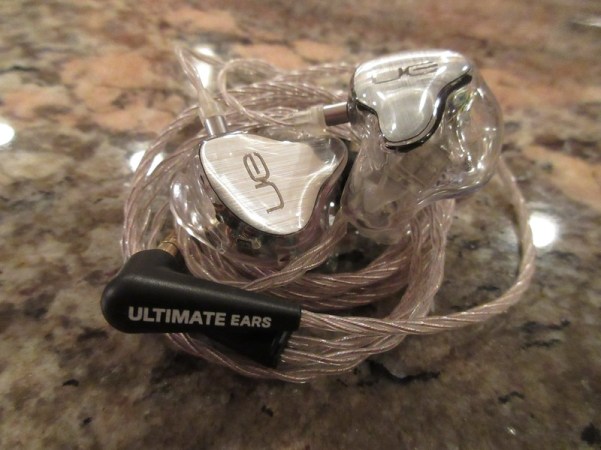
UE Live is available only in custom fit (CIEM) which requires ear impression from a professional audiologist or using UE 3D Ear Scanner system. If you are a returning customer, your impression is stored on digital file for a fast recall and 3D printing. The customization is done using UE Designer where you have a choice of 20 colors, 10 wood finishes, 10 pattern finishes, 4 specialty material, or a custom artwork when it comes to the faceplate. The shell itself stays clear, and I noticed it was more transparent and less “cloudy” then UERR. I know UE been trying to improve their 3D printing process, trying to reach a compromise between the shell clarity and the thickness of the walls for more durability. They are certainly making a progress.
Inside you will find 6 Balanced Armature drivers, 1 True Tone Plus (improved over the original True Tone) BA driver, and one 6mm dynamic driver. All 8 drivers are partitioned into 3 Lows, 4 Mids, 1 High/Mid, and 1 High with 4 distinct channels routed into precision tooled branched acoustic audio paths which get combined into one going to a single bore opening in the nozzle. Also, to minimize (and simplify) crossover components, each driver is customized and tuned for a specific bandwidth.
The overall sensitivity is a little lower, at 105 dB, and the impedance of 10ohm is also on a lower side, all of which shouldn’t be a problem when using low impedance SuperBax cable and when paired up with low output impedance source. I will cover sound analysis, comparison, and pair up with different sources in the follow up sections of my reviews.
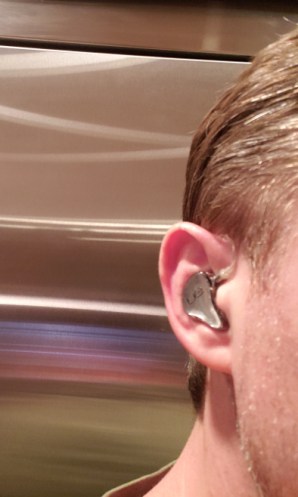
UE Live fit was perfect, and using these CIEMs with Linum SuperBax was very comfortable, can hardly feel it. As I mentioned before, I didn’t experience any microphonics, and isolation was pretty good, according to UE these should offer 26dB of isolation. UE also offers the ambient feature option (need to specify in UE Designer when building the CIEM) which allows for the stage sound-bleed, so you can hear more ambient stage atmosphere at expense of some attenuation in low-end. It’s an option which some stage performing musicians might find useful.


The fit.
Sound Analysis.
I analyzed UE Live sound performance across different sources while playing a variety of test tracks, such as Agnes Obel “The curse”, Sandro Cavazza “So much better” (Avicii remix), C-Bool “Never go away”, Ed Sheeran “Shape of you”, Galantis “Hunter”, Iggy Azalea “Black widow”, Indila “Boite en argent”, Robin Schultz “Oh child”, David Elias “Vision of her”, and Michael Jackson “Dirty Diana”. Also, UE Live went through about 100hrs of burn in before I started analyzing it, just playing tracks in the loop, to make sure its DD is fully conditioned.
UE Live has a reversed J-shaped sound signature (not quite L-shaped and not exactly V-shaped) based on a boosted low-end impact and some lift in lower treble. The tonality is rich, smooth, lush, musical. As a result, UE Live tuning yields a sound which is full of natural organic details that have more focus on warm smooth naturalness rather than high resolution or high clarity. Basically, you get a full bodied thicker sound with an analog quality bass slam, organic lush mids, and well-defined treble, except for a peak in lower treble around 8k which puts a little more emphasis on “s”, though to my ears it’s not harsh or sibilant.
Soundstage is wide, audibly above average but not super wide, and with a nice depth, not exactly too intimate or too far out of your head but rather somewhere in between. Soundstage scales up/down, depending on the source, and can feel narrower with my phone and a lot wider with SP1000. Imaging is OK, but due to a warmer smoother sound and a low-end lift, don’t expect a super accurate positioning of sounds.
You can already guess, this is not an audiophile tuned IEM with anemic bass, analytical retrieval of details, or transparency with zero coloring. The sound is lush, laid back, with a rich tonality and thicker body, and yet it’s not congested or veiled. I’m not sure if this has to do with a precision of crossover design or the bandwidth limited accuracy of every driver tuning, but UE made it work where the bass is big and analog, doesn’t have as fast decay, yet it coherently blends with the mids instead of “bleeding” into the mids.
Starting with low end, you have a deep smooth velvety sub-bass rumble which is elevated but not too overwhelming, and a slower attack rounded mid-bass slam which is linearly balanced with sub-bass. Mid-bass also has a slower attack, with an overall bass having a typical analog quality dynamic driver response. This is not a tight layered bass, it’s big, it goes deep, it drives the sound signature. This is a type of bass you would expect from floor standing speakers with big subs. For my preference, I was OK with its quantity and didn’t feel it was overwhelming. Also, in my opinion, it will please both bassheads and “regular” audio enthusiasts.
With mids, lower mids are north of neutral, with a thicker fuller body. I was on the fence if the thickness of lower mids is due to mid-bass bleed, but as I mentioned already, the bass is big yet somehow controlled, thus to my ears I consider these having a fuller body by tuning. Upper mids are smooth, organic, lush. They do have a natural warmer tonality with plenty of clarify, but don’t expect high level of micro-details here. Vocals, both male and female, do sound very rich and natural, except for some poorly recorded tracks where 8k peak (lower treble) can accentuate “s”, depending on your ear sensitivity.
When you move up to a treble, this one caught me by a little surprise. It’s well controlled, clear, has not a bad definition, but starts to roll off after about 12.4k (based on my measurements and multiple sine sweeps). Don’t expect a typical 12k peak to give you higher definition. UE really went for a smooth lush sound, while maintaining its definition with a boost around 8k. As a result, you have a peak between an infamous 6k sibilance and popular 12k high definition marks. This way it worked well to preserve the clarity without adding extra crunch or sparkle. With a roll-off of a treble extension, don’t expect too much airiness either.

 Twister6 Reviews
Hi twister. I was thinking of getting the a pair of the UE Live simply because of it’s current labor day sale which has it down a whopping $600…. The sale seems absolutely irresistible, as it has coincidentally fallen right into my personal budget/ price range of $1599. I’ve tried to do as much research as I can into other brands but the wormhole of info is overwhelming. Before I pull the trigger on this, I want to know if you have any other suggestions on an CIEM that would fall in the $1600-1800 range. The primary application would be vocals and guitar.
LikeLike
I would seriously consider 64 Audio N8 CIEMs, tuned in collaboration with Nathan East. Both are good for your application, but from my audiophile perspective, N8 is tuned better (you can read the comparison between N8 and Live in my N8 review). If you are not in a rush, wait until black friday sales or just email 64audio now and ask for discount, you can probably save easily 10-15% that way to get under your budget. Plus, 64audio offering the option of IPX connectors in addition to 2pin.
LikeLike
I appreciate your reply. I will certainly consider those. I am unfortunately in a bit of a hurry. I was hoping to have some sort of IEM for an upcoming project. This is my first venture into the CIEM world and I’m seeing that 4 weeks seems to be the average turn around time. Which is where 64 Audio is at. Unless expedite fees are paid. Which I suppose I could pay if I really must. Another company having a similar sale is Clear Tune. Their Davinci IX is down from $2200 to $1760. JH Audio currently has a pretty fast turn around. 2nd fastest to UE that I can find. At $1899 it would be a stretch out of my budget, but the JH Audio Roxanne look nice. The Westone ES70’s are also on my budget at $1599. Have you experienced any of these aforementioned IEMs? And if so, do any stand in any comparison to the UE Live?
LikeLike
Don’t just focus on “ciem”, you have to focus more on tuning. UE Live was poorly tuned, imho. Heard universal DaVinci 2+ years ago, it was just OK. JH – have to fiddle with that cable, tuning down the bass, but they are not bad. Love Westone ES60 and ES80. Not familiar with ES70. You might want to consider ES60, more natural tonality. Also, don’t look at msrp, many of these manufactures will offer you up to 20% discount when you ask customer service, just be a bit persistent.
LikeLike