
Design.
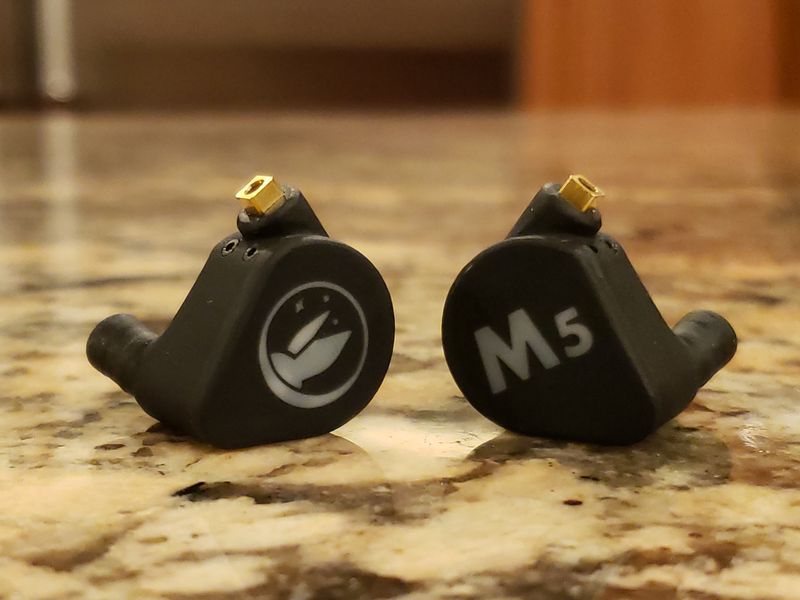
The M5 review unit I received was a 3D printed universal demo shell of FIR Audio CIEM version of this hybrid. As some probably guessed, the model name corresponds to a number of drivers, and M5 hybrid design has 5 of them: DD low, BA mid, BA hi-mid, BA high, and Electrostatic high (Sonion single ES tweeter). The design is completely tubeless, meaning the sound of all 5 drivers is mixed naturally inside its 3D printed shell without limiting the air volume of each driver output. And to resolve the problem of sound wave resonance, dampening material was used inside the shell to absorb and to control the frequencies.
Interestingly enough, there has been a number of other recent IEM releases utilizing dual ES from Sonion, but FIR Audio decided to go with a single one which I have a feeling probably has to do something with this ES tweeter being placed right into the nozzle of IEM, next to another smaller BA driver. Two other larger BAs are in the middle of the shell, and the dynamic driver along with ATOM module and a dedicated built-in ES transformer module occupying the rest of the space. Thanks to ES transformer, there is no need for any high voltage external amping to drive ES tweeter. Overall, if you think about it, that’s a lot of components, yet the shell is surprisingly compact. Perhaps, the lack of tubes and utilizing nozzle space helped with a layout to fit everything inside.
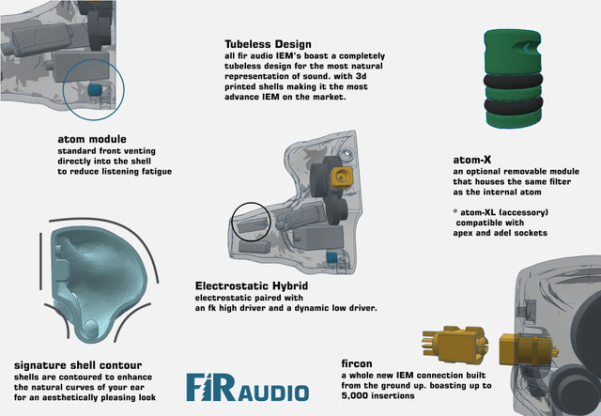
Regarding ATOM, it stands for Air Transferring Open Module and allows front venting of the driver directly into the shell. Basically, it’s a controlled leak valve intended to relief the air pressure which results in non-fatigue open sound listening even at higher than usual volume. Many will probably recognize this to be similar in functionality to apex module, but they differ in the method of how this leak is created and controlled. I don’t know enough design details to explain the difference, but I can confirm that I was able to raise the volume beyond my normal listening level and experienced neither sound fatigue nor ear pressure discomfort.
My review unit arrived with ATOM module being internal to the shell, non-removable. But I have been told that Custom IEMs will have an option for either non-removable ATOM or a replaceable ATOM-X with a socket built into the faceplate. There is also ATOM-XL, compatible in size with apex socket. ATOM-X is smaller in diameter and shorter in length in comparison to ATOM-XL/APEX. Furthermore, the default built-in ATOM module has “N” baseline tuning, while the optional removable version will be color-coded as I described in my XL review, being “+” and “-” variants of “N”. I already tested and reviewed all 3 ATOM-XL modules and found the baseline “N” to sound closer to apex M15, while + and – variants have the effect of lifting the sub-/mid-bass either up or down without changing too much mids/treble or the soundstage expansion. Also, I didn’t experience any sound leakage, and isolation was pretty good.
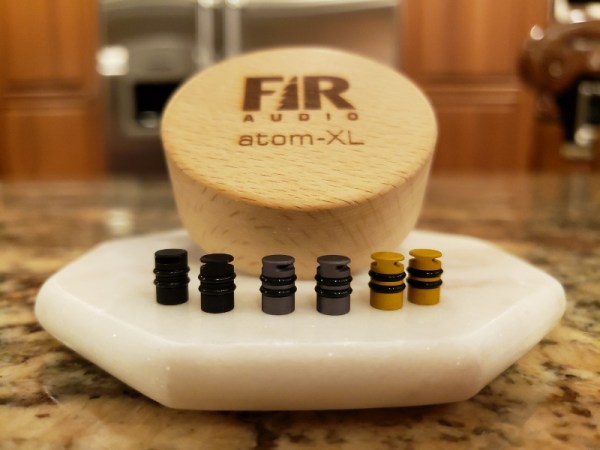
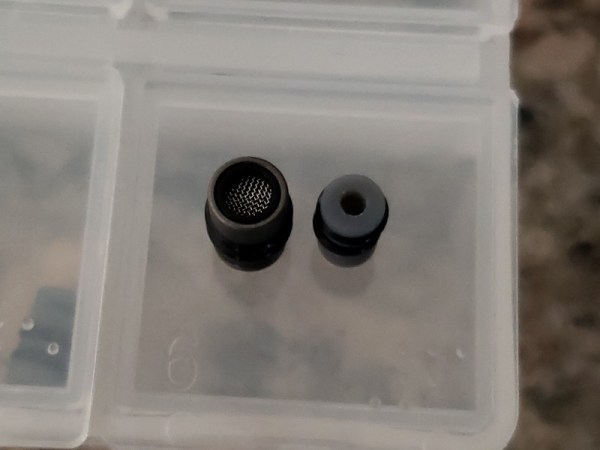
APEX M15 vs ATOM-X.
There is a lot going on under the hood of M5, but from the exterior perspective its a very compact size shell with a metal mesh covering the nozzle, and dynamic driver and ATOM vents next to the connector. Keep in mind, I have a universal demo, but you can use their new IEM designer tool to customize further. In there you will have options to select a body color: smoke, red, blue, green, white solid, black solid, and faceplate color: various colors, predefined finishes (28), watch gears, wood (12 types), or custom. Then, you can add artwork or a standard logo, design your own cable and even customize the case. All these customization options are already included in the price, no need to pay extra. You literally get unlimited shell and design customization at no extra charge.
Also, I have been told that updated universal shell design will be available in a very near future, and FIR Audio is working on a new aluminum shell and faceplate, but most likely the ATOM module will be internal to the design of universal model.


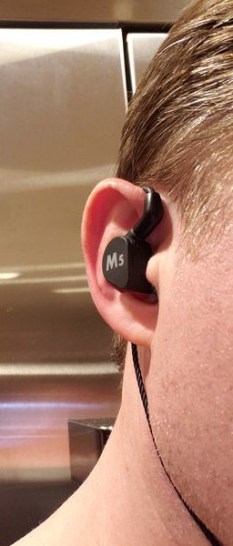
The fit.
Page 3 – Sound analysis.
Page 4 – Comparison, Pair up, and Conclusion.

 Twister6 Reviews
One thought on “FIR Audio M5”