

Design.
Coming off DX150/200/220, DX160 is a lot slimmer and more comfortable in your hand, especially when you are comparing all these DAPs in their corresponding stock cases. But you also have to keep in mind, those are modular designs which add extra bulk. DX160 is not as small and slick as DX120, but bigger size is expected due to a full Android DAP with 5” display. Despite its 5” hi-res (1080×1920, selected in Setting as 1080p or 720p) Sharp screen, iBasso designed DX160 alloy-aluminum chassis to fit display edge to edge, without any wasted space. The overall size of DX160 is 113mm x 69mm x 15mm. The weight of 178g feels light in my hand as well. Once power is on, the display with its rich colors and high resolution is definitely an eye candy.
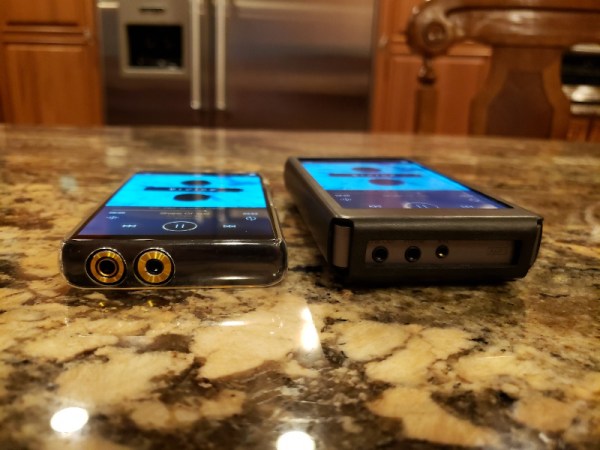
Top of the DAP has USB-C port in the middle for USB charging, data transfer, and USB DAC connection. Next to it is a power button, with the usual long press for power on/off, and short press for display on/off. Left side of the DAP has spring loaded microSD card slot, supporting up to a usual 2TB flash cards. At the bottom you have 4.4mm Balanced headphone port, and next to it a multi-function 3.5mm port selectable as headphone, line out, or SPDIF. On the right side you have a new golden slick low profile volume wheel, and hardware playback control buttons with skip and play/pause. The back of DX160 has a curved glass panel.
While DX160 has a simple slick design, it still has a distinct personality with golden external accent disks around headphone ports, golden slim volume wheel with slightly raised top/bottom guards around it, slick glass back, and a gorgeous bezel-less display (16.7 million colors, 445PPI retina fine display).


Under the hood.
Inside, iBasso decided to take a break from the usual AKM and ESS DACs, using a dual CS43198 DAC. But after this break, went back to their good-old Rockchip Octa Core processor. I confirmed AnTuTu 3D benchmark score to be on par with DX220, no surprises here, even so DX160 has 2GB of RAM. I know, the performance score is not as high as what I have seen with other Snapdragon and Exynos DAPs, but iBasso already has a sw platform built around this processor, and they decided to focus more on analog design and audio performance of the DAP, instead of starting from scratch with a new processor.
Based on my experience with DX160, using its Mango v2 audio app, or streaming using Qobuz and Spotify, or just a general navigation around the system, I didn’t find any lag or other issues. Is it as fast as my Galaxy S9 phone? Definitely not. Is it faster than other Snapdragon based DAPs? Not really. But when advantage in performance is measured in milliseconds, for me personally it’s not a big deal. Perhaps it will become more apparent if playing video games or running more CPU and GPU intense apps. But for audio playback and streaming popular apps, it was fast enough.
As already mentioned, DX160 has Balanced and Single Ended ports. 4.4mm BAL has a low 0.4 ohms impedance and 6.4Vrms output. The single ended 3.5mm port is also low impedance, 0.3 ohms, with 3.2Vrms output. 3.5mm port is multi-functional and could be selected between 3.5mm Headphone Out, 3.5mm Line Out, and SPDIF digital out using the same cables as provided with DX150/200/220 (the cable wasn’t included with DX160).
Internal storage is 32GB, and you can expand it further with micro SD card. WiFi supports a dual band, covering both 2.4GHz and 5GHz. Bluetooth is based on BT5.0, including support of LDAC, aptX and other codecs. I will talk more in my review about BT performance which I found to be a little underpowered (in terms of a distance).
USB port supports Type-C (for charging and data transfer), and also supports popular quick charge standards, such as QC3.0 and PD2.0. Internal battery is 3200mAH li-po battery, and I confirmed getting about 9.5hrs of playback time on DX160 (4.4mm BAL, low gain, FLAC in a loop with a display off). Going to single ended and with mp3 playback should extend this playback time, while going in the opposite direction with a playback of power demanding DSD files will shorten that playback time, as expected.

Based on its DAC, DX160 supports variety of lossy and lossless audio formats, such as APE, FLAC, WAV, WMA, AAC, ALAC, AIFF, OGG, MP3, DFF, DSF, DXD, CUE, ISO, M3U, M3U8. I tested up to DSD256, all without a problem. But one very important format support here is MQA. Since you can install and run Tidal app, it automatically gives you partial software unfolding (decoding), but the device has to be certified for a full hw decoding. I was able to confirm that DX160 supports full MQA unfolding to the original file format while playing MQA FLAC files, noticing the correctly interpreted bit depth, sampling frequency, and sampling rate.

Lately I have been using DX160 a lot for Qobuz streaming. I had no issues with that so far, tried it on WiFi at home and at work, always a strong connection, never drop outs, and fast access without any stuttering or buffering. Also, I’m able to download content for off-line listening and access it later without a need for WiFi. And of course, the artwork of tracks is a treat to view on DX160 display. 32GB of internal storage is not that much, but with access to expand it with 1TB micro SD and all the streaming sources, there is no complaints here.


Page 3 – GUI, and EQ/PEQ.
Page 4 – Sound Analysis, and Digital filters.
Page 5 – Pair up with IEMs and Headphones.
Page 6 – Comparison with different DAPs.
Page 7 – Wired/Wireless Connections, and Conclusion.

 Twister6 Reviews
Thanks for reviewing. I wonder if you could make a brief comparison (in terms of sound) with DX150+AMP7?
LikeLike
imho, it will not get better. In case of DX150, the DAC is behind its technical performance which is just OK. AMP7 can color the sound a little, maybe improve some dynamics, but technically DX150 with any amp (even amp8) will still be inferior to DX160.
LikeLike
Hi. I use the X5iii(line out) via a Magni 3 amp+hd598 headphone. Following the above configuHiration(line out+amp) does the X5iii then have a sound quality as good as Ibasso DX160?
LikeLike
I still think LO of DX160 will be better due to a different DAC (LO is a direct DAC output). But again, “better” is very subjective. X5iii DAC is warmer/smoother than DX160 DAC, so you might hear a combo with 160 to be more revealing, more layered.
LikeLike
Hey, I am about to buy a new DAP and stuck between DX160 and M11. To give you some context, I still use the original Fiio X5 (Gen 1) and still love its sound signature. Which one would you recommend? DX160 or M11?
LikeLike
Purely on a sound quality, Dx160 sounds better.
LikeLike
Thanks for your review. I also read your DX120 review and found that you quite enjoyed that too, and now I am looking for a comparison between these two DAPs. What do you think of them in term of sound quality?
LikeLike
I need to charge up the battery again of dx120 to compare, but in general with dx160 out, I wouldn’t consider 120 unless you want something even smaller and lighter and need two micro SD cards. 120 was noisier with sensitive iems, and just not the same level of resolution, layering, and soundstage expansion. 160 sound quality is aiming closer to 220 with its default amp1mk2. But keep in mind, 160 Bluetooth performance is not that good if you are relying on it.
LikeLike
Been trying to look for an spdif cable for this unit. Not sure what kind of termination I should be looking for. A typical spdif RCA won’t fit the player. What connections should I be looking for for spdif output through the player? Thanks 👍🏻
LikeLike
I was using a short spdif cable that came with dx220/200, like in this picture from my dx220 review https://twister6com.files.wordpress.com/2019/05/ibasso_dx220-06.jpg – rca on one side, 3.5mm on the other end, but it’s a 2ring 3.5mm (not the same as the ones used with fiio daps).
LikeLike
This is a fantastically helpful review, particularly given the wide choice of mid-range DAPs nowadays. Thank you. I see you’ve reviewed the HiBy R6Pro too – which, thanks to your review, is now the only other DAP left on my shortlist (unless I buckle and go for a DX220 plus Amp 8 or a A&K SA700, but the extra cost seems barely worth it). I’d be grateful for your thoughts on Dx160 vs HiBy R6Pro, particularly on overall sound quality and robustness. The main pairing for me will be B&W P9s.
LikeLike
If we are talking about wired P9, either one should work fine based on sound quality of pair up, they both sound great. It’s the other features/use that will set them apart. For example, R6Pro Bluetooth wireless performance will be noticeably better or if you are running lots of apps, R6Pro will handle it more efficiently. But as a portable dap, Dx160 is lighter, slicker, and more enjoyable to use at a fraction of the price.
LikeLike
Hi Thx for such an in depth review I was wondering how would you compare this to the old Hiby R6? And If I would be able to get the old R6 and the R5 for the same price which one should I get?
LikeLike
I wouldn’t recommend old R6, it has high output impedance which messes the sound of many IEMs. So, scratch R6 off your list. R5 is nice, definitely cheap at $299, but its sound quality is not the same as DX160, though R5 has a faster processor and better wifi/BT performance.
LikeLike
Good stuff. I think I’ll go for it. For those still looking for a leather case for the Dx160, there seem to be three options. First, a company called EASECASE sometimes puts one they make that looks pretty good on eBay or AliExpress (they do similar models for other iBasso players too). The nice thing about this is that it is real leather and evidently comes in a wide range of colours that can be ordered along with initials, if you’re into that sort of thing. Korean company Miter have a similar case, but in ‘PU leather’, on their Korean website, which I’ve not found elsewhere. Last, there’s a guy called Valentin Valentinum who advertises on Etsy hand makes leather cases and has done a Dx160 one to order. They’re a bit chunkier than the other two.
LikeLike
I’m currently still using the DX90 as my DAP but I’m hoping to upgrade for the ability to stream and the balanced output. I also have an OG micro iDSD. I was just wondering how the DX160 sounds with IEMs on balanced compred to your iDSD. Is the iDSD noticeably better even if you do not need the extra power? What are the major differences in sound signature and technicalities?
LikeLike
don’t think there going to be a huge difference in sound between micro iDSD and DX160. Basically, it all comes down to choosing between transportable setup with high power output and using your smartphone or another source to drive micro iDSD or using a totally portable solution, all in one with DX160. Personally, I would go with DX160, especially since you are planning to use IEMs.
LikeLiked by 1 person
I am in the same dilemma, i had the DX90 and loved it now i use the X7II and i am not a fan, its boring thats what i can say. Loved the DX90 and would be looking forward to something similar/
Is the DX160 more like the DX90 or the X7 II tonally ?
thanks
LikeLike
Have no idea how dx90 sounds, sorry. X7ii, aside from tonality that varied between amps, the biggest problem with older fiio daps was lack of dynamics with everything sounding flat, boxed, and boring. Dx160 is definitely not that.
LikeLike
Thanks for this!
I was actually thinking of getting a BTR5 to pair with my phone since I’ve started streaming and since carrying a phone and a DAP might get a bit too bulky. I’ve also considered just waiting for the third generation of iDSDs but that seems to still be a year or two away. What draws me to the DX160 is the all-in-one solution but if I’m spending that much, I might as well just pick up an xDSD or shell out another $200 for the iDSD BL, especially if the sound quality is still significantly better on the iDSD, BL or not.
Would you happen to have directly compared the DX160 as a USB DAC/Amp for IEMs? If no, it’s alright! Just wondering if that would bring the gap, if any, closer. I actually do not find the amp section of the iDSD to be the best being a bit thin and dry especially as you go up the power modes. The DAC on it though just brings so much body to the equation.
LikeLike
Yes, micro iDSD as amp is not that great, but as dac/amp it’s fantastic. But it’s transportable, not portable. Don’t have experience with xDSD. I have mentioned using dx160 as USB dac in my review, it makes the sound a little thicker when compared to playing the same track directly from the dap.
LikeLike
For Just pure SQ wise could you rec 3-5 daps the best for under $500? They dont have to be feature packed or android, just SQ and power
Thank u
LikeLike
there are not too many DAPs I have tested under $500. Based on pure SQ, DX160 is definitely among the best. R3 Pro is pretty good too and so does AP80 Pro (and probably its copper version).
LikeLike
I see so does the AP80pro and the R3pro sounds better than the other sub 500 such like the m11/R5/R6?
LikeLike
Hello there, thanks for the in depth review.
I currently own the dx80 and have been looking for an android dap upgrade for a while now. In your opinion, soundwise, is the dx160 an upgrade to the dx80?
Thank you!
LikeLike
soundwise, DX160 is on a level of their flagship DX220, and in general on a level with some other daps that cost twice as much.
LikeLike
Excellent review I was thinking about The Shiningling M6 Pro or ibasso DX 160
LikeLike
First want to tell you how much I love your website the reviews are very informative and easy to read. My question is about the future. I have the DX 160 I love it. However you’re absolutely right about the Bluetooth it’s almost nonexistent if I get more than a few feet away it drops out. Same with the Wi-Fi you have to be right on top of the signal for it to work. So I see for yes a much higher price 2 new digital audio players hitting the market. One I think is out now the I Basso 220 Max the other is about to come out soon Hiby R8. What I know so far about the new I Basso is that it’s a much bigger unit. I think they’re saying it’s more transportable than portable. However I hear the sound is amazing. So you may not have any answers now but in the future could you do a comparison between the 220 Max and the new R8. Specifically I want to know about the Bluetooth and Wi-Fi on both of them. I hear the new R8 is going to have a Sim card slot. Like to know how well that works. Also a size comparison is the R8 going to be more portable than the DX 220 Max. Finally on the upgrade I only had to pay $400 for the 160. I’m not rich so this will be a considerable investment. Do you think it will be worth it to bump up to the R8 in terms of sound compared to the 160 same with the 220 Max I know they’re going to sound better but is it marginally better or noticeably better. I know I threw a lot at you for units you probably don’t have yet ha ha. But during this pandemic time I’m feeling a little antsy and rather than go burning down a building or or fighting with the police I think I’ll just spent a lot of money on a portable music player. Thanks in advance for your answer.
LikeLike
I do have MAX and R8 is incoming, but I don’t know how R8 will sound/perform. But I can tell you with certainty that R8 most likely will have a much better BT/Wifi performance. Listen, I love ibasso products and truly respect them as a brand, but their focus is more on sound performance, not BT/wifi. Even DX220 MAX which sounds amazing, still uses old rockchip processor and all the same digital guts as dx200 and dx220. And yes, MAX is not portable at 750g in weight and a big size, but it is transportable, you can carry it in a pocket of cargo pants, and the analog design is high end desktop quality. Hopefully, their next flagship release (maybe next year?) will step up using different CPU/GPU and better performance BT/Wifi. On the other hand, Hiby is the company who used to write sw/fw for everybody from fiio to cayin, shanling, hidizs, and many others until they decided to release their own hardware product line. They really know the “digital” side of android design, how to optimize it with their own mods and drivers, and always go for the fastest hardware. I don’t know how R8 will sound, but at flagship level they all sound good… But, everything at that level will be in over $1k range, way over $1k range. DX160, just purely on its audio performance is on a VERY high level which can match daps twice its price. If you are really feeling antsy, why don’t you look into upgrading your IEMs/headphones to the next level. You will get a LOT more noticeable improvement in sound quality by upgrading your IEMs rather than upgrading your DAP. Just saying 😉
LikeLike
Thank you so much for your quick reply. So I have the two TOTL drop IEM’s the Noble Kaiser 10 and their Empire Ears Zeus. I also have the Final Audio Heaven VIII (the best sounding headphone I think I have but just very heavy). the Sony Z5 and the Shure 846’s. An example of older headphone I really like is the Fostex TE05. So here’s the thing when I was working pre-virus I was listening to a lot more IEM’s at work. But with the virus I’m working mostly from home so I tend to be listening to my speakers a lot more. So I run my DX 160 through a Sony amplifier to JBL speakers. However even when I do finally get back to the office whenever that will be I work in a secure location where Wi-Fi is all encrypted. There is no public Wi-Fi. So the R8 looked very interesting because of the Sim card possibilities. However even in my home I cannot use the DX 160 with my Sony because it’s not near where the Wi-Fi router is. So there’s always problems. There’s a lot of dropout it will just stop after a track won’t go to the next track because the connection is not secure. Now if I use my phone I have no problem because both the Wi-Fi and the Bluetooth are way better. So I was really looking for something that had way better Bluetooth and Wi-Fi. Again the R8 looked intriguing because of the Sim card possibilities. So based on what you told me and also based on my own research it looks like the R8 is the way to go. Yes I know it’s going to be very expensive probably over $2000. So based on the IEM’s I have and I prefer IEM’s vs over the ear headphones. If I was going to spend my 2000 on an IEM versus the R8 which one would you recommend that would give me my best bang for the buck. Also I should throw in the mix I listen to mostly jazz and classical especially with my top-of-the-line IEM’s. I find that popular styles like Pop, R&B, Rock, EDM etc. sound good to me with pretty much any headphone because the music is created to be heard on cheap headphones. So thanks again appreciate the quick reply and I always love the reviews.
LikeLike
Which out of 3: DX160, Cowon Plenue D2, Hiby R3Pro Sabre has better sound quality?Help please
LikeLike
DX160 and by a margin.
LikeLike
well, that without external amplifier it should be used in PO mode with IEM?
do I damage if I use it in LO mode?
LikeLike
You are not going to damage it, especially since you can still adjust the output using volume wheel. LO output supposed to bypass internal amplifier so you only hear the output of internal DAC.
LikeLike
Thanks for the great review! I would like to ask which earphones would you choose with this player for classical music – Andromeda or Solaris, if you had to choose between these two?
Thanks!
LikeLike
I have 192 kHz (fully unfolded track) in Tidal app on my Ibasso dx160, can I get the same 192kHz when connected to an external DAC over spdif?
Tested the same over USB and only got 96kHz out of 192kHz on an external DAC.
LikeLike