
Design.
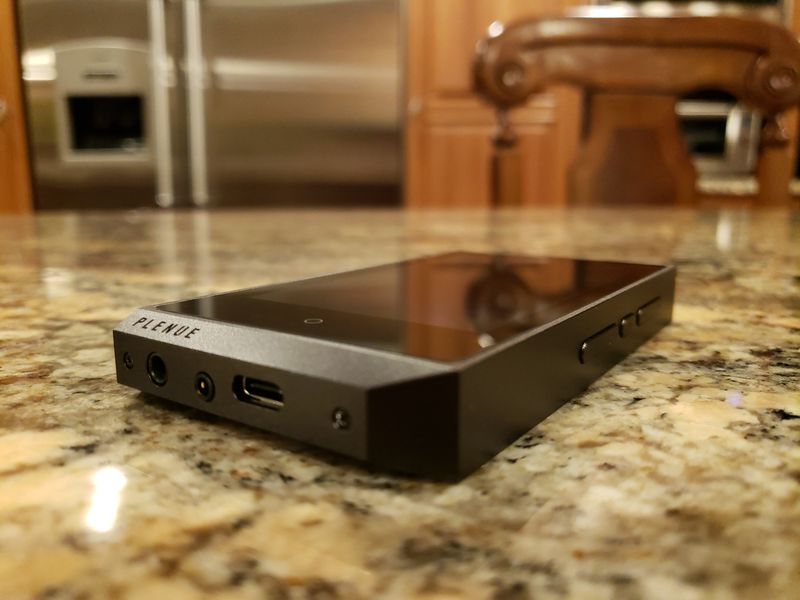
Like all the previously reviewed Plenue DAPs, R2 feels very solid in my hand, has platinum-black aluminum chassis, a rubbery non-slip back panel, and 3.7” AMOLED symmetrically positioned touch screen with an assignable home button at the bottom (like in other Plenue models). The footprint of the DAP is identical to R model, very compact, measuring 61.5mm x 112.9mm x 13.9mm and only 154g in weight. It is more compact than M/2 and P2/L, and smaller than majority of my other mid-fi and flagship DAPs. Since there is no volume wheel to worry about, you can drop it in your pocket with HO plugs facing up toward you.


The only negative (like in R) here is a sharp lower right edge which makes it not very comfortable to hold in my hand without a case. I felt a lot better when I got leather case on, making more comfortable to hold it. Plus, as mentioned before, the leather case is of a high quality, like premium Dignis cases (but this is Cowon own design).
Upon closer examination of R2, you will find on the left side at the bottom a slot for microSD card which can accommodate 256GB card and I have read other reports on Head-fi with people using higher capacity cards. Personally, my music collection is not that big, and I do stream (Qobuz), so I wasn’t able to test with higher capacity cards. At the bottom, you have USB-C connector for charging, data transfer, and USB DAC connection, 2.5mm TRRS balanced headphone output, and 3.5mm single ended headphone output which also doubles as optical digital out.
At the top in the upper right corner, Cowon has a unique looking power button in a shape of a camera shutter-release. This specific power button design, including its physical placement, is now common among the other Plenue DAPs, such as PD, PS, and PM2. But what’s different is Sound Source LED indicator inside of the upper left corner cavity of the chassis, underneath of that power button. It changes its color according to the sound source. Blue color whenever it’s a normal lossy playback, purple color when it’s HD sound with lossless file playback, and yellow-ish/greenish color with its DSD/DXD playback. Nice eye-candy feature, though I have it turned off to squeeze more battery life without causing extra drain.


Identical to R, on the right side you have transport control and volume buttons. Volume up/down is placed logically at the top and it’s a combined rounded button, adjusting the volume in 140 steps, 0.5dB at a time. Play/Pause is a separate button below it with similar rounded corners, just shorter. And then you have track skip next/prev, a combined button in the same shape as volume, also multi-functioning as rewind/fast forward when you press’n’hold it. All the buttons have a clear marking on the top, very nice tactile response, and absolutely no wobbling. They are accessible to control volume and playback with screen either on or off.
The back has a ribbed non-slippery rubbery/plastic material, making it safe and secure to place on any surface. It feels nice and helps with a grip of R2, but as I mentioned before – I still prefer to dress this DAP in a leather case.


Under the hood.
R2 steps up to a new Cirrus Logic MasterHiFi line of DACs with introduction of dual CS43131 DAC. Also, like in other Plenue DAPs, you have a low jitter dual clock precision TXCO oscillator. Furthermore, you will find a proprietary CPLD (32bit/384kHz) for digital signal processing. In the heart of the DAP you still have ARM Cortex A9 1.2GHz dual-core processor since we are not running a demanding environment requiring high level of processing power. But it’s plenty of power to easily decode and process any lossless or lossy audio formats, such as DXD, DSD (DFF, DSF), FLAC, WAV, AIFF, ALAC, APE, MP3, WMA, OGG, WV, TTA, and DCF. And this time R2 steps up to DSD256.
Display has 3.7″ AMOLED touch screen with 480×800 resolution and deep rich colors. R2 has 128GB of built-in memory and microSD card expansion to add another 256GB (and probably higher) of storage. In addition to 3.5mm single ended HO which doubles as optical digital output, R2 also adds 2.5mm balanced HO. Per spec, the balanced 2.5mm port is rated at 4.0Vrms with output impedance of 1.2 ohms, and the unbalanced 3.5mm port is rated at 2.0Vrms with output impedance of 0.6 ohms. This is a noticeable step up from the original R spec, and I also noticed that R2 can drive more demanding full-size headphones much better than original R. No issues with multi-BAs or hybrids either.
The rechargeable battery is a nicely sized 3,000 mAh li-po @ 3.7V which you can charge in under 3hrs using 5V/2A charger. I guess due to new more power efficient DACs and despite the same battery and even higher power output, R2 boosted its playback time over original R, now giving you about 20hrs of music playback time with lossy and 18.5hrs of playback time with lossless Flac files.
R2, just like R, are the only Plenue models with Bluetooth support, though still an old Bluetooth 3.0 standard. Similar to carrying the same older processor and interface, perhaps that’s a reason for using older BT chipset. But considering you only use BT in a transmit to pair up with external wireless headphones and speakers and only aptX protocol, it doesn’t really matter. Yes, you get the convenience of wireless connection, but unfortunately it doesn’t support HD or LDAC.
Page 3 – GUI.
Page 4 – Sound analysis, and Comparison.
Page 5 – Pair up, Other Connections, and Conclusion.

 Twister6 Reviews
Hi
You mentioned the Opus#1 in the review. When I go to the “The Bit” website, there hasn’t been and firmware updates for about 18 months. Are they still trading?
LikeLike
Opus#1 is a history, I mentioned Opus#1s in hte review 😉 But yeah, still an old product thus no fw updates. And, true, they haven’t released anything new in a while.
LikeLike
Thank you for the excellent review. I bought the original Plenue R based on your recommendation. I really like that player it has some firmware issues and the Bluetooth was nonexistent. But the sound was amazing and music was easy to load on the micro card. However I use a lot of Hi-Res files. They say you can use a 252 GB micro card. I found that not to be the case it really only takes a 128. That’s just not enough space if you use a lot of Hi-Res files. So again based on your recommendation I decided to go with the I Basso DX 160. After reading this review I think I made the right decision. The 160 has weak Bluetooth and you have to be sitting right on top of a Wi-Fi spot for the Wi-Fi to work. However the sound is absolutely amazing better than the Plenue R. So I was really curious when I heard the R2 was coming out if that would be worth the extra investment. The main thing I notice is that the memory capacity for the micro card is not changed. So it even if it really does take a 252 card in the I Basso I’m using a 512 GB card with no problems. And while I actually use my streaming more with my LG style 5 which has great sound by the way. It’s nice to have the option with the I Basso and if the sound is just the same and the price is $150 cheaper. I think the I Basso is a no-brainer. Thanks again for the great review.
LikeLike
What brand of micro SD cards are you using? Typically Sandisk is my go to since it works universally with any DAP. Also, did you format it fat32? I read many comments on head-fi and many do use 256GB cards with Plenu daps, some even 400GB. I think the issue with Cowon is that you can browse higher capacity cards by folder, but something in their fw prevents it from indexing higher capacity (indexed when you search by artist, genre, etc). But either way, there are SO MANY choices now in mid-fi DAP market sector, glad you found what you like. DX160 is one excellent DAP as well!!!
LikeLike
Thank you for your reply. Yes I was using Sandisk a 256GB card. The first one worked great. The next couple had a lot of problems. Some things would load some things some would not. So then I tried some other 256 GB micro cards. The exact same thing happen. No I did not do that formatting to fat 32. I’m not sure how to do that. So I tried to contact Cowon. I never heard back from them. So then I contacted the seller. Jet audio I think. They told me to use a 128 GB card. Once I did that I never had a problem. So I think the issue is I need to do that formatting and I’m not sure how. In any case I’m really happy with the DX 160. I recently picked up the Noble Falcon wireless. Best sound I think I have heard out of a wireless headphone. Sounds really good from a LG phone sounds way better with the DX 160. it doesn’t even work with the R hopefully the R2 has better Bluetooth.
LikeLike
Don’t know if it will help, http://www.ridgecrop.demon.co.uk/index.htm?guiformat.htm
LikeLike
Which one do you think is better with the R2 or the P2 Mark 1.
LikeLike
I heard you can get original P2 at a killer pricing now, the same price as R2. So, if pricing is the same, I would go for P2. Otherwise, R2 is really good!
LikeLike
Great review as always , I have been using a good old Plenue D and an AP80 since quiet some time. Looking for an upgrade. I am confused after sleepless nights comparing R2, P2, DX 160 and Dethonray DTR1 ( or anything other better brand model if m missing) I don’t care much about streaming. I am looking for a dap with the best sq. I am sucker for Soundstage, imaging and details. Your help would be much appreciated. Keep up the good work.
LikeLike
the key words you just said “not much streaming, best SQ, soundstage/imaging, and details” – that spells out DX160 🙂 Though you can also stream with it, and Mango app has a killer regular EQ and parametric EQ.
LikeLike
DX 160 has better sq than DTR 1?? Are there any other options that I shud take a look at, if I stretch my budget a bit?
LikeLike
This is not a simple comparison. Dtr1 has a great sound but it will depend which iem or headphones. If it hisses really badly with half of my iems and can’t be used without iematch, but it can drive better some other demanding headphones, how do really do a true a/b comparison? Dtr1 has a great sound, but it will dependent on pair up and if you can tolerate its button clicking for navigation instead of touch screen. If you can stretch your budget, my favorites are LPGT and N6ii w/E02. But we are talking about much higher pricing.
LikeLike
What I liked about DTR is how simple and basic it looks . But the hiss issue might create a serious problem for me cuz I use a wide variety of chi-fi iem’s at the moment. As much as like the looks and old boxy feel of DTR 1, I won’t get a dap just based on that. Sq is my first and most important preference. Battery is the next but I’m willing to sacrifice a bit on that part (coming from plenue d) and focus only on sound. My budget is 600$ and I usually listen to a lotta fast music like metal and sometimes even jazz, ambient, ost. So detailing, separation and Soundstage is a must. LPGT and N6ii is sitting on a place where I can’t reach now 😔 I really enjoyed reading your N6ii review of both the dap and the module. Thankyou for your reply. It really helps a newbie like me and I have to say, your reviews are the best among all the others on internet.
LikeLike
I can sacrifice my love for old school buttons and designs for better sound. If it gives me great sound, I don’t mind touch screen or streaming or less battery life ( hoping I would atleast get 10hrs lol, is that too much to ask?) so going forward beyond all the look and features and functions, what is the best available option in my budget?
LikeLike
I would go with dx160
LikeLike
Vruksha I am also a regular reader of these columns. And I corresponded with him a few months ago. You can read my post. I think you would be happy with the I Basso DX 160. It’s definitely not perfect. But I think it’s going to give you everything you want detailing, separation and soundstage are all done extremely well. There are some minor problems I have the screen seems to freeze up quite a bit but it seems to restart right away. You mentioned battery life the battery life is just okay. It says 10 hours I don’t think you’re really going to get 10 hours, however it charges quickly once you get down to about 25% of battery left recharge it within an hour your back 100%. The touchscreen is very sensitive. So you have to be a little careful with the Mango player as your scrolling through the albums if you accidentally touch it it pops right up. More importantly the Bluetooth and Wi-Fi are not very strong the Wi-Fi you have to be right on top of a signal and the Bluetooth you basically get about 5 feet no more than 10. You even have trouble if you put in your pocket with trying to stay connected. However these are all minor quibbles I think what you’re looking for you’re going to get it at $400 you can use the extra 200 to put into some new IEM’s.
LikeLike
Thanks Raymond! That really helps 👍
LikeLike
Thanks twister6.
LikeLike
Where did you get the lighter coloured case? The only one I see on Amazon is the darker coloured one.
LikeLike
i think it is the same color as original R case… Cowon sent it to me, and I thought it was the only case they sell for R2. Maybe the picture on Amazon is incorrect?
LikeLike
I read your reviews with great interest. Now I am facing a dilemma of choice. Cowon Plenue R2, P2 or M2. Which one would you choose from these three players?
LikeLike
tried to reply a few times, keeps crashing, so not sure if the previous reply showed up… don’t want to retype everything, but M2 is ancient and discontinued, P2 is very old and most likely discontinued as well. They might be selling R2 new, but if you can find Plenue 2 used for a price cheaper than R2, go for it. Though, keep in mind, it is so old, still uses micro usb port/cable.
LikeLike