

Under the hood.
Inside AP80 Pro you have Ingenic X1000 processor, common to many smaller non-Android DAPs, and at the heart you have a Dual ES9218P DAC, in comparison to a single ES9218P in AP80. The 3.5mm output has the same power rating of 70mW @ 32ohm load, while balanced 2.5mm steps up to 190mW @ 32ohm, plenty of power for IEMs and some efficient headphones. There are also two other DAP features, not very common for audio players: FM radio (using 4705 chipset), and a step counter (built-in pedometer sensor, KX126). Clearly, AP80 Pro is designed for users with active lifestyle, and it can even display a clock.
You will also find Bluetooth 4.2 supporting many protocols, including aptX, LDAC, and even the new UAT (ultra audio transmission). The BT is bi-directional, meaning you can use it as a transmitter to pair up with your wireless headphones or other BT DAC/amp devices. Or you can use it as a receiver to work as a wireless DAC/amp paired up with other sources. For example, you can pair it up to your smartphone to stream audio from various apps wireless to your AP80 Pro using lossless LDAC protocol.
The internal battery capacity of AP80 Pro is the same 800mAh, 3.8V LiPo battery as in AP80. According to Hidizs, this should give you 13hrs playback from 3.5mm and 9hrs playback from 2.5mm. My test results for original AP80 were a little bit lower, so I expect AP80 Pro to get you probably closer to 10hrs of playback on SE and less balanced. I didn’t have a chance to run battery test, so will update this section of the review when I get to it. And of course, keep in mind, when you start playing lossless files or go up to DSD format, the battery will drain faster.
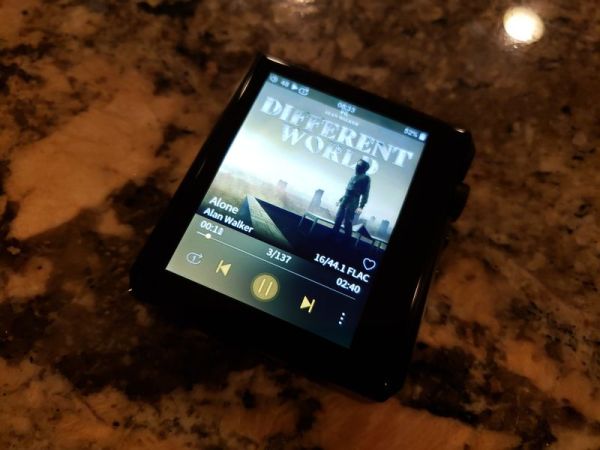
The operating system under the hood is Hiby 3.0 OS which is based around HibyMusic Player, including all of its bells’n’whistles, even Mage Sound 8-ball DSP effects and EQ with genre specific presets and custom adjustment. And because you are running Hiby, you can also implement HibyLink to control AP80 wireless from your smartphone. Many lossy and lossless audio formats are supported, such as FLAC, APE, WMA, WAV, ALAC, DSF, DFF, SACD-ISO, and native support of DSD 64/128/256 and PCM up to 384kHz/32bit.

Original AP80 supported only up to DSD128 native decoding, while AP80 Pro added a dedicated HBC3000 FPGA for DSD decoding, taking it up to DSD256 which I confirmed to play without a problem. I will cover more about this in Sound analysis section, but DSD playback of AP80 Pro actually has a higher sound quality than AP80.
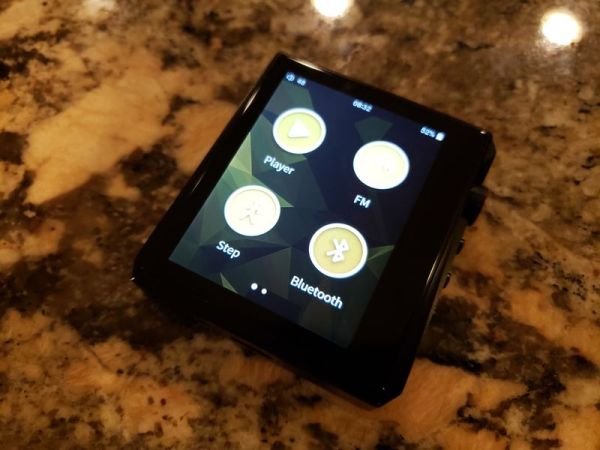
When you start the DAP, you can see the main navigation screen with icons of Player (HibyMusic), Step (step counter), FM (radio), Bluetooth (wireless controls), System setting (lots of options), and About. When you start Player, you are dealing with a scaled down version of HibyMusic which many are already familiar with. Also, swiping the display up brings up short cut controls for playback and some functionality settings.
Sound analysis.
I played a selection of the following test tracks to analyze the sound of AP80 Pro: Agnes Obel “The curse”, Sandro Cavazza “So much better” (Avicii remix), C-Bool “Never go away”, Ed Sheeran “Shape of you”, Galantis “Hunter”, Alan Walker “Darkside”, Iggy Azalea “Black widow”, Indila “Boite en argent”, Robin Schultz “Oh child”, David Elias “Vision of her”, Dua Lipa “Love again”, and Michael Jackson “Dirty Diana”. AP80 Pro had about 100hrs of play (burn in) time.
I prefer to describe the DAP sound based on the comparison to other DAPs and pair ups with different IEMs/headphones since the DAP by itself doesn’t have a “sound”. What we hear is how it sounds through IEMs/headphones connected to it or the difference from other sources using the same pair of IEMs/headphones for monitoring the sound. As a result, this section of the review usually summarizes what I find in the follow up Comparison and Pair-up sections.
I noticed across many different pair ups that AP80 Pro sound sig is neutral with a little more revealing transparent tonality. The sound is still natural, but has more sparkle in upper mids and treble, and more neutral slightly leaner body. The sound is not congested, and actually has a good level of detail retrieval. Being an entry level DAP, don’t expect outstanding layering or separation of sounds or dynamics expansion on the level of upper mid-fi or flagship DAPs. That’s just not a realistic expectation. But the sound is not compressed, has plenty of clarity, black background, and surprisingly good soundstage expansion and imaging, especially from the balanced output.
Similar to AP80, with Pro in low gain the sound was a bit dull and was lacking clarity and energy, especially in upper frequencies. Once you switch to high gain, almost in every single pair up the sound came alive with more clarity in mids and more expanded soundstage width. After that, I didn’t even bother using low gain.
Another important thing to note, there was absolutely no hissing with sensitive low impedance IEMs, not even with Andromeda. Even during the playback with volume down to zero or when idling, I didn’t hear any hissing.
And last, but not least, I hear a noticeable difference when playing DSD files. AP80 Pro DSD playback has a more dynamic, more layered, more multi-dimensional sound, while AP80 playback of the same DSD files sounds flatter in comparison.
Page 3 – Comparison, and Pair ups.
Page 4 – Wired/wireless connections, and Conclusion.

 Twister6 Reviews
Fantastic review! I must admit to being a little jealous of your collection. I’ve had my pro since early May and I’m enjoying it a great deal. A couple of adds, BT works nicely in the car I am having issues with some jaybird wireless headphones. I like my (very affordable) ms1 mermaids though. A great value set up IMHO. I made a pan unbox and generalist overview video if interested: https://www.youtube.com/watch?v=OcLwUedNMhw
LikeLike
Hi. .
I like your reviews so much…
I am Sooooo confused between Hiby R3 Pro & Hidizs AP80 Pro…
Plz suggest better DAP in terms of Sound quality….
Thanks
LikeLike
If you need streaming, tidal or quboz, that will be an easy decision. Otherwise, pick whichever looks better to you 🙂 if you want the smallest, or prefer volume wheel vs buttons. It’s your call.
LikeLike
You prefer the ap80 pro over the dx120?
Jesus, I thought… Soundwise…
The dx120 was better.
LikeLike
You have both, right? Of course, this is a subjective opinion, but I have described how they compare relative to testing with 64 Audio U18t and VE Elysium, and in both cases I preferred pair up with AP80 Pro due to the reasons in my comparison notes. Plus, DX120 has a strong hissing with sensitive IEMs, so in many pair ups it was a no-go for me.
LikeLike
Can’t make up my mind between the Sony Walkman A55, iBasso DX120 and Hidizs AP80 pro.
I was going to purchase the Cayin N6ii but I had to use the money to help my mother she had an emergency I couldn’t ignore. I can’t get over this months budget so I’ll wait a little longer.
Care to give me a hand? Your advice would be extremely helpful.
My priorities:
Sound quality
Build quality(dealing with broken parts or buttons is a no no)
Reliability(I’d like it to last at least 3 years without issues, even if I purchase the Cayin)
Wifi(Nope)
Bluetooth (maybe, but not a priority)
My parings are:
Etymotic Er2xr
Moondrop Blessing
Tin Hifi T2
Blon BL-3
Moondrop Starfield
ThieAudio Clairvoyance
My current DAPs
Dx90(I’ll give it to my cousin as soon. As I purchase a new DAP)
Shanling M5s(on sale)
Thanks for your time, I’d really appreciate your advice.
LikeLike
I’m not familiar at all with Sony A55, but between DX120 and AP80 Pro I would go with AP80 Pro, plus it is half of DX120 price. With build quality and reliability, I would assume that Sony will be ahead of both. So, maybe do a little more research about A55.
LikeLike
My problem with the Sony A55 is it’s power SE output(35mw). It doesn’t have a balanced output as well. It’s 26 hour battery life, smooth UI and well known Sony reliability kinda makes up for it, perhaps…
The AP80 seems reasonable, but I question it’s build quality and UI functionality. It only provides around 13 hours of battery life.
On this case, the DX120 is kind of a combination of both(excluding sound according to what I’ve read). It has a decent UI and it’s battery life provides around 15-16 hours of playback. It depends of course on the type of files, usage or headphones/iems I’ll be using.
Anyway, at this point I feel like the AP80 could be a better choice by sound quality alone. What about the other things? Is the DX120 that far behind?
Wish I could try them before spending my money.
LikeLike
Don’t get me wrong, dx120 is a great little dap, but it being 2+ year old audio playback only design, not even BT, and since you are using mostly iems some of which could hiss, if you want to stick with ibasso then maybe get dx160 instead? You will get a powerful Android dap with an excellent sound. But either way. Dx160 or ap80 Pro should be fine.
LikeLike
Thanks very much!! I’ll have this in mind.
Although, I’d like to have a internet free DAP since I really want to disconnect from anything related. Having an Android device(in my opinion) takes away the experience.
LikeLike
Hey there. How does the AP80 Pro compare to the Shanling Q1 in sound, battery, Bluetooth strength and UI responsiveness? Thanks
LikeLike
M0 and Q1 are similar, thus the same holds true for Q1 comparison.
LikeLike
hello, i have a ap80pro and i would like to know if it’s possible to connect the ap80 pro to a stereo amplifier to be able to use it as an audio source through its integrated DAC? In this case do you need a USB-c to RCA cable? thank you
LikeLike
If you are connecting amplifier, use 3.5mm to 3.5mm audio cable to connect analog signal from headphone output and set it to line out in ap80 Pro setting. USB C to USB is only for external dac/amp connection to bring out the digital signal to external dac.
LikeLike