
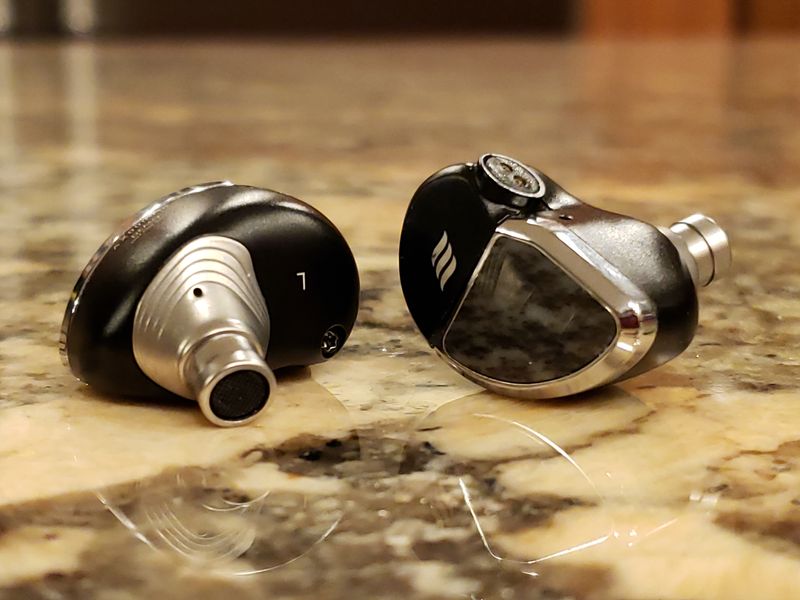
Eartips Selection.
The selection of eartips is crucial to any universal in-ear monitors and will affect the sound, especially the bass impact depending on the seal. Due to a large opening of my earcanals, I usually go for the largest size eartips to get a better seal. Also, please keep in mind, eartips impressions are subjective and will be based on anatomy of your ears. Here, I was analyzing the sound using LPGT and EVO10 cable.
stock ePro – with these stock silicone eartips I hear a nice sub-bass rumble and treble sparkle, while vocals are smoother and warmer, and pushed more to the back. Also, ePro cap is softer and sometimes I have to adjust Axiom in my ears to fix the seal.
stock AZLA Crystal – Crystal improves the bass, both sub-bass and mid-bass (stronger impact), and also makes treble a little more revealing. This benefits when using YU module. Xelastec had a similar sound effect as Crystal.
Symbio F – Symbio are always my go-to foam eartips, and their pair up with Axiom is pretty good, actually pulling up mids more forward, turning the sound sig to more balanced. Treble is a bit hot with OG module, but it works great with YU.
SpinFit CP100+ – I hear an improvement with mid-bass that sounds stronger in comparison to ePro eartips, and mids are more forward, more balanced. But treble sounds a bit plasticy with these eartips.
Final Audio Type E – Type E doesn’t work for my ears with Axiom. Probably due to poor seal, I was losing sub-bass rumble and treble was peaky.
Crystal and Symbio F were my favorite eartips with Axiom, especially when using YU module. With original module, I kind of liked ePro better.

Comparison.
The comparison was done using Axiom with EA EVO10 cable and LPGT source; volume matched in every comparison.
Axiom vs CFA Andro ’20 – two things stand out in this comparison right away, Andro missing sub-bass and not as clear 3D imaging when compared to Axiom. Their upper mids/vocals are similar, though Andro lower mids are more neutral. Also, Andro treble is a touch more natural in comparison to Axiom. The soundstage is close, but the imaging of Andro was below Axiom level, bringing sounds closer together while Axiom spreads them further apart. The biggest difference that it right in your face when comparing these two is Andro lacking the sub-bass extension and having a softer mid-bass impact which makes Andro bass to sound a lot more neutral in comparison to Axiom beefier low end and fuller body lower mids.
Axiom vs CFA Solaris ’20 – unlike Andro, Solaris is a better match in this comparison. Both Axiom and Solaris have a similar imaging and Solaris soundstage expansion is just a touch wider than Axiom. They both have similar upper mids and treble characteristics, in terms of quality and quantity, actually very similar upper frequencies tonality. Now, with both having DD bass, Solaris sub-bass extension improves over Andro, but Axiom digs in a bit deeper. Also, mid-bass impact of Axiom is a little higher in comparison to Solaris. But the biggest difference here is lower mids, the part of the tuning that gives the sounds and the vocals its body. Solaris is more neutral and less colored, while Axiom has more body, warmer tonality, making midrange thicker. Both are great IEMs, but if you ever felt that your sound was missing extra body and warmth with Solaris, Axiom will fill in that gap.
Axiom vs FirAudio VxV – I have been getting quite a few questions lately about VxV so it was on my desk and I decided to compare these, and to my surprise found this comparison to be very interesting. First of all, they both have a very similar soundstage and imaging, maybe with Axiom being a little bit wider. Then, upper mids and treble have a lot of similarities as well in tonality, retrieval of details, and overall quantity. Then, when you start focusing on the bass and lower mids, you quickly realize their quality is not too far off, but VxV quantity is reduced like someone applied a shelf filter to attenuated it down. VxV goes deep, but rumble is reduced down. VxV bass has a nice punch, but impact feels more neutral in comparison to Axiom. And, the same with lower mids that feel quite neutral in comparison to Axiom having a fuller body and warmer tonality.

Source pair up.
In each source pair up I was using EVO10 cable and YU optional module. Between 2 modules and different cables and sources, there are too many combinations to test, and switching between modules is not as fast as flipping a switch. So, in source pair up section I decided to use warmer YU module. Axiom is easy to drive considering its 112dB sensitivity and 32ohm impedance. No hissing was detected. For your reference, here are my brief pair up notes. And by brief, I just focus on any changes related to a sound sig and general tonality, without going into too many details of technical performance difference.
w/L&P P6 Pro – very similar sound sig and tonality as with LPGT, being W-shaped balanced, with a deep sub-bass and strong mid-bass, fuller body lower mids, clear, natural, detailed upper mids, and well-defined treble. But in comparison to LPGT, bass was tighter with P6 Pro.
w/Hiby RS6 – I hear a change in this pair up with mid-bass being softer and upper mids/vocals being more forward while treble sounded a bit attenuated. To my ears, this was not the best pair up synergy.
w/Hiby R6 2020 – contrary to RS6 pair up, this one is a lot better with a deep sub-bass rumble, punchy mid-bass slam (not as soft as with RS6), smooth detailed mids/vocals, and smooth and detailed treble with a good definition.
w/A&K SP2k – a balanced signature with a smooth natural detailed tonality. Here, mids/vocals remained similar to previous pair ups, but mid-bass was stronger and punchier, while treble lost a little bit of its definition. Good pair up, just as long as you don’t expect more energy in treble.
w/iBasso DX300 – excellent pair up, probably my favorite out of all other DAPs I tested. The soundstage is big, open, and with holographic imaging. Bass goes deep with a textured rumble and mid-bass hits hard and fast. Mids have full natural body, clear detailed tonality with a very good retrieval of details, treble is crisp, clear, and natural.
Pair up with R6 2020 and DX300 w/amp11mk2 elevated Axiom performance, and I really enjoyed these sources with Axiom using either OG or YU modules.
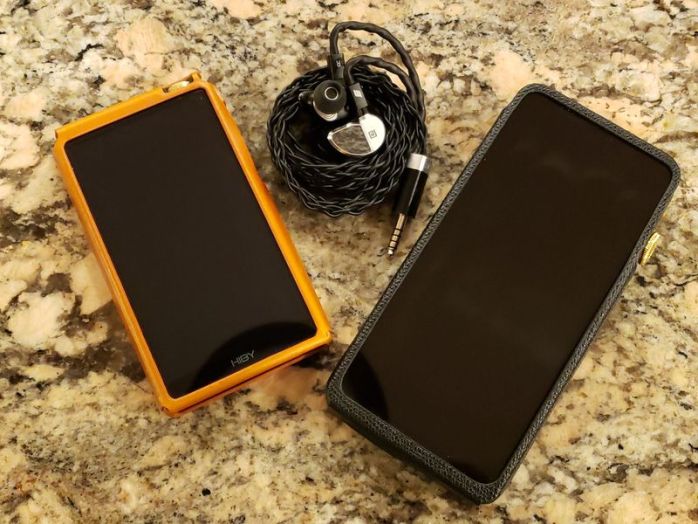
Conclusion.
As I implied in the intro, it is not uncommon for cable manufacturers to release IEMs, and even EA has done it in the past. But some of those releases are based on collaborations, while here it looks like it was a brand-new project from ground up. And even before you get into the sound analysis, its multi-function removable modules is what makes it stand out from the crowd. You can argue there are IEMs with switches that let you change the sound. But so far, many I tried don’t have as precise tuning control as I found when switching to YU module unit. Plus, the modular design of Axiom is not just about sound change but also functionality change. By default, you get 2pin and mmcx modules with the same tuning where you make a selection depending on the cable connector you have access to. Then, you can switch between original and the new optional YU module to update the treble response, and EA promises more modules to come. Plus, they are looking into Bluetooth wireless module which I think going to be a cool option to convert Axiom from wired to TWS wireless.
But the elephant in the room is the original announcement about cable-less release, regardless that some retailers like MusicTeck offer you a free cable. If you already have a big collection of cables, I strongly encourage you to experiment with different pair ups, to find the best synergy. And since OG module comes with both 2pin and mmcx connection, you are no longer limited to just 2pin. Go ahead, try your other less frequently used mmcx cables. If you don’t have a lot of cables, or have mostly IEMs with cheaper budget cables, there is no need to panic that you have to spend another $500 to $2k to scale up Axiom sound while going up the cable food chain. Getting something like EVO10 should be enough to enjoy and to appreciate the tuning of Axiom with its deep textured bass, natural smooth mids, and depending on module selection, either crisper and more detailed (original) or smoother and slightly rolled off (YU) treble. Now, all we need is a Bluetooth module!

 Twister6 Reviews
Nice review…I have to admit these are damn sexy!
LikeLike
Hopefully, Musicteck will have it next month at CanJam show. I assume you are going to be there?
LikeLike
Any word on how the beryllium version will differ to these in terms of sound?
LikeLike
Sorry, didn’t hear that one.
LikeLike
Thanks the detailed analysis!I like this IEM’s design (although i already have ConX cable), but switching module concept still very attractive
I’ve tried the OG module , the bass powerful and able to deliver a clear crispy aound at the same time,i would pick axiom over CA solaris ,as no hissing issue and sound layering , separtaion an edge better , and for female voice , axiom also have the edge
Thanks again for this useful review , like it
LikeLike