
Sound Analysis.
I analyzed ZE8k sound performance paired up with my Galaxy S22 while playing a variety of test tracks, such as Agnes Obel “The curse”, Sandro Cavazza “So much better” (Avicii remix), C-Bool “Never go away”, Ed Sheeran “Shape of you”, Alan Walker “Darkside”, Galantis “Hunter”, Iggy Azalea “Black widow”, Indila “Boite en argent”, Dua Lipa “Love again”, Counting Crows “Big yellow taxi”, Bob Marley “Jamming”, David Elias “Vision of her”, and Michael Jackson “Dirty Diana”. ZE8k probably had a few hundred listening hours under its belt since it has been my daily driver for the last 3 months.
By default, with its Semi-Parametric Pro EQ off, the sound tuning has a more commercial V-shaped flavor with a warmer organic tonality emphasizing more the bass and the treble. Don’t get me wrong, it’s a well done tuning, but I preferred to “correct it” with an EQ setting that going to give me a more balanced sound signature. I applied the following EQ with Lows -3dB @ 60Hz (to cut sub-bass weight), Mids +3dB @ 3.2kHz and +3dB @ 4.8kHz (to boost pinna gain), and Highs -3dB @ 12kHz (to smooth out treble sparkle). This custom present became my default sound setting. One thing to note, even though we are talking about +/-3dB adjustments, it’s not that drastic, but rather more subtle and still quite effective to get the tuning to its perfection to my ears.

I do have to admit, you will hardly find me talking about EQ adjustment in any of my IEM reviews. One of the reasons is that I use a lot of different sources, and different DAPs and apps use a different EQ algorithm which might not sound the same or can introducing aliasing or distortion. One of the conveniences of TWS IEMs is when you apply EQ, it gets stored inside these earphones and will stay with them no matter what source you pair up with. Furthermore, the EQ adjustment here is more like a finetuning of the sound, rather than extreme boosting or cutting frequencies.
After the finetuning, I can hear ZE8k with a W-shaped balanced sound signature and a natural rich organic tonality with a very good retrieval of details. Basically, it has a full-bodied sound with a more laidback presentation of the bass which has a slower attack and longer decay, warmer, colored detailed mids without any veil or muddiness, and a clear detailed natural tonality treble. This finetuning adjustment also helped with layering and separation of the sounds. And last, but not least, a huge soundstage expansion with a nearly 3D holographic imaging which makes you feel like being surrounded by the sound.

Comparison.
ZE8k vs Final ZE3k – I was also able to audition their other TWS model, ZE3000 which is great as well and offers a similar natural organic tonality with a big size soundstage. ZE8k does have the advantage of higher resolution for picky audiophiles, but ZE3000 is not too far off. ZE3k shell has a more traditional Final A-/B-series shell design, but it doesn’t offer ANC, and doesn’t have app support to change the EQ. Also, ZE3k is smaller, comes with a more compact battery charging case, and has a more robust and intuitive touch controls in lieu of its more traditional shell shape. I personally like both ZE3k and ZE8k. These TWS are not tuned like other bloated bass releases geared toward a general consumer crowd. In my opinion, these Final TWS earpieces were tuned for audiophiles. But, if you want the best sound quality, especially from a technical perspective, ZE8k is a clear choice over ZE3k.
ZE8k vs Final EVA2020 – Special edition EVA has a more commercial tuning with a dominating strong bass impact and a smoother tuned mids and treble. The soundstage is rather narrow, projecting more in front of you rather than expanding in width, and overall sound layering and separation is not on high level. The tuning is not targeting picky audiophiles, that’s for sure. It is night and day in comparison to ZE8k which has a lot bigger soundstage, higher resolution, a lot better retrieval of details, better layering and separation of the sounds. EVA has a typical consumer tuning with Evangelion anime theme shell design. If you want audiophile grade tuning, either ZE8k or ZE3k will be a better choice.
ZE8k vs UM U-Free – Both have a very similar soundstage expansion, perhaps with ZE8k being just slightly wider. They also have similar technical performance with a very good retrieval of details and layering/separation of the sounds. Also, they both have a similar sub-bass extension and U-Free even has a bit more mid-bass punch. Mids are slightly more forward and more organic in ZE8k while U-Free mids slightly pulled back and the tuning is a little leaner and slightly more revealing. Treble is where I hear the bigger difference with ZE8k being smoother while U-Free having more sparkle and air. U-Free is another example of audiophile company doing it right. And, I actually enjoyed both of these TWS earphones, just two different flavors of the sound tuning.
ZE8k vs Noble FoKus Mystique – These two are pretty far apart from each other in tuning. First of all, ZE8k soundstage is a lot bigger and more holographic, while FoKus soundstage is more intimate, bringing sounds closer to the center. The tuning, even the default ZE8k, is more balanced and smoother in comparison to V-shaped sound sig of Mystique which has a lot more emphasis on sub-bass and lower/mid treble. I also think their EQ implementation is different. After EQing the ZE8k, it sounded more balanced, coherent, and still natural, and detailed. With Mystique, applying EQ did attenuate the sound of corresponding frequencies, but it wasn’t as coherent and was still V-shaped.
ZE8k vs Air Pods 2 Pro – Pods have a more inside-your-head soundstage while ZE8k has noticeably wider/taller/deeper soundstage with holographic level of imaging. Pods tonality is more neutral and smoother in comparison to ZE8k having more balanced tuning with more texture in bass and more sparkle in treble. I also hear instruments with ZE8k being more layered and better separated in comparison to Pods feeling a bit compressed. By default, ZE8k mid-bass is slightly elevated which gives its sound thicker tonality. But with EQ adjustment of dropping the bass 3dB and boosting 3k-5k pinna gain, the sound transforms into a more balanced signature with cleaner tonality. ANC is slightly better in Pods.

Source pair up.
When it comes to wireless earphones and headphones, and especially TWS, it doesn’t matter what DAC or amp your source has. None of this matter because your source will digitally encode and transmit the sound and TWS earphones will decode and drive the transducer inside the shell. Especially with ZE8k, internal DSP sound processing is what should keep the tuning relatively close and less dependent on the source you pairing it with.
In my testing, pair up with either S22 or iPhone XS MAX yielded nearly the same sound results. And I found the similar with a few other DAPs I tried.

Conclusion.
I didn’t know what to expect when I received ZE8k considering I’m quite familiar with A8000 and thought ZE8000 will be a wireless version of it. The only thing they have in common is “8000” in their model’s names which according to Final refers to high resolution like in 8k TVs. Sometimes we assume that high resolution means revealing brighter tonality which is true with A8k. But ZE8k follows the sound tuning of their (Final) E-series IEMs, also known for having a very natural organic tonality with a high-resolution tuning, but the wireless version adds internal DSP processing among other features. And with that, even a lack of LDAC codec support becomes less relevant because the sound performance gets maximized to its full potential instead of relying on codec alone.
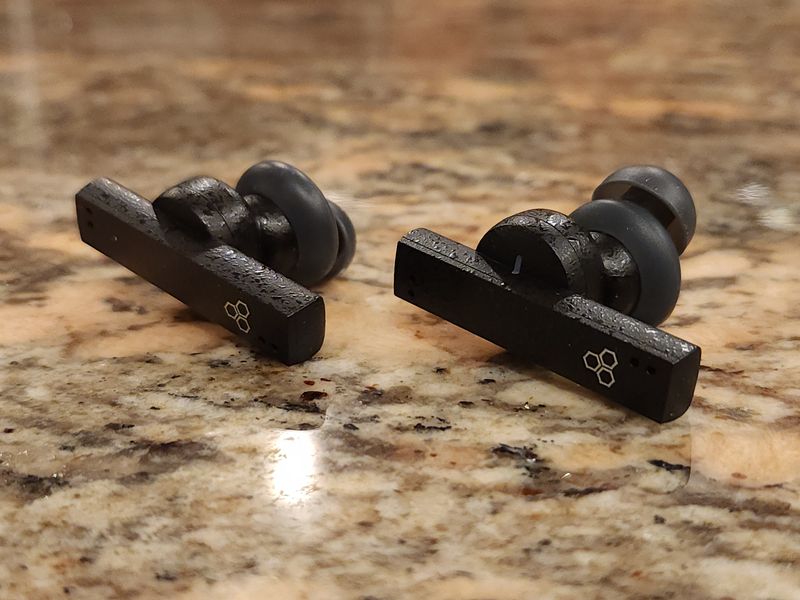
What impressed me here is not just the organic natural tonality that draws you right into the music, or the precise finetuning of the sound using the available semi-ParametricEQ, but also a big soundstage expansion with a holographic imaging. It was great for playing the music and watching the movies. And I was also impressed with ANC performance, making the background noise disappear into the blackness or “removing” the wind noise while walking outside. And despite its unconventional design, thanks to their custom eartips, ZE8k always stayed secure in my ears no matter what. ZE8000 represents a new breed of higher end audiophile TWS where you can enjoy the sound regardless of the source or fancy cables, just pair it up with your smartphone. I definitely recommend giving these a try.

 Twister6 Reviews
I am going to completely disagree with your review. I bought them when they first released, I’ve had these for a few months. This is the worst fit I’ve ever had. The left ear doesn’t stay in at all, the right ear comes out as soon as you get up out of the chair. Yes they look way cool. They just don’t fit. As for the sound, nothing special especially for the price point. I have to totally disagree with your review on the Noble true wireless. The Noble beats this thing in every way. The Noble seems to fit perfectly. The soundstage is enormous on the Noble restricted on the final audio. I use the Samsung S 22+ as well as the Hiby R8, RS6 and the iBasso 300. Both headphones sound the same on all the units. I would give the Sennheiser momentum 3 and the Sony link bud S way higher ratings then this thing. However the Noble is by far the best TWS out there right now.
LikeLike
That’s quite ok if we agree to disagree. After all, this is just a matter of a personal taste and preference, as well as your unique ear anatomy (assuming, you tried every size of included eartips and they still didn’t work for you). Noble tws were sticking out way too far out of my ears and default tuning was too V-shaped, actually more like U-shaped since there is a bit too much emphasis on booming sub-bass weight and crunchier mid-treble sparkle. I was missing the body in mids, vocals were too thin. But that’s just a personal preference. If you are enjoying something, don’t let the review or someone else’s opinion change your mind. ZE8k has a very different tuning in comparison, just not your cup of tea. That’s why it is great to have choices!
LikeLike