
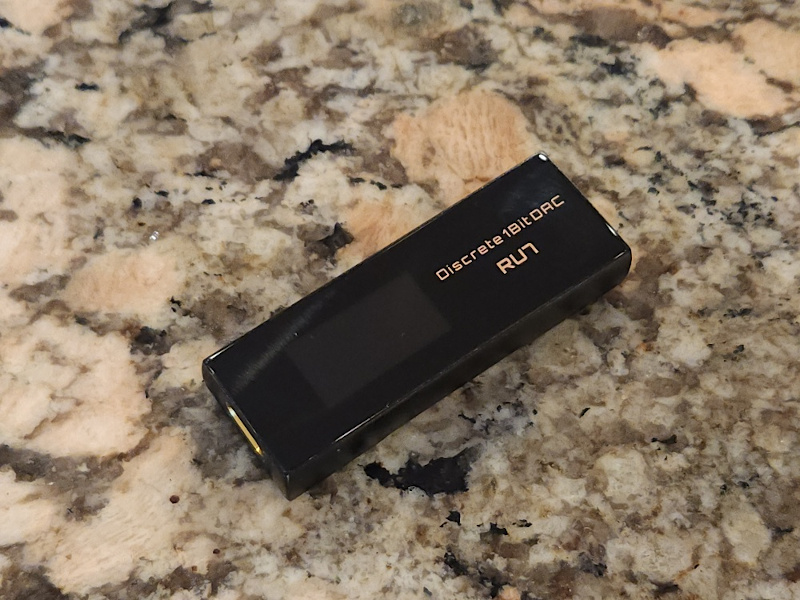
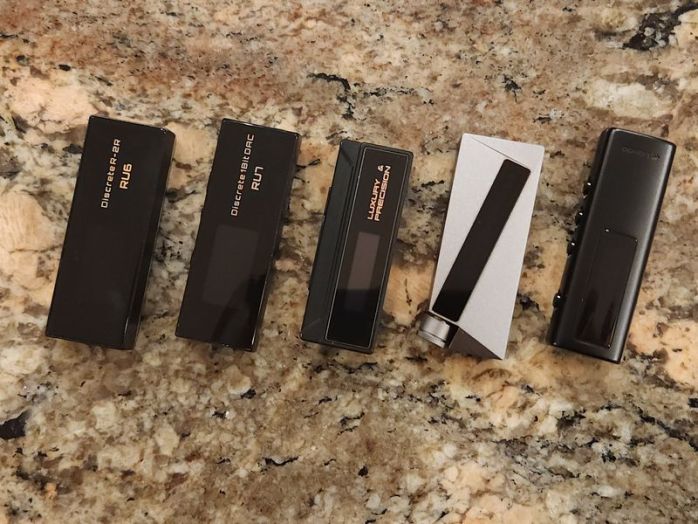
Comparison.
During this test, I was using Jewel for my critical listening. RU7 was set to High Gain and DSD128. Each of these dongles, besides a difference in tonality and pair up synergy, has their own Pros/Cons when it comes to features, all of which should be taken into consideration depending on your priorities. But first, let me bring up Cayin’s own N7 DAP.
vs N7 – RU7 will not be a replacement of standalone N7 DAP, but I’m sure the question of the comparison will be on many audiophile’s minds. I tested both from BAL output, with DSD256 setting in high gain on each device. There are some differences in technical performance such as wider soundstage expansion and improvements in micro-dynamics when switching to N7, and those are probably due to amplifier difference, with N7 having more advanced design. But the tonality was nearly identical. N7 is a great DAP, but if you don’t want to drag it around all the time, you can use RU7 as an alternative with your smartphone. Again, not a replacement.
Now, versus other dongles.
vs Cayin RU6 (NOS setting) – RU7 imaging has a more holographic effect; both have a wide soundstage expansion, but RU7 imaging has more 3D depth. One difference in tonality that stands out to my ears is in treble where RU6 is crisper in comparison to more natural sparkle of RU7 treble. Also, I’m hearing a tighter bass with RU7 which also has a bit deeper sub-bass rumble. Of course, RU7 BAL will give you more power.
vs L&P W4 – W4 has a little different presentation of the soundstage where the width is slightly narrower while it has more out of your head depth. The main tonality difference is in mids where W4 is a little brighter and more revealing while RU7 is warmer and more colored. They both have a punchy tight bass and natural crisp treble, though RU7 adds a bit of extra weight in bass. Both have a similar high-power output (BAL).
vs L&P W2 – when it comes to the soundstage, RU7 might be just a touch wider, but it is not too far off. Also, the tonality is rather close when you are focusing on the bass and the mids. Treble might be a little smoother in RU7 and just a bit more energetic in W2. Keep in mind higher power output of RU7 BAL.
vs Lotoo S2 – in this comparison, I hear RU7 being a little wider in soundstage expansion. Also, there are a few differences in tonality. S2 mids/vocals are smoother and a bit warmer (colored) while RU7 is more revealing and more resolving. Also, S2 treble is noticeable smoother, which contributes to its warmer tonality. In contrast, RU7 has a little more of natural treble sparkle. You do get higher power output from BAL in RU7.
Conclusion.
As I have mentioned in my N7 review, the concept of 1-bit DSD DAC design is not new and has been implemented in higher end expensive CD/DVD players. But I never came across another portable device (DAP or USB DAC/amp dongle) with implementation of this DAC architecture, especially an all-discrete design. I was impressed with its sound performance in Cayin’s N7 DAP, but RU7 takes it to another level by implementing this DAC design in usb-stick size dongle. It’s like a déjà vu when Cayin implemented the first discrete R-2R DAC in RU6, pushing the envelope of new design instead of just going with a flow of incremental upgrades.
But at the end of the day, it’s not just about marketing buzzwords, but rather how it sounds and pairs up with your favorite IEMs/headphones, and to my ears RU7 delivers on every account with features many audiophiles going to appreciate. Besides 1-bit discrete resistor DSD DAC, you have user selectable all-to-DSD upsampling where you can choose between DSD64, 128, or 256 which actually affects the sound tuning, and also gives you a choice to optimize the current draw from your source. You have a clean fixed voltage Line Out, either SE or BAL, to use with your external amp, or a direct headphone output. And the BAL output power is up to 400mW.
With its advanced design and additional features over their previous RU6, RU7 costs just a little more, a difference equivalent to the leather case price which btw is included. In the past people looked at dongles mostly for IEM use, for convenience when you don’t want to carry a separate DAP. But with these additional features, extra power, and excellent sound quality, a dongle like RU7 can be a real competitor to most of the entry level and some mid-fi level DAPs.

 Twister6 Reviews
I’d love to hear more about the differences between the RU7 and the RU7 paired with the C9.
Thanks!
LikeLike
In general, C9 is a very powerful amp that will color the sound. RU7 by itself has plenty of power for most of the iems and even some harder to drive headphones. Adding C9 will enhance it (more output current, even higher power, choice of solid state and dual NuTube “coloring”) which adds more body to the sound and changes pair up synergy depending on what you are trying to drive. Keep in mind, C9 will hiss with as sensitive iems. So for more sensitive or average iems to keep the sound more transparent and with deeper blacker background, perhaps stick with RU7. But at the end of the day, it is up to you and how you want to refine the sound.
LikeLike
Hi Twister6, Great review, thank you!
With ddHiFi TC28i Pro and mFI07S, were you able to use the iPhone to drive the Cayin RU7 to at least Vol:50, High gain, DSD256?
I am currently using iPhone 11 Max Pro with Cayin RU6 and ddHifi mFI09S. I get stuttering / music cutting out at Vol:55, High gain. With the TC28i Pro, I wonder if it is the phone being charged or the Cayin RU7. Thanks!
LikeLike
Which iems or headphones? Actually, just tried iPhone XS MAX with TC28i Pro, RU7, and Meze Empyrean headphones, RU7 DSD256, volume up to 65, high gain, no stuttering.
LikeLike
Thanks – I was using Fatfreq Maestro Mini on EA CODE23 on the iPhone 11 Max Pro and Cayin RU-6, vol.: 55-65 and high gain. The music would stutter or cut out when the bass kicks in. I reckon its due to the iPhone limitation. I’ll give this a try then.
LikeLike
Thank you for the excellent review of RU 7. Here’s what I wanted to ask you : I have sennheiser i 900 headphones and they are constantly plugging, even in DSD 64 mode after volume level 45. I have already ordered the ddHIFi adapters you mentioned, but I am not sure about the success of the future design. Are the sennheiser such a big load for the iPhone? Perhaps the purchase of a cheap android phone is necessary? I listen to the Qobuz streaming service.
LikeLike
I don’t have IE900 to try it, thus hard to tell. DSD64 at volume 45 shouldn’t give you a problem. Have you tried using RU7 with your laptop, just a sanity check with IE900 without iPhone current limitation problem.
LikeLike
Thanks for the quick response. Yes, I used on windows 11, via Ruun, no problems with either Sennheiser or Audeze LCD 2 in any modes. I also noticed that when streaming higher resolutions the plugging comes faster. Nevertheless, as a person with a long experience of listening to classic high end systems, I recognize the baby RU 7 as an excellent result. But the situation with the iPhone is extremely frustrating, and there are no reviews about it except yours.
LikeLike
Hi, thanks for the nice review ☺️
I read the short comparison with the ru6 (which I own)!
I wonder if switching to ru7 is a valid update, I read that the treble is less brilliant in 7, do you mean that it can be less “”””ringing “”””? I find it hard neither in the instruments nor in the voices with “s” and “c” (like rammstein and ghost) in ru6, although it is quite sharp and it seems to me that ru6 has the voices quite close up too! is ru 7 smoother?
thanks (sorry for the mistakes I use google translate)
LikeLike
Thanks for the extensive review. I just got mine this week and am currently testing it with my various earphones and headphones. While I like what the dac can do, I want to know if during your testing, you encountered occasional short delay/pause during playback, i.e. similar pause to the one would encounter when increasing volume passing the volume segment. For each playback, I would experience 2-3 delays. Just for reference, my files are mostly flac with 24/44.1 or higher resolution and DSD64, and I’m testing the dac using my Mi9. I wonder if this phenomenon would change later on after further burn-in. Your input would be very much appreciated.
LikeLike
Mi9, is that a phone, Android? I assume? What payback app are you using? Does it happen with every app? Have you tried using RU7 with another source, maybe your laptop to see if it happening in there as well?
LikeLike
Yeah, running it from android phones (LG v50 and Xiaomi Mi9) using HiByMusic and UAPP with USB exclusive mode. There are some differences in the audio output, but the pause is there. It may have to do with the USB audio setting. I will play more with them. However, on LG V50 music player, there was no pause, but it is not outputting bit-perfect when it comes to certain files. So, I thought I’d give it more burn-in time since I didn’t do it in the beginning at all. Reading reviews here and there, it seems others have given 70+ burn-in time. On windows, currently it gives pops and clicks sounds like what you’d encounter when playing an LP back in the days (don’t know if turntable still doing that these days since I haven’t used one in aeons) truly analog sound. 😀
Thanks again for your reply. I take it you didn’t experience the pause based on your response.
LikeLike
Okay, I figured out why this happened: DSD mode has to be set to DoP for this device. Though the specs say there’s support for DSD64, 128, and 256, it does not offer native dsd decoding support. Changing the DSD mode in my app to DoP solved this.
LikeLike
Hello, nice review there. Planning to upgrade from dap to dongle. I said upgrade because it seems like it on the ru7. But of course I’m not sure, just an assumption. I’m currently using my old dx160. And the dap is no longer performing well with so many issues, planning to go phone dongle setup. My question would be does my plan make any sense? Or dx160 will still stand superior against ru7 phone setup. Thanks! Appreciate the review and your response if ever.
LikeLike
Well, considering you will be using RU7 with your smartphone, this probably does qualify it as an upgrade over DX160, in both the sound and “system” performance since your smartphone will be faster and more robust running the latest apps.
LikeLike
Hi Twister,
Went to most of your publications here and want to say CONGRATS. Great info with details and comprehensively presented.
Now, regarding the RU7 – I am having the RU6 and love it, also I have the Hiby RS2 and Mojo2. Is it worth getting the RU7 or I’d better save more and got to N7 or DX320?
The dilemma b/n N7 and DX320 is also quite big for me.
Please, advice! I listen mainly rock & metal (Deep Purple, White Snake, WASP, OZZY, Metallica) but I am also a big fan of Pink Floyd, Santana and Moby, Robert Miles. Not too much fan of female vocals like Adele, Agillera, … I value extremely big soundstage replay and balance (fair neutrality) – I hate too much (sub)bass or too much treble, and too forward (in the face) vocals but like clear nuances and details. My favorite ‘modern’ IEMS are Z1R, MMK2, Helios.
Thank you in advance!
LikeLike
Hi,Thanks for the great review. I was wondering if you know if the current iPhones that have a USB-C instead of Lightning connector still have the iPhone current limitation problem. Was that a Lightening-specific issue or is that an Apple issue in general?Thanks in advance!
LikeLike
From all the comments on head-fi in RU7 thread, I have not come across anybody with issues using RU7 with new iPhones. So, let’s assume it works OK?
LikeLike
I have an iPhone 15 with USB-C and haven’t run into the current limitation problem. The problem I do have is rapid battery drain. I’ve ordered a DDHiFi TC28C Pro from AliExpress to solve the problem.
LikeLiked by 1 person
Hi,
Thanks for the reply. Glad to hear you’re not having the current limitation problem with your iPhone 15, but the rapid battery drain is definitely a bummer. Good to know the DDHiFi TC28C Pro offers a solution, but it kind of affects the portability for on-the-go use if you also have to carry around a power bank.
LikeLike
Hi,Thanks for your reply. Glad to hear you’re not having the current limitation problem with your iPhone 15, but the rapid battery drain is a bummer. Good to know the DDHiFI TC28C Pro is a solution, but it kind of affects the portability if you also have to carry around a power bank.
LikeLike