

Comparisons.
Helios vs Triton vs Meteor

All 3 IEMs offer something different while not straying too far away from each other or into wonky category. For ease, I decided to create an easy to follow chart which can give everyone an idea of how the IEMs perform against each other and which one could serve your preferences better –
- Meteor – Coloured W tending U-shaped tuning that makes music sound more lively.
- Triton – Warm, smoothest sounding IEM out of the 3 with recessed upper-midrange.
- Helios – A reference-ish tuning that is equally fun to listen to as it is natural.
Tonal Qualities.
- Tonality and Timbre – Helios > Meteor > Triton
- Bass quantity – Meteor > Helios > Triton
- Bass quality – Helios > Meteor = Triton
- Midrange accuracy – Helios > Meteor ≥ Triton
- Treble tuning accuracy – Helios > Meteor = Triton
- Musicality – Helios = Metro > Triton
Technical Performance.
- Soundstage – Helios > Triton > Meteor
- Left to right separation – Helios > Triton > Meteor
- Detail retrieval – Helios > Meteor = Triton
- Imaging – Helios > Meteor > Triton

Helios Comparisons
64 Audio U12t.

Helios and U12t are IEMs from a similar school of tuning and yet quite different because of subtle differences here and there in the frequency response. First of all, U12t has 12BAs and is almost twice the price of Helios, so most would be thinking that it isn’t a fair competition but it ‘almost’ is because of how well Helios performs.
As you can see in the graph, Helios has a tiny bit more sub-bass but the U12t has much more mid-bass. This results in U12t’s bass coming across more coloured, more in your face with more punch and weight. Helios’ bass is much cleaner, more precise, come across more accurate, is quicker and presents the mix of the song more accurately. The midrange of both IEMs is fairly similar but with slightly different flavour because of where their ear gain peaks peak. Since U12t has slightly more presence in mid-bass and 250-500Hz, it comes across slightly fuller and Helios more neutral. Both have similarly forward definition of instruments because of similar ear gain but U12t has slightly more accurate presence in 5-8kHz region and comes across as having better instrument attack and definition as a result. Both IEMs are slightly recessed in mid-treble and airy with their upper-treble presentation but U12t takes the airiness up quite a few notches with a significant boost via its Tia driver. This sounds a bit artificial in the first listen until the ear adapt to it but then greatly helps in detail retrieval. Also, the dipped lower to mid-treble and then greatly boosted upper-treble helps give U12t a holographic, out of head soundstage with a roomy character – which sounds like there’s a tiny bit of room reverb added to the whole mix. Helios is more balanced and accurate with quite an open and holographic soundstage too but it sounds like the sounds are to you more directly than in a diffused fashion. When it comes to technical performance, U12t has better instrument definition, slightly better detail retrieval and deeper soundstage depth. Helios on the other hand has wider soundstage boundaries, slightly better LCR separation and precise imaging.
Is the Helios as good as the U12t? Almost, and that says a lot about its competence. U12t does have slightly better definition and attack of instruments with a roomy sounding soundstage but Helios is more neutral while serving a similar out of head soundstage, with better LCR separation and a cleaner, more neutral bass response. It’s 95% there in resolution and detail retrieval compared to U12t and that could serve Helios as a U12t alternative at a lower price point for quite a lot of people.
Custom Art FIBAE 5.

FIBAE 5 (F5) is a 1DD + 2BA + 2 Planar IEM and has a more W-shaped signature with a stronger bass and mid-treble boosts. F5 has significantly more sub-bass as well as mid-bass than Helios. F5 has very slightly fuller lower-midrange compared to Helios and a slightly more recessed upper-midrange particularly around 3kHz. As a result, instruments sound slightly fuller but not as forwardly defined in F5 as the Helios. F5 has significantly more mid-treble boosts which lends it a sparkly and sizzly character and is similarly airy in upper-treble. Because of F5’s more treble presence at 5kHz and from 9-15kHz, it comes as having much energy as well as sharper attack. You need to be a treble fan or older in age to appreciate F5’s sizzly treble. Both have open and wide soundstages but F5 builds a helmet around you while Helios sounds like the sound is coming from very specific points in the plane based on where they’re panned in the mix, which is why I’d say Helios has better imaging. F5 might seem like it has better detail retrieval due to its brighter nature but it’s similar and I’d in fact say Helios does better while maintaining a more even signature. Helios actually has better depth layering. In general, F5 is a more energetic listen and Helios a more neutral and accurate. Both are equally musical but targeted at significantly different preferences.
Lime Ears Aether R.

Lime Ears Aether R is 5BA IEM that goes for a bass boosted Diffuse Field style of tuning while the Helios takes inspiration from Harman IE 2019 target. Aether R is a leaner, slightly more aggressive listen and the Helios, a more even and better balanced signature pitched to be versatile. Since Aether R has a more conservative bass boost, Helios has more sub-bass rumble as well as mid-bass punch. Aether R comes across leaner in comparison. Aether R has more ear gain than Helios which results in stronger instruments definition but then has significantly brighter lower-treble which has it coming across much brighter in comparison and can sound a bit too bright for the treble sensitive. Helios is more even with its upper-midrange to lower-treble transition. Helios has better upper-end extension while Aether R has a treble roll-off. Helios has a more open and wide soundstage with better imaging, layering and even detail retrieval for its more even sounding signature.
Custom Art FIBAE 7U.
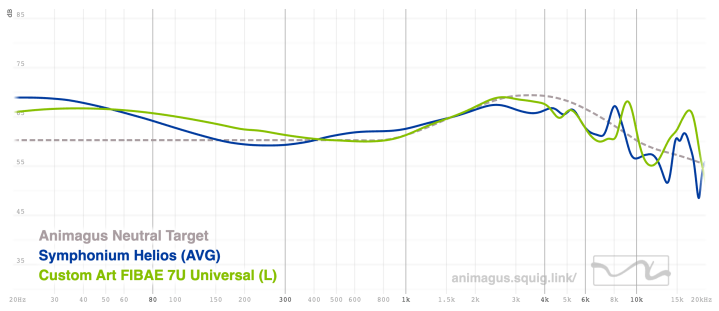
FIBAE 7U (F7U) and Helios go for a similar W-shaped tuning but with some key differences that have them sounding quite different. Helios has more sub-bass rumble but F7U has slightly more mid-bass punch as well as slightly fuller lower-midrange in the 250-400Hz region. These differences have Helios sounding slightly and more neutral while lend F7U a slightly fuller bodied character. F7U on the other hand is more tonally accurate with the 400-1kHz as well as the upper-midrange ear gain post 1kHz. So, F7U has slightly more forward definition of instruments. Both IEMs are similarly warm in lower-treble but F7U is significantly airier in upper-treble like the U12t, which lends it a much airier character. Helios has an airy upper-treble boost too but is more even with the boosting. Both IEMs have open and wide holographic soundstages with very good LCR separation, layering and imaging. F7U is slightly better at detail retrieval but that could very well be because it has a more W-shaped tuning. In general, Helios comes across slightly more neutral and F7U slightly more W-shaped.

Triton Comparisons
Moondrop S8.

Moondrop S8 is my benchmark IEM under $1000 and tough one to beat in terms of technical performance and Reference style tuning. Triton comes across a warmer IEM compared to S8 primarily owing to its recessed upper-midrange tuning. They’re actually very similar IEMs till 1kHz but after that is when things change completely. S8 has more accurate ear gain and much more accurate tonality. It in fact over does it by 1-1.5dB which results in it coming across a bit shouty to people who’re used to lower ear gain levels. S8 has better balanced lower-treble as well as mid-treble and airier upper-treble. Triton is recessed in upper-midrange and has a warmer treble presentation compared to S8. As a result, instruments come across more forward, stronger defined with better tonality in S8 and not as strongly defined in Triton. S8 is much stronger in technical performance with better detail retrieval, layering and left to right separation. Triton has slightly wider boundaries but falls short of S8 in most other aspects of technical performance.
Softears RSV.
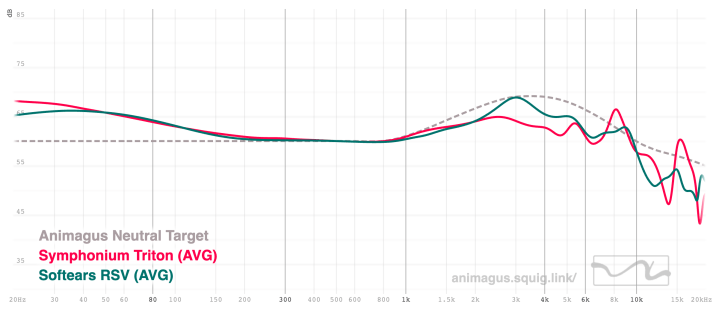
RSV is a 5BA IEM and is tuned to be a warm Reference IEM. They’re in fact both warm tuned IEMs but RSV is more accurate sounding IEM tonally while Triton goes for a more V-shaped tuning in comparison. Triton has very slightly more sub-bas rumble, both have similarly boosted mid-bass and neutral lower-midrange tuning, RSV has more accurate ear gain peak at 3kHz that results in a more accurate tonal character and forward definition of instruments and Triton is very slightly airier with better extension on top. When it comes to technical performance, RSV has better instrument definition and layering while Triton has a slightly more open and wide soundstage with better LCR separation.
Custom Art FIBAE 5.

F5 is a much more W-shaped IEM compared to Triton. It has much more bass presence with more rumble and punch, a more forward upper-midrange with better instrument definition and sparkly and sizzle treble tuning that adds in lots of energy on top to make for an exciting listen that demands your attention at all times. Triton is a warmer IEM in comparison and even though it has quite a nice soundstage with good LCR separation, F5 has an even more holographic soundstage with wider and deeper boundaries. F5 also has better instrument definition, detail retrieval and depth layering – a lot owing to the kind of tuning it has.
Meteor Comparisons
Moondrop S8.

Moondrop S8 has 8 BAs and is one the nicest tuned IEMs with benchmark technical performance under $1000. S8 goes for a more reference-ish sound signature while the Meteor a more coloured and fun. S8 has a more neutral 6dB bass shelf which is much lesser and why Meteor’s bass will come across much more in your face in comparison. Where Meteor trumps S8’s more agile and accurate bass presentation is in timbre as it is able to fool one with its big rumble and punchy performance. Lower-midrange is quite neutral in both IEMs but S8’s upper-midrange is way more accurate because of more accurate ear gain. The only downside is that S8 overdoes the ear gain by a dB or two, which is why it comes across a bit shouty to a lot of people. S8’s treble sounds slightly more accurate while Meteor’s comes across as purposefully boosted for a more coloured, airy presentation than neutral. When it comes to technical performance, it is tough to beat the S8 at its asking price – it has a slightly cleaner, more open soundstage with better left to right separation, imaging and depth layering. Meteor is no slouch but it’s tough to beat a segment benchmark. I’d recommend the S8 for reference heads and people who like neutrality while the Meteor for bass lovers and lovers of well-done coloured signatures that don’t stray away too far from natural tonality.
BGVP DM9.

DM9 is a tri-brid with 1DD+4BA+4EST and goes for a neutral-bright, revealing signature. DM9 has a conservative approach to bass tuning and Meteor has much rumble and punch. They have similar lower-midrange tuning but DM9 has more ear gain, lower and mid-treble which results in a much brighter signature compared to Meteor. Meteor on the other hand is airier with slightly more treble presence and extension up top. DM9 due to the nature of its tuning is much more revealing with more detail retrieval and resolution at the cost of sounding clinical. Meteor on the hand is a warmer, more musical and comfortable listen with a more fun and punchy bass performance and good treble extension up top. DM9 has slightly better left to right separation but Meteor has a more engulfing soundstage with better imaging and depth layering.
Tanchjim Prism.

Prism is a 1DD + 2BA IEM with a sub-bass boosted, reference-ish W-shaped signature like the Meteor but differ in a quite a few areas making for a very different listen. Meteor comes across as a bass boosted W-shaped tuning while the Prism presents a more energetic slightly clinical listen in comparison. Meteor has more mid-bass and more punchy bass presentation as a result while the Prism is cleaner and slightly more neutral. Prism has much more ear gain, which is more neutral than Meteor who has recession there, and results in much more forward and stronger definition of instruments. But Prism overdoes the ear gain by a dB or two resulting a slightly shouty listen whereas Meteor does not have instruments as strongly defined because of recession in the region. They otherwise have very similar presentation but Prism is slightly airier with its upper-treble resulting in the peaks standing out a bit in the initial listen until the ears adapt to them, just like in the U12t and F7U. Prism has a cleaner and more open soundstage with wider and deeper boundaries, slightly better detail retrieval, better depth layering as well as sharper and more precise imagining while the Meteor’s soundstage allows for a slightly more holographic experience just because you can boost volume levels with the Meteor without it getting shouty.
Conclusion.
Symphonium Audio are doing interesting work, collaborating with other interesting brands and teams to make very interesting IEMs. It’s very cool to see what they’re able to achieve with fewer drivers and how they’re including very nice accessories while pricing their IEMs fairly reasonably (compared to what some other brands are doing). In my opinion, Triton, even though no slouch by any means, had a tougher time competing against the competition just because of the abundance of very well tuned IEMs in the sub-$1000 segment but Helios and Meteor are very capable IEMs that offer something that stands out. Helios is the IEM that impressed me most out of Symphonium’s arsenal and is in fact an IEM that I’d place as a segment leader in its price segment for quite a few things, particularly the best combo of tuning + technical performance at its price point. It is an all-rounder and will impress way more people than it will disappoint. Meteor on the other hand is a fun little pocket rocket that is quite an engaging listen and offers a nice coloured alternative to the more neutral, Harman-ish flavours of some of the segment popular IEMs. With all that said, Symphonium is a brand that should be on everyone’s radar and I highly recommend giving the Helios and Meteor a try!
Gear used for testing and review.
- DAPs – HiBy R6 Pro II & R6 III | iBasso DX240
- Laptop – Apple Macbook Pro 15″ + Tanchjim Space Dongle / iBasso DC04 Pro
- Phone – OnePlus 7 Pro + Tanchjim Space Dongle / iBasso DC04
Artists I like and listen to.
- Rock – Foo Fighters, Linkin Park, Switchfoot, Imagine Dragons, Daughtry, Green Day, MuteMath, X Ambassadors, Dave Matthews Band, Vertical Horizon, Our Lady Peace, Lifehouse, Fall Out Boy, Breaking Benjamin, Muse, ACDC, Audioslave, Rage Against the Machine, Biffy Clyro, I Am Giant, Normandie, Paramore, Slash & Guns N Roses, 3 Doors Down.
- Pop Rock – John Mayer, Coldplay, Paul McCartney, James Bay, Hunter Hayes, Niall Horan, Keith Urban, The Bros Landreth, Bryan Adams.
- Progressive Rock/Metal – Porcupine Tree/Steven Wilson, Karnivool, Tool, Dead Letter Circus, Periphery, Lamb of God.
- Pop/Soft Rock – Ed Sheeran, Adele, Taylor Swift, OneRepublic, The Script, Gavin James, Magic Man, Maroon 5, Bruno Mars, Charlie Puth, Dua Lipa, The Weeknd, Oasis, Panic! At the Disco, TwentyOne Pilots.
- EDM – Chainsmokers, Zedd.

 Twister6 Reviews
I really enjoyed the deep and detailed review — it was a pleasure to read.
I have an important question, and I think you can really help with your precision and attention to detail.
My current IEM is the Monarch MkII, and I’ve also owned the Blessing 2 in the past (both were excellent for me). Now, I’m looking for a complementary IEM to the Monarch MkII — something more fun and aggressive in presentation. I’m not entirely sure whether I should be looking for that excitement in mid-bass or sub-bass.
I’ve also tried the Variations before.
To be honest, the Variations had very prominent sub-bass, which really stood out to my ears. While it performed very well in other aspects and I didn’t want to take it off, the sub-bass felt a bit too dominant, like it was drawing too much focus away from the rest of the mix.
So I have three questions:
LikeLike
Thanks. Well here’s what I think,
Also for now I only know of your views on two IEMs – Monarch MK2 and Variations – which are very similarly tuned. So I can’t suggest without knowing what you’re looking for exactly. If you’re getting Helios under $600, that’s a great deal and you should jump on it to see and decide what you like more of – a cleaner sounding IEM or fuller/bassier. It’ll give you a clearer view of where to go from there if you don’t. It should be an easy sale even if you don’t like it. Just beware, the fit is not ideal. I’d suggest looking for Helios SE if you find one. That has a better fit from what I’ve been told.
LikeLike
Thanks for taking the time to respond. I actually live in Iran, so there’s really no place for me to test IEMs in person — most of my decisions have to be based on reviews and trusted impressions.
I’ve heard the sound of Monarch MK2 and Variations, and while they’re good, I definitely feel a lack of excitement, punch, and natural timbre. I think a more U-shaped or V-shaped tuning might be more fun for me. (Just to clarify, I do understand sound profiles well.)
What I want to be sure of is whether the Helios can give me that extra excitement and punch. I’m confident in its technical performance, no doubt about that, but I’m a bit unsure about its tuning and whether it has that engaging, dynamic feel.
Or — maybe there’s another $500–600 IEM out there with a warmer, more V-shaped tuning that could give me what I’m looking for? (Even if it doesn’t reach Helios levels in technical ability.) Something like the Meteor — which has that fun, energetic character — or maybe another recent release that fits this description.
Again, I know Helios is technically very strong and can be considered endgame. I also don’t have any issues with fit — my ear canals are basically black holes, haha.
Thanks again for your help!
LikeLike
Haha 😅 I think Helios will fit your bill very well in that case. I can’t think of another IEM around $600 that can. Most do not have as well extended treble as Helios nor Variations or MM2. Meteor is too bassy and warm for my preferences. If you come a segment up, Phantom SE and Custom Art FIBAE 5 are 2 very fun IEMs. Phantom SE is a looker with a very nice high end cable. FIBAE 5’s sizzle can need a slight adjustment period but it’s a lot of fun and you can control between 2 bass shelf levels using the filters they provide. Both have big and open soundstages too. I’ve reviewed both here. Check out the reviews and see if they’ll work for you. If you know how to read graphs, you compare all of them on my Squiglink – https://animagus.squig.link/
LikeLike
Thank you so much! The suggestions you gave are excellent—I’ll definitely read them and check them out. I’ll also take a look at the graphs; I can somewhat understand them. But I also know that everything isn’t about graphs, and I can benefit much more from your listening experience. Time to dive into those reviews—just need another earphone, haha.
That said, my gut feeling tells me that, based on the descriptions I’ve heard so far, the Helios might be the perfect match for my ears. Thanks again for your helpful responses, my friend.
LikeLike