
Design.
Starting with exterior dimensions, 320Max is similar to 300Max and 220Max and measures approximately 146mm x 86mm x 30mm with a weight of about 620g w/o a case and 682g with a case which I always find to be a good idea when dealing with a bigger/heavier device to enhance the grip. 300Max was 820g, 200g more because of stainless steel chassis, while 320Max is lighter due to a more exclusive Ti material, though it adds to the price in lieu of additional cost and more expensive manufacturing process. Yes, it is transportable, not exactly portable, and you have to keep in mind that extra room is required for a total 5 battery cells (for separate analog and digital circuits), dedicated ports, big/tall audiophile-grade capacitors, custom analog stepped attenuator volume, separate gain switch, and a big 5” 1080p display with 1080×1920 resolution.
The right side of the DAP has hw playback controls with play/pause surrounded by skip next/back, grouped separately from Power button further up. Buttons have a nice tactile response, all metal, solid, round, no rattling, and also no labeling. Instead, Power and Play/Pause buttons have label imprint on the leather case. Skip buttons are not labeled because you can flip them in Audio Control Button menu under Android Settings. The left side has no controls. The back of 320Max has 2 removable screws, giving you easier access to open the back panel and to gain the access to battery replacement.


With the exception of gain control switch, 320Max is similar to 300Max, and also an improvement over 220Max where there were no playback controls.


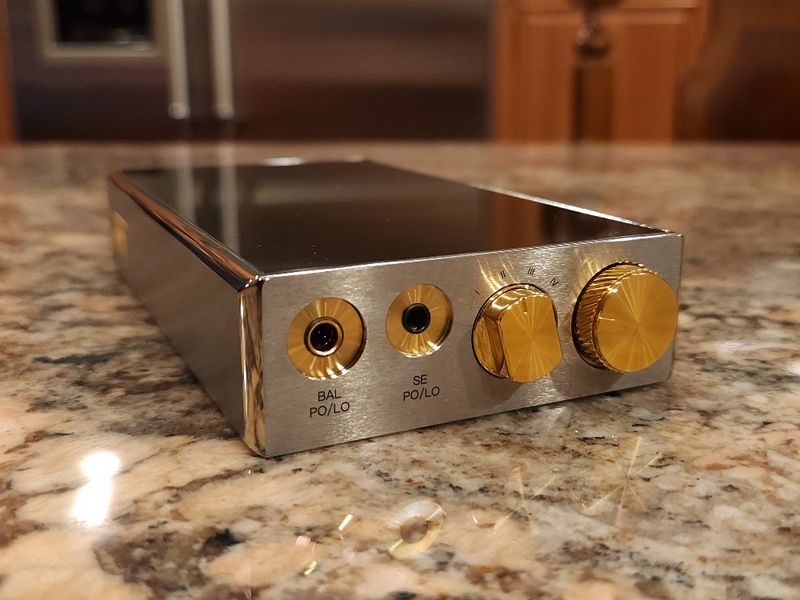
The eye-candy of the Max design is the front and the back of the chassis. There, every individual port has a golden surrounding faceplate, and the contrast with Ti chassis makes it look even more premium. On the front, left to right, you have a shared balanced 4.4mm Phone Out and Line Out port, a shared single ended 3.5mm Phone Out and Line Out port, 4 settings physical gain control golden rotary switch, and a large golden knob controlling a custom 4-wiper stepped attenuator to adjust the headphone output volume. The side of a volume knob is etched to enhance the grip.
On the back, you have DC-in for 12V AC/DC brick input to charge the analog section batteries. Next to it is USB-C port for charging of digital section battery and other digital in/out functionality, and btw, this port also has a cutout with a gold faceplate. Then, you have 3.5mm digital SPDIF output. And last, but not least, spring loaded microSD card slot for easier access to a flash card. Especially for desktop use, the location of ports is very convenient with power supply cables on the back, and headphone ports and volume/gain control on the front, while playback controls are conveniently located on the right side.


Under the hood.
In their 320Max design iBasso stepped it up to a quad flagship BD34301EKV DACs from ROHM MUS-IC series. On top of that, iBasso continued with implementation of Qualcomm Snapdragon 660 SoC 8-core processor, the same as in their other latest releases. Along with 6GB LPDDR4x RAM, 128GB ROM, and optimized Android 11, 320Max benchmark results are very high, matching AnTuTu 3D Benchmark scores of other top-performing 660-based DAPs. 320Max still carries the legacy of dual OS boot, and in addition to Android 11 it also supports 5th Gen Linux-based Mango OS. When it comes to playback, it supports most of the lossy and lossless formats up to 32bit/768kHz and DSD512, including APE, FLAC, WAV, WMA, AAC, ALAC, AIFF, OGG, MP3, DFF, DSF, DXD, and MQA 16x.
The highlight of this design is a new volume control implemented by using a stepped attenuator which in reality is a mechanical switch with many positions, 24 in this case, where each one has pairs of fixed resistors that yield a different volume level, gradually increasing the amount of resistance on each switch position. And because it is a switch with coarse steps, you will hear a bigger jump in volume as you turn the knob. Plus, as you are turning, between switch positions there will be a small pause when switch is disengaged. This is a completely different volume control experience from the continuous fine volume adjustment found in 300Max. As a matter of fact, I’m not aware of any other DAP implementing the same volume control. This stepped attenuator has less than +/-0.1dB channel tolerance imbalance, the reason iBasso decided to implement it in their design. But there is a trade-off in usability, though, really not the end of the world unless you are dealing with very sensitive IEMs. And also, you will find 4-position physical gain control switch next to volume, giving you more hands-on hardware control.

Another highlight of the design carried over from their flagship DX320 is in-house developed FPGA-Master. Of course, iBasso is not manufacturing their own FPGAs, but they did implement FPGA and developed FPGA-Master code to make it function as audio system controller to offload SoC processing by directly requesting audio data, as well as syncing and generating all audio clocks to reduce the jitter. 320Max remains a multimedia powerhouse and managing resources between System and Audio Processing is important task in order to maximize sound performance. Furthermore, 320Max USB-C port supports USB 3.1 standard, and Wireless is covered by Bluetooth 5.0 with all the popular codecs and WiFi 802.11b/g/n/ac. Wifi also stepped it up with a dual band 2.4GHz and 5GHz and two antennas (2x2MIMO) to establish up to two streams of data with the receiving device.
As part of the Max design, 320Max features iBasso own patented dual battery power supply architecture where digital and analog sections are powered separately so you need 2 separate chargers. There is one large battery for digital application and 4-cell battery for analog application. While not mentioned in 320Max spec, I assume it will be the same as in 300Max, 6200mAh digital and 4x900mAh analog batteries. With the back panel being removable, you have easier access to replace the battery. In my testing using average sensitivity and impedance IEMs, balanced output, lower gain, Ultra mode ON, playing hi-res local FLACs in a loop, periodically checking battery status while the display mostly off, I was getting on average 12.5hrs of playback time until the battery was down to about 20% Analog, 2% Digital. Keep in mind, Ultimate mode is ON which means all 4x ROHM DACs are engaged, and that is probably why digital battery drains faster. If you disable Ultimate mode, you will gain more time, according to iBasso up to 4 additional hours.
Also, according to iBasso, the internal amp circuit features optimized super Class A discrete amp design based on AMP8 module which eliminates the switching distortion of transistors while providing the sound signature of Class A amplifier with a reduced heat generation. With every new release, they keep tweaking and optimizing it, including some exotic audiophile caps. The amplifier section of the design is powered by a true +/- 8.4V battery without any voltage step up boosters. The output of 4.4mm BAL PO is 9Vrms @300ohm and 6Vrms @32ohm load (w/SNR 125dB). For 3.5mm SE PO is 4.5Vrms @300ohm and 4.0Vrms @32ohm (w/SNR 122dB). Line Out is 4.4mm BAL with max 4.5Vrms and 3.5mm SE with max 2.25Vrms, assuming at max gain. When you lower the gain, the LO output voltage should decrease.

Page 3 – GUI, Mango app vs Mango OS, Graphic and Parametric EQs.
Page 4 – Sound Analysis and Pair up.
Page 5 – Comparison, Wired/wireless connection, and Conclusion.

 Twister6 Reviews
Hi, thanks for the last help in choosing Dx320 Max It’s already ordered and it’s on its way. I’m thinking of one more dap for jazz, blues, female and male vocals for mentor, jewel and phoenix, which one would you recommend hiby rs8 vs cayin n7?
LikeLike