

Comparisons with IEMs in this price range.
Empire Ears Odin.

In my experience of having graphed 3 different samples of EE Odin, I saw that they all had slight unit variation in tuning post 4kHz, where some were brighter than others. So, I’m going to use averaged out impressions of all 3 samples for ease and to equal the differing experiences due to unit variation. Odin and Loki Emerald have quite a few similarities in the larger scheme of things but substantial differences that helps them not threat each other’s standing in the market. On graphs it might seem Odin and Loki Emerald both have similar bass shelf with similar sub-bass and mid-bass quantity but Loki Emerald’s bone conduction driver adds in a bit more boom and punch on top it. Again Loki Emerald’s lower-midrange looks like it has a scoop but Odin and Loki Emerald are very similar sounding IEM till about 3kHz because of the BC driver adding in some body in Loki Emerald’s case and both having similar ear gain in the 1-3kHz region. Odin is brighter with its lower-treble, some sample units more than others while Loki Emerald is sizzlier in mid-treble with better extension till 20kHz. As a result, Odin comes across brighter in lower-treble while Loki Emerald a little airier. Both have very competent technical performance. Loki Emerald has a slightly more open and airy soundstage. Both have similar stage width but Loki Emerald goes deeper. Odin has slightly quicker transient presentation but both resolve micro-details very well, have very good left to right separation, good depth layering but Loki has better space between instruments, better instrument vividness and slightly better imaging.
Elysian Annihilator 2021.
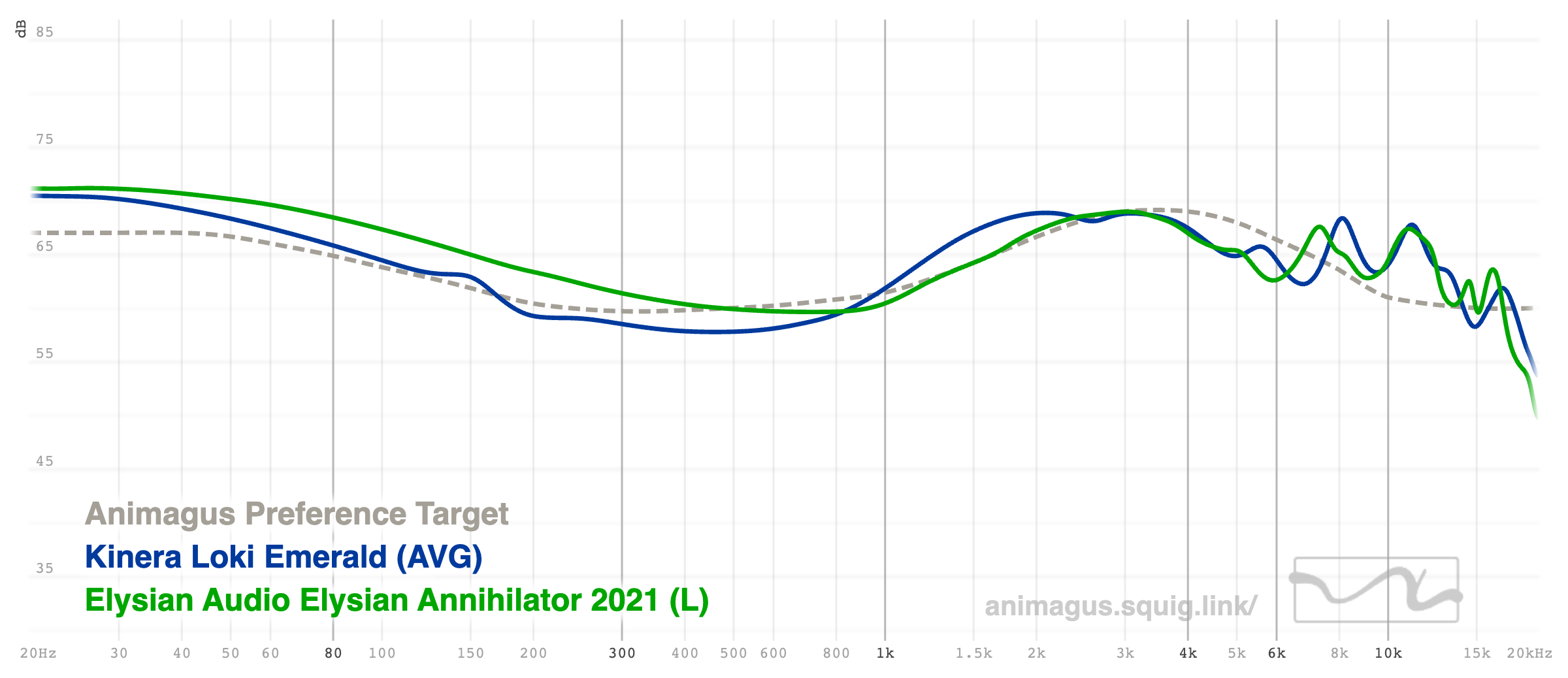
I haven’t yet tried the 2023 version of Annihilator which was recently released, so my impressions are based on the 2021 version. Annihilator is probably Elysian’s most popular IEM and a popular benchmark in the $3k+ price range. It has 1DD+4BA+2EST and goes for a bass boosted, slightly fuller take on reference tuning. As you can see in the graphs above, both Annihilator and Loki Emerald are tuned in the ballpark of reference tuning but with one major difference – Annihilator is a bassier and fuller take on reference tuning while the Loki Emerald is a cleaner, a slightly more neutral take on reference tuning. Annihilator has slightly more sub-bass (about 1-2dB) but significantly more mid-bass than Loki Emerald. As a result, Annihilator’s bass occupies more space and is more upfront and in your face in comparison with more body and punch whereas Loki Emerald’s stands cleaner, is more accurate to the song, is more in control in its place and sounds deeper in the soundstage. Annihilator has a fuller than neutral lower-midrange due to north of neutral presence in 250-500Hz region and as a result instruments have extra warmth and body added in compared to a reference approach. Loki Emerald seems slightly leaner than neutral in graphs but I hear the Bone Conduction driver adding in the body on top of it, which does not show up in graphs owing to bone conduction method of transmission. They both are very similar sounding 2.5kHz and up due to a similar forward upper-midrange with about 9dB of ear gain, slightly warmer lower-treble and very well extended, airy upper-treble. Coming to technical performance, both are strong performers with different strengths. Loki Emerald has a cleaner, more open sounding soundstage whereas Annihilator has a slightly fuller soundstage. They both have wide soundstage boundaries but Loki Emerald has deeper depth. Both have equally good resolution but Loki Emerald has better left to right separation and more space between instruments owing to its relative cleaner signature in comparison. Both are really good sets for resolution and micro-detail retrieval and you’d be pulling hairs to decide which one is better. At the end, it’ll all mostly down to one thing – do you want a fuller take (Annihilator) on reference-ish tuning or a cleaner one (Loki Emerald)? For most, it’ll boil down to that preference in particular.
FiR Audio XE6.

FiR Audio XE6 has 1DD + 4BA + 1EST. It has such a highly coloured sound signature that it completely skews the mixes wonky and yet is an IEM that can be quite a fun listen with the music that fits in with its signature – the reason why it has a significant amount of takers on audio enthusiast platforms. Loki Emerald is a much more accurately tuned IEM with a tasteful, exciting, slightly coloured take on a reference style tuning. As you can see in the graphs, XE6 has a crazy amount of bass and extremely full sounding midrange which results in bass being in your face at all times and so much fullness that it results in instrument body sounding bloomy and muddy, giving a low-fi feel to the lower end. Loki Emerald comes across much better tuned, with sub-bass emphasis and a cleaner mid-bass presentation that presents bass and midrange more authentic to the mix in comparison. Both have a nice forward upper-midrange presentation but Loki Emerald has significantly better tonality and definition of instruments owing to a more accurate ear gain peak. XE6 has brighter lower-treble, has similar sizzle in mid-treble and is slightly airier up top but it needs all that brightness to level the crazy amount of boosting below 1kHz. Loki Emerald is the one that comes across more linear with a slightly sparkly take on neutral tuning. Loki Emerald has the better technical performance too with a more open, clean and airy sounding soundstage, wider stage width and deeper depth, better left to right separation, more space between panned instruments and is also more resolving of micro-details within the music.
Lime Ears Anima.
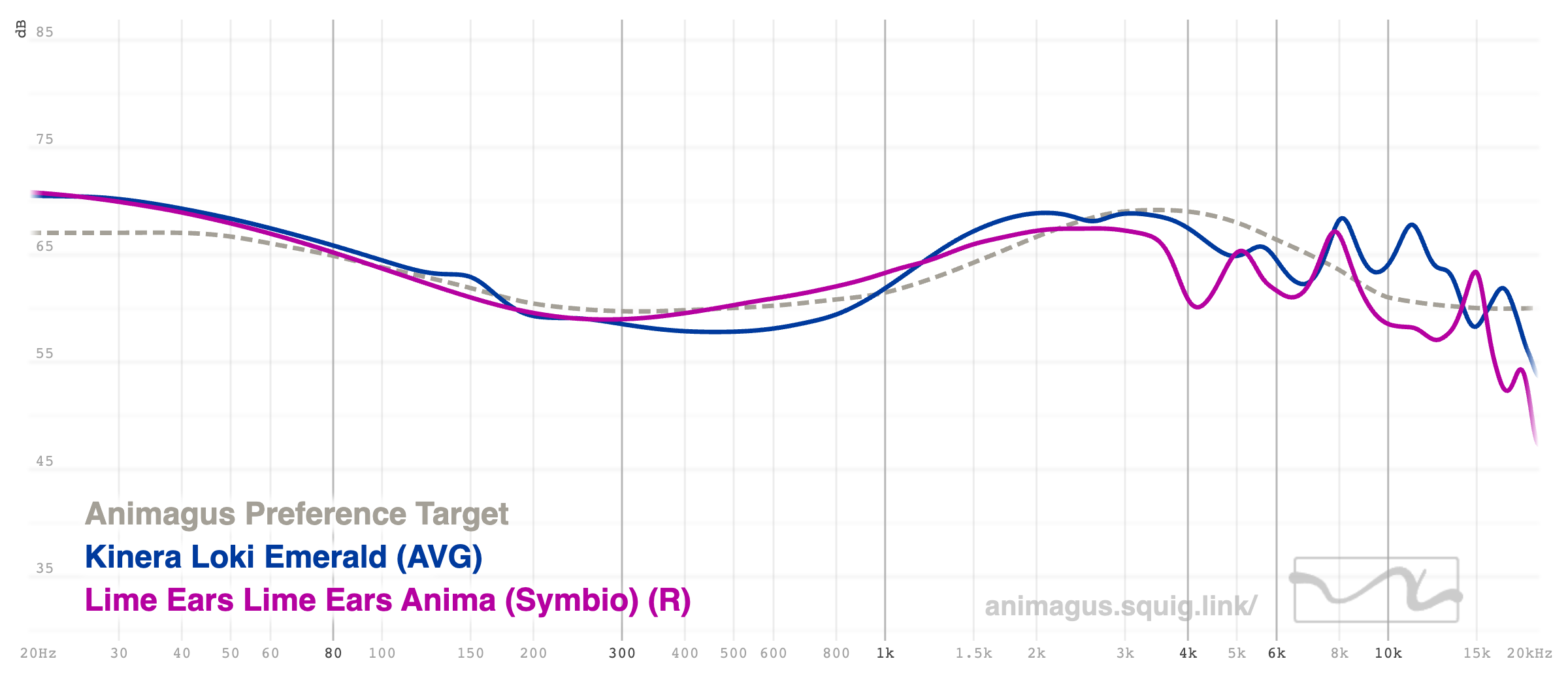
Lime Ears Anima has 1DD + 8BA + 4EST and has a W-shaped signature too but one that is more coloured and very different from Loki Emerald’s. They both have a sub-boosted outlook but Anima’s bass comes across a bit more full and upfront while Loki Emerald’s comes across a bit cleaner but with more punch and boom from the BC driver when the songs demand. Loki Emerald’s lower-midrange and upper-midrange ear gain are more accurate than Anima’s and instruments sound more natural and accurate tonally. Loki Emerald’s treble sounds more linear and has better extension up top whilst it being slightly sizzlier than neutral. Even though Anima has very good technical performance, especially a deep stage and imaging, Loki Emerald has a wider and more open sounding stage as well as better left to right separation, space between instruments and detail retrieval.

Comparisons with another popular Bone Conduction driver quad-brid IEM.
Unique Melody MEST MK2.
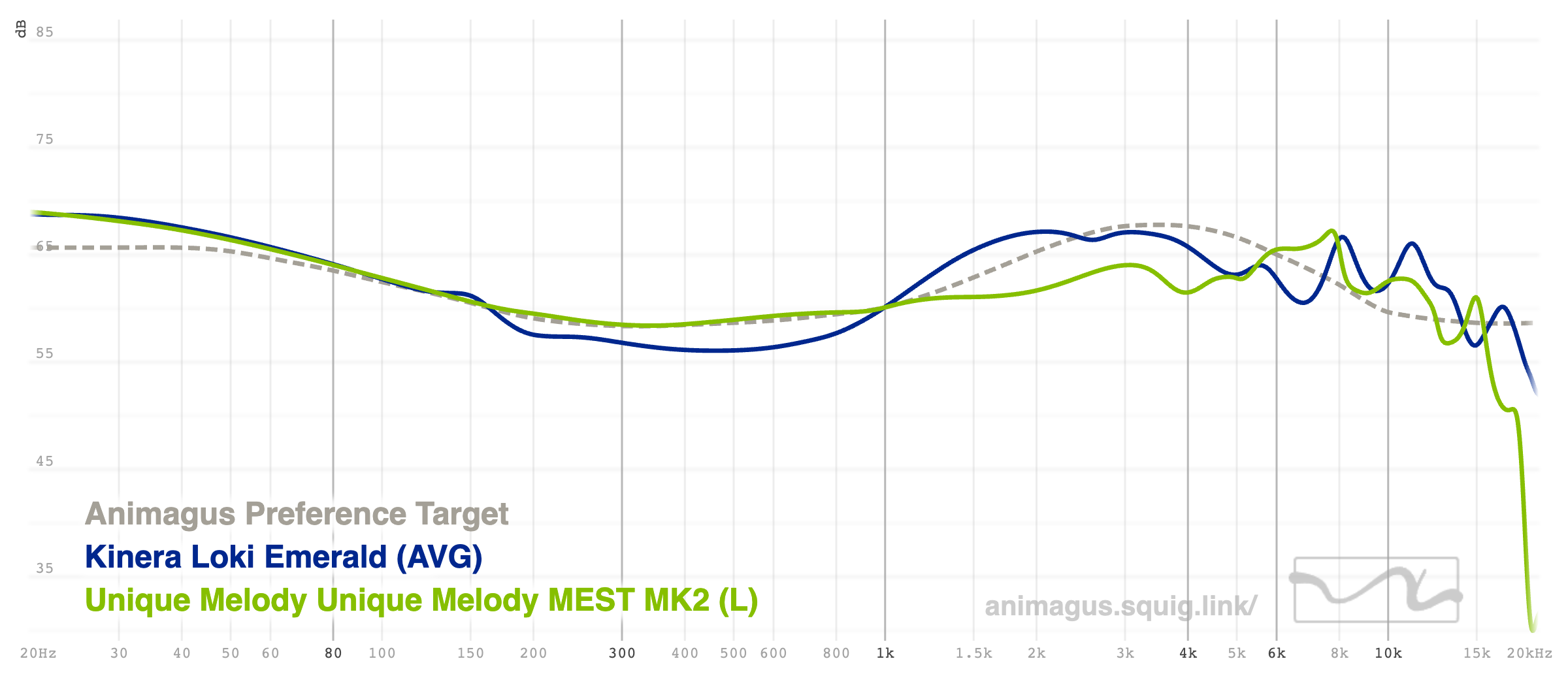
Mest Mk2 is a quad-brid with a bone conduction driver too but with a 1DD + 4BA + 2EST + 1 Bone Conduction driver configuration. It has a V-shaped signature that has a similar bass boost but slightly fuller lower-midrange, recessed upper-midrange, sparkly lower-treble tuning with slightly less air up top in comparison. Loki Emerald comes across more accurately tuned tonally due to better, more neutral, forward ear gain which results in better, stronger definition of instruments in the soundstage. Loki Emerald also has better extension up top and sounds airier. Mest Mk2 has slightly fuller body of instruments but also has their presence slightly pushed back in the soundstage with lesser definition because of the upper-mid recession. This also leads to it not being as tonally accurate or resolving of nuances that depend on definition when compared to Loki Emerald. When it comes to technical performance, both have a similar soundstage width but Loki Emerald has deeper depth. Loki Emerald has better left to right separation, space between panned instruments as well as better depth layering. Talking about Bone Conduction driver performance in particular, I feel I can hear Loki Emerald’s Bone Conduction contribution to the sound better just because of it having much higher sensitivity and output, which is quite noticeable in some tracks. Mest Mk2’s Bone Conduction isn’t heard working as prominently and it’s difficult to point out how much of its sound performance is owed to contribution of DD, BA and EST drivers and how much of it is the Bone Conduction driver.
Comparisons with some Benchmark Stalwarts in the $1500-2000 range.
Here are some comparisons with some of my personal and popular benchmarks in the sub-$2000 range to give you an idea of Loki Emerald’s performance compared to them.
64 Audio U12t (M15 Module).

64 Audio U12t has 12BAs with a W-shaped signature but a slightly warmer and fuller one in comparison. Because of its warmer lower-treble, it comes across as having more bass presence but it sounds softer and rounder in comparison. Loki Emerald’s bass presentation is more precise, has better separation, speed and transient presentation while enough punch and rumble when the song demands. Loki Emerald has a better carved out ear gain which results in stronger definition of instruments in the stage along with slightly more accurate tonality of instruments. U12t is slightly warmer in lower-treble which has it sounding slightly dark but then the airy Tia treble peak adds in air up top which gives it an illusion of good treble extension up top but also one that stands out in the first listen and even after ears have adapted with some songs that have slightly brighter cymbal presentation. Loki Emerald’s treble is more linear in comparison, slightly sizzlier in mid-treble but more linear and neutral with the lower-treble and post 15kHz air region. When it comes to technical performance, Loki Emerald is an outright winner with a more open, airy, wider and deeper soundstage, better detail retrieval, stronger imaging and instrument definition in the stage and better left to right separation and space between instruments.
Softears RS10.

RS10 has 10 BAs and a sub-bass boosted-neutral, reference style signature while Loki Emerald has a more W-shaped take on a reference signature. When it comes to tonal accuracy, RS10 is the outright winner. Loki Emerald’s tasteful colour on top of a reference signature results in a more vibrant presentation of music that is equal parts musical and technical. Loki Emerald has slightly more sub-bass rumble and boom owing to the Bone Conduction driver working its part. RS10 is more accurate with its midrange performance, especially the more accurate sounding upper-midrange ear gain and forwardness. RS10 is slightly more natural with its treble tuning, a bit warmer in comparison as Loki Emerald is sizzlier as well as airier with its mid and upper-treble tuning. This mainly results in Loki Emerald sounding like a tasteful coloured take on RS10’s tuning. When it comes to technical performance, RS10 is no slouch and has very good definition of instruments, imaging and detail retrieval but Loki Emerald has a more open and airy soundstage, wider and deeper stage depth, better left to right separation and more space between panned instruments.
Custom Art FIBAE 7U.

Custom Art has 7BAs and has a W-shaped signature but Loki Emerald’s is very slightly more W-shaped in comparison. Loki Emerald has more sub-bass boom and rumble as well as body but F7U has very slightly more mid-bass presence along with a very slightly fuller than neutral lower-midrange presentation. They both have a similarly forward upper-midrange but Loki Emerald is slightly brighter in lower-treble, much sizzlier in mid-treble while F7U is airier with its upper-treble in comparison. F7U actually comes across slightly dark compared to Loki Emerald and it sounds like you switch from a warm concert in an auditorium to a vivid arena when switching from F7U to Loki Emerald. Of course, it’s a more a metaphor to give one an idea than reality as Loki Emerald can’t really sound as big as an arena stage being an IEM. F7U has quite an open and wide soundstage with very good technical performance but Loki Emerald is a significant step above. It has an even more open and airy stage with stronger definition of instruments, better left to right separation, better detail retrieval, better imaging as well as better space between instruments.
Conclusion.
I must say Kinera has done a good job with Loki Emerald, not just with the tonal and technical performance but all the premium accessories included in the package as well. I personally don’t really like ever increasing prices of flagship IEMs (it is what it is) but funnily Loki Emerald’s pricing of $3099 can now be considered relatively reasonable considering where other brands are pricing their flagship IEMs now. On top of that, Kinera actually put in quite a lot of goodies in the package unlike what some other brands are doing. Loki Emerald has a very attractive shell design and comes stock with 2 premium cables, 4 different ear tips from premium brands (Azla, Final-E, Spinfits and Symbio), a nice zipped leather case and one of the nicest unboxing experience at its asking price. The only major complaint I have with Loki Emerald is the Bone Conduction driver’s ringing with tapping and mouth movements that can be a bit distracting when listening to speech in isolation. But it’s also something that helps you notice the Bone Conduction driver’s contribution and the part it plays in the overall sound. Generally, Empire Ears’ Odin and Elysian Annihilator used to be my default recommendations, as one of the nicest tuned IEMs in the $3k+ category but I’ll be adding Loki Emerald to that list now. All 3 have similar ballpark tuning but provide fairly different flavours for very different preferences overall. But comparatively, it’s the Loki Emerald that’s priced the cheapest and comes with the most amount of goodies in the package in comparison. So, for all these reasons combined, Loki Emerald gets a recommendation from my side as a must try IEM. Just make sure you use the right tips and have the snuggest fit for the Bone Conduction driver to do its thing.
Gear used for testing and review.
- DAPs – iBasso DX240 | HiBy R6 Pro II
- Phone – OnePlus 7 Pro with iBasso DC03 Pro, Tanchjim Space and HiBy FC4.
Artists I like and listen to.
- Rock – Foo Fighters, Linkin Park, Switchfoot, Imagine Dragons, Daughtry, Green Day, MuteMath, X Ambassadors, Dave Matthews Band, Vertical Horizon, Our Lady Peace, Lifehouse, Fall Out Boy, Breaking Benjamin, Muse, ACDC, Audioslave, Rage Against the Machine, Biffy Clyro, I Am Giant, Normandie, Paramore, Slash & Guns N Roses, 3 Doors Down.
- Pop Rock – John Mayer, Coldplay, Paul McCartney, James Bay, Hunter Hayes, Niall Horan, Keith Urban, The Bros Landreth, Bryan Adams.
- Progressive Rock/Metal – Porcupine Tree/Steven Wilson, Karnivool, Tool, Dead Letter Circus, Periphery, Lamb of God.
- Pop/Soft Rock – Ed Sheeran, Adele, Taylor Swift, OneRepublic, The Script, Gavin James, Magic Man, Maroon 5, Bruno Mars, Charlie Puth, Dua Lipa, The Weeknd, Oasis, Panic! At the Disco, TwentyOne Pilots.
- EDM – Chainsmokers, Zedd.

 Twister6 Reviews
Thanks for a great review. Seeing your musical preferences I would recommend to have a look of Nothing But Thieves.
LikeLiked by 1 person
Hey! I know about, listen to and like Nothing But Thieves. Their recent album was quite nice. Itch is generally in my test playlist. 😉
LikeLike
Loki review is excellent, and a very interesting read.
I agree the Loki is very well tuned. Your sound impressions very much mirror my own experience. (Also international version)
Loki is very much worthy of flagship status IMHO.
LikeLiked by 1 person