
Sound Analysis.
I analyzed N30LE sound with different IEMs while playing a variety of my favorite test tracks, such as Agnes Obel “The curse”, Sandro Cavazza “So much better” (Avicii remix), C-Bool “Never go away”, Ed Sheeran “Shape of you”, Alan Walker “Darkside”, Galantis “Hunter”, Iggy Azalea “Black widow”, Indila “Boite en argent”, Dua Lipa “Love again”, Counting Crows “Big yellow taxi”, David Elias “Vision of her”, and Michael Jackson “Dirty Diana”. This DAP was a demo unit with hours of accumulated playback time, so burn in wasn’t necessary.
I prefer to describe the DAP sound based on the comparison to other DAPs and pair ups with different IEMs/headphones since the DAP by itself doesn’t have a “sound”. What we hear is how it sounds through connected IEMs/headphones or the difference in sound relative to other sources using the same pair of IEMs/headphones. As a result, this section of the review jumps ahead with a shorter summary of what I found in the follow up Comparison and Pair-up sections which I decided to combine in this review (going through each pair up while comparing multiple DAPs). And as the usual disclaimer, this is my subjective opinion, describing how and what I hear during the short time I spent with this DAP.

You can’t help but to assume that N30LE will be a more advanced version of N8ii, thus a comparison to N8ii comes naturally. But as I spent more of my limited time with N30LE, I started to realize that Cayin N30LE scales up the technical performance of Cayin N8ii and probably should be compared to iBasso DX320 Max Ti (Max320) as well. That comparison was also an overwhelming request I received from my readers. When it comes to flagship level DAPs, to me it is less about which one sounds better and more about the secret tuning sauce of each one and how it affects the pair up synergy with my favorite earphones and headphones. N8ii gave us flexibility of solid state and dual NuTube timbre, Class A and AB amp modes, and normal and boosted P+ outputs while focusing more on a natural revealing tonality. Complementary to that, Max320 had a more reference quality micro-detailed tuning with a super clean, detailed, neutral tonality where transparency and technicality were among its strongest points.
Joining the party, N30LE introduced a new Classic Tube mode to give the sound even more natural, textured, analog tonality with a touch smoother treble response and a rather impressive airy extension without adding crunch to the high frequencies. N30LE also scaled up N8ii technical performance with an improved vertical dynamics expansion, both on a micro- and macro-dynamics level, and improved layering and separation of the sounds while still keeping it smooth and natural. A Hyper mode which enables optimized Class A and P+ output was like an adrenaline shot with a power boost of a proper desktop quality amp which refined the technical performance of N30LE even further. I’m usually not a big fan of Class A because it gives the sound a fuller body and a more laidback presentation. But here, I switched N30LE to Hyper mode with a Classic Tube timbre and couldn’t make myself go back to Modern or to turn the Hyper mode off.
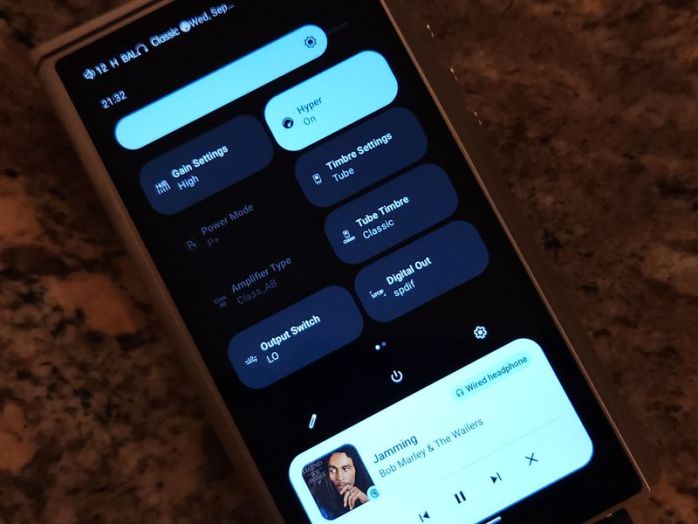
Cayin N30LE in a Hyper/Classic Tube mode gives you a unique combination of a natural, textured, analog tonality with a fuller body sound, similar to N8ii in Tube Mode with Class A and P+ output. But unlike N8ii where the higher sound resolution comes from a more revealing treble sparkle, N30LE achieves it with a more natural extended airy treble response and a scaled-up expansion in sound dynamics and layering which reminded me of Max320 performance but without the analytical transparency of the iBasso DAP. And on top of that, N30LE was able to expand its soundstage to not just being wider, deeper, taller, but also expanding the width to make you feel like the sound was wrapping around and behind you, creating a more holographic 3D effect. And with my test unit and IEMs/headphones/cables combination I tested, there was a pitch-black background and a fast transient response of details popping out of the blackness.
 (led lights should be green, but that’s how my phone camera captured it)
Other sound analysis observations.
3.5mm (SE) vs 4.4mm (BAL) – The tonality and the sound signature are nearly identical. There is a difference in soundstage expansion with BAL output being a little bit wider relative to SE. Also, BAL has a higher output power, so while using the same pair of IEMs I had to adjust the volume going between these ports. Otherwise, performance is very similar.
Class A (Hyper mode, Classic Tube) vs Class AB (Classic Tube) – To my ears the difference is very subtle when you just switch amp type between A and AB. But I do hear a bit more difference when switching to a Hyper mode which enables optimized Class A and P+ output. In AB the sound is a little faster, has more punch, and a bit less weight in lower mids. Hyper mode gives the sound slightly fuller body with mids being more forward, more expanded, more multi-dimensional and the volume increasing as well. Surprisingly, the change is not as much in tonality, but rather in technical performance.
NuTube Modern vs Classic – You have to listen very close to hear the difference. Nothing is night and day in this comparison, but Modern mode does have a bit less coloring, noticeably crisper treble, and overall, a bit more energetic sound. In Classic mode the mids have a little more coloring, treble is a bit smoother, and the sound has slightly more laidback presentation.
N30LE (Hyper mode, Tube Classic) vs N30LE LO + C9 (Class A, Tube) – In Hyper mode I hear a smoother and more textured analog tonality. With N30LE+C9 I hear mids to have a bit more revealing tonality and slightly narrower soundstage. I mean, the soundstage is still pretty wide with C9, but with earphones connected directly and Hyper mode enabled, the soundstage wraps around and behind you.
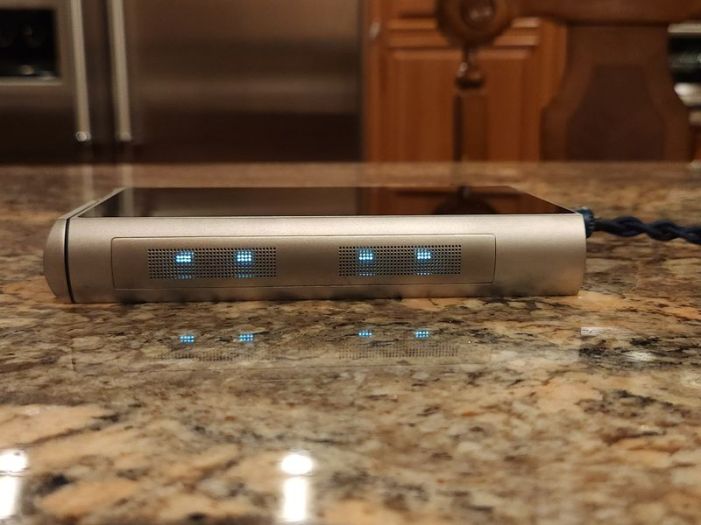 (led lights should be green, but that’s how my phone camera captured it)
Pair up and Comparison.
In this section of my review, I will go over how various earphones and headphones pair up and sound with N30LE. In each pair up I will also compare the performance of the same pair of earphones/headphones with other DAPs. These are short analysis notes to give you the basic idea of what to expect.
Since I wanted to be sure each source was set to its peak performance (relative to my personal preference), the following config was applied to each DAP:
- N30LE – Hyper mode (Class A, P+), High gain, Classic Tube, short delay sharp filter
- N8ii – Class A, P, High gain, Tube mode, sharp roll-off filter
- Max320 – Ultimate mode, G3 filter

Pair up with Headphones.
Audio-Technica ATH-R70x (vol 41) – R70x are open back 470ohm headphones and they do need to be pushed harder to drive them to their full potential which N30LE did with ease and plenty of headroom. In Hyper mode, the soundstage expansion is huge, literally wrapping around and going behind your head, and the imaging stands out with 3D holographic precision. The width of the soundstage expansion does exceed both N8ii and Max320 with those DAPs being wide, yet slightly narrower relative to N30LE. The tonality is still very natural, clear, and transparent. With N30LE there is a combination of natural detailed smoothness with expanded dynamics and less coloring. In comparison, N8ii has slightly more neutral mids and a little less air between the layers, while Max320 has more weight in sub-bass, leaner mids, and a bit brighter treble. To my ears, the layering and the separation of sounds in N30LE did standout in this pair up, especially micro-/macro-dynamics of vertical expansion of the peaks where it reminded me of Tsuranagi/475 performance but with a more natural tonality. With R70x, N30LE tonality sounds more in a direction of N8ii musicality with Max320 technicality.
MEZE Audio Empyrean (vol 32) – another pair of open back cans, and these planar magnetic headphones do sound very open with a precise 3D holographic imaging I heard with N30LE as well as N8ii and Max320. The sound sig is balanced, fast, very clean and clear, but the colorings in mids/treble does vary. With N30LE and N8ii, I do hear a deep sub-bass rumble with a little extra weight and a fast articulate mid-bass punch. With Max320 the bass is a little more elevated though. Mids/vocals have a natural, detailed tonality with a little more transparency in N8ii and slightly more warmth in N30LE, and Max320 mids are a bit brighter and more revealing here, though in all 3 pair ups mids do have this extra soulful texture. Treble is where I hear the biggest difference paired up with R70x. N8ii has less airy treble extension, while N30LE still retains the same musical smoothness but adds more air with an improved extension. Max320 makes treble sound crisper and airier. And again, I noticed the vertical dynamics of the peaks being more expanded in N30LE and Max320, but the tonality being more natural and more textured in N30LE and N8ii. This was another good example of similarity in musical tonality between N30LE and N8ii, while having more in common between N30LE and Max320 when it comes to a technical performance, such as dynamics, layering, and separation.

Pair up with IEMs.
Aroma Jewel w/FT (vol 20) – The soundstage is wide open and expanded in all 3 directions with holographic imaging, common across all 3 DAPs, maybe with N30LE being just a touch wider, especially wrapping the sound more around and behind you. Sound signature is balanced, as expected, and tonality being closer to natural with a more revealing presentation of the sound in upper frequencies. The variation between three DAPs was consistent and similar to what I found with other iems/headphones. N30LE gives you a smoother, more textured, and fuller body tonality in mids, while Max320 made mids more neutral, more revealing, and a bit thinner in comparison. N8ii was somewhere in-between, giving you a similar natural textured body, a bit more revealing than N30LE, but less analytical than Max320. The weight, the extension, and the punch of the bass was similar between N30LE and N8ii, while more elevated in Max320, perhaps due to a contrast with its thinner and more transparent mids. With treble, N30LE was a bit smoother in comparison to N8ii, while Max320 was a bit crisper and brighter. N30LE had similar treble extension as Max320 but the tonality and the presentation of the treble was closer to N8ii. And just like in other pair ups, N30LE yielded improved dynamics and better layering and separations of the sounds, similar to Max320, reminding me of what I heard with Tsu/475 amps.
EE Odin (vol 17) – Right away I can appreciate a pitch-black background with zero hissing, and as a matter-of-fact other sensitive iems (like Campfire) were the same. The soundstage here is huge, and so does the expanded holographic imaging, being on 3D level with all 3 DAPs. While paired up with N30LE, the sound signature is more balanced rather than usual mid-forward sig, and the same was with N8ii, where both of the DAPs added more natural body to the mids, though you can hear more analog texture in N30LE pair up. Max320 with Odin had a brighter and more transparent mids. The bass had a nice deep rumble and a tight fast mid-bass punch. Actually, with N30LE the speed and the articulation of the bass was similar to Max320 while with N8ii the bass was a bit laidback and slower. Mids is where N30LE and N8ii separate from Max320 since Cayin DAPs add more natural revealing body to the vocals while Max320 gave it more analytical details. But the technical performance with layering and separation of the sounds with N30LE scaled up to Max320 level, giving you the best of both worlds in terms of a more natural tonality and better technical performance. Treble tonality and extension were similar between N30LE and N8ii, perhaps a bit smoother with N30LE. In general, I wasn’t a big fan of Max320 and Odin pair up due to thinner vocals but was quite pleased with Odin and N30LE pair up.
UM Mentor Multiverse (vol 16) – Starting with the soundstage expansion, I do hear N30LE to be wider than both N8ii and Max320. With the latter ones, I heard more depth/height than width, though imaging was 3D holographic in all three. But with N30LE, it feels like the sound wraps around you. In this pair up with N30LE, I hear balanced W-shaped sound sig with a natural detailed tonality. The scale was tipped more toward warmer and fuller-body tonality with N30LE and a bit thinner and brighter tonality with less coloration using Max320. Bass sounded more neutral, relaxed, with a good extension down to sub-bass rumble and slightly elevated mid-bass punch when pared up with N30LE and Max320, though with N8ii it was a bit elevated in sub-bass. Pair up with N30LE yielded smoother and more natural treble response yet still with plenty of airiness and a great extension while Max320 gave treble a crisper and airier extension. MM treble response with N8ii was somewhere in between, giving a more natural tonality but still brighter than N30LE. The overall tonality of MM with N30LE was shifted more toward N8ii, while technical performance was more toward Max320.
FiR Audio RN6 (vol 17) – Here I found a huge holographic soundstage expansion, consistent across all 3 DAPs. N30LE had a more W-shaped balanced sound sig with a powerful speaker like analog bass response and more even tuning between sub-bass and mid-bass. N8ii and Max320 also sounded close to balanced but had more elevated bass impact where N8ii had more focus on mid-bass and Max320 had more weight in sub-bass. The mids/vocals of RN6 paired up with Max320 were less colored, more transparent, more neutral in lower mids and more revealing with higher resolution in upper mids. N30LE added more body to the lower mids, making vocals fuller in tonality similar to N8ii, but the upper mids had more clarity and higher resolution like in Max320. Similar to other pair ups, N30LE yielded a smoother treble response with more controlled airiness, while Max320 was crisper in treble. RN6 paired up with N30LE had treble tonality similar to N8ii, smoother and more natural, but the extension of the treble was on the level of Max320. From a technical performance perspective, RN6 scaled up with better dynamics and improved layering and separation while paired up with N30LE and Max320, but the pair up synergy of RN6 with N8ii gave the sound a bit less air between the layers of the sound.

Conclusion.
As I already mentioned, when it comes to flagship DAPs it is not always about which one is better. Every manufacturer puts their best effort into the design of the next flagship model. And a better DAP for you ends up being the one which has the best synergy with your favorite earphones or headphones. Of course, it’s a subjective opinion because we all have a different preference in sound and use different IEMs/headphones. But when we have access to more sound-shaping tools within a DAP, we no longer have to worry about which source to use, but rather using the available tools within a source to fine-tune the pair-up synergy. It’s almost like a modular design, except you don’t need to buy additional modules or switch between modules.
With N30LE you have access to even more options and setting combos than with N8ii, allowing you to switch between Solid State or dual NuTube in Classic or Modern modes, Class A or Class AB amp mode, extra voltage boost going from P to P+, and also a gain control on top of that. Or you can go straight to a Hyper mode with a maximized P+/Class A performance. Basically, you are in full control to mix and match these settings. And if you want more sound coloring, you have a choice between a regular Line Out or Pre-amp outputs to give you more flexibility when using the external amp. With all these available tuning options, you have access to multiple tools to finetune N30LE sound to a perfection, allowing you to achieve the best pair up synergy with your favorite IEMs and headphones.

 Twister6 Reviews
Wow..and that’s what dap did..Hm I’m not that rich..just stay with my endgame system for IEM which is: old in facts extinct Q5S TC(dualAKM4493which in RMEadi2 + dualTHX aaa as amps modules) + cheaps Xduoo MT604 which is 4pentodes = heaven is it..Notes:- I’m convinced that 5G phones with USB or analog or even Bluetooth Available for sourcing output yet able to music streaming sumore Ha3..all cheap sir..Peace!
LikeLike
Today you don’t have to spend a fortune to get a great sounding audio setup. Yes, you can get a usb dac dongle, like RU7, and use it with your phone.
LikeLike
Are you going to compare to other TOTL DAPS like you usually do or is this your new format? Personally I prefer the comparisons vs N8ii and A&K as well as other DAPS I have to gauge how this will sound. I agree DAPS don’t have a sound but your previous format was far more useful to me. Is it possible this is not 1/2 the review being only 2 pages and not 4? I don’t use IEMS so for me the performance vs other DAPS is fundamental as well as the Over Ear comparisons with the likes of Meze Empyrean etc.
Regardless thank you for a preview into this amazing DAP. As usual you are not only the first but also the best.
Regards,
Enrico
LikeLike
Well, originally this was meant to be my in-a-snapshot short review. They can’t sent me a long term review sample because it is a very limited edition and quite expensive. So, I borrowed it for a few days to make a short write up. But it was more then just a “snapshot” review since I added N8ii and Max320 comparison and pair up with a handful of iems/headphones. I’m sorry, it is not my usual complete full review because I only had it for a few days, just not enough time. But I tried to cover as much as I can… That is a reason I prefer long term review samples because I get asked so many questions about comparison and pair ups, especially in my future reviews.
LikeLike
Hello thanks so much for your informative review, I always look forward to your opinion as you have had the chance to compare so many DAPS. So I’m in the process of finally upgrading my A&K CU S1000 and so far the options are HiBy rs8, Sony mz2, A&K SE300, and now also Cayin N30LE. I’m also awaiting an L&P LP7 near future. ( Maybe you can give an exclusive if it is in the process of release). So you have $5000-$6000 and you can only have one DAP out of all those DAPs listed above which one will you keep?
LikeLike
Nobody knows anything about LP7 yet. But out of those you mentioned, N30LE is definitely a front runner for me.
LikeLike
Thank you so much for your review. N30LE vs SP3000 which one would you personally prefer.
LikeLike
As I mentioned in the review, it is not about which one is better, but rather which one pairs up better with your iems/headphones. Its Classic Tube Class A mode might sound amazing with more revealing or neutrally tuned iems, but could fail (lacks resolution, punch) with a warmer tuned iems. There has to be a pair up synergy which you personally prefer… Now, with all that said, N30LE simply gives you more sound shaping options to fine tune that pair up synergy. SP3k is great, but you can look at it as one trick pony. Thus, between these two, my personal preference would go toward N30LE.
LikeLike
Thank you for the great review. between the N30LE and Max320, which is one pair up better with VE Aura that you recently reviewed?
LikeLike
Aura was on a short loan for review thus I can’t do a real a/b comparison. Either sources should pair up well with this iem. If you want a deeper bass impact and more organic mids, N30LE is better. If you want to improve the resolution and have less coloring with more sound transparency, Max320 Ti.
LikeLike
i want to listen to bass notes when it is running riffs and basslines with good voice. I can only afford either the MAX320 or N30LE. Which one should i choose?
LikeLike
If you have to choose, N30LE will be a better choice due to all the available sound-shaping “tools” packed inside N30LE.
LikeLike
If you already had a Hugo2 + SP2000 + Cayin C9 ; would the N30LE be an upgrade, side-step or … just not value for money. We don’t have a local model to test. Will be driving Utopia (22) and the bird
LikeLike
If it would be up to me, I prefer everything in one package 🙂 SP2000 is a slow closed android OS, hugo 2 is just a dac (more neutral, not as colored) and under powered, and then you are adding C9 to bulk up your system. Instead, you can replace it with one N30LE, a compact DAP, super fast Android performance, lots of flexibility of different sound shaping options. That would be my call to replace everything else 🙂 Of course, you will be taking a financial hit selling other gear to get N30LE.
LikeLike
Excuse me as I ask an unrelated question ;]
I’ve been reading you a lot lately as I’m looking to get my first higher end dap and you give excellent details with troves of comparisons.
I almost got the wm1z but after more reading I’ve narrowed it to sp1000 and dx240 as they’ll have the treble and micro-detail focus I’m looking for, I believe?
I was wondering what your take is on some of the older totl daps like the sp1000 and wm1z vs some of the newer mid tier daps out now like the shanling m8, fiio m15s and dx240/300 and if the older totl models still offer a level of sound the new mid tiers can’t quite reach?
They’re similar prices these days so it’s been hard to decide.
Sorry to write in length but I felt the dap sage was the only one I could ask.
LikeLike
Can’t comment on FiiO daps since I haven’t tested any of their latest models. But since you are talking about older models, keep in mind the battery condition and possibility of issues… SP1k is very old, I wouldn’t even bother. DX240 is older, but at least you can “finetune” it with different amp modules. The original wm1z is classic and still highly regarded. Their android MK2 version is slow and not as responsive. Tbh, if you can find a good deal on the original wm1z golden brick, go for it. LPGT is also very good, one of my favorites (very fast boot up, small, responsive).
LikeLike