
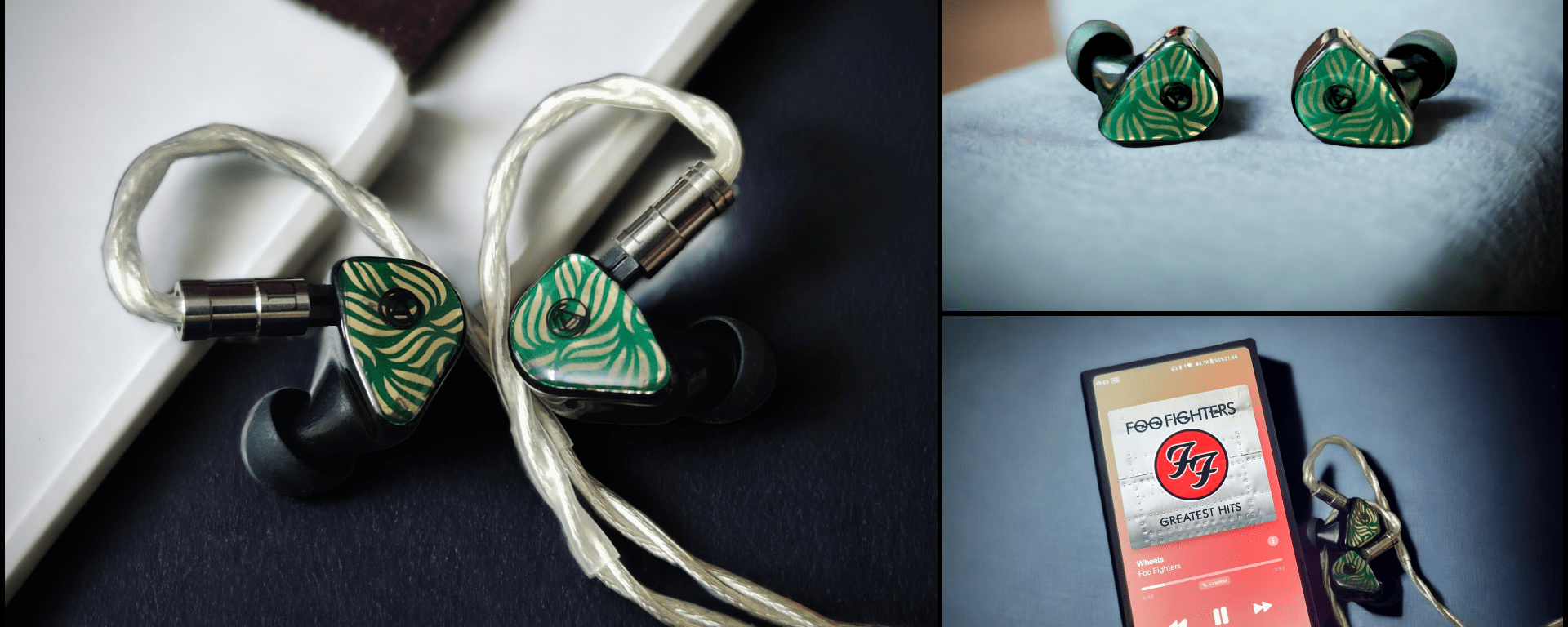
A Custom Art IEM with no BAs?
PROS: Good build quality with an attractive faceplate design, tasteful colour on top of reference tuning, very good technical performance for the price – bass details and dynamics, micro-detail retrieval, separation, layering and strong definition of instruments in the stage, Knowles filters to tweak the bass shelf, very comfortable fit, flat impedance tech.
CONS: Stock cable feels cheap, mid-treble dip, tip sensitive as the treble sounds uneven with the wrong tips, tuning filters too small and easy to misplace.
About Custom Art.
Custom Art was founded in May 2012 in Warsaw by Piotr Granicki, a long-time reviewer of portable audio equipment, Head-Fi member and DIYer. The natural step forward for him was to create his own series of earphones. The company’s foremost philosophy is to deliver the best products possible at the most affordable pricing and delivering this kind of quality requires Custom Art to be excellent at service and sound. As one of the few companies in the world offering custom in-ear monitors in silicone instead of regular acrylic, Custom Art takes advantage of silicone and its soft comfort to allow monitors to be worn for longer periods.
In 2015, the company entered the acrylic CIEM market with the Ei.3, the world’s first 3-way, 3-driver CIEM priced below $300. In August 2015 Custom Art introduced FIBAE technology. The name stands for Flat Impedance Balanced Armature Earphone and is world’s first, revolutionary IEM design providing flat impedance and phase, which solves one of the oldest problem in the audio industry – dependence on output impedance of sound source for correct earphone output. IEMs equipped with FIBAE technology will always perform best from any audio source. First two models (single driver FIBAE 1 and dual-driver FIBAE 2) were released in April 2017.
Official Website – Hybrid 3 Pro UIEM (€700) | Hybrid 3 Pro CIEM (Starts from €800)
Technical Specifications.
- Drivers – Single Low Dynamic Driver, Single Mid Dynamic Driver, Single High Planar
- Impedance – 7 Ohm @1kHz (+-1.3 Ohm 10Hz-20kHz)
- Frequency Response – 10Hz-19000Hz (+-5dB into IEC 60318-4 coupler)
- Sensitivity – 110dB @1kHz @0.1V
- 3D-printed waveguide
- Custom or universal fit
Included in the box.
- H3 Pro UIEM
- Ear tips – SML silicone single flange, 1 double flange
- Cleaning brush
- Warranty card
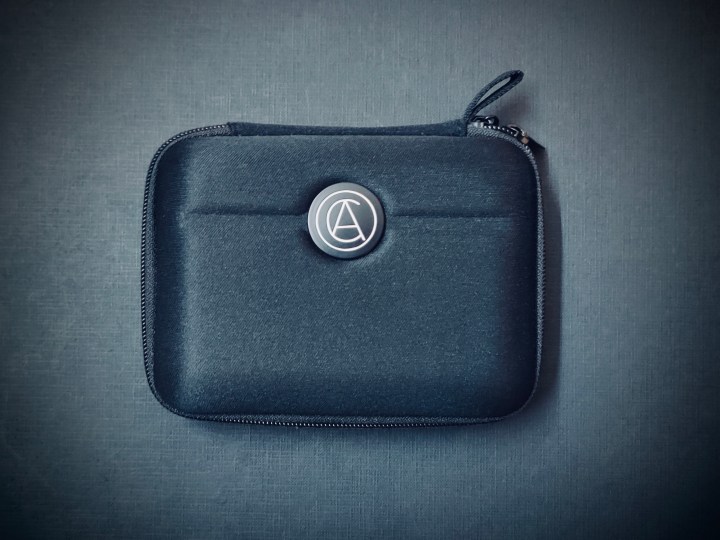
- Zipper case
- Knowles filters + tool (if you purchase the tuning kit)
Build Quality, Fit and Comfort.
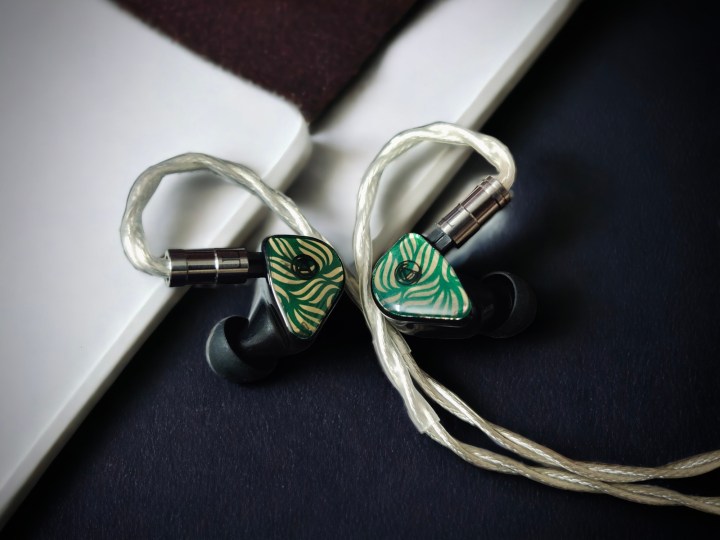
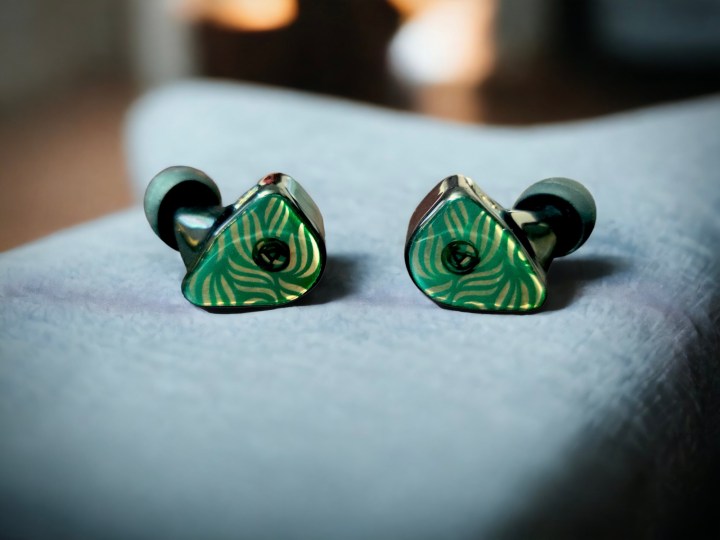
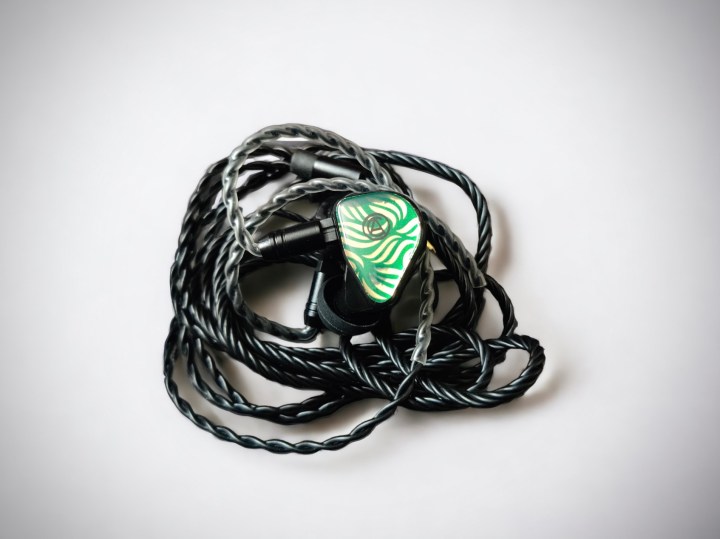
H3 Pro are slightly larger than F7 but smaller than F5. They share F7’s shape but have deeper depth. They’re all in fact tiny, very well designed considering the kind and number of drivers they fit. H3 Pro has a nice resin build with a faceplate design that looks like it’s a collaboration project with Starbucks. Quite simple but unique and attractive as I’ve never seen this faceplate from another IEM manufacturer before. Nozzle are the perfect size to fit most tips and make for a very comfortable snug fit. It has 2-pin sockets with a hole below to fit the Knowles filters, which are offered for one to tweak the bass shelf as per one’s preference.
For me the fit is very snug and the shells sit flush with the outer ear. Custom Art shells have always been some of the most comfortable shells for me, which I can even use to watch movies while laying down sideways. On top of that they isolate really well too.
Cable – H3 Pro comes with a non-branded cable. It is soft, supple, light and has absolutely no downward pull which makes for a very comfortable wearing experience. It’s a decent cable for live/performance as it almost disappears when wearing it but for proper high quality audio performance, this isn’t the best. It feels a little too thin and cheap considering H3 Pro’s asking price, a price segment where some brands now offer flashy cables with swappable jacks and what not.
FIBAE (Flat Impedance) Tech.
Custom Art’s FIBAE flat impedance technology is highly welcome breakthrough tech that is extremely useful without you even knowing that you need it. Since low impedance IEMs can act quirky and sound absolutely wrong when plugged into sources with high output impedance (hint – Andromeda), it is not only great for audiophiles who like using a multitude of sources to listen to music but even more useful for musicians who have to plug their IEMs into an even more variety of unpredictable gear depending on availability and situation, especially when you need to plug IEMs into extremely unpredictable vintage gear with ‘who knows what’ output impedance. FIBAE tech makes sure that the source’s output impedance won’t affect the sound signature of the IEM, whatever source/device you plug it into.
Drivability – H3 Pro has a very low 7Ω impedance, fairly high sensitivity of 110dB and is extremely easy to drive!
Sounds Analysis.
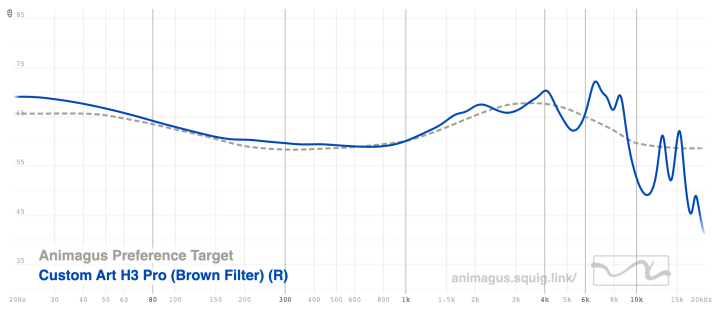
Graphs are measured using an IEC60318-4 (IEC711) setup. You can compare all the graphs on my IEM Graph Database here – Animagus Squiglink.
Summary – H3 Pro with the Brown Filter has an exciting, sparkly, sub-bass boosted neutral signature that adds very slight, tasteful colour on top of reference tuning. It has a presentation that has a micro-detailed approach to instrument definition, placement, separation and detail retrieval, all the while having a good quality of keeping the musicality alive without coming across too strident or cold.
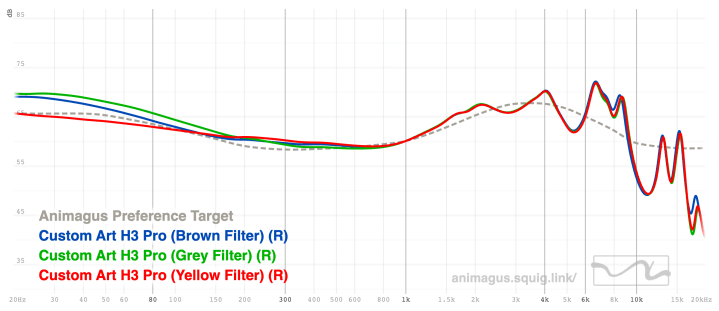
Filters to increase and decrease the bass shelf (graph below) – You can increase or decrease the bass shelf by using the H3 Pro tuning kit that Custom Art sells separately for €50. The Yellow Filter decreases the bass shelf by about 3.5dB and the Grey Filter increases the sub-bass and the mid-bass by about 1dB and 1.5dB respectively. Just be careful when handling the Knowles filters as they’re very small and are quite easy to drop and misplace.
Tip selection – One needs to choose the tips wisely as you can have H3 Pro sounding extra sparkly or warm with choice of ear tips. I personally like it with Final E, Softears Foam, Symbio W and F. With Azla Sedna Standard/Short and similar wide bore tips it sounds a little bright for my tastes.
I also highly recommending switching out the stock cable for a nice UP-OCC or similar quality of cable as the stock cable is nice for live and on the go use but not ideal for audiophile level performance. It is particularly restrictive when it comes to staging and openness of sound that the H3 Pro is capable of. You don’t even have to go for anything expensive. Custom Art themselves offer a few fair priced sub-$100 cable options from Null Audio. Maybe you can just negotiate with them to swap out the stock cable for a nicer one.
Let’s dig in deeper…
Bass – H3 Pro’s has a DD handling bass and another handling the midrange. It has about a 10dB bass shelf with the Brown Filter which is carved out really well. The bass has natural timbre with very good tonality along with very good speed, precision and separation in the centre. It generally plays the songs as per the mix and has very good punch and slam when the song calls for it. You can increase the punch and slam even more by putting in the Grey Filter which boosts the bass shelf by a couple of dBs.
Midrange – It has a fairly clean sounding lower-midrange and a forward upper-midrange with double peak ear gain like the U12t but one that has more gain in comparison, resulting in strong and forward definition of vocals and instruments. It has a north of neutral 4kHz peak and this is where I’d advise tip rolling. It can highlight vocal presence and instrument attack, particularly stick attack, which with wrong ear tips can come across a little snappy and shouty to the sensitive. With the right tips, it actually adds on greatly to vocal and instrument realism and liveliness, adding tasteful energy and excitement to songs.
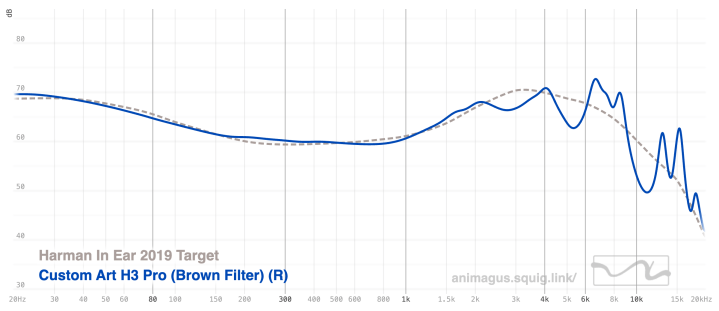
Treble – H3 Pro has its focus on lower-treble sparkle than mid-treble sizzle like the FIBAE 5 or upper-treble air like the FIBAE 7U. How sparkly the lower-treble sounds is subject to the filters and tips you use. With the stock and right 3rd party tips like Final E and Symbio W, it comes across perfectly balanced but with the wrong tips, the north of neutral sparkle along with the mid-treble dip adds a slight metallic tinge to stringed instruments and snare hits in brighter mixed songs, which is why I highly recommend tip rolling. In my experience, Custom Art IEMs take on tips really well and have the ability to sound exceptional with the right pairing. Also, using the Grey or Brown Filter for the bigger bass shelves help fine tune the signature and tilt the IEM warm or bright as per your preferences. With the right tips, especially ones that have a nice snug fit along with filters that have the kind of bass shelf one likes, it not only promotes good balance for a natural tonality but even more, detail retrieval and energy to make music sound exciting. This is an IEM that focuses on instrument clarity and micro-detail retrieval the most and a lot of it has to do with the treble tuning. It’s more neutral in the upper-treble region with extension that is more on the airy side of Harman target (see graph below) but slightly on the warmer side of my Preference Target (see graph above). For reference, it is brighter than F7U and U12t, less sizzly than FIBAE 5, airier than Harman target but not as airy as the F7U or the U12t.
Technical Performance – This is a very capable monitor when it comes to technical performance in this price segment, especially when it comes to vocal and instrument definition and strong instrument placement and imaging in the stage. I feel this will particularly be great for live monitoring as it manages to keep instruments highly defined, sounding crisp and sharp even with high levels of crowd noise in the background. It has a nice open stage with good width and depth, falling just slightly short of FIBAE 5’s level of staging (which is an exceptionally open sounding one if you don’t know). Really good micro-detail retrieval along with good depth layering has it performing complex, layered songs with fair ease.

Comparisons.
Custom Art FIBAE 5.
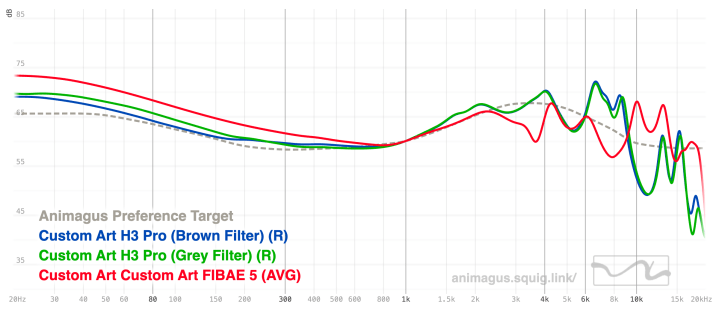
FIBAE 5 (F5) has a 1DD + 2BA + 2 Planar Driver config and is significantly different sounding IEM compared to H3 Pro, which is what I love about Custom Art’s range as all their IEMs offer something significantly different. F5 has a more coloured tuning with a much bigger bass boost of about 13dB compared to H3 Pro’s 10dB. F5’s bass in fact has much more mid-bass than H3 Pro’s and more slam and punch as a result. F5 has a much fuller lower-midrange which makes instrument body sound fatter than it is compared H3 Pro’s more neutral presentation. F5 has recessed upper-midrange in the 2-4kHz region which pulls instrument definition back and makes for easier listening at louder volumes (though I highly recommend keeping your volume levels in check). H3 Pro on the other hand is more neutral in this region with more accurate ear gain but its extra boosting at 4kHz can have instruments sounding sharper than reference accuracy and as a result, shoutier at louder volumes. Where F5 gets its treble uniqueness from the sizzly mid-treble boosts that adds on vibrancy to its signature resulting in hi-hats and cymbals sounding a little energetic and sizzly, H3 Pro comes across more sparkly because of its boosts in lower-treble where vocals and instruments like acoustic guitars get some extra sparkle and zing. F5 has better mid-treble and upper-treble extension which results in it coming across more open and airier resulting in a bigger soundstage overall with wider and deeper boundaries. F5 also has better left to right separation but its the H3 Pro that has better instrument definition and stronger perception of instruments placement in the stage. Both have good micro-detail retrieval but do it in different ways because of their differing signatures.
BGVP Phantom.
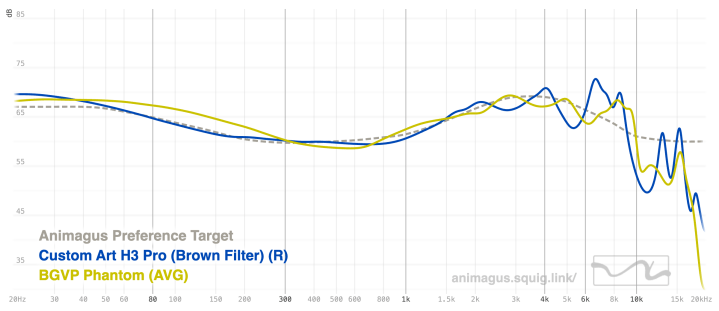
Phantom is a quad-brid with 2DD + 2BA + 2EST + 2 Bone Conduction drivers. Phantom has similar-ish bass shelf but one which boosts more mid-bass and as a result sounds punchier and has more slam. Also, because of the dual BCD, its bass comes across slightly more three dimensional. H3 Pro on the other hand goes for a very well crafted sub-bass boosted reference approach. Phantom has very slightly fuller sounding lower-midrange while H3 Pro’s is again more neutral, more accurate in comparison. Phantom has slightly more natural tonality and timbre owing to a more linear and accurate ear gain along with more even treble tuning. H3 Pro is sparklier and comes across as having a slightly more clinical approach to detail retrieval and instrument clarity in comparison. Overall Phantom has a more pleasing tonality with a fuller sounding soundstage and better punch and slam along with slightly better depth layering while H3 Pro has a cleaner, more open sounding stage with better detail retrieval, better separation and stronger instrument definition in the stage.
Kinera Nanna 2.0.

Nanna 2.0 has a neutral-bright tuning too like the H3 Pro but a very different sounding one. H3 Pro has slightly more sub-bass rumble. Both have a very clean sounding lower-midrange but H3 Pro has stronger sounding upper-midrange owing to more ear gain which is also more accurate towards reference tuning relatively. This results in stronger instrument definition along with better tonality and timbre of instruments. H3 Pro’s slight emphasis in 4kHz has it pushing the attack of instruments while the Nanna 2.0 has a dip there resulting in slight blunting of the same. Nanna 2.0 has the slightly more even treble presentation out of the two. H3 Pro is sparklier in lower-treble whereas Nanna 2.0 is brighter in the 8-13kHz of ending lower-treble and all of mid-treble. This leads to H3 Pro focusing on bringing out extra clarity to acoustic and stringed instrument and Nanna 2.0 highlighting hi-hats and cymbals for some energy and vibrancy. When it comes to technical performance, both are quite competent but H3 Pro’s takes the cake with a slightly deeper stage, better micro-detail retrieval and slightly better imaging and layering.
Conclusion.
Hybrid 3 Pro is another good addition to Custom Art’s new evolving lineup of IEMs that all boast of the awesome flat impedance tech they’re known for but now have very interesting driver configs like 1DD + 2BA + 2 Planar Driver in the FIBAE 5 and 2DD + 1 Planar driver in the H3 Pro besides the multi-BA IEMs they’re generally known for. What’s great is that they’re also trying to give buyers the option to fine tune the bass shelf as per their preference using swappable Knowles filters. The filters sure work quite well but I think Custom Art should invest some time and money into developing something like 64 Audio’s swappable filters which are a decent size and much easier to handle, as the Knowles filters are too small for easy handling and quite easy to drop and misplace. They also need to get rid off the cheap thin stock cable and come in line with competition as other companies are now including flashy cables with swappable jacks in price segments much lower than H3 Pro’s. With all that said, H3 Pro provides a very attractive package when it comes to FIBAE tech, tonality and technical performance for its price segment. It is an IEM that I think will be a nice option not only for musicians to use for live monitoring (particularly vocalists, guitarists and keyboardists) but also for audiophiles who love IEMs that prioritise good tonality with good detail retrieval and particularly, strong instrument definition. I highly recommend giving it a shot if and when you get the chance!
Gear used for testing and review.
- DAPs – HiBy R6 Pro II | iBasso DX240
- Dongle – Tanchjim Space | iBasso DC04 Pro
Artists I like and listen to.
- Rock – Foo Fighters, Linkin Park, Switchfoot, Imagine Dragons, Daughtry, Green Day, MuteMath, X Ambassadors, Dave Matthews Band, Vertical Horizon, Our Lady Peace, Lifehouse, Fall Out Boy, Breaking Benjamin, Muse, ACDC, Audioslave, Rage Against the Machine, Biffy Clyro, I Am Giant, Normandie, Paramore, Slash & Guns N Roses, 3 Doors Down.
- Pop Rock – John Mayer, Coldplay, Paul McCartney, James Bay, Hunter Hayes, Niall Horan, Keith Urban, The Bros Landreth, Bryan Adams.
- Progressive Rock/Metal – Porcupine Tree/Steven Wilson, Karnivool, Tool, Dead Letter Circus, Periphery, Lamb of God.
- Pop/Soft Rock – Ed Sheeran, Adele, Taylor Swift, OneRepublic, The Script, Gavin James, Magic Man, Maroon 5, Bruno Mars, Charlie Puth, Dua Lipa, The Weeknd, Oasis, Panic! At the Disco, TwentyOne Pilots.
- EDM – Chainsmokers, Zedd.

 Twister6 Reviews