

Comparison.
The comparison was done using E12 with a stock cable and LPGT source; volume matched in every comparison.
E12 vs RN6 (black atom) – some might ask, would it be fair to compare FirAudio mid-level IEM to its flagship that cost a double? I think it’s a fair question because while RN6 is the flagship of Frontier series, some of its technology did trickle down to a more affordable member of Fir’s Electron series. You still get Atom venting, though it is not replaceable, and you get the same build quality and design details, not to mention a bonus of replaceable/customizable faceplates which you can’t get with RN6. But the most important point here is the bass. Yes, you can definitely get a satisfying taste of RN6 kinetic bass which E12 shares DNA with. When used with a black module, my current favorite w/RN6, you are getting a pretty damn close sense of the sub-bass rumble and mid-bass impact. The difference with E12 is that its lower mids are more attenuated down and upper mids are more forward, so RN6 bass has a perception of having a bit more weight. But at the same time, E12 bass is cleaner, more controlled, more tactile and precise. And as you can imagine, the warmer fuller body of RN6 is complimented by a higher clarity of mids in E12. With treble, you get better extension and airiness with RN6, especially since it has EST high driver, but E12 holding its own with a natural clarity. Some people like to draw the conclusion from a comparison, deciding which one is better or superior, often looking at the extra tech or the pricing. Here, I will dare to say, they are complementary in their tuning and functionality. I love RN6, no question about it. But I’m also enjoying a hell out of E12.
E12 vs KR5 (black atom) – It takes 5-10sec for my ears to adjust when switching from E12 to KR5 due to a very noticeable difference in sound tuning and presentation. The first thing you notice is a more intimate soundstage and presentation of KR5 sound in comparison to a more expanded bigger expansion in E12; literally more expanded in all 3 directions. E12 bass is also noticeable more elevated from sub-bass rumble to mid-bass punch, being punchier and more precise, while KR5 bass is more neutral and relaxed in comparison. The overall tuning of KR5 is more balanced, smoother, more laidback, while E12 is more energetic, with more forward and higher clarity upper mids and treble. Again, both have their own unique tuning and sound presentation. If you want more energy, more bass, more clarity, then E12 definitely has an upper hand. For a more intimate, laidback, smoother sound go with KR5.
E12 vs VxV – If I’m not mistaken, VxV along with M-series has been discontinued and no longer available from FirAudio. But I have seen a few people posting questions about the comparison of VxV and E12. After all, aside from Bellos X-series CIEMs, these are the cheapest FirAudio models. Sorry to disappoint VxV fans, but E12 trumps all over it. In this relative comparison, VxV really does sound like an entry level IEM with narrower soundstage, lower resolution, and a bit rougher tonality. VxV bass is a lot more neutral, mids are not as resolving or as layered, and mid-treble has harsher peaks. In comparison, E12 bass has deeper extension with more rumble, more elevated punch, more weight, better overall control; its upper mids have more resolution, more layering, and the treble sounds more natural and less fatigued. If you have VxV and thinking about moving up within FirAudio lineup of IEMs, E12 would be a good next logical step if you want to stay under $2k budget.
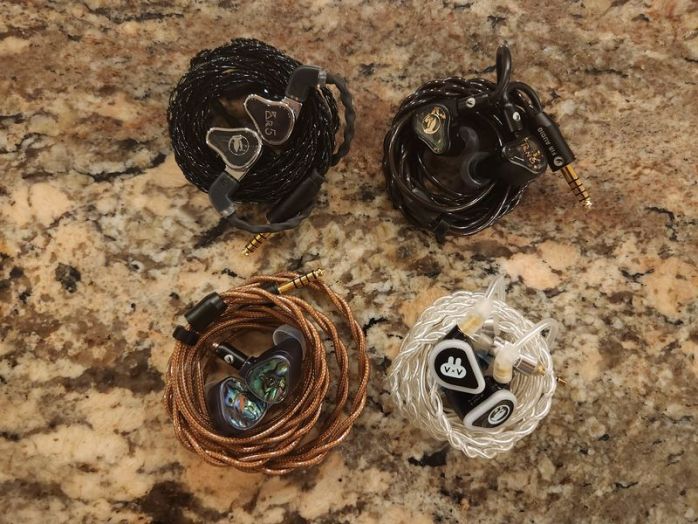
Having a single DD driver E12 design begs a question of how it compares to other single DD iems. Unfortunately, I don’t have as many for comparison. I have reviewed A8000 in the past, but at the current moment it is on loan with one of the contributing reviewers on our site. But I can certainly recall by memory that A8000 bass is rather flat and neutral in comparison to E12, while its upper mids and treble will be more micro-detailed, more revealing and brighter. Another popular single DD is IE900 which I finally had a chance to hear early this year. I hate going by a distant memory, but can only comment that while they both offer a very impressive bass performance, to my ears IE900 treble was rather harsh and fatigue. So, I will leave it at that and provide a few comparison examples with a couple of other popular hybrids.
E12 vs 64 Audio Trio – I have be honest, once I started listening to E12, the first thing that crossed my mind was “it has a hybrid iem coherency… I have to compare it against Trio”. There are definitely some similarities in sound presentation with emphasis on bass and upper frequencies, but also a variation that helps differentiate these two. The extension, impact, and control of the bass is scaled down in Trio, having noticeably less weight and longer decay of notes in comparison to snappier and more articulate mid-bass with a shorter decay. The difference in mids is that Trio has a slightly fuller body lower mids and less emphasized upper mids while E12 has leaner lower mids and more forward and detailed upper mids. As a result, Trio vocals are more laidback and smoother, while E12 has more forward and more energetic presentation of vocals. Then, relative to treble, Trio’s mid-treble is more emphasized, making it stand out even over its bass, while E12 mid-treble is as clear and as energetic as its upper mids. Due to this tuning, Trio’s bass and vocals are more coherent, laidback, while treble is over-emphasized which in some tracks could become fatigue. In contrast, E12 bass stands out from its mids and treble, creating a better coherency with improved retrieval of details in upper frequencies.
E12 vs UM Mest MK2 – another comparison, in this case against a quad-brid which I’m sure some will be interested in. Of course, there is a difference in sound signature that stands out right away, with V-shaped tuning of E12 vs U-shaped tuning of MK2. That reflects in both having a deeper sub-bass extension, while E12 has a punchier mid-bass impact, lifting the weight of the bass. Both have an unmistakable DD bass performance, but E12 bass quantity is noticeably scaled up. Moving up to mids/vocals, MK2 has its vocals pulled back, more into the background, with a smoother tonality, the reason for its U-shaped sound sig. In comparison, E12 has upper mids more forward, brighter, more energetic. And with treble, both have it emphasized, but it creates a much bigger contrast in MK2 due to its presentation of upper mids/vocals, while in E12 it is more evenly balanced across upper frequencies. In this case, if you want more elevated and articulate bass impact with more forward presentation and enhanced clarity of vocals and wider soundstage expansion, E12 is the way to go.
E12 vs VE EXT – was looking forward to this comparison as well since I had a feeling the bass performance might be a close matchup. Yes, EXT is almost double the price of E12, but still a worthy comparison. You do need to raise the volume since EXT has lower sensitivity, and once you match it the rumble and the impact of the bass is almost the same. Another thing I noticed to be very close was the soundstage expansions, nearly the same in all 3 directions, quite a good match between these two IEMs. But the rest does vary. EXT mids have more body, sounds fuller and warmer. And EXT treble, despite having quad EST drivers, also sounds smoother though with more airiness. In comparison, E12 has more revealing brighter upper mids and treble, adding higher resolution to the sound. It is another comparison case where one is not better than the other, just different depending on your preference. But the bass performance and the soundstage expansion are quite similar. One thing to note, EST drivers help with treble extension and soundstage expansion, so E12 might not be able to match EXT or RN6 in treble extension since it doesn’t have EST drivers, but E12 still has a great layering and separation and soundstage expansion by itself with its single DD driver.

Conclusion.
It probably sounds cliché saying that I didn’t know what to expect when I received these IEMs, and I honestly didn’t. And sometimes you just assume where the product would stand based on the price and the driver config relative to other IEMs offered by the same manufacturer. But in case of Electron 12, these are just unique in their own way, offering a single driver design with a hybrid driver performance, tricking your ears and your mind into thinking that you are listening to an IEM with a powerful DD bass and multi-BAs covering the rest of the spectrum. This is kind of ironic since many IEM manufacturers are striving for the opposite, a tuning of tribrid or quadbrid designs with a coherency of a single driver.
E12 has a mature tuning with a big, expanded sound and a mildly V-shaped signature with a clear, detailed tonality. Here you get a powerful, tactile, articulate bass impact, and a clear, detailed, transparent upper mids that pack lots of energy. The tuning and the presentation of the sound is not as musical as Frontier Series which has a more blooming kinetic bass and fuller body mids, but that is what makes E12 sound unique and complementary to something like RN6 or KR5. And despite its smaller price tag, E12 SwapX design is a step ahead of Frontier series, offering user-replaceable and customizable faceplates in addition to internal Atom module and modular shell design.
I hope we are going to see more models from this new Electron series. Seeing the potentials of E12, I can only imagine what Fir Audio can come up with next, maybe with a bigger or a different DD driver. Or maybe they can add EST driver to E12. But regardless of what they will decide to do, I’m already looking forward to it and probably going to be as surprised, again, because you never know what to expect from Belonozhko brothers!

 Twister6 Reviews