

A promising new brand that does well!
PROS: Good sub-bass boosted warm reference signatures with very good tonal and timbral quality, good bass and midrange performance, good technical performance for their price segments with special mention to Canon II, good no-BS build quality, very comfortable fit, nice cables and leather cases (especially Moonlight Ultra’s leather case).
CONS: Nitpicking – Both are a bit safe in treble tuning as both could use more sparkle in treble, basic accessories except the nice leather case that comes with Moonlight Ultra, only 1 set of ear tips included as stock with both IEMs.
About Yanyin Audio.
Yanyin Technology was incorporated in 2020, but when it comes to experience of the founding members, the company has existed since 2012 and comprises of core members who have experience working in IEM crafting and tuning for over a decade, starting from hand crafting IEMs, to OEM designing and manufacturing for other well known brands. Today they’re an established international brand for Research and development [the Rd logo, also the meaning of Yanyin in Chinese: Research [Yan] in Acoustics [Yin]] and manufacturing of Hi-Fi IEMs. As per their rep Joseph, the company applies itself rigorously to Research and development of IEMs that express the musicality of audio recordings by faithfully reproducing every nuance of every musical performance without distortion or omission. They’re now onto the second generation of IEMs products and have been selling worldwide with excellent results. Yanyin say their tuning is based on earnestly listening and acting on a decade’s worth of user feedback, which is why it is very mature, yet gives a clear different character to each model. They say they have always insisted on giving the best quality of product and service, and in this age of high inflation of product prices, their motto is always to keep prices reasonable and try and give the best sound quality for the price.
Official seller – Yanyin @ Linsoul Audio
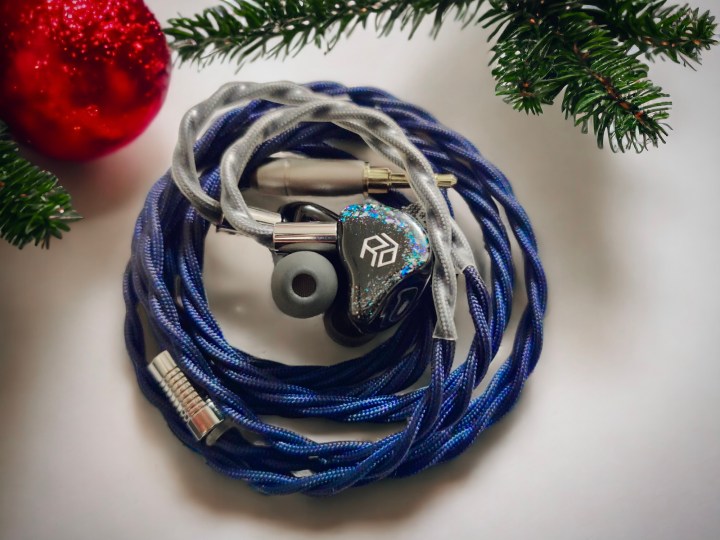
Technical Specifications.
Moonlight Ultra.
- Driver – 10mm Bio-diaphragm dynamic + 3 Knowles independent balanced armature + 1 Sonion balanced armatures+ 4 Sonion electrostatic units
- Shell Material – Medical grade resin
- Frequency response – 20Hz-40kHz
- Input sensitivity – 112dB
- Impedance – 27Ω
- Cable – 26 AWG 6N single crystal Copper + 26 AWG 5N pure Silver materials with 24 AWG Oxygen-free Copper shielding layer
- Connector – 0.78mm detachable cable design
- Jack – Choice between 3.5mm, 4.4mm and 2.5mm
Canon II.
- Driver – 1DD + 4BA
- Impedance – 27-40Ω
- Input – 112dB
- Frequency – 5Hz-25kHz
- Shell Material – Medical grade resin
- Cable – 4-core Graphene Silver Plated Single Crystal Copper Cable
- Connector – 0.78mm detachable cable design
- Jack – Choice between 3.5mm, 4.4mm and 2.5mm
Build Quality, Fit and Comfort.
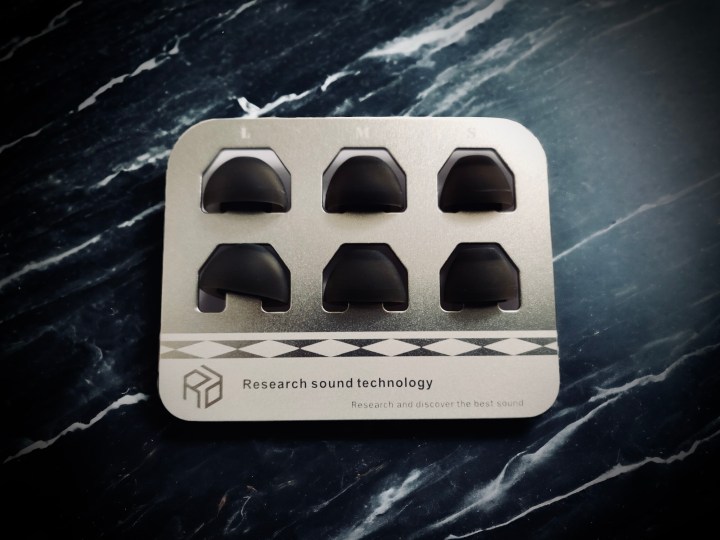
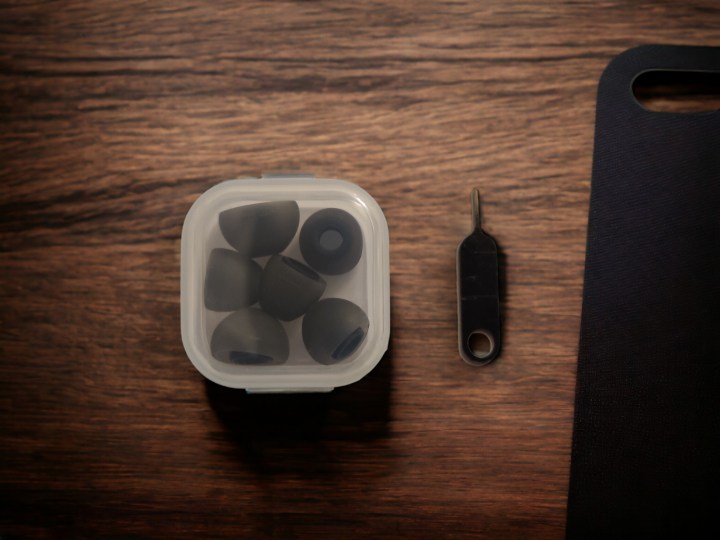
Both the Moonlight Ultra and Canon II have a similar build with a similarish design. They’re made out of resin and have semi-custom contours for a very comfortable fit that is very easy on the ears for the longest listening sessions. Both have metal nozzles with a strong lip to hold the ear tips and they come across as well thought out designs. They both come with very nice leather case – Canon II a small light brown coloured case while the Moonlight Ultra a big black, designer leather zipped case that has contours on the inside to denote space for the shells and a looper to loop the case. The only complaint I have with both is that they come with 1 set of ear tips. Even thought they’re very nice tips that allow for a very comfortable fit, it’s a let down for ear tip rolling enthusiasts that like to experiment with tips for fit and tweaking the sound to their preferences. Yanyin surely could’ve done much better in this regard!


Cable – They both come with pretty nice cables. Both are 2-pin and offer the option to choose between 3.5mm, 4.4mm and 2.5mm jacks. Canon II has a white coloured, 4-core Graphene Silver Plated Single Crystal Copper cable that is very supple and is the right thickness to feel well built while easy to manage. The Moonlight Ultra cable on the other hand is a 26AWG 6N single crystal Copper + 26 AWG 5N pure Silver materials with 24 AWG Oxygen-free Copper shielding layer, which I feel is a light stiff and fat to be very ergonomic for on the go use. Don’t get me wrong, it’s a very nice cable but just a little thick for my tastes.

Sounds Analysis.
Drivability – Both IEMs have low impedances and fairly high sensitivity to make them very easy to drive.
Canon II

Graphs are measured using an IEC60318-4 (IEC711) setup. You can compare all the graphs on my IEM Graph Database here – Animagus Squiglink.
I’ll primairly be using the 00 switch combo as the reference point (because it’s the stock combo and my favourite out of the 4 too) for the sound analysis.
Summary – Canon II has a no-BS, tastefully bass boosted warm neutral signature that is equal parts refined and versatile. Canon II has a very nice 8.5dB bass shelf that boosts both sub-bass and mid-bass without bleeding into the midrange or overpowering the rest of the FR, a very neutral and clean lower-midrange, twin peak forward upper-midrange with about 8dB ear gain, very neutral lower-treble and very slightly warmer than neutral upper-treble. It’s the kind of IEM that sounds natural and accurate as soon as you put it your ears and doesn’t require much adaptation period and with its easy on the ears nature, it’s an absolutely fatigue free listen even in the longest of listening sessions.
Let’s dig in deeper…

Bass – One of the most impressive things about Canon II’s bass presentation is how well separated it is in the centre. This allows for bass performance stand out and not play a supporting role behind the whole band. The 8.5dB bass shelf allows for it to have impressive rumble and mid-bass punch, but one that is quite in control tastefully. It is quite a substantial bass boost and yet never takes over the rest of the FR and manages to shine nicely in its place.
Midrange – It has a very clean and neutral lower-midrange and about 8dB of ear gain with twin peaks like the 64 Audio U12t. I personally like about 9-10dB of ear gain and Canon II’s 8dB of ear gain feels very slight recessed, especially because of the dip in the very important 3-4kHz region. But it still allows for a very nice forward definition of instruments in the larger scheme of things and along with the very clean lower-midrange, it makes for a very accurate tonal and timbral presentation of vocals and instruments. In fact the U12t sounds more recessed in this region compared to Canon II. Filling up the 3-4kHz dip with EQ allows for even better tonal performance and I wish Yanyin would’ve got this right from the start. Yet, this is one IEM that impresses with its midrange quality right off the bat and has very good layering and separation that helps with very good separation and space between instruments.
Treble – Canon II treble has very even treble with fairly good extension but one that is on the warmer side of what I consider neutral. The thing is that even though it’s very slightly warm, it’s not dark by any means and maintains a very easy to listen to character which remains easy on the ears for the longest listening sessions and yet has enough energy to make for an interesting listen. You could criticise it for being a bit on the safe side, but that’s not to big a con to be honest, in fact a pro as it is so smooth and easy to work with on an every day basis. It surely is never boring. The rather linear treble character also helps keeps the natural-ness and accuracy of the midrange tonality intact, which makes Canon II stand out as a fairly accurate listen with a tasteful bass boost.
Technical Performance – Canon II has impressive technical performance for its asking price. Canon II had impressive left to right separation and good space between instruments, which isn’t as common with IEMs in this price segment. It also is able to create a better sense of a round soundstage than most IEMs I’ve heard in the sub-$500 price segment. It would’ve had even better imaging and definition if it didn’t have that dip around 3kHz but it’s no slouch. It has pretty good detail retrieval and resolution for a warmer IEM too. All in all, it does it all pretty well for its segment, in fact beating above its asking price.
Moonlight Ultra
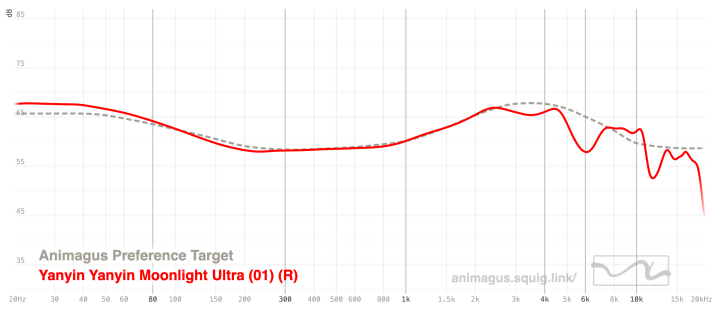
Graphs are measured using an IEC60318-4 (IEC711) setup. You can compare all the graphs on my IEM Graph Database here – Animagus Squiglink.
I’ll be using the 01 switch combo as the reference point (because it’s the stock combo and my favourite out of the 4 too) for the sound analysis and include differences between switch combos along the way.
Summary – Moonlight Ultra is a slightly warmer take on sub-bass neutral style of reference tuning with about an 11dB bass shelf that goes for a nice sub-bass lift and a cleaner mid-bass boost, a very clean and neutral lower-midrange, a forward upper-midrange with about 8dB ear gain, a slightly dip in 4-6kHz of lower-treble, more neutral mid-treble and fairly airy upper-treble region. With a combination of switches, you can lift the bass by about 2dB and reduce the treble post 6kHz by a significant margin to make for a much warmer listen. In the 01 and 11 switch configuration, it is a natural listen that sounds good from the get go without the need for an adaption period but it’s the dip in the lower-treble region that skews it on the warm side and makes it a little too safe a tuning. Now safe tunings are like a jack of all trades that you can’t go wrong with but lack the sparkle and sizzle to make them have that special sauce to stand out shining bright. Even though Moonlight Ultra is quite a well-tuned IEM, likability will depend on whether you’re looking for a do it all IEM or an IEM with a more coloured tuning with sparkle, vividness and energy over neutrality.

IMO, it’s the 01 and 11 combo that’s actually the better ones, with the 11 being a 2dB bassier version of 01.
Let’s dig in deeper…

Bass – Moonlight Ultra has a 10mm bio-diaphragm DD handling bass duties and it’s a very good one at that which is tuned even better. It has a very natural timbre along with very good rumble and slam. If the 11dB bass shelf wasn’t enough, you can turn the 1st switch on to add an extra 2dB boost which not only boosts the sub-bass but also the mid-bass significantly for it to come across and shine with songs that have good bass playing. Because of the well crafted shelf, the bass doesn’t overpower the rest of the frequency spectrum but is very effective in transferring all the rumble and drops while staying in its place. Switch 1 that has more mid-bass turns on the fun to the next level but without bleeding into the lower-midrange.
Midrange – The lower-midrange is very clean and that results in an accurate representation of body of vocals and all instruments along with keeping the mix absolutely clean from mud or bloom. The ear gain is slightly on the softer side, around 8dB, with twin peaks like the 64 Audio U12t, a very good one at that – one which is a dB away from my personal preference but also one that will be versatile for most people, especially ones who prefer the ear gain on the easier side. This results in very close to accurate tonality of instruments with a fairly forward definition.
Treble – It’s the 4.5-7kHz dip that is my main complaint with the Moonlight Ultra and also one that restricts it from what could’ve been one of the best tonal performances in this price segment. This region is responsible for vocal and instrument attack and presence in the stage and the dip makes vocal and instruments come across slightly softer than how they should for reference accuracy. This is also the reason that makes Moonlight Ultra a slightly warmer listen than reference – something fans of warmer and easy to listen to IEMs would dig. It otherwise has very neutral mid-treble presence and an airy upper-treble presentation with very good extension till 20kHz. The mid-treble to upper-treble balance is quite well done and results in a very natural listen with good amount of energy that keeps cymbals or acoustic guitars sounding very natural and never splashy or sizzly.
Technical Performance – A lot of IEMs do good technical performance by extra boosting of treble but Moonlight Ultra does it well without going overboard. It has good left to right separation as well as resolution but better dynamism, particularly in the bass region. It has a fairly open soundstage with decently wide and well separated boundaries and decent depth but is on the more intimate side due to the nature of its tuning. It isn’t as open sounding as the segment leading technical performers like Symphonium Helios or the Custom Art FIBAE 5 but that’s also because of the significant tonal differences between them, where F5 and Helios are leaner and airier sounding IEMs that helps with the perception of a more open and airy soundstage. Compared to Helios, it has a more intimate stage with instruments pushed slightly back in the stage, primarily owing to the dipped presence region of 4.5-7kHz, which also affects instrument definition and imaging that come across softer in comparison. Yet it makes for a fairly good performer in technicalities considering its asking price with a very close to accurate sounding, natural frequency response, something the FIBAE 5 cannot claim to have.
Comparisons.
Versus Canon II.
Symphonium Meteor.

Symphonium Meteor has 4BAs and has a much bassier signature compared to Canon II, which comes across more neutral. Meteor has more in your face sub-bass as well as mid-bass but Canon II does it cleaner and with more control which makes the bass presentation come across more refined. Canon II has a cleaner lower-midrange as well as a forward upper-midrange which not only makes it come across more neutral but also results in better tonality and timbre presentation. Canon II is more even in lower-treble as well as mid-treble and even though Meteor can be seen as having airier upper-treble with slightly better extension, it still comes across as a bassy IEM because of the significant bass boost. When it comes to technical performance, Meteor due to the bassier nature of its tuning does have more punch and rumble but Canon II has a cleaner and more open soundstage with much better left to right separation, better detail retrieval as well as better space between instruments.
Softears Volume.
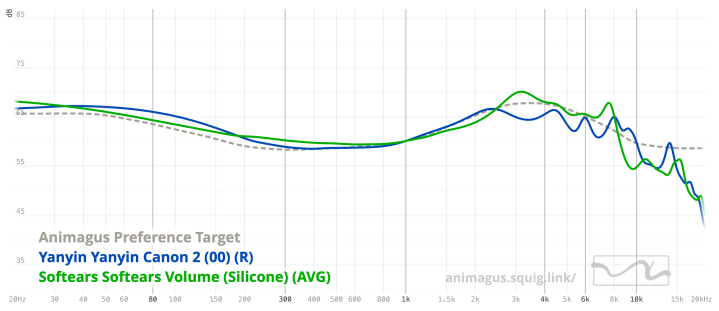
Volume has 1DD+2BA config and follow the sub-bass boosted neutral tuning philosophy like the Canon II but is a starkly different sounding IEM. Canon II has more sub and mid bass but ends up sounding brighter, more neutral compared to Volume because of slightly better mid and upper-treble presence and extension. It’s Volume’s warmer treble and slightly fuller than neutral lower-midrange that makes it come across warmer in comparison. Volume on the other hand has better ear gain, which even though a dB more than what I’d consider neutral does not come across as peaky owing to its bass boost and fuller lower-midrange. Overall, it’s the Canon II that comes across more linear and more neutral. Canon II also has better technical performance with significantly better LCR (left, centre and right) separation, space between instrument, depth layering as well as a more open sense of space with wider and deeper boundaries.
Moondrop Blessing2.

Even though there’s the new Blessing 3 now, I think Blessing 2 still holds its place as the tasteful sub-bass neutral benchmark under $350. Canon II comes across as a warmer, slight bassier take on sub-bass neutral than Blessing 2. Canon II has more sub-bass rumble as well as mid-bass punch, which will appeal to bass lovers more. Both IEMs have a neutral lower-midrange and forward upper-midrange but its the Blessing 2 that does it more neutrally, whereas the Canon II has a dip around 3kHz that has it come across slightly less forward/recessed. Blessing 2 forwardness and slight boost in lower-treble also results in it coming across brighter. Canon II has slightly better mid-treble, where Blessing 2 has a dip. Blessing 2 on the other hand is very slightly airier with better extension up top. All in all, Blessing 2 comes across as a brighter take on a sub-bass boosted neutral tuning and Canon II, the tastefully bassier and warmer one. When it comes to technical performances, both are really good at what they do as per their tunings. Due to Blessing 2 thinner sound signature, its soundstage comes across airier and more open. On the other hand, Canon II has better left to right separation and slightly better resolution. Both have good detail retrieval but due to Blessing 2 brighter signature, it can come across more micro-detailed. Both have very good imaging and layering for their respective price segments. At the end of the day, it’ll all come down to the kind of signature you’re looking for than there being an outright winner.
Versus Moonlight Ultra.
Symphonium Helios.

These two are fairly closely tuned and yet it’s the differences that make them very different IEMs with different strengths. Helios has a slightly leaner, cleaner take on sub-bass boosted neutral tuning and Moonlight Ultra a bassier, slightly warmer take on the same. Both do bass really well and Helios has a very tastefully tuned 7dB bass shelf with very good technicalities and timbre but Moonlight Ultra has a bigger bass shelf and hence more sub-bass rumble and mid-bass punch. Both have fairly neutral lower-midrange bit it’s Moonlight Ultra that has more neutral upper-midrange relatively and comes across slightly more forward in comparison as Helios’ ear gain is a 1-1.5dB lesser than Moonlight Ultra’s. So, Moonlight Ultra has slightly stronger definition of instruments as a result. Even though both IEMs have warmer lower-treble presentation, Helios is slightly better in the region and Moonlight Ultra a bit better in mid-treble and upper-treble extension. Even though Moonlight Ultra does treble slightly more linearly, Helios comes across very slightly brighter in comparisons because of its leaner tonality and Moonlight Ultra’s stronger bass shelf. When it comes to technical performance, Helios has a more open and airy soundstage because of its leaner character while Moonlight Ultra has a more intimate presentation in comparison owing to its slightly bassier signature.
Custom Art FIBAE 5.
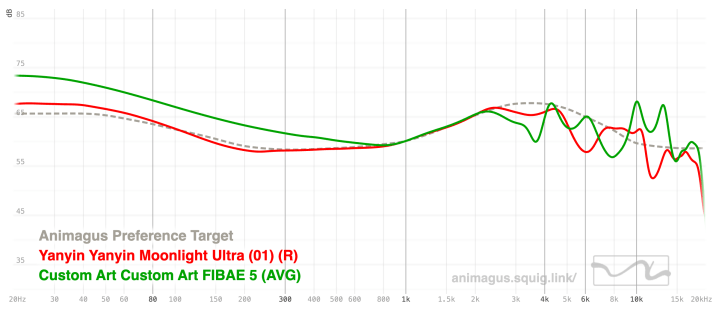
Moonlight Ultra has 1DD+4BA+4ESTs while the F5 has 1DD+2BA+2 Planar drivers. Where the Moonlight Ultra is a more neutral sounding with a nice sub-bass boost to accompany, F5 is a more V-shaped IEM relative to Moonlight Ultra’s tuning. It has about 4-5dB more of a sub-bass boost that lifts not only the sub-bass but also also more mid-bass punch as well as lower-midrange fullness into the mix. On top, it has significant boosting in the mid-treble section which makes it a much more vivid and energetic presentation in comparison. Moonlight Ultra has a more neutral lower-midrange, upper-midrange as well as treble section, which all lend it better, more accurate tonality and timbre. When it comes to technical performance, F5 significant boosting at both ends helps the perception of better technical performance greatly. It does have a bigger soundstage with wider width and deeper depth but a lot of the perception of nicer resolution and detail retrieval can be attributed to its brighter treble boosting. Moonlight Ultra does good technical performance while maintaining a more neutral signature. It has better instrument definition and slightly better imaging compared to F5.
BGVP Phantom.

Phantom is quad-brid with 2DD + 2BA + 2EST + 2BCD with a more V-shaped presentation compared to Moonlight Ultra. Phantom has a slightly leaner lower-midrange owing to the slight dip in 300-800Hz region while the Moonlight Ultra is more neutral in this region. Phantom has a more accurate ear gain region, especially the lower-treble region of 5-7kHz. This results in a more upfront presentation with slightly better, stronger instrument definition. Phantom is slightly brighter in mid-treble while Moonlight Ultra has better top end presence and extension. Yet it’s the Phantom that comes across more V-shaped and energetic due to more lower-treble and mid-treble presence. Both have good detail retrieval and resolution for this price segment but Phantom has deeper depth while Moonlight Ultra has better instrument definition and realism, left to right separation and imaging. Phantom is slightly more vivid and holographic with more blackness between instruments, probably due to the BCD doing its thing but the Moonlight Ultra is a much more natural listen with better tonal and timbre quality.
Conclusion.
Having tested these two Yanyin IEMs from starkly different price segments I can see that Yanyin surely is a brand that knows how to tune IEMs that sound great from the get go and have very good tonality and timbre. These two are IEMs that you do not need any adaptation period with and offer pretty good technical performance on top of that. Even though Moonlight Ultra is a very well tuned IEM and one of the better performing IEMs around the $1000 mark IMO, it’s the Canon II that is the real winner here. It provides impeccable tonal and technical performance at the $379 asking price and what really sets it apart from most of the sub-$500 IEMs is the proper left to right separation it does that most IEMs in that segment don’t do that well. Moonlight Ultra is a very capable IEM that does most things right with only one thing that irks me, which isn’t a con per se but a double edged sword – it is a bit too safe and a bit too much of a jack of all trades. This quality surely makes it one of the easy and safe IEMs to recommend at its price but also an IEM that doesn’t have an outright USP that can help it stand out as an outright benchmark in tonal and technical performance at its price. Yet, it’s an IEM that I will add to the list of my personal top performers in its segment along with Symphonium Helios and Custom Art FIBAE 5, with a special mention to the absolutely comfortable fit it has, something the Helios doesn’t. With all that said, I highly recommend giving both an audition if you’re looking for IEMs in these price segments and Canon II a special mention as a fairly safe blind buy at its reasonable asking price.
Gear used for testing and review.
- DAPs – HiBy R6 Pro II | iBasso DX240
- Dongle – Tanchjim Space | iBasso DC04 Pro
Artists I like and listen to.
- Rock – Foo Fighters, Linkin Park, Switchfoot, Imagine Dragons, Daughtry, Green Day, MuteMath, X Ambassadors, Dave Matthews Band, Vertical Horizon, Our Lady Peace, Lifehouse, Fall Out Boy, Breaking Benjamin, Muse, ACDC, Audioslave, Rage Against the Machine, Biffy Clyro, I Am Giant, Normandie, Paramore, Slash & Guns N Roses, 3 Doors Down.
- Pop Rock – John Mayer, Coldplay, Paul McCartney, James Bay, Hunter Hayes, Niall Horan, Keith Urban, The Bros Landreth, Bryan Adams.
- Progressive Rock/Metal – Porcupine Tree/Steven Wilson, Karnivool, Tool, Dead Letter Circus, Periphery, Lamb of God.
- Pop/Soft Rock – Ed Sheeran, Adele, Taylor Swift, OneRepublic, The Script, Gavin James, Magic Man, Maroon 5, Bruno Mars, Charlie Puth, Dua Lipa, The Weeknd, Oasis, Panic! At the Disco, TwentyOne Pilots.
- EDM – Chainsmokers, Zedd.

 Twister6 Reviews