
Sound Analysis.
I analyzed Monachaa sound performance paired up with a neutral LPGT source while playing a variety of test tracks, such as Agnes Obel “The curse”, Sandro Cavazza “So much better” (Avicii remix), C-Bool “Never go away”, Ed Sheeran “Shape of you”, Alan Walker “Darkside”, Galantis “Hunter”, Iggy Azalea “Black widow”, Indila “Boite en argent”, Dua Lipa “Love again”, Counting Crows “Big yellow taxi”, Bob Marley “Jamming”, David Elias “Vision of her”, and Michael Jackson “Dirty Diana”.
I let Monachaa burn in for about 4 days before I started taking my notes, but then realized it needs more for its 4 DD drivers to settle in, especially upper frequencies. I thought I was done around 100hr time mark of non-stop playback in a loop, but then heard more changes as I continued playing and listening, even close to 120hrs. At first, the sound had a more pronounced U-shaped tuning but after the burn-in I heard lowest registers of sub-bass rumble to settle in, lower mids to gain a little more body, and a few treble peaks to exhibit a slight shift which made the treble sound a bit smoother and more natural. As a matter of fact, in my CanJam SoCal ’23 overview where I talked about Monachaa, I said they were U-shaped because that sample didn’t have as much burn-in time on it. After a proper burn-in, the sound sig became more V-shaped.
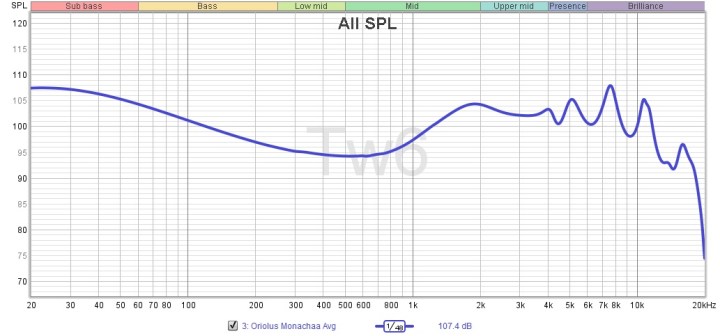
Overall, Monachaa has a mildly V-shaped sound signature with hi-res tuning and clear, natural, analog tonality that focuses on deep textured bass, neutral detailed mids, and clear airy treble. The textured analog nature of the sound is unmistakably attributed to DD driver performance. But at the same time, the speed, the tightness, and the articulation of the notes reminded me of a coherent multi-BA driver performance.
In more details, Monachaa has a deep, elevated sub-bass rumble along with a fast mid-bass punch. I hear the low-end tuning being tilted toward the sub-bass which gives the bass its weight and fullness. The mid-bass punch is fast, tight, articulate, with a shorter decay, less aggressive and not too much in your face, though packs a great punch when called upon. In a way, it almost feels like the bass is covered by a finetuned combination of DD and BA drivers, though in reality it is not.
Mids are more on a neutral revealing side, but still sound natural, just with a leaner analog texture. Lower mids are close to neutral, maybe even a touch south of it, lean, fast, giving more room for the upper mids to shine. And those do shine with a detailed, pure natural tonality that brings out more clarity and higher resolution to the sound. But despite its revealing clarity, they don’t sound cold or analytical. These are not overly musical in tuning since you are missing that fuller body warmth from lower mids, but I’m still hearing a revealing analog texture of DD driver performance.
Treble has a good airy extension, crisp and clear. At the initial listening it did sound a bit too crisp with some resonating zing in mid-treble. After the burn-in that “zing” along with any harshness was gone, leaving you with just a clear resolving treble which contributes to a higher sound definition and improved layering and separation of mids. I did find treble to be quite source dependent, but more about it in a source pair up section of the review.
As already mentioned, the airiness of the treble contributes to enhanced layering and separation of the sounds, from instruments to vocals, preventing even a slightest hint of congestion. The airiness also contributes to the open nature of Monachaa tuning which has a big soundstage with 3D level of holographic imaging and pretty accurate placement of instruments in space. The soundstage is not the widest I have heard, but it is big and holographic.
Also, this tuning worked very well with my library of test tracks, regardless if I was listening to instrumental or classical tracks with natural timbre instruments or EDM/Top40 tracks with synthesized instruments. Furthermore, regardless of the music genre I tried, male and female vocals always stood out with clarity and details.
Eartips Selection.
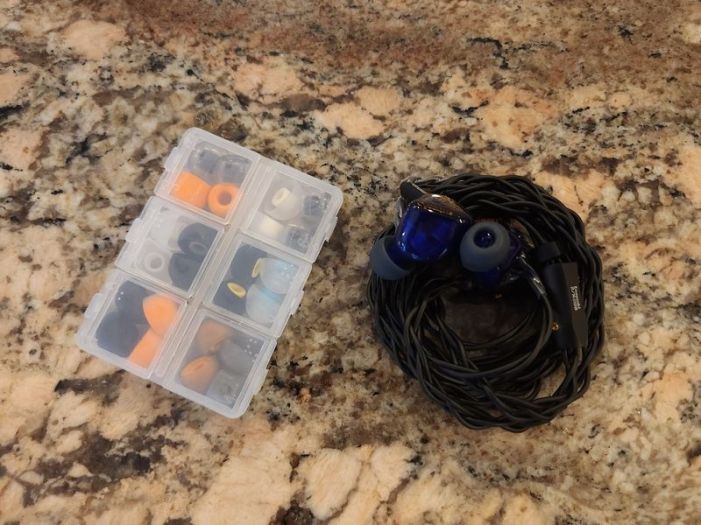
The selection of eartips is crucial to any universal in-ear monitors and will affect the sound, especially the bass impact depending on the seal. Due to a large opening of my earcanals, I usually go for the largest size eartips to get a better seal. Also, please keep in mind, eartips impressions are subjective and will be based on anatomy of my/your ears. As they say, YMMV.
And let me reiterate again here, for me personally with Monachaa the eartips selection was a VERY crucial task. I have access to a big pool of eartips to choose from and went through every single pair, making the full circle back to Oriolus own stock silicone tips. To my ears, those yielded the smoothest treble response and the least lean body in lower mids. At first, I thought Comply TSX will be a better choice, but, especially after the burn-in, they rolled off treble a bit too much, killing some of the air which affected the layering and the resolution of the sound, so I went back to stock silicone tips.
Cable pair up.
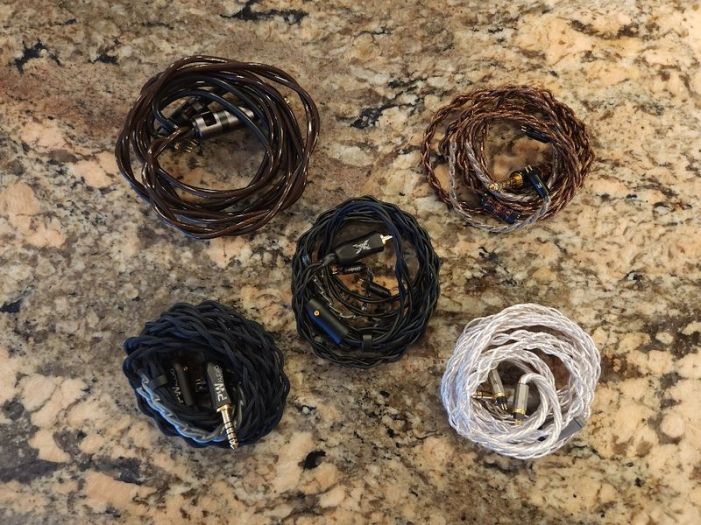
I’m aware that some people don’t believe in cables and have very strong opinion about it. It’s not my intent to change those minds. Instead, I’m just sharing what I hear during my testing. What makes sense to me, a metal wire is a material with physical properties of resistivity, conductivity, purity, and unique geometry, all of which put together act as a filter between your source and headphones. Variations of these physical properties can affect the conductivity of analog signal, resulting in a sound change, from a subtle to a more noticeable level. If the talk about cables upsets you, please skip this section. Otherwise, enjoy these short impressions.
w/EA Cleo II octa – I hear more rumble in sub-bass and the overall weight of the bass is a bit more elevated. Mids are slightly more forward, creating a more balanced sound tuning. Treble was unchanged.
w/PWA FirstTimes – switching to FT from a stock cable felt like a real PWA upgrade. While the level of sub-bass rumble and extension remained the same, the mid-bass punch gained more power. The mids were also a little more forward with an improvement in retrieval of details. Treble had a little more airiness with slightly better extension.
w/Eletech Ode to Laura – Laura had a great effect on Monachaa bass tuning enhancement. Here, I hear a deeper and slightly more elevated sub-bass rumble and also a stronger mid-bass punch, scaling up the bass. That also added a little more body to lower mids and made upper mids tonality more organic. Treble was unchanged, but the bass effect was quite noticeable.
w/EA Code 23 – C23 has a noticeable effect on Monachaa sub-bass, elevating it higher with more “physical” rumble and texture. Mids also sounds a touch more organic in comparison to a stock cable, perhaps my perception due to an elevated sub-bass. There was also a bit more sparkle in treble. C23 ergonomics is not the most ideal, but its effect on finetuning of the Monachaa tonality was impressive.
Tbh, I don’t even know which cable is a must upgrade for Monachaa. I went back to its stock cable and still enjoying it. If you have other cables, I strongly recommend trying them all. But do you absolutely need to upgrade the cable? That will be up to you, but in opinion PWA Ensembl stock copper cable is not bad at all.

 Twister6 Reviews