
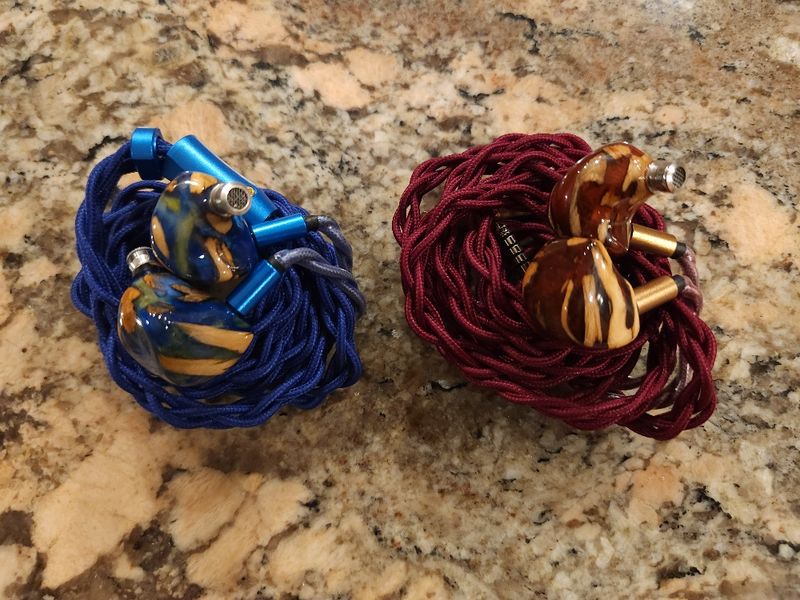
Sound Analysis.
I analyzed Mason FS ’24 sound performance paired up with a borrowed Cayin N30LE (Classic Tube, Class A, P mode) while playing a variety of test tracks, such as Agnes Obel “The curse”, Sandro Cavazza “So much better” (Avicii remix), C-Bool “Never go away”, Ed Sheeran “Shape of you”, Alan Walker “Darkside”, Galantis “Hunter”, Iggy Azalea “Black widow”, Indila “Boite en argent”, Dua Lipa “Love again”, Counting Crows “Big yellow taxi”, Bob Marley “Jamming”, David Elias “Vision of her”, and Michael Jackson “Dirty Diana”. I had Mason FS ‘24 on burn in for at least 100hrs before I started to collect my impressions.
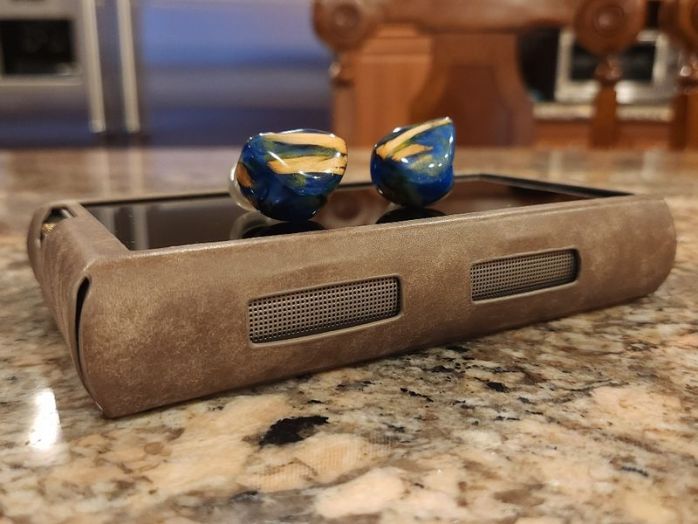
Burn in effect:
It is always hard to tell what exactly contributes to changes in the sound chain, and if the changes are even real while going by memory. But when doing a side-by-side comparison with one out-of-the box unit (ST) vs the other one with 100 hours of burn in (NE), there were noticeable changes. The sound became smoother, more laidback, a bit more “tubey”. It sounded like the edge was taken off the initial sharper tonality. The bass had more fullness, more bloom. Mids had fuller body with more organic tonality. The perception of treble also changed a bit, becoming smoother, though it could also be due to changes I hear in lows and mids. Also, the soundstage opened up and expanded wider, especially in mids/vocals.
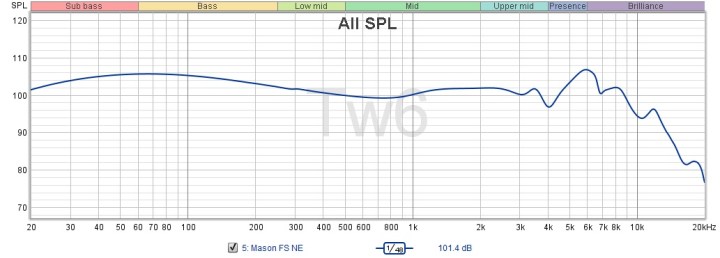
I found Mason FS ’24 to have a neutrally balanced sound signature with a smooth analog tonality throughout lows and mids, complemented up top with a naturally resolving treble. Usually, a balanced tuned IEMs have W-shaped signature where you have a distinct emphasis on lows, mids, and highs. Here, I find a rather linear, balanced, fuller body tuning throughout lows and mids, blending in a perfect coherent harmony, complemented up top with a bit of an extra emphasis in upper mids and lower treble which add a natural high resolution to the sound. I do want to mention that treble emphasis here does vary, depending on the source pair up synergy and eartips selection, especially in pair ups where I applied Turbo/Hyper/P+ voltage boost or a higher gain which adds more energy to the treble. With only a few exceptions, I never found the treble to be fatigue or harsh.
The bass has a deep extension with a textured analog-like rumble, giving the low end its fullness while holding back any additional weight. The mid-bass is rounded and has a bit more emphasis in comparison to sub-bass. Its attack is not as fast, giving the bass a more laidback less-aggressive feeling. The decay of bass notes is not short either, blending in nicely with lower mids rather than “bleeding” into the lower mids. The bass is full of expansive richness and warmth, it is slower, closer to neutral, doesn’t have a tight punch, and actually feels like you are listening to a DD driver rather than BAs.
Mids tuning feels like an extension of the bass. That is how seamlessly they blend in together, in a perfect harmony without adding any bloat to the sound. Lower mids are definitely north of neutral, having a fuller body which gives the sound its rich analog natural tonality. Upper mids are smooth, detailed, have natural resolution with plenty of clarity thanks to the lower-treble presence which gives mids/vocals its clear natural definition and more forward presentation. Mid-range tuning of Mason FS ‘24 has lots of musicality and natural clarity.
As I already mentioned, depending on pair up synergy and eartips, I found treble to vary from adding a natural clarity to packing a bit extra energy. I assume there is some dependency between source’s output power/voltage and the effect it has on BC-turbo micro booster. Overall, don’t expect a lot of airiness or crisp details. To my ears, I find Mason’s treble to have a complementary tuning while balancing out smooth tonality of fuller body mids and adding higher resolution with more details and natural clarity to the sound. While not exactly the star of the tuning, to my ears Mason’s treble does a fine “resolving” job while keeping the sound non-fatigue.
By the nature of its tuning, don’t expect new Mason IEMs to have a high level of layering and separation of the sounds. This is not a revealing micro-detailed tuning with air between the layers of instruments and vocals. Instead, the layers of the sound blend in together, though each sound could still be easily distinguished without any congestion. The soundstage is expanded, especially when focusing on vocals, and proportional in all 3 directions, not overwhelming but definitely above the average in width, depth, and height. And the same goes for the imaging with a relatively accurate placement of instruments and vocals in space.
People often ask me about genres of music that work better with a particular IEM tuning. Mason FS NE/ST is unique in its sound presentation, but don’t expect a fast elevated bass punch if that is what you are craving when listening to your favorite EDM tracks or sterile micro-details if you like to analyze the sounds. For anything else where you want a fuller body natural musical tonality with a timbre accuracy of real non-synthesized instruments, Mason FS ’24 will be an excellent go-to set of monitors. It worked perfectly with classical and jazz music, as well as vocal and instrumental tracks. And tbh, I also enjoyed it with my usual selection of EDM and Top40 tracks, giving it a smoother, laidback, fuller body musical presentation of the sound without too many in-your-face fast details.
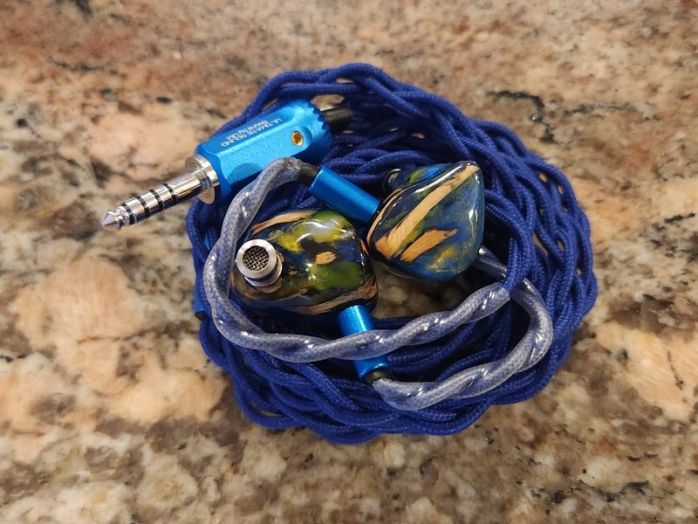
Eartips Selection.
The selection of eartips is crucial to any universal in-ear monitors and will affect the sound, especially the bass impact depending on the seal. Due to a large opening of my earcanals, I usually go for the largest size eartips to get a better seal. Also, please keep in mind, eartips impressions are subjective and will be based on anatomy of your ears.
Azla Xelastec/Crystal – natural detailed tonality with a neutral-balanced signature; fuller body sound with a rounded bass, smooth detailed mids, non-fatigue clear treble.
SpinFit W1 – a hear the impact of the bass to gain a little more weight, making the punch stronger. Another change is in soundstage with mids/vocals being more out of my heard and the left/right separation being a bit narrower.
SpinFit CP100+ – a hear a similar change with a bass as I have using W1, mid-bass has a stronger punch with more overall weight down to sub-bass rumble. The soundstage remains evenly expanded in all 3 directions, and left/right separation is as wide. But I also noticed a bit more crunch in lower treble.
Symbio W – very similar natural detailed tonality with a neutral-balanced signature as with Azla, and the same big soundstage expansions. But here I also hear a better retrieval of details, more clarity in mids without affecting harshness of the treble.
Symbio F – very similar tonality as their W version, but for some reason the soundstage left/right separation got a bit narrower, and maybe the tonality is just a bit smoother.
Eletech Baroque – very similar tonality and sound sig as I hear with Azla eartips. The only difference here is softer material which makes the fit more comfortable.
Final Type-E – to my ears, these don’t work well with Mason FS ’24. The imaging became center-focused, closer to the middle, shrinking left/right separation. Also, mids/vocals were a bit too warm, too organic, and a bit veiled.
Out of all the eartips, Symbio W were my favorite, followed by Azla and Baroque. Of course, this is very subjective and relative to my ear anatomy.

Cable pair up.
I’m aware that some people don’t believe in cables and have very strong opinion about it. It’s not my intent to change those minds. Instead, I’m just sharing what I hear during my testing. What makes sense to me, a metal wire is a material with physical properties of resistivity, conductivity, purity, and unique geometry, all of which put together act as a filter between your source and headphones. Variations of these physical properties can affect the conductivity of analog signal, resulting in a sound change, from a subtle to a more noticeable level. If the talk about cables upsets you, please skip this section. Otherwise, enjoy these short impressions.
I wasn’t sure if I even going to include this section in my review. The manufacturer used a specific high-end cable to tune the sound of their IEMs. And the cable by itself cost the 1/3 of the IEM price. If you have other cables, go ahead and try it. But you also have the option to buy Mason FS ST/NE without a cable, to use your own FTS or other hi-end cables. I don’t have access to Brise Audio cables or the Orpheus, so can’t test it. But thought maybe it will be an interesting test to compare FT w/o shielding (which I have) vs stock FTS cable. And, maybe some will be wondering how a brighter, more revealing hi-end cable will pair up with these IEMs, so I will also try EA Centurion.

Stock PWA FT Shielding vs PWA FT – The imaging and the soundstage expansion improvement with stock Shielding cable is quite noticeable here. I went multiple times back’n’forth, doing a blind test and was able to pick shielding cable every single time due to a more holographic imaging of how sounds were positioned in space, and also how much wider I heard the vocals spread. There is also a noticeable deeper/blacker background, especially when I’m listening to instrumental intro of The Curse, first 30seconds.
Stock PWA FT Shielding vs EA Centurion – Feels like the soundstage spreads a little wider and wraps around/behind you with Centurion. The tonality is still warm, smooth, analog, textured, and the sound presentation is quite relaxed. The main difference I hear is in lower mids, having a bit less thickness to give the sound less coloring and more transparency with Centurion. It is not exactly night’n’day difference, but it is noticeable. You can look at it as “cleaning” up the warmth, giving the tuning a level of side-grade, but I don’t know if it is really an upgrade.


 Twister6 Reviews
No amber pearl reviews??..Peace!
LikeLike
https://twister6.com/2023/10/30/canjam-socal-2023-impressions-from-musicteck-tables/ covered it here when I had it on loan. This is a very limited release, probably sold out already 😦
LikeLike
I agree there is a market for this and understand they will milk it till the cash-loaded fans breathe. They clearly going for the marginal coverage and maximum profits which is just plain sad. It is a sad company making a good gear, it brings bad emotions into the mix with their approach but they have right to do so. I don’t admire what they do and don’t support it anymore but have bought form them twice before.
LikeLike
Hey Twister6, as always love your reviews! Could you share how you feel this compares to the Amber Pearl? I own the AP and N30LE Pearl Thank you!! Never had a Mason before…but I love Amber Pearl more than Mentor.
LikeLike
It’s already there, on page 3. “AP” is Amber Pearl 😉
LikeLike
Thank you so much! Sorry I missed that 🙂
LikeLike
What do you think they compares to your reference Jewel? Are Jewel still more neutral than the Mason? Or the new Mason is somewhat closer to Jewel?
LikeLike
They could be both perceived as neutral when it comes to their sound signature, but have a completely different tonality. To me “reference” means more resolving leaner reference to analyze the sound. New Mason has a rich organic musical tonality, the opposite of a leaner reference tuning of Jewel. It terms of the tonality, AP (Amber Pearl) will be closer to that than FS ST/NE. But AP also has a more balanced W-shaped tuning. So, AP and FS ST/NE are quite complementary in tuning. From what I understand, Mason line was always tuned with a fuller body sound while Mentor is leaner and more resolving.
LikeLike
I own 2021 UM FS, Traillii JP, and now UM AP. I’m want to get the traillii ti or 2024 FS for my upcoming birthday.
Sounds like they are very similar. 2024 FS focuses on natural tonality (analogue), while traillii ti has better bass.
Would love to have your opinion compare these two giants. thanks in advance.
LikeLike
Traillii Ti is a faster and more revealing version of the original Traillii JP. I should have a detailed write up about it in a few days. The new Mason FS model is warmer and more analog version, per my review. Based on what you have, I would add Ti version to your collection.
LikeLike
Great write up as always! I had a question – I am saving up to buy the ST. Is it worth it to go in for the custom version? Would it result in better bone conduction and sound quality at this TOTL level, or is it only/mostly a matter of fit and comfort? Thanks!
LikeLike
As long as you get a good fit (depending on eartips selection), it doesn’t matter if it’s uni or custom. And in my personal opinion, what if you change your mind later or want to upgrade it or not happy with the sound? With custom shells you are stuck, won’t be able to sell it.
LikeLike
Thank you very much for taking the time to reply. I will go in for the ST universal – I always got a good fit and seal so far with UM IEMs.
LikeLike