
Comparison.
The comparison was done using Mason FS ’24 with a stock PWA cable, stock Azla eartips, and Cayin N30LE source (Classic Tube, Class A, P mode); volume matched in every comparison. Of course, it’s possible to do the comparison to any IEM, but what made sense to me is to compare Mason FS ’24 flagship model to their previous Mason FS ’22 flagship, and also to compare it to the latest Mentor-based flagship, Amber Pearl.
Mason FS NE/ST vs Mason FS LJ – I always start with a perception of the soundstage because that is how I get immerse into the sound, the first thing that hits me when I press Play. They both have a wide/deep soundstage expansion, but when I focus on vocals, those sound wider in NE. I have heard a similar effect relative to a cable swapping before, and found a similar difference when compared FTS vs FT. So, a more holographic imaging with a wider spread of vocals could be due to FT Shielding cable or could be due to the actual difference in BC driver. When it comes to the tuning, right away you will notice more weight in NE bass, having more sub-bass depth and weight and a stronger mid-bass punch. I also hear more body in mids of NE as well as a little smoother treble. In contrast, LJ mids sound a bit more neutral and treble has more crunch. The treble change is just a matter of a small scaling factor, not the result of NE treble rolling off. Both IEMs have plenty of treble presence, just NE scales it down by a bit to make the sound more natural. And as I was thinking about these changes, I realized it being similar to what happened when UM/Cayin retuned their MM into AP, very similar scaling changes.
Mason FS NE/ST vs UM/Cayin AP (Amber Pearl) – Starting with the soundstage expansion, these have a lot in common. Despite the difference in tonality, they both have a similar expansion of the soundstage. As I was focusing on vocals, I found them to have a very similar width, the same as when you are focusing on percussions and its panning that matched the left/right spread in both IEMs. Imaging also had a similar placement of instruments and vocals in space. But the sound signature is different. AP has a perfect W-shaped tuning where there is a separate emphasis on bass, upper mids, and mid-treble. In comparison, NE has a more even linear tuning from the bass and throughout mids. It is balanced, but the bass blends right into the mids with a very smooth transitional coherency. NE bass has enough weight and body, with more texture and more laidback presentation. But in comparison to AP, its (NE) bass felt more neutral in quantity. AP bass has more punch and speed. And when you are comparing the bass of AP vs NE, it almost like a comparison of BA bass to DD bass. AP mids have leaner body and more emphasis in upper mids, while NE has a more linear fuller body organic tuning of the mids. But thanks to its treble, NE mids still have plenty of clarity and details. In comparison, AP mids are a bit leaner, but the treble is not too far off. AP treble has a bit more airiness, while NE is smoother.

Overall, while NE does sound like a finetuned/retuned version of LJ, considering they are from the same “Mason” family, a comparison of NE and AP sounds like two different IEMs with a complimentary tuning. AP has a leaner and more resolving faster-speed tuning while NE has a fuller body more organic detailed tonality with a more laidback musical presentation of the sound.
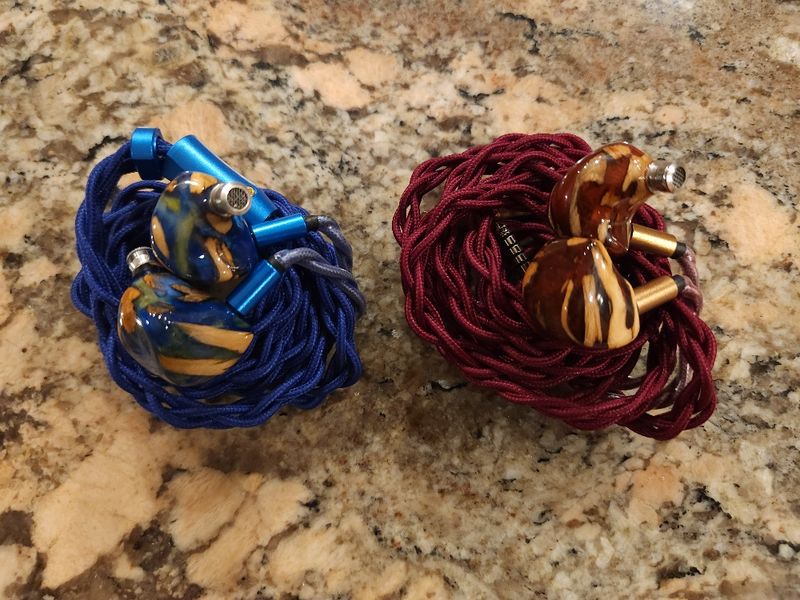
Since Le Jardin is no longer available and considering Amber Pearl is a limited-edition version, for the review purpose I received these IEMs as a demo in a different shell finish. So, below you will see Mason FS NE, Mason FS LJ, and AP.


Source Pair up.
In each source pair-ups I was using a stock cable and stock eartips. Mason FS ’24 IEMs have 23ohm impedance and are very easy to drive, but I found source matching to be very critical here. Here are my brief listening notes, focusing on changes related to a sound sig and a general tonality without going into too many intimate details.
w/ Cayin N30LE – I hear a very natural fuller body detailed organic tonality. Bass has a bit extra bloom with an analog texture which can fool you into thinking you are listening to DD driver. Mids are organic, detailed, nicely balanced with lows, and have a bit forward presentation. Treble quality could be finetuned to go from smoother and more natural to more energetic with extra crunch.
Switching from P to P+ tightens the bass, makes it faster, but it also adds more crunch to the treble. P relaxes the bass, still keeping it articulate, but not as fast or as tight, and treble performance has a more natural tonality since I no longer hear that extra crunch.
When switching between Class A and AB, AB gives the sound more speed, faster attack. This is more noticeable with EDM and Top40 tracks where you have synthesized instruments and faster transients of sounds. The change still noticeable, but not as much, with natural instruments when listening to other genres of music.
With N30LE I liked P power mode, Classic Tube timbre, and Class A amp mode. It gave me the most natural organic tonality. Hyper mode enables P+ power mode, and I still preferred P over it. The beauty of N30LE is having all these different power, amp, and timbre modes at your fingertips to find the right pair up synergy.
w/ L&P P6 Pro – I hear a similar natural fuller body detailed organic tonality as with N30LE, but the mids and the treble sound a little smoother. Bass has a natural bloom and a little more speed (faster attack and decay) in comparison to N30LE, sounds just a little bit tighter. The mids are organic, detailed, and linearly balanced with lows, but I’m hearing a bit more body in lower mids which also gives them slightly more forward presentation in comparison to N30LE. Treble is smooth, natural, a bit smoother than with N30LE.
Not much to adjust here, except for the gain. Low gain is no go since it made bass sound slower and too laidback for my taste. So, definitely would want to keep it in high gain in this pair up.
w/ iBasso DX320Ti – this was probably one of the few pair ups were the sound of Mason FS ’24 changed too much from what I have heard with other sources. The tonality becomes leaner, and the overall sound signature becomes more V-shaped, having a very powerful tight bass impact and crisp airy treble. It wasn’t U-shaped since both sub-bass and mid-bass scaled up along with mid-treble.
I did adjust the gain, and it seems that treble becomes more tolerable in low gain. But still, I found treble in this pair up to have a bit too much energy.
The biggest tweak here was the addition of iBasso’s own PB5 dual NuTube amp, keeping DX320Max LO at lowest gain and PB5 also in low gain. The sound signature became more balanced, the tonality was more natural, warmer, not as thick or organic, but definitely gaining another layer of analog texture to make the sound smoother. Treble still has a bit extra energy, but it sounds very natural.
If you got DX320Ti and Mason FS ’24, PB5 will be a worthy addition to perfect this pair up synergy.
w/ Cayin N7 – Another good pair up with a little more transparency in sound. The tonality is still very natural, detailed, and the sound is very expanded. But I also do hear a bit less coloring in this pair up. Bass has a strong punchy impact, mids are clear, natural, details, and treble is crisper and detailed, still non-fatigue and sounds natural.
What I noticed in this pair up, as I was switching the output from DSD64, 128, 256, to 512, mids went from thicker and more organic, to less colored and more detailed. I did prefer DSD256 setting, and had to switch to Class A to give the sound more analog texture.
w/ Hiby R8ii – To my surprise, this particular pair up was actually not too far from how I hear Mason FS ’24 with N30LE, except N30LE has a bigger soundstage opening in mids. The sound was very natural, organic, textured, and still quite detailed thanks to FS ’24 treble tuning with its higher definition. The bass has a bit extra weight in sub-bass and stronger punch in mid-bass, I like that a lot. Mids were natural and still detailed. Treble was also under control, though it does have a bit more energy.
I did switch R8ii to Turbo mode and Class A amp. Turbo mode gives treble extra energy within natural limits and Class A gave the mids more analog texture. Contrary to N30LE where had to switch from P+ to P, here I enjoyed it more with Turbo mode enabled.
w/ Lotoo LPGT – LPGT is usually my neutral reference DAP when testing various IEMs, but in this case the pair up synergy wasn’t there. The sound is very organic, thick, with mids/vocals being more forward, oozing with warmth, wrapped in a warm cozy blanket. Not muddy or veiled, they still sound clear, but a bit too warm for my personal liking, especially since bass was lower in quantity. It was just the opposite impression of Mason FS ’24 pair up with DX320Max. It does create a new and a different texture, but the overall sound was too organic and less resolving.

Conclusion.
It has been a long time since my UM Mason V3 review, making me realize that I missed quite a few Mason-series releases prior to the latest Mason FS NE/ST. This review gave me the opportunity to catch up with and to compare not only the latest Mason and Mentor IEMs, but also one of the previous Mason flagships. Plus, I got a chance to learn more about their latest BC drivers which made me realize that evolution in tuning of these IEMs was achieved not only through the “fine-tuning”, but also while pushing the new tech envelope, like BC-turbo micro booster for BCD which made its debut in this release.
Every new tech, either if it’s a driver or a booster, or even just a fancy cable, are part of the building blocks used to sculpture the sound. And if you want the sound with a fuller body natural musical tonality and a more laidback, smoother, analog presentation without too many overwhelming in-your face details, the latest UM Mason FS NE/ST checks all the right boxes. It has a unique tuning with a linear transition of lows and mids, complemented by a natural resolving tuning of the treble, along with the expanded soundstage and the precise imaging.
To make the full circle back to my Preamble intro, yes, this IEM has a hefty MSRP price tag, but you also have to be aware we are talking about MSRP and not the actual sales price. And I think it was a great idea for Musicteck to offer the option for purchasing of these new IEMs without a cable at a noticeably reduced price to accommodate those audiophiles who already have PWA and other hi-end cables in their collection. Of course, I’m not going to tell you to tap into your home equity loan to buy more expensive IEMs. But if you can afford it and in search for something new with a unique smooth analog sound tuning to complement your other more revealing TOTL IEMs, in my humble opinion UM Mason FS Nuit Etoilee and Soleil Tombe offers exactly that.

 Twister6 Reviews
No amber pearl reviews??..Peace!
LikeLike
https://twister6.com/2023/10/30/canjam-socal-2023-impressions-from-musicteck-tables/ covered it here when I had it on loan. This is a very limited release, probably sold out already 😦
LikeLike
I agree there is a market for this and understand they will milk it till the cash-loaded fans breathe. They clearly going for the marginal coverage and maximum profits which is just plain sad. It is a sad company making a good gear, it brings bad emotions into the mix with their approach but they have right to do so. I don’t admire what they do and don’t support it anymore but have bought form them twice before.
LikeLike
Hey Twister6, as always love your reviews! Could you share how you feel this compares to the Amber Pearl? I own the AP and N30LE Pearl Thank you!! Never had a Mason before…but I love Amber Pearl more than Mentor.
LikeLike
It’s already there, on page 3. “AP” is Amber Pearl 😉
LikeLike
Thank you so much! Sorry I missed that 🙂
LikeLike
What do you think they compares to your reference Jewel? Are Jewel still more neutral than the Mason? Or the new Mason is somewhat closer to Jewel?
LikeLike
They could be both perceived as neutral when it comes to their sound signature, but have a completely different tonality. To me “reference” means more resolving leaner reference to analyze the sound. New Mason has a rich organic musical tonality, the opposite of a leaner reference tuning of Jewel. It terms of the tonality, AP (Amber Pearl) will be closer to that than FS ST/NE. But AP also has a more balanced W-shaped tuning. So, AP and FS ST/NE are quite complementary in tuning. From what I understand, Mason line was always tuned with a fuller body sound while Mentor is leaner and more resolving.
LikeLike
I own 2021 UM FS, Traillii JP, and now UM AP. I’m want to get the traillii ti or 2024 FS for my upcoming birthday.
Sounds like they are very similar. 2024 FS focuses on natural tonality (analogue), while traillii ti has better bass.
Would love to have your opinion compare these two giants. thanks in advance.
LikeLike
Traillii Ti is a faster and more revealing version of the original Traillii JP. I should have a detailed write up about it in a few days. The new Mason FS model is warmer and more analog version, per my review. Based on what you have, I would add Ti version to your collection.
LikeLike
Great write up as always! I had a question – I am saving up to buy the ST. Is it worth it to go in for the custom version? Would it result in better bone conduction and sound quality at this TOTL level, or is it only/mostly a matter of fit and comfort? Thanks!
LikeLike
As long as you get a good fit (depending on eartips selection), it doesn’t matter if it’s uni or custom. And in my personal opinion, what if you change your mind later or want to upgrade it or not happy with the sound? With custom shells you are stuck, won’t be able to sell it.
LikeLike
Thank you very much for taking the time to reply. I will go in for the ST universal – I always got a good fit and seal so far with UM IEMs.
LikeLike