

Design and under the hood (D16).
D16 measures about 139mm x 82mm x 28mm and weights 312g, a similar form factor to DX320Max brick’s footprint at half of its weight. Its aluminum chassis are lightweight. 2/3 of the top is occupied by a glass panel with a small 1.3” OLED built-in display, and the rest has ridged surface, the same surface as on the bottom, and with finer ridges on the sides. The design has an industrial hardware look, and when you wrap it in a leather case, all the “ridges” are covered except for the bottom ones under the metal cutout for extra cooling.
The front of D16 has 4.4mm BAL and 3.5mm SE ports which double as either headphone output or Line Out, selectable from settings. To the right of the headphone jacks you have a smaller knob which doubles as digital DAC volume output control or Selectable Switch. Press once to turn the display on/off, long press’n’hold enters Settings menu which is visible for a few seconds and goes back to a default view if you don’t press anything. But if you continue pressing this Selectable Switch, you can cycle through various Settings, such as AMP gain (H/L), DAC Gain (H/L), Input (USB/COAX/OPT), Output (Phone or Line), Backlight (always On, 10s, 20s, 30s), and Version number. Values of each setting can be changed by rotating the knob. The default view of the screen displays all the essential settings in one place, such as selection of Input and Output, DAC and AMP gain, Digital Volume value, and the battery status (in 3 segments).


Next to the Selectable Switch (which doubles as a digital DAC volume control), you will find Analog Volume control. Yes, it is the same analog stepped attenuator with 24 steps, used in DX320Max and DC Elite, and by design of step attenuator the volume will drop between the “steps” as they disengage. While it was a bit cumbersome in DX320Max adjusting the volume in 3dB increments, DC Elite had additional 1dB volume micro-adjuster button. With D16 you have Digital Volume for such micro-adjustment. I usually set digital volume to 95 to have extra headroom and then micro-adjust it after settling on one of the 24-steps of analog volume control. Another thing to keep in mind, especially when using IEMs, I usually bring down stepped attenuator volume before plugging in the cable and then start adjusting to avoid blasting my ears. This is especially important since the analog volume indicator on the D16 knob is hardly visible, though you can always add a slim sticker strip as I have done it on DC Elite.
On the back you have a combined COAX (PCM768kHz / DoP256) and OPT (PCM192kHz / DoP128) input port and then 2x USB-C ports, one for USB DAC input (PCM768kHz / DSD512) and another one for charging. Next to the charging port you have blue LED indicator and a toggle power switch. The switch is small, takes some time to familiarize yourself with location of everything and getting used to turning it blindly on/off. It is a good idea to be able to charge the device separately instead of having it combined with DAC input while draining its battery (smartphone or tablet). Plus, while I was using DX260 DAP as a source, I was able to have DX260 connected to D16 through COAX while independently charging DAP and D16 by itself. And speaking of charging, USB-C port supports 5V/2A or QC3.0 quick charging, with a charging time of about 2.5hrs and a battery life of about 9hrs.


Inside of D16, you have a 1bit discrete DAC design under a custom FPGA-Master 2.0 control which gets its input from an independent Audio DSP and re-organizes and recodes the digital input and generates PWM signals driving discrete PWM-DACs for decoding. iBasso implemented 16 sets of 8E PWM-DACs in a cascade (each one visible under the cover), making it a total of 128 independent PWM-DACs operating in FIR (Finite Impulse Response) mode. Plus, there are 128pcs low-temperature drift 0.1% high-precision 25ppm thin film resistors. FPGA applies the delay and the alignment through compensation of these signals under a picosecond-level high precision control. Then, add to this a Class A discrete amp based on the architecture of DX320Max using top end audiophile grade components, including 20pcs of Low VCEsat (BISS) transistors double which are known for their low power consumption and heat dissipation while providing high output current of up to 2 amps. As a result, you get a high- power output with a current of up to 2A and 6.8Vrms (1125mW @32ohm) from 4.4mm Balanced output or 3.4Vrms (640mW @16ohm) from 3.5mm Single Ended output.

And last, but not least, there are two Torx 8 screws on the back of the chassis which you can easily remove to slide out the top panel to gain access to replace the battery and to take a peek at the inside circuit. I’m sure those who love modding amp ckt will appreciate the opportunity.


Design and under the hood (PB5).
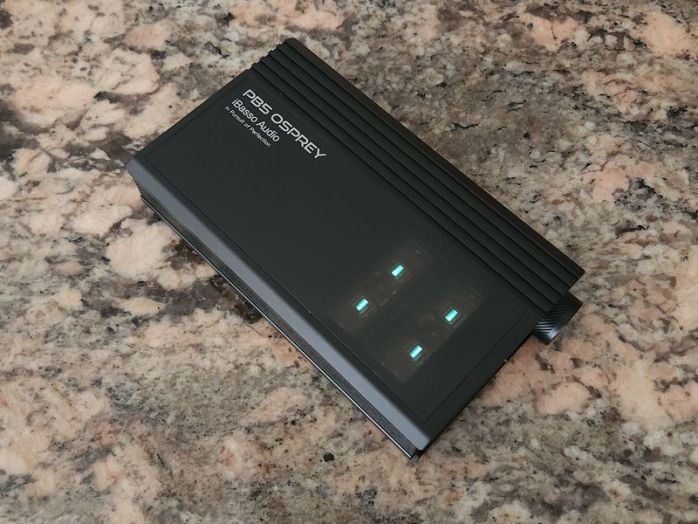
Coincidentally, PB5 exterior design has the identical footprint as D16, to the point where sometimes I had to look closer at the printed label on the glass surface to see from the top if I’m picking up the dac/amp or the amp. Of course, they do have different ports and a different view when powered up, but PB5 still measures 139mm x 82mm x 28mm, just like D16, and weight 352g, just a tad more than D16. From the top, the bottom, and the sides, the design is also identical with ridged aluminum surface and the same area occupied by a glass panel. Except, PB5 doesn’t have OLED display, instead it showcases the glow of 2x Korg NuTube modules.
It is a fully balanced dual NuTube amp design, so on the front you will find 4.4mm BAL input, but in addition to 4.4mm BAL output you will also find 3.5mm SE output next to it. And you will find the same 24-step analog stepped attenuator with everything mentioned before (in D16) applicable here as well. The volume wheel still has a poor marking, so make sure you turn the volume down every time before plugging in IEMs. And you have to keep in mind, there is no volume micro-adjustment, but it doesn’t matter because you will be driving this AMP from a DAC source which going to have its own volume adjustment to fine tune the sound between 3dB steps of stepped attenuator.


On the back you will find 5V USB-C charging port, and iBasso really means “5V”. Using PD or QC chargers will not work with PB5. PB5 uses 6 batteries, with NuTubes powered by 2 of these and remaining 4 used for a secondary amplifier. While I haven’t found more info about it, I think the limitation of the charger has to do with the selection and the efficiency of batteries and the converter to charge them. Maybe it is 5V based and can’t accept higher voltage inputs of faster chargers. And since we are on the subject of batteries, it takes about 2.5hrs to charge these, assuming 5V/2A supply, and they should last about 10.5hrs. One more thing to keep in mind, the battery indicator here is quite limited. On the back next to the charger port you will see a blue LED status light that will indicate a full charge and when the battery is low. But in between, there is not much to go by. Wish there would have been a multi-led battery capacity indicator for an early warning.
Also, on the back, besides USB-C charging port, you have 2 toggle switches, the left most is for power on/off and the one next to it is for High/Low gain. Both are very small toggle switches located close to each one, a warning for audiophiles with phat fingers! It also took me a bit to get used to which one is which and, on a few occasions, I turned the power off by mistake when I was trying to change the gain. But after a while I got used to the power switch being always closer to the edge and never made the same mistake again.
Under the hood, you have dual Korg NuTube 6P1 vacuum tube modules. Those are 6th Gen NuTubes that still operate similar to a conventional triode vacuum tube, but at a lower power, and with higher reliability. This is not the first time iBasso implemented NuTube modules in their design. It has been featured before as part of their DX DAP series modular amp design, in AMP9, AMP13, and AMP14. And with every AMP design they have been making improvements, but still had the limitation of having hardly any room left on the amp board. Here, iBasso had more room to play with and implemented 2-step suspension to absorb the mechanical vibrations and to minimize the microphonics effect. If you have IEMs in your ears and PB5 powered up while you insert cable into the headphone jack, you can hear a brief ringing, but it is brief. Another problem iBasso was able to address is with a carefully designed cathode input to reduce the impedance which results in a reduced signal interference from external sources.
The design of Amp section of PB5 was utilized using popular low-noise high-precision TI OPA827 opamps. Also, they used Low VCEsat (BISS) transistors double which are known for their low power consumption and heat dissipation while providing high output current of up to 2 amps. Plus, iBasso used custom film capacitors to add more analog tonality to the sound. The output spec is 9Vrms (1700mW @32ohm) from 4.4mm BAL and 4.5Vrms from 3.5mm SE. The gain switch gives you +2dB (low gain) and +11.5dB (high gain). This is a very powerful output to drive some of the more demanding headphones, and iBasso even mentioned in the spec a recommended headphones impedance of 8-600ohms or to use with IEMs, considering low output impedance of 0.25ohm from 4.4mm BAL and close to 0ohm from 3.5mm SE.
Similar to D16 design, PB5 also uses two Torx 8 screws on the back of the chassis which you can easily remove to slide out the top panel to gain access to replace batteries (all 6 of them) and to take a peek at the inside circuit and its components.


Page 3 – Sound Analysis and Pair up.
Page 4 – Comparison, Source pair up, and Conclusion.

 Twister6 Reviews
Thanks for your impressions! Did you also test the DX260+PB5? Thanks.
LikeLike
It will improve some technical performance (DX260 LO + PB5 vs direct DX260 PO) with an improvement in soundstage and dynamics, but the tonality will get warmer. With some of my IEMs it was a bit too warm, loosing details, lowering the resolution. So everything comes down to a pair up synergy.
LikeLike
Hello,
Do you think it’s possible to combine both tech into a pocketable iBasso Max DAP-series? A fully analog DAP with R2R/discrete DAC and Tube/discrete AMP would be awesome! It’ll probably be noisy and battery draining, though, but the analogue goodness!
LikeLike
That was exactly the first thing I asked iBasso about, D16+PB5 would make an ultimate DX400Max 😀
LikeLiked by 1 person
I’d also like to fit in Cypher Lab’s Picollo amp in there for handling low-gain, because that amp works even specially well at low volumes with sensitive IEM’s. It’s great for low listening volumes!
Then typing the statement above made me realize why iBasso went with separate blocks. Because everyone wants something different in there DAP.
LikeLike
just dropping back here to let people know that iBasso made D17 (r2r dac + nutubes.) I guess iBasso went all-in on analogue goodness!
LikeLike
Hello, thanks for the review.
I am curious about the comparison between D16 and Chord Hugo 2. It seems to be that Hugo 2 will be slightly more incisive in tonality, but I wonder how the resolution, spatial presentation, and driveability will differ.
For driveability, I don’t really mean the maximum volume/power, but rather the ability to pull out the potential of over-ear headphones/IEMs generally known to be better sounding with a desktop amp.
I would have waited for Hugo 3 if it seemed to be anywhere near launching, but there seems to be almost no rumors so I am looking for other portable DAC/AMP options…
LikeLike
Sorry, I have no experience with Hugo 2, thus can’t comment on it.
LikeLike
Oops, I saw an article by VishnuSiddharth including the Hugo 2, and simply thought you could answer my question… My bad, thanks for the reply!
LikeLike
Hi
is there an upcoming solo review of the dx260? I am curious about a detailed Sound description of dx260 especially how it compares to dx300. Would be a nice more portable Alternative or sidegrade.
cheers Jonathan
LikeLike
Yes, will start working on dx260 review soon.
LikeLike
This review would be great if you could get to it! I am wondering if DX260 is just good enough even without D16 or PB5. For one, the DACs seem to be pretty similar architecture. And DX260 amp may be enough to drive even my planars
LikeLike
I had to send dx260 to another reviewer, but I also received and just finished testing their dx180 which has usb-c and coax and works as good as dx260, driving D16. So, if you need a great digital source to drive D16, save yourself money and get dx180.
LikeLike
Thanks for this review! Do you plan to review the A&K PA10 amp?
LikeLike
Sorry, I don’t have access to PA 10 at the current moment
LikeLike
Hi I’m not sure from the review (great as usual), can I replace my desktop Jotunheim with this stack and not worry about the battery charging or over charging from a PC.?
LikeLike
Tbh, this part is not clear to me as well. I believe it was intended for a portable rather than desktop use. Thus I don’t know the effect of keeping it constantly on the charger.
LikeLike
Hey, brother. Excellent work, as always. So, I’ve been a DC Elite fan for a bit (price to performance and all), but the Taipan (by itself) is a really compelling try. Is diminishing returns just too steep, or is the d16 worth price of admission compared to holding back with the DCE? Help out a brutha!
LikeLike
These are 2 different beasts. Obviously, D16 will be intended for a desktop setup, and more natural tonality in comparison to DCE. But the most important thing, D16 offers a lot more power and a lot more functionality (inputs/outputs) and flexibility for different source connections. If your primary use is smartphone with DCE and IEMs, it makes no sense to get D16. But if you are planning to drive more demanding headphones/iems, or have fancy sources and planning to use externals amps, DC16 has a lot more flexibility and power.
LikeLike
Update…chose the D16 and have zero regrets! It’s that piece of kit that makes you feel like you cannot get any more out of your IEMs (in particular). I doubt I’ll dabble back into headphones, but couldn’t be happier with this & the Volur. Threw a DC04 pro in the bag and set. Thanks for what you do! Keep it up!
LikeLike
With the VE10, are you sure you had it on “line” and not “phone” out with the PB5? The output is much more controlled through to the PB5, especially maintaining low gain on the back. I only get the hiss/waterfall if I really crank the volume well past any level I’d listen to. I wish you’d tried it. All the descriptions you give of the PB5 expanding soundstage, smoothing upper mid/treble all apply, and more. The mids on the VE10 are already great, and the soundstage width creates an even better sense of imaging, especially with vocals. It is the best IEM setup I’ve had thus far.
LikeLike