

The copperhead with a twist!
PROS: improves soundstage depth, enhances sub-bass rumble, fuller body mids, and natural treble sparkle, pliable construction and comfortable fit even considering 18AWG wire thickness, lots of customization options, durable build.
CONS: thicker wire, more expensive than a typical copper cable, the sound improvement varies depending on pair up synergy.
The product was provided to me free of charge for the review purpose in exchange for my honest opinion.
Manufacturer website: PlusSound Copper XL.
Preamble.
I’m aware that some people don’t believe in cables and have very strong opinion about it. It’s not my intent to start an argument here. Instead, I would like to share what I hear during my testing. Perhaps, I can’t fully explain why there is a change in sound, but I do hear it and don’t believe it’s a placebo effect. What makes sense to me, a metal wire is a material with physical properties of resistivity, conductivity, and purity, all of which put together act as a filter between your source and earphones. Variations of these physical properties can affect the conductivity of analog signal, resulting in a sound change, from a subtle to a more noticeable level. Also, the sound change introduced by a specific cable is not universal because it will depend on the design of earphones and their synergy with a source.
Intro.
I hate to copy my own intros, but I still feel the same as I did when I published my PlusSound SPC XL review. When it comes to IEM cables, using various exotic materials, getting creative with fancy geometries, and adding extra layers of shielding is still there. But the latest trend is something I didn’t expect when I saw the rise in popularity of phat wires. And I’m not talking about multi-braided cable construction to increase the overall thickness while decreasing the cable impedance. I’m referring to using thicker wires with lower AWG, one per side.
These types of wires are more common when it comes to full size headphones, often even braided while using multiple conductors since portability is not of a great concern in a desktop setup while relaxing and enjoying your full-size cans. But it’s a different story when portability of enjoying your IEMs on the go is at stake. Following the success of their large wire size SPC XL release, PlusSound decided to continue with another phat wire release – Copper XL. That is what I’m going to cover in today’s review which is going to be shorter and mostly focused on the comparison and sound analysis.

Unboxing and Accessories.
While I received Copper XL cable by itself, I assume that the unboxing experience will be the same as with SPC XL which is also identical to other PS cable releases I have seen in the last few years. So, it should still feature an elegant compact box that looks more like a jewelry giftbox with a cover logo and inner edges in gold. With the cover off, you will find a clear plastic display cover with a message: Designed and Hand Assembled in Los Angeles, California, USA – a nice custom touch filled with pride.

The cables will be kept sealed in a clear plastic bag, again, something you will find with every PS product, even their addon accessories (like adaptors). The other included accessories are usually a pleather storage pouch branded with PS logo, PS branded cleaning microfiber cloth, a leather cable organizer band, and a warranty card. The color of the storage pouch and cable band varies between the releases.
The cable I received came terminated with 4.4mm balanced plug, the only termination I care about. But if you decide to go with 2.5mm balanced plug and need 4.4mm and 3.5mm adaptors, PS also makes their own ultra short or regular ones with pigtail extension, per request and at a reasonable pricing. Pigtail extension adapter convenient going from 4.4mm to 3.5mm.
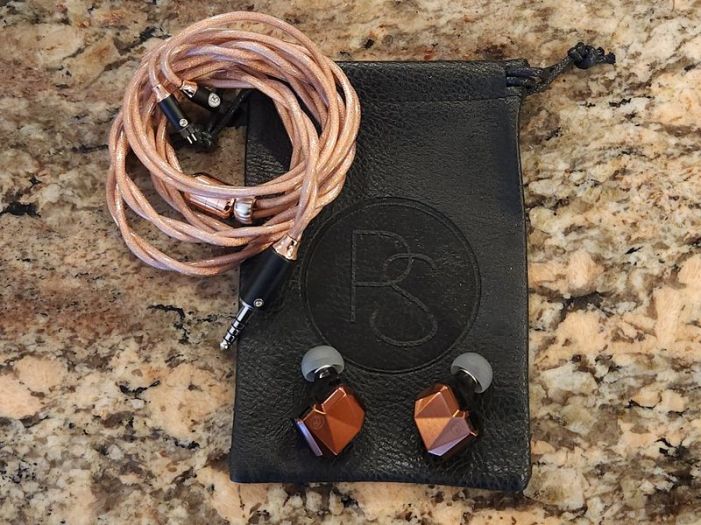
Design.
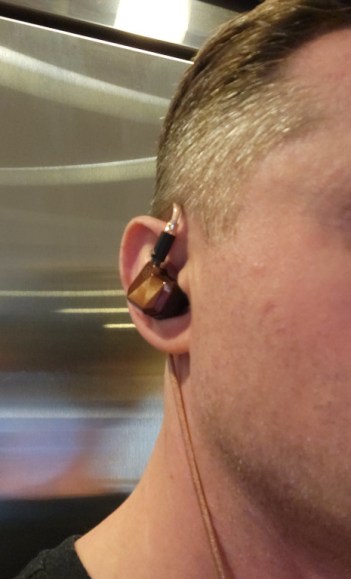
Most of the PS IEM cables are based on Type 6 litz wires which have 26 AWG thickness. Their shielded plus (+) series litz wires were a bit thicker at 24 AWG. The XL is based on Type 6 as well, except after experimenting with a different wire geometry, they decided to combine the wire in 6x Type 6 bundles (Type 6×6 Litz), each with 36 groups. The resulting XL cable features two conductors, Left and Right, each 18 AWG in thickness. While it does look thick, to my big surprise I found it to be soft and pliable and with minimum microphonics. It was even softer than Plus series, thanks to their own proprietary insulation and multi-varied dampening cores.
As a result of using these proprietary dampening cores, according to PS, it allows them to maintain a round shape for consistent conductivity, prevents mechanical vibrations that will affect interference and interruptions, and softens the XL wire to make it as flexible as its smaller counterpart for on-the-go use. Overall, I found Copper XL to have a decent ergonomics and comfortable fit. But I also noticed these wires being listed under Headphones cables on PS website, so it looks like it will be available for both IEMs and full size, the same as it was with SPC XL.

The wires used in this cable are UP-OCC Pure Copper. According to Christian, the man behind PlusSound Audio, they have been experimenting with various metals and sizes and originally settled on one of their popular wires, SPC, due to its unique sound characteristics. Following its release and by a popular demand, they decided to continue XL series with Pure Copper. Also, the decision to go 18 AWG was because it’s the max gauge you can incorporate based on the connector specs.
As far as the exterior design goes, PS offers a ton of customization options where it feels like you are choosing CIEM rather than a cable. You start off with a cable length (up to 10ft) which is useful when dealing with headphone cables or desktop use if you prefer longer wires. Then, you have a choice of different termination plugs (2.5mm, 3.5mm, 4.4mm, USB Type C with built-in dac/amp, RSA/ALO, and 1/4 “), iem termination connectors (every variation of 2pin, mmcx, and other available connectors), termination end color (in 6 colors), y-split color (in 7 colors), slider (in 4 colors or none), and even color of left/right indicator (in 6 colors).


The fit.

 Twister6 Reviews