

Comparison.
Here is how I hear Copper XL cable compares to other cables while using Aroma Jewel and PS Allegro IEMs. In this test I was using LPGT and P6 Pro as my reference sources, volume matched, and playing the selection of my usual test tracks, such as Agnes Obel “The curse”, Sandro Cavazza “So much better” (Avicii remix), C-Bool “Never go away”, Ed Sheeran “Shape of you”, Counting Crows “Big yellow taxi”, Galantis “Hunter”, Alan Walker “Darkside”, Iggy Azalea “Black widow”, Indila “Boite en argent”, Robin Schultz “Oh child”, Dua Lipa “Love again”, David Elias “Vision of her”, and Michael Jackson “Dirty Diana”.
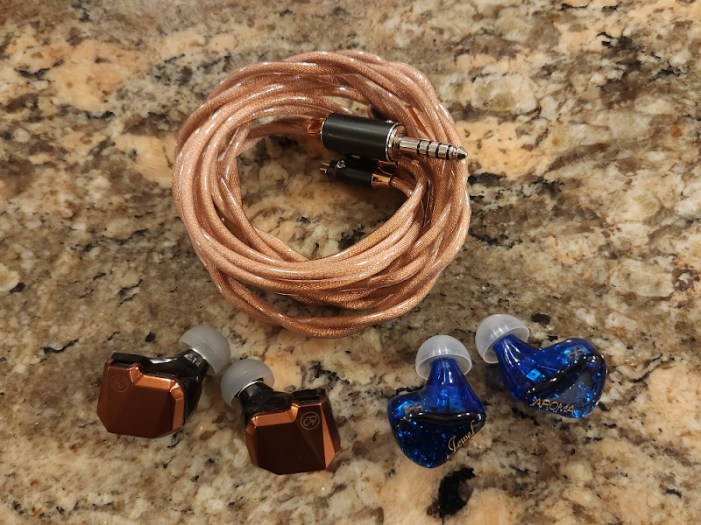
Consistent with my cable testing philosophy, I typically use the same IEM and the same source, and only change one variable at a time to note the sound difference I hear while keeping the volume matched. The focus here is mostly on other Copper cables from PlusSound, including one extra bonus. Obviously, such impressions are subjective with me describing what and how I hear it.
PS Copper XL vs PS SPC XL – Starting with soundstage analysis, both have a decent expansion, but at the same time they do vary with SPC having a noticeably wider left/right spread while Copper having more depth. As a result of this difference, to my ears the imaging and the sounds spread was more holographic with SPC and more center-focused with Copper XL. Tonality change here is noticeable as well. Copper cable adds more textured sub-bass rumble, elevating its weight. Copper also adds more body to the lower mids, giving vocals a more organic musical tonality, as well as adding more natural sparkle to the treble. In comparison, SPC doesn’t affect as much the weight of the bass, but it does bring mids more forward with less coloring and improved retrieval of details.

PS Copper XL vs PS Quad-Copper – the soundstage expansion here is nearly identical with a similar improvement in soundstage depth, also having a bit more center-focused imaging. I also noticed similar changes in bass, elevating the weight with deeper sub-bass rumble and more analog texture. The mids is where I hear the biggest difference. Copper XL makes mids smoother and warmer while Quad-Copper has less coloring in mids, making them more transparent. To my ears treble sparkle is nearly identical, but due to a difference in mids the perception of treble tonality does vary a bit. With Copper XL and its smoother presentation of the mids, there is more contrast with treble which makes them snappier, while Quad-Copper treble blends in better with upper mids due to a lesser contrast.
PS Copper XL vs PS Copper+ – very similar soundstage expansion here as well, following the same enhanced depth and more center-focused imaging, perhaps with Copper+ having even a bit more depth. Both have a deep sub-bass extension, very similar textured rumble, but Copper+ also elevates the mid-bass, punching through a bit stronger. The mids are very similar, with fuller body and more natural tonality. When it comes to treble, Copper XL and Copper+ have a similar amount of treble sparkle, but XL has a bit more airiness and a slightly better extension. Also worth mentioning, Copper+ feels stiffer in comparison to Copper XL.
While I do hear more sound difference between Copper XL and SPC XL, when it comes to its “copper” siblings, the selection of either Copper XL, Copper+, or Quad-copper will depend on direction of the finetuning you want to follow relative to the original sound signature of your IEMs.

PS Copper XL vs Effect Audio Code 23 – Starting with a soundstage expansion, I do hear Code 23 to expand wider while Copper XL to go deeper. Also, I do hear C23 adding more analog texture to the bass like the XL. But on the opposite side of the spectrum, I hear C23 lifting upper mids and treble higher, making the sound more revealing in upper frequencies. In contrast to that, the pair up with Copper XL creates a more balanced smoother tuning, having a similar bass enhancement as C23 while the rest is different. Copper XL makes mids smoother and treble more natural relative to the same IEMs used with C23. Also, C23 is noticeably stiffer in ergonomics.

Conclusion w/Sound Analysis.
As I mentioned in many of my PlusSound reviews, the company has been around for over a decade, celebrating their 12th anniversary this year, and has a very impressive portfolio of products which is still expanding, though the core of the business is still focused on cables. With so many cables to choose from, some might get overwhelmed, especially trying to determine which one is better. But in reality, it is not about finding which cable is better, but rather finding which cable is going to pair up better with your IEMs in order to finetune them to perfection. That was the reason why I decided to focus this review on comparison of various PS cables, including a bonus C23 comparison. And of course, when people ask about the price difference, it all comes down to a difference in cost of the material and the amount of the material being used in a construction of the cable.
Based on my testing, I found PlusSound Copper XL sound characteristics to be aligned with a more common copper cable performance, but there is still a bit of a twist here. Typically, I find pure copper cables to lift both low end and upper end, adding more weight to the bass and more sparkle to the treble. Copper XL does follow a similar blueprint with more elevated and textured sub-bass rumble and higher resolution upper mids due to the improvement in treble definition. But the treble itself remains natural in tonality without adding too much harshness. Also, due to a more mid-centric focus of the imaging, the sound signature remains balanced regardless of the added weight in bass and some lift in treble. Thus, you don’t have to worry about the sound sig of your IEMs becoming skewed toward a more V-shaped signature. These finetuning variations between different copper cables should help in a decision of which copper cable will be the right one for your earphones. Plus, these PlusSound cables don’t just sound good, they also look good and can be customized to complement the look of your fine IEMs.

 Twister6 Reviews