

Sound Analysis.
I analyzed 3T-154 sound performance paired up with DX320Max, P6 Pro, and DC-Elite sources while playing a variety of test tracks, such as Agnes Obel “The Curse”, Sandro Cavazza “So much better” (Avicii remix), C-Bool “Never go away”, Ed Sheeran “Shape of you”, Alan Walker “Darkside”, Galantis “Hunter”, Iggy Azalea “Black widow”, Indila “Boite en argent”, Dua Lipa “Love again”, Counting Crows “Big yellow taxi”, Bob Marley “Jamming”, David Elias “Vision of her”, and Michael Jackson “Dirty Diana”. I had 3T-154 on burn-in for about 150hrs before I started to collect my impressions. Also, I was using the stock cable and Xelastec eartips in my sound analysis.

The sound sig of 3T-154 has a balanced tuning with a more mid-forward presentation and a very clean, detailed, natural tonality. The tuning is quite coherent, not very typical for a single DD IEM where I often feel like I’m listening to a hybrid driver config with a boosted bass and exaggerated mid-treble. Here, the sound is pure, detailed, and natural, flowing effortlessly across the entire frequency range, with a linear transition of lows into mids and mids into highs, something you would expect from full-size headphones with a large DD driver. But here you are dealing with a scaled-down large IEM DD driver (15.4mm). Depending on the pair-up, especially with more powerful portable and transportable sources, the bass and the treble quantity can scale up, but that effortless flow and transition remains.
Bass in 3T-154 is slightly elevated, but not exaggerated. I would never consider it to be neutral or flat, it is definitely above the neutral level. It has a rather nice analog texture with a healthy amount of rumble and softer punch which scales up depending on the source you pair these with. The bass here is more about the quality rather than the elevated quantity and has a nicely pronounced articulation and plenty of air movement you can feel. Mids are very clear, detailed, and resolving, with a natural tonality without being too smooth or warm. Lower mids are neutral, adding a moderate amount of body to the sound to keep it from being lean. Upper mids have a more forward presentation, very clean, layered, and detailed without being too resolving. Treble also has a natural modest amount of sparkle without any exaggeration, giving you clean details without a hint of extra brightness or harshness. The upper mids effortlessly flow into the lower/mid-treble, a very linear transition.
The soundstage expansion is big and open, not super wide or exaggerated, and also scales up well depending on the pair-up source. It is spherically expanded in all 3 directions with imaging that has a realistic placement of instruments and vocals. It is not on a 3D holographic level, but realistic and natural, being very convincing how everything is positioned in space. Also, despite having a well-controlled amount of air in treble, the layering and separation of the instruments are pretty good, nothing is congested or veiled, and the sound has a high level of natural clarity.
The tuning of these IEMs is great for those who love natural effortless details in mids/vocals without exaggerated bass or treble getting in the way and still want accurate bass timbre and natural treble sparkle. Also, it is great for those who are looking for IEMs that feel like wearing full-size open-back headphones with open sound presentation.
3T-154 is not for bassheads or treble-heads, definitely not for those who like a strong elevated bass impact or crisp micro-details due to extra zing in the treble. Yet, the sound tuning is very addictive for all-rounder listening, especially when you pair them up with the right source which can tastefully scale up the bass and extend the treble. I enjoyed these with everything from EDM and Top40 to Pop, rock, classical, and instrumental music.
Eartips Selection.
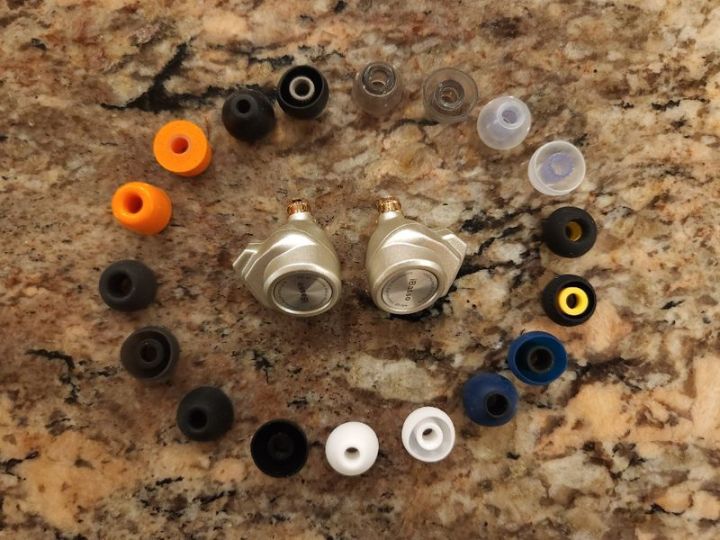
The selection of eartips is crucial to any universal in-ear monitor and will affect the sound, especially the bass impact depending on the seal. Due to a large opening of my ear canals, I usually go for the largest size eartips to get a better seal. Also, please remember that eartips impressions are subjective and will be based on the anatomy of your/my ears.
- Stock white – a bit more emphasis on upper mids and treble, less air in treble.
- Stock black – more punch in mid-bass and a bit more crunch in treble.
- Stock grey (wider bore opening) – deeper sub-bass, more punch in mid-bass, and a bit more crunch in treble.
- Stock blue/black – the cap material is very soft, and while I need to use the largest size pair, its soft silicone material opened up a seal, and I lost all the bass.
- Stock foam – unfortunately, these are too small for me.
- Eletech Baroque – closer to balanced signature tuning with bass being scaled up, mids clear and detailed and more balanced, clear, detailed, airy treble; overall a more revealing tuning with a deeper bass.
- Final Type-E – warmer tuning, deeper sub-bass, smoother mids, clear detailed treble, a bit narrower soundstage.
- Symbio F – smoother tuning, more neutral deeper analog textured bass, fuller body smooth detailed mids, natural clear treble.
- Azla Xelastec – closer to balanced signature with slightly more forward mids, warmer detailed tuning. Elevated sub-bass and mid-bass, fuller body clear detailed natural mids, clear detailed treble. Smoother tuning with more elevated bass response.
- SpinFit W1 – more mid-forward tuning with textured neutral bass, more neutral natural mids, and clear detailed treble.
As they say, YMMV, try them all and see which one works better for your ears.
Cable pair up.
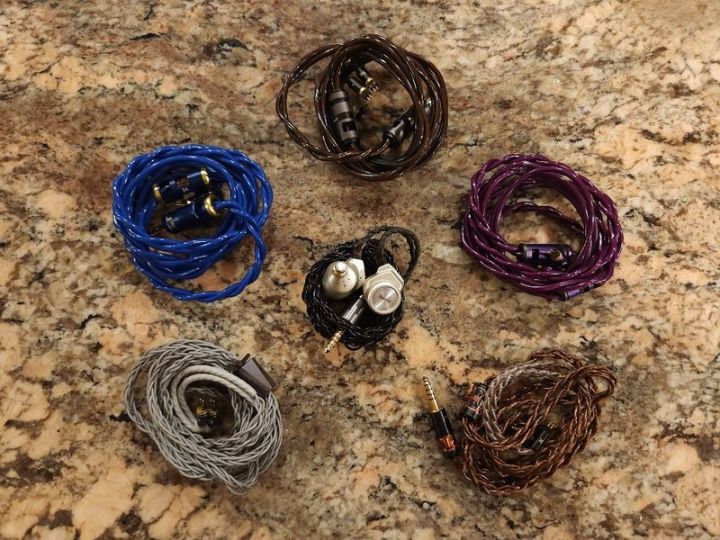
I’m aware that some people don’t believe in cables and strongly oppose them. It’s not my intent to change those minds. Instead, I’m just sharing what I hear during my testing. What makes sense to me, a metal wire is a material with physical properties of resistivity, conductivity, purity, and unique geometry, all of which put together act as a filter between your source and headphones. Variations of these physical properties can affect the conductivity of analog signal, resulting in a sound change, from a subtle to a more noticeable level. If the talk about cables upsets you, please skip this section. Otherwise, enjoy these short comparison impressions relative to a stock cable.
EA C23 (copper) – bigger soundstage, more bass impact, brighter treble.
EA C24C (copper) – bigger soundstage, more bass impact, a little less treble than in C23.
EA C24 (SPC) – bigger soundstage, smoother tonality.
EA Eros S (silver/copper hybrid) – the same soundstage, more revealing mids.
Eletech Ode to Laura (triple-copper) – the same soundstage, deeper sub-bass and a lot more punch in mid-bass, smooth natural fuller body mids, clean airy treble.
At this point, I had to stop the cable rolling. Don’t know if it makes sense to suggest buying a cable that costs 20x more than IEM itself. If you are getting 3T-154 and already have Ode to Laura, that pair-up was quite impressive. I also really enjoyed the C24C pair-up, but a thicker heavier cable with these larger shell IEMs was pulling them out of my ears. Tbh, I did enjoy the smoother analog tonality with a stock cable, so I wouldn’t invest a ton of money into a cable upgrade. But if you have other upgrade cables, go ahead, and try it, always fun to experiment!

 Twister6 Reviews