
Sound Analysis.
Drivability.
All 3 Oriveti IEMs are fairly easy to drive via phones and dongles, and you don’t really need powerful DAPs just to drive them. If you’re on a budget, here’s my article on some of the nicest dongles you can buy under $150 – The Dongle Olympics.
Oriveti OH700VB ($699).
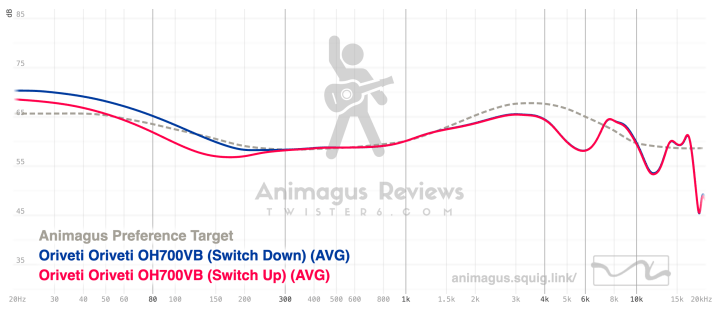
Graphs are measured using an IEC60318-4 (IEC711) setup. You can compare all the graphs on my IEM Graph Database here – Animagus Squiglink.
OH700VB has a warm leaning sub-bass boosted V-shaped tuning that has a signature quite reminiscent of older Audeze headphones because of its similar recessed upper-midrange tuning. With the Switch Down, it has about 10dB of a sub-bass shelf, fairly neutral lower-midrange, recessed upper-midrange, slightly recessed lower-treble and and fairly airy upper-treble tuning. This results in a signature that has very good sub-bass rumble, a warm lush midrange that is pushed back in the stage because of the upper-mid recession and a fairly balanced treble tuning that is equal parts smooth and exciting. It’s an IEM for fairly easy background listening and not one that brings you all the details right up front like neutral forward presenting IEMs. Also, the main highlight of this tuning is the very well separated sub-bass rumble that makes it not only quite a nice listen for bass oriented genres but even better for watching movies because of its otherwise smooth and easy on the ears character that pushes instruments and information further back in the soundstage and helps present a picturesque portrayal of what is happening in the movie rather than the sound being completely in your head. With the Switch Up it drops the frequency response <250Hz by about 2-3dB and you mostly hear the sub-bass being pushed further back in the stage with less rumble. When it comes to technical performance, it does some things really well like really good left to right separation for the price, a well defined and separated centre image and good stage width and depth with a roomy small hall like soundstage, but has average resolution, detail retrieval and imaging chops which are primarily results of the caveats of the tuning itself.
Oriveti OD100 ($70).
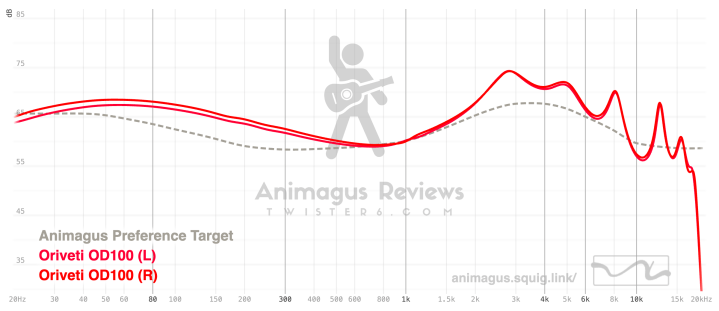
Graphs are measured using an IEC60318-4 (IEC711) setup. You can compare all the graphs on my IEM Graph Database here – Animagus Squiglink.
OD100 has a fun W-shaped tuning on steroids that goes for a vivid presentation of music, one whose tonality and timbre aren’t exactly neutral and yet quite balanced to not sound wonky. It has strong boosting in the upper-midrange and treble for a very forward presentation and then strong boosting in bass (mid-bass over sub-bass) and a fuller bodied lower-midrange to compensate for the upper-end brightness resulting in a balanced sounding signature with not many quirks as the graph would have you believe. Ear tips play a very important role here since the barrel shaped shells are quite small and you need to have a nice snug fit for the original intended signature to transfer or else the bass balance can reduce, resulting in the upper-midrange coming across shouty, which is not the case otherwise.

It has very good left to right separation for its asking price and the bass comes across very well separated in the centre, with more punch and impact than rumble because of its mid-bass over sub-bass boosting approach. It has a slightly fuller lower-midrange than neutral, which even though I would’ve preferred to be more neutral, is a very clean take on a fuller bodied sound without muddying up the spectrum. Upper-midrange has north of neutral forwardness, even north of Diffuse Field target (see graph below) but doesn’t come across shouty because of the boosted bass and lower-midrange tuning. Post that the treble tuning, though not very linear, has enough sparkle and vibrancy to make OD100 an exciting listen yet quite smooth. This is one of those IEMs that sounds very enjoyable as soon as you put them in your ears. It has a fun tuning that I can even see neutral/reference heads (like me) just enjoy it for the very well done tasteful colouring.
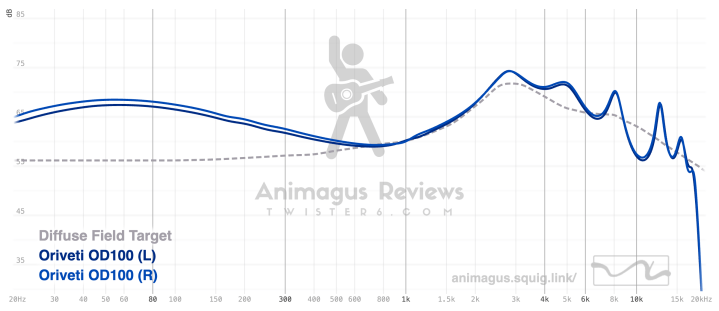
Coming to Technical Performance, OD100 is quite an impressive tiny performer for its asking price – good left to right separation, fairly good imaging, good detail retrieval as well as a fairly nice wide and deep soundstage for its price, that isn’t as common in this price range. This is of course no wonder kid kilobuck killer, but it is a wonder kid for a sub-$200 IEM for sure.
Oriveti OD200 ($199).
Graphs are measured using an IEC60318-4 (IEC711) setup. You can compare all the graphs on my IEM Graph Database here – Animagus Squiglink.
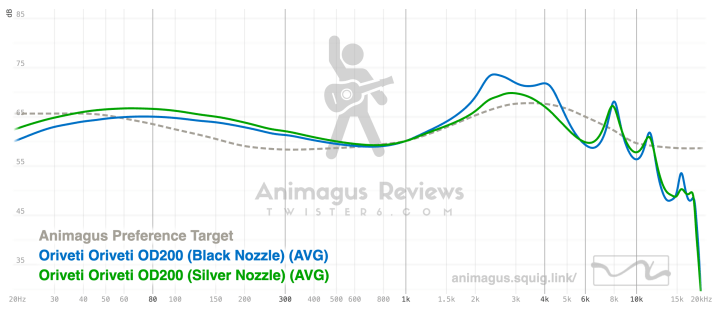
OD200 takes OD100 signature and turns down the boosting at both ends while giving you two different sounding signatures via the swappable nozzles (as you can see in the graph above). OD200 with stock Black Nozzle, even though still a fuller bodied sound, has slightly less of the bass, lower-midrange and treble boosting compared to OD100 while moving the upper-midrange ear gain more towards 2.5kHz than the more accurate 3kHz. All of this results in a fairly different sounding signature, one that is warmer but also one that I feel loses the excitement and energy that the OD100 has, while adding some honk with its peaky ear gain in the wrong region as well as a bit of haze and muddiness on top because of its lower-midrange fullness. On top of that the dip in the 4-8kHz range as well as it lacking air past 12.5kHz restricts it from having enough energy in the top end to make it interesting and restricts it from having a USP that can stand out in this very competitive price segment.

The extra Silver Nozzle has a sloping tilt effect on the stock tuning (Black Nozzle), which fixes the shout of the upper-midrange and brings it to a more neutral level but also adds a 2dB shelf boost to the bass resulting in an even more warmer sounding IEM. That would’ve otherwise been fine but it doesn’t really fix the main issues as reported above. Its tonal shortcomings further influences its technical performance, making it an average performer compared to the popular benchmark IEMs in its segment like the Hana 2021 and Moondrop Kato. The soundstage feels closed in because of the lower-midrange bloom and extra mid-bass boost, detail retrieval is compromised because of lack of proper treble extension while the imaging and separation chops are average at best, bettered by quite a few sub-$200 IEMs.

 Twister6 Reviews