
Comparisons.
OH700VB Comparisons
Symphonium Meteor.

Symphonium Meteor is a 4BA IEM with a signature that is significantly bassier and fuller sounding than OH700VB. It has a similar recessed upper-midrange but significantly more sub-bass rumble as well as mid-bass boom, fuller sounding lower-midrange and airier upper-treble. All of this makes the OH700VB come across much cleaner as well as more neutral and balanced. With that, OH700VB has a cleaner and deeper soundstage, better left to right separation, better defined centre image, slightly better imaging and because of it having a less bassy, cleaner signature, it also comes across as having better resolution and detail retrieval.
Custom Art H3 Pro.
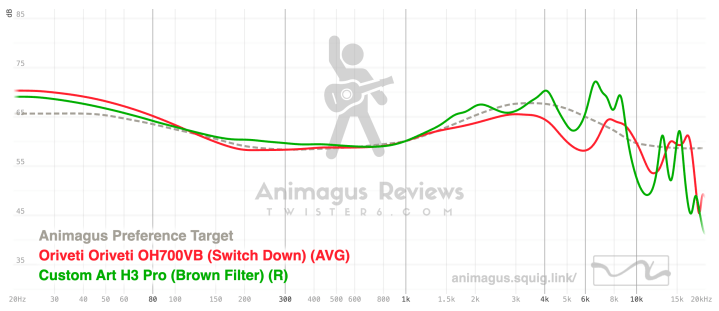
H3 Pro has 2DD + 1 Planar Drivers with a bright leaning W-shaped signature. H3 Pro has better ear gain leading to better, more forward and stronger vocal and instrument definition. It also has more than neutral lower-treble boosting which results in it not only coming across brighter but also having better detail retrieval. OH700VB does have slightly more sub-bass rumble but because of a dipped upper-midrange and lower-treble tuning, comes across much warmer with more bass impact. H3 Pro’s bass on the other hand has very good precision, with impact when the song demands. OH700VB has better treble extension with more air on paper but H3 Pro still sounds brighter because of the north of neutral lower-treble boosting. When it comes to technical performance, they both have different strengths – H3 Pro has significant better detail retrieval and stronger definition of vocals and instruments while OH700VB has better left to right separation, a better separated centre image and a deeper soundstage.
Softears RSV.
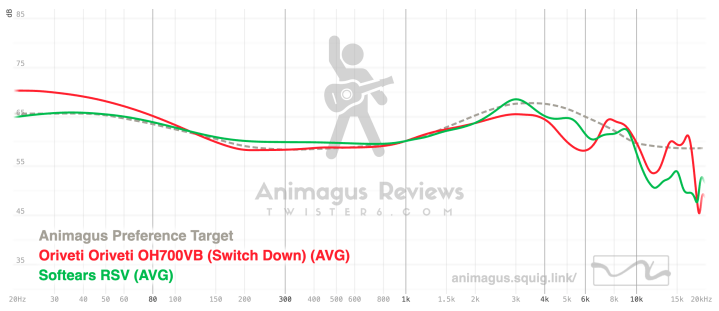
RSV is a 5BA IEM with a warm sub-bass boosted reference tuning. It has less of a boosted sub-bass shelf than OH700VB, very slightly fuller lower-midrange in comparison, much better and more natural ear gain (forward upper-midrange), more neutral lower-treble tuning and less air up top. All of this results in RSV having a more natural tonality and timbre of voice and instruments and a more accurate, forward presentation of the mix in comparison. OH700VB on the other hand pushes the whole presentation further back because of the dipped upper-midrange and lower-treble tuning. It comes across much warmer up till 8kHz and then airier up top than the RSV. When it comes to technical performance, there are some things RSV does better like instrument definition, resolution and detail retrieval but OH700VB has better left to right separation, better defined centre image as well as a wider and deeper soundstage.

OD100 Comparisons
Moondrop Aria.

Aria too is a 1DD IEM but with a warm sub-bass boosted reference style tuning. OD100 is a significantly coloured IEM in comparison. It has more sub-bass rumble, much more mid-bass boosting, a slightly fuller bodied lower-midrange, significantly more upper-midrange as well as brighter lower and upper-treble. All this results in OD100 having a more vivid presentation than Aria while the Aria comes across more neutral and more evenly balanced. OD100 is not only bassier but also more forward and sparklier sounding than Aria. Yet it comes across tastefully coloured and smooth and with the right tips and a snug fit, not as shouty as the graph would have you believe. But if you already find Aria shouty, then you’d definitely find OD100 shouty as well. I do perceive a wider and deeper soundstage in OD100 with more definition, resolution as well as detail retrieval owing to the boosted ear gain and lower-treble tuning. All in all, I’d go with Aria for a more neutral tuning and OD100 for a well balanced coloured tuning. OD100 has another significant advantage over the Aria and that is build quality along with much better accessories and packaging. Even though my Aria unit’s paint is still intact as it was on day 1, there were too many complaints from buyers about the paint chipping which I can’t confidently recommend anymore. OD100 on the other hand has exceptional machining and build, so it’ll be a stress free ownership experience in that regard.
Truthear Hexa.
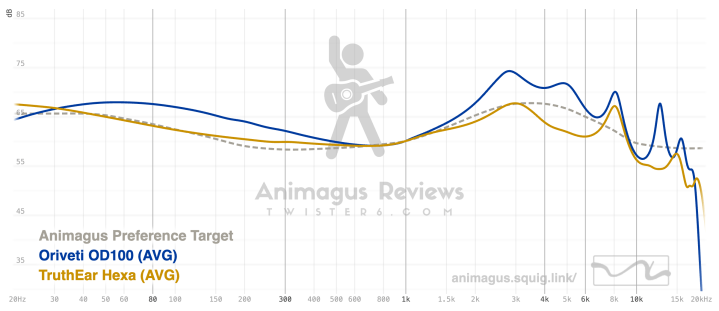
Hexa is a 1DD+3BA hybrid and one of the most popular ones around the $80 mark, hence the inclusion for people who just want to get one IEM with a sub-$100 budget and don’t care about the driver tech inside. It’s anyway the tuning that matters at the end of the day..
Hexa, like the Aria, has a sub-bass boosted reference style tuning, one that has a more neutral sub-bass shelf, a cleaner, more neutral lower-midrange, more neutral ear gain but one that still has a bit of recession in the 3.5-8kHz region as well as a more neutral, slightly warm leaning treble tuning with better, more linear extension. This results in Hexa having more natural tonality and timbre while the OD100 has a tastefully coloured vivid tuning in comparison. Coming to technical performance, Hexa has a cleaner sounding stage with better imaging but OD100 has stronger instrument definition, slightly deeper soundstage and is a touch better in detail retrieval. Again, just like the Aria, I’d go with Hexa for a more neutral (more capable than Aria) and safe sounding IEM while the OD100 as a tastefully coloured fun IEM.
OD200
Moondrop Kato and Tanchjim Hana 2021.
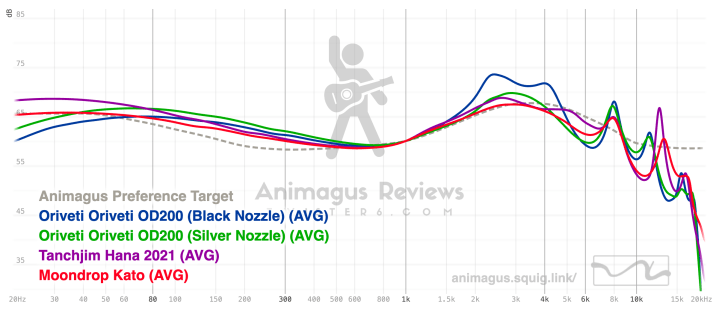
With the Black Nozzle, OD200 has too much mid-bass and lower-midrange bloom as well as too much ear gain – all of which take it too far off natural tonality and into wonky territory that adds too much muddiness and honk to the songs. Both Hana 2021 and Kato come across much more natural and even sounding in comparison with better, more even bass rumble, punch as well as better bass speed and precision, much cleaner lower-midrange, more natural ear gain at the right spot and more even treble balance and extension with more air on top. With the Silver Nozzle, OD200’s ear gain peakiness does normalise but gets even more mid-bass boom and lower-midrange bloom added to the signature without improving the treble performance. So it does not serve the OD200 too well as it does not fix its primary problems. Both Hana 2021 and Kato have better technical performance including a more clear and open sounding stage with a better sense of openness as well as better detail retrieval, resolution, left to right separation and imaging.
Conclusion.
Having taken all 3 IEMs through their paces, I see Oriveti has great resources and potential as they have a keen eye for attention to detail in all the physical aspects. They have exceptional build quality and packaging along with very good set of high quality accessories but when it comes to sound, I think they can do even better. I do find OD100 and OH700VB quite capable for their price segments but OD200 needs a bit more work and refinement in my opinion. OD100 provides a very tasteful coloured take that is quite ambitiously boosted in some places and yet comes across very well balanced. OH700VB, the most expensive of this lineup at $699, offers a very nice Audeze-ish kind of recessed upper-midrange signature with very good sub-bass rumble in stock tuning and a switch to reduce that to a slightly more neutral level if one prefers. Both of them have their tonal caveats but their respective pros place them as good options in their respective price segments. OD200’s tonal caveats on the other hand kind of outweigh its very impressive design, build and packaging, limiting it from being as attractive a proposition for its price segment, which is one of the most competitive and cut throat segments today. Don’t get me wrong, OD200 isn’t a bad IEM, it’s just not as competitive for its price segment in today’s world. With all that said, I can safely recommend the OD100 if you’re a fan of well done coloured tunings as it is an exceptionally well done package for $70 and OH700VB to fans of Audeze style recessed midrange tuning with good technical performance to go with but I’d suggest skipping OD200, unless you particularly love a very coloured tuning, because there are just too many better performing, more versatile products in its price range.
As I said before, Oriveti definitely has great potential and I think some further work on the tuning side of things, benchmarking the top performers in different price segments to offer even better performing products can easily propel them into a top performing manufacturer because they are one of the few companies in my opinion that have the capability, resources and attention to detail in most aspects to make that happen. All they need is a slightly push in the right direction.
Gear used for testing and review.
- DAPs – iBasso DX300 | HiBy R6 Pro II
- Laptop – Apple Macbook Pro 15″ + Tanchjim Space Dongle
- Phone – OnePlus 7 Pro + Tanchjim Space Dongle
Artists I like and listen to.
- Rock – Foo Fighters, Linkin Park, Switchfoot, Imagine Dragons, Daughtry, Green Day, MuteMath, X Ambassadors, Dave Matthews Band, Vertical Horizon, Our Lady Peace, Lifehouse, Fall Out Boy, Breaking Benjamin, Muse, ACDC, Audioslave, Rage Against the Machine, Biffy Clyro, I Am Giant, Normandie, Paramore, Slash & Guns N Roses, 3 Doors Down.
- Pop Rock – John Mayer, Coldplay, Paul McCartney, James Bay, Hunter Hayes, Niall Horan, Keith Urban, The Bros Landreth, Bryan Adams.
- Progressive Rock/Metal – Porcupine Tree/Steven Wilson, Karnivool, Tool, Dead Letter Circus, Periphery, Lamb of God.
- Pop/Soft Rock – Ed Sheeran, Adele, Taylor Swift, OneRepublic, The Script, Gavin James, Magic Man, Maroon 5, Bruno Mars, Charlie Puth, Dua Lipa, The Weeknd, Oasis, Panic! At the Disco, TwentyOne Pilots.
- EDM – Chainsmokers, Zedd.

 Twister6 Reviews