
Sound Analysis.
I analyzed AE sound performance paired up with P6 Pro, using a stock cable and Azla Crystal eartips while playing a variety of my test tracks, such as Agnes Obel’s “The Curse”, Sandro Cavazza “So much better” (Avicii remix), C-Bool “Never go away”, Ed Sheeran “Shape of you”, Alan Walker “Darkside”, Galantis “Hunter”, Iggy Azalea “Black widow”, Indila “Boite en argent”, Dua Lipa “Love Again”, Counting Crows “Big yellow taxi”, Bob Marley “Jamming”, David Elias “Vision of her”, and Michael Jackson “Dirty Diana”. Since I wasn’t sure how much burn-in these IEMs already had, I let them play in a loop for a day before starting to collect listening notes.
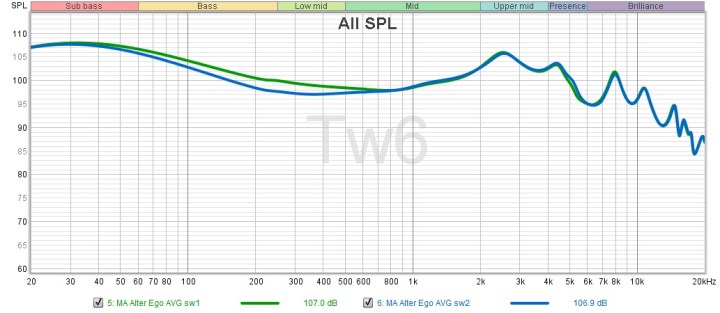
AE has a balanced sound sig with some tilt toward the elevated sub-bass, and a natural, clear, fuller body detailed tonality. The tuning of AE’s hybrid driver config is quite coherent, with all 9 drivers (DD/4BA/4EST) working together in perfect unison harmony, even considering the sub-bass lift which I found to blend in well without feeling disconnected.
Bass is probably the star of the tuning with a deep elevated sub-bass rumble you can feel as AE’s DD driver vibrates the air which btw doesn’t cause any pressure or discomfort due to the open-back design of these IEMs. The rumble adds a sense of more depth, extension, and weight to the bass, giving the bass its fullness. The mid-bass has a nice well-controlled punch, with a decent speed for a DD driver, but not too overwhelming in impact. The switch has precise control of the mid-bass quantity and lower mids body, but it doesn’t add muddiness or veil to the sound. With the switch on, the bass impact scales up, giving the mid-bass a stronger punch with more weight which also helps to elevate the sub-bass a bit as well. With other IEMs that have either a switch or a module to control the bass, I usually pick one setting that I prefer and stick to it. For the first time, I was going back and forth, using the same test track, and I couldn’t make up my mind because I enjoyed both settings.
Mids are very natural, and detailed, on a smoother and more musical side, and still with plenty of natural clarity. Again, the switch here does an excellent job of controlling the amount of body in the lower mids. With the default tuning of the switch being off, you get neutral lower mids which bring upper mids a bit more forward, giving them more clarity and some improvement in the retrieval of details. With the switch on, lower mids have a fuller body without adding veil or muddiness, giving the mids more organic, smoother, musical tonality, still with plenty of clarity, though a touch less resolution. Again, I couldn’t decide which I prefer. The coherency of the tuning and the effect of the switch on the tonality worked well with either setting, and I enjoyed both.
The treble tonality of AE is softer and smoother but still has plenty of natural clarity. The sound is open and clear without extra airiness or boosted peaks to add more crunch. The treble is there, with plenty of clarity giving the vocals their natural definition, but it is on a smoother side. Also, while the switch doesn’t change the treble directly, its perception is affected. With a switch off, the neutral lower body of mids gives more room for upper mids to shine through and for a treble to gain a bit more sparkle. With a switch on, fuller body mids projected a perception of a smoother treble.
The layering and the separation of the instruments and vocals are good and natural, and as I already mentioned, even with the switch on which adds more weight to the bass and more body to the lower mids, there was no congestion and no muddiness or veil. Everything is easy to distinguish in the mix. The soundstage has a big open expansion, spherically shaped to cover evenly the width, depth, and height. The open-back design enhances the imaging and how accurately all the instruments and the vocals are placed in space, creating a 3D imaging effect without relying on extra treble sparkle or exaggerated holographic soundstage expansion.
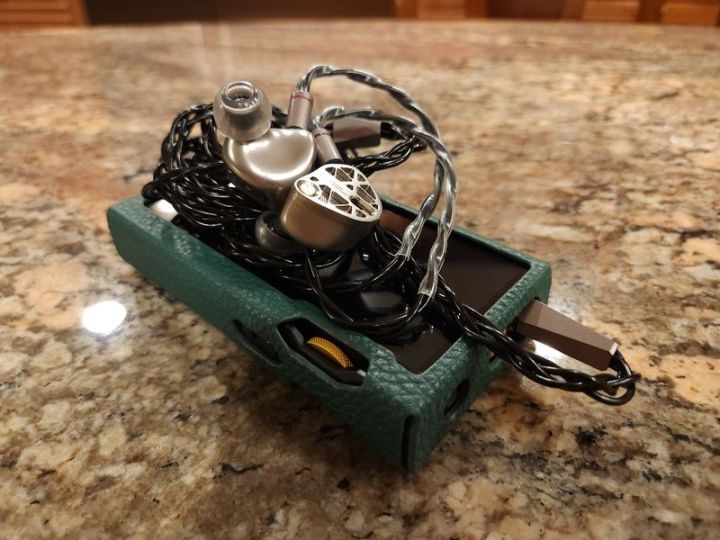
Of course, a white elephant in the room is the open-back design question. What does that mean to sound isolation and sound leakage? Usually, in the open-back design you have to compromise both, while here I noticed a relatively good sound isolation. Of course, it wasn’t like wearing earplugs, but it was on par with many other IEMs, especially when you pick the right eartips to give you a good seal. With sound leakage, it’s a different story. I wouldn’t recommend you wear these in the library, and they didn’t pass the “wife test” in the bedroom since it was bothering her. It’s not exactly as loud as when listening to open-back full-size headphones, but you can hear what the person is listening to when standing 6-7 feet away. So, keep that in mind if you are planning to wear AE in public. However, I found that I was able to use AE in my ears with noise-canceling headphones over the top, a nice workaround. It didn’t affect the sound tuning, it was nearly the same as wearing them by itself. Even the soundstage was close enough, though by itself it was a bit more open.
Eartips selection.
The selection of eartips is crucial to any universal in-ear monitor and will affect the sound, especially the bass impact depending on the seal. Due to a large opening of my ear canals, I usually go for the largest size eartips to get a better seal. Also, please remember that eartips impressions are very subjective and will be based on the anatomy of your ears, such as these impressions being relative to mine.
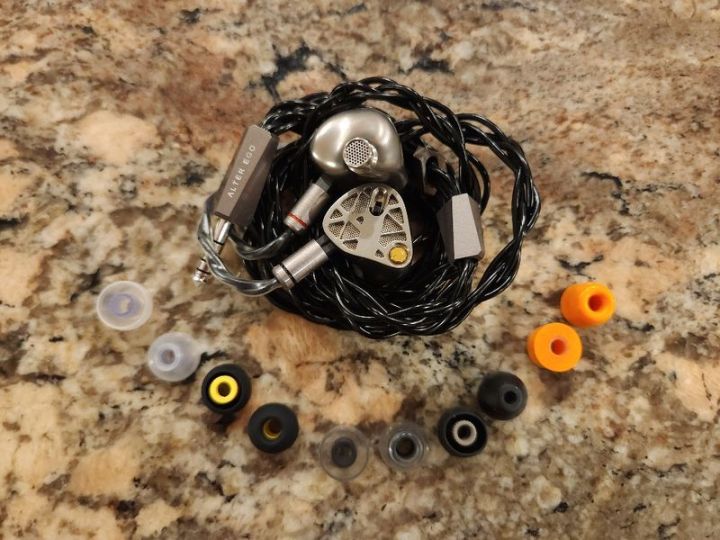
Final Type-E – balanced signature, mids/vocals were more center-focused, and the bass was a bit booming.
SpinFit W1 – balanced signature with a wide/open soundstage, deeper bass, more clarity in mids, and smooth treble.
Eletech Baroque – balanced signature, the soundstage had more depth than width, deeper bass, and a little more crunch in treble.
Symbio F – balanced signature, the soundstage has less width and more depth, the bass is more neutral, and the mids/treble are smooth.
Azla Crystal – balanced signature, wide/open soundstage, more weight in the bass (deeper rumble, stronger punch), natural detailed mids, a little more crunch in treble.
To my ears, AE worked better with Crystal eartips.
Cable pair up.
I’m aware that some people don’t believe in cables and have a very strong opinion about it. It’s not my intent to change those minds. Instead, I’m just sharing what I hear during my testing. What makes sense to me is that a metal wire is a material with physical properties of resistivity, conductivity, purity, and unique geometry, all of which act as a filter between your source and headphones. Variations of these physical properties can affect the conductivity of analog signals, resulting in a sound change, from a subtle to a more noticeable level. If the talk about cables upsets you, please skip this section. Otherwise, enjoy these short impressions.
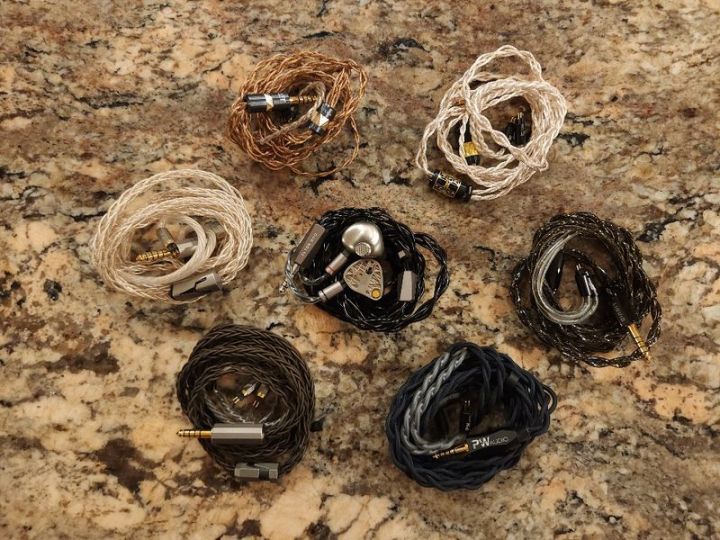
PWA FT – not too far off from the stock cable, just a bit more texture in the sub-bass.
EA Centurion – the soundstage expansion is more holographic; bass is tighter, has more punch and improved articulation; more sparkle in treble; improvement in retrieval of details and layering of the sounds.
EA Chiron – bass is tighter, has more punch and improved articulation; more sparkle in treble; and some improvement in retrieval of details.
LL Venom – some improvement in soundstage expansion; bass has more texture in sub-bass and a bit more punch in mid-bass; more sparkle in treble; more revealing upper mids.
Eletech Sonnet of Adam – the soundstage expansion is more holographic; bass has more texture in sub-bass, and a little more punch in mid-bass; a bit more sparkle in treble; improvement in retrieval of details and slightly more revealing upper mids.
Eletech Raphael – bass is tighter, has more punch, and improved articulation; more sparkle in treble; improvement in retrieval of details.
To my ears, I preferred the AE pair-up with more neutral or brighter cables.
Conclusion.
After spending a few days with these titanium beauties, it was clear to me how they became one of the highlights of the CanJam SGP ’24 show, mentioned in so many impressions I’ve read on Head-fi in various threads. Between Alter Ego’s unique open-back design, solid titanium alloy build, balanced tuning with a natural tonality, powerful dynamic bass, and a switch with precise bass-boost sound adjustment, Melodic Artification delivered a great sophomore release. Even the pricing was relatively reasonable at $2.5k (and I know, I will get yelled for this) considering many of today’s flagships are going for double or triple that. Melodic Artification is definitely on my radar now and I can’t wait to see what else they are going to come up with!

 Twister6 Reviews
Great review! How is the bass compare to empire ears odyssey?
LikeLike
Both iems were on loan, so I don’t have it either one. And Oddysey was reviewed long time ago. No way I can go by memory without real time a/b comparison.
LikeLike