
Sound Analysis.
For the sound analysis I am going to plagiarize myself a little bit and say pretty much the same thing I said in my review of the Violectric V226: For the sound impressions I worked similar to a few of my recent reviews. I have taken my time and simply used the CH-Amp/Tradutto stack, instead of going through my standard review routine of focusing on an extended critical analysis. I find that when I listen casually, I often more readily notice those aspects that most clearly characterize what I am reviewing. These are more important than tiny nuances that might or might not be relevant to anyone else listening to the same setup. This is in every way a down-to-Earth, real-world review that I hope gives a good idea of what you get with the CH-Amp and Tradutto DAC. I actually like this type of long-term reviewing because it reflects general use much better and I can get to know the product more intimately. This also makes it sound like I did this intentional. I did not, life simply got in the way of me doing my reviews in a timely manner (I have been apologizing to a lot of people lately), but let’s pretend I am really clever and that it was all part of a very well thought out reviewing strategy.
Of course, as always, I do put in a lot of effort to build up my impressions and use a wide variety of gear. For listening I used IEMs such as the Vision Ears VE7, Empire Ears Wraith and Phantom, DITA Audio Dream XLS and Final A8000. I also used low-impedance earbuds, the FiiO FF3, and the high-impedance TGX Ear Serratus. For headphones I only had the Sennheiser HD650 available. My main transport has been my MacBook Pro (2020), which I used both via USB and Bluetooth.
The sound of the CH-Amp/Tradutto stack is neutral with a natural tone, without giving me the feeling there is much coloration. With that I mean that the warmth that enhances the naturalness is very subtle. I think the balance that EarMen struck here is very nice and should appeal to most people. I don’t think anyone will call it ‘organic’ nor ‘clinical’. That might risk the accusation that it lacks character, but that’s not the case either. There is a subtle liveliness to the bass that adds musicality. I think the CH-Amp/Tradutto stack is ‘neutral’ in the best sense of the word. There is musicality there and because the stack does not color the sound of your headphones/earbuds/IEMs, it allows you to thoroughly enjoy the gear that you have by bringing out the best in those. It also makes the stack very versatile because there won’t be issues with synergy. I genuinely expect any gear will pair just fine in that sense.
One of my favourite pairings to listen to was the VE7 paired with the Eletech Sonnet of Adam aftermarket cable. The VE7 have amazing clarity and a very accurate tone, and listening to them with the CH-Amp/Tradutto stack was a real joy. This is where I most clearly felt that the stack ‘got out of the way’ and let the IEMs shine. Moving to much warmer IEMs such as the Phantom illustrated that too. No sudden increase in that warmth, nor did they suddenly lose their warm comfy blanket character. Just the Phantom as I have always loved them.
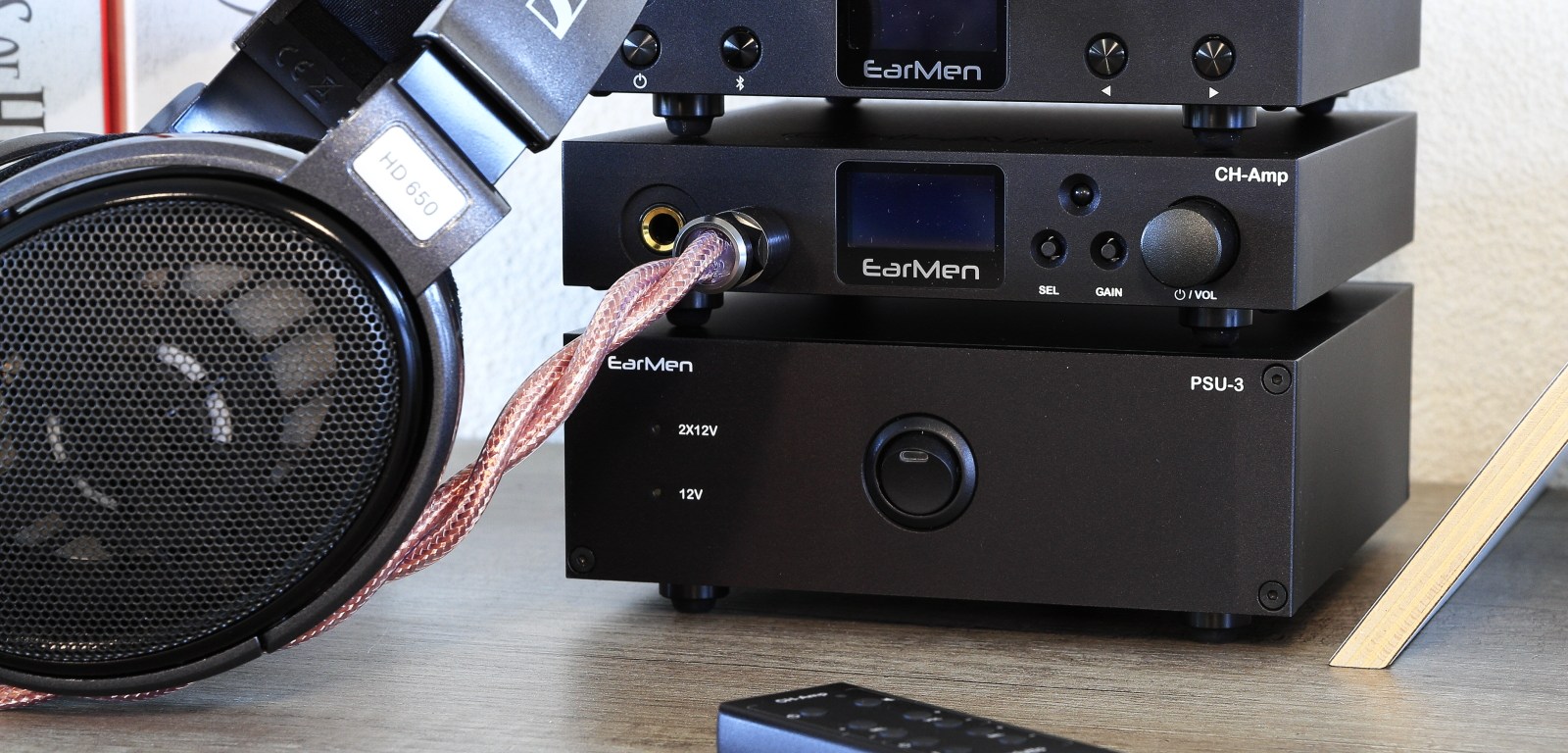
Although IEMs work nicely and there is at times good scaling with those, the CH-Amp/Tradutto stack really comes into its own with headphones. When I paired the Sennheiser HD650, it was an instant reminder of why these headphones are so legendary and why people insist they need a proper amp. I can drive them decently with the Shanling M8 or EarMen’s Angel, but it simply does not compare. With the Angel the sound is nice and I would say the Angel drives the HD650 well enough to enjoy. The CH-Amp/Tradutto stack however scales the HD650 considerably beyond that. Notes are fleshed out a lot better, there is more air and the headroom expands to feel more immersive and holographic, the Angel driving the HD650 feels anemic by comparison. The CH-Amp/Tradutto stack drive the HD650 beautifully and allows these venerable headphones to fully envelop you in their sweet and utterly addictive sound. The presentation is very clear with great transparency against a very black background. There is gobs of texture to every note and you can easily place every instrument.

Comparisons.
-Violectric DHA V226-
Unfortunately, I don’t have the V226 around anymore for a direct comparison, but from memory and my notes there are a few general observations that I feel are still worth sharing. Not in the least because the V226 and CH-Amp/Tradutto sit roughly in the same price range and I think will appeal to a similar audience.
In terms of build quality, the CH-Amp and Tradutto are more solidly built. The V226 is very well built and the front plate feels just as solid as the CH-Amp and Tradutto, however the casing of the V226 felt thinner. That does not mean the V226 is not well built, it is just that the ‘feel’ of the CH-Amp and Tradutto inspires more confidence.
While the V226 is super versatile, the CH-Amp/Tradutto stack has more inherent versatility because it is a stack, which means you can separate the amp and the DAC physically, if you wish. You can also add the Staccato streamer to it, while maintaining the overall look of the stack (i.e., not a different looking streamer unit), something my OCD greatly appreciates. The V226 does have a great advantage with Violectric’s brilliant pre-gain settings, which adds a lot of room to play with. The Tradutto in turn adds Bluetooth, which can be very convenient and still has an optical in. The V226 does offer a proper (up-to-date) USB-C digital in, while the Tradutto is unfortunately stuck with a dated USB type B port. The CH-Amp/Tradutto stack has the option of being connected by a 4.4mm balanced connection, which is nice and clean. Again, my OCD greatly appreciates this.
Sound impressions are of course a bit difficult to do without having both side-by-side. Still, there are some things I can say with reasonable confidence. The V226 performs better in terms of its noise floor. I have tested this with some of the most sensitive IEMs available and the V226 has always been perfectly useable, whereas the CH-Amp/Tradutto stack has more noticeable noise with the Empire Ears Wraith. While I was happy to use the V226 with the Wraith, I was a more bothered by the noise with the CH-Amp/Tradutto stack. Not everyone will be as bothered by it because it is still very little noise. I am however quite sensitive to it, especially when listening to classical music, as the noise, however slight it might be, becomes noticeable at sections where there should ideally be a perfectly black background.
Both the V226 and CH-Amp/Tradutto stack have a thoroughly enjoyable sound and I have loved using both. The V226 has a smoother and more analogue-type of sound. Especially that smoothness is quite characteristic of the V226, which is why I am happy to point it out without the direct comparison. The CH-Amp/Tradutto stack feels a little dryer and perhaps more analytical by comparison, although I would call both natural. Both also seem to have a subtle bit of bass emphasis, making each more musical than analytical when comparing to strictly neutral sources.
A choice between these two is very tough and I think will depend on your use, as some features might give one an edge over the other, as well as which sound you enjoy most. Both are very enjoyable to listen to. For me personally, I would probably lean towards the V226 because I particularly like its smooth and analogue sound, and would benefit most from the exceptionally low noise floor. However, the CH-Amp/Tradutto stack has been a joy to use, always putting a smile on my face. I also greatly appreciate the versatility of the stack and the option to add a streamer down the line, while maintaining a consistent look.
-EarMen Angel-
Although serving different purposes, I think a comparison with the Angel makes sense from the perspective of someone who might consider upgrading to the CH-Amp/Tradutto stack. What does the stack offer over the Angel?
I reviewed the Angel a while back and was very impressed with it. It is a highly versatile, portable DAC/amp with excellent sound quality and plenty of power. When I spoke to Miroslav of EarMen after that review, he explained that it was developed to sound like a desktop amplifier (consistent with my impressions in the review). With EarMen’s own desktop amp in hand, a comparison was naturally required. Interestingly, this link did not actually occur to me when I started the comparison. I just did it because it made sense to compare two items from the same brand. It was only when I listened to the Angel back-to-back with the CH-Amp/Tradutto that I was reminded of that conversation because once again I felt the Angel gave a taste of what a dedicated desktop setup can do.
It is of course not an entirely fair comparison because of the different purposes they serve and the difference in price point. The CH-Amp/Tradutto stack is simply more mature and delivers true desktop performance. There is however still a similarity in the tone and both feel neutral with perhaps a hint of a lift in the bass to emphasize musicality. The most obvious difference is that the CH-Amp/Tradutto has fuller notes and comes across more natural, whereas the Angel has slightly more energy in the treble, leading to a leaner sound. This difference is noticeable with sensitive IEMs, but becomes even more obvious with high impedance headphones such as the HD650. Similarly, the background with the HD650 is very black and clean with the CH-Amp/Tradutto, more so than with the Angel. When moving to more sensitive IEMs, it becomes increasingly clear that the CH-Amp/Tradutto has a noticeably cleaner background.
Comparing the Angel with the CH-Amp/Tradutto stack illustrates very nicely how the proper desktop setup will scale beyond the highly versatile, portable and take-everywhere Angel. If therefore your primary use is always at the same desk, then the CH-Amp/Tradutto stack will offer a comfortable upgrade over the Angel. Of course, if you move around a lot, then the Angel will still give you a taste of desktop sound everywhere you go.
Conclusions.
The CH-Amp and Tradutto DAC makes for a great sounding and highly versatile stack that integrates well into a modern, multimedia desk space. The sound is neutral, thoroughly musical and will bring out the best in anything from sensitive IEMs to high-impedance headphones. Noise levels are very low and are inaudible with all but the most sensitive IEMs. Build quality is very solid and the design is clean and modern. There are plenty of wired options for connecting, as well as a very stable Bluetooth connection. Because EarMen have used a standard design for this line of devices, it is possible to add other devices down the line that will match perfectly in the stack.

 Twister6 Reviews