

Pair up.
Here is how 3kT pairs up with some IEMs and headphones. In each pair-up, I noted the volume (V) setting out of max 150. All were used from 4.4mm BAL output.
Headphones.
Audio-Technica ATH-R70x (V98) – These 470ohm open-back cans are not easy to drive, and I did have to set the volume to 98. The soundstage is wide, but in OP mode I do hear more depth/height in comparison to width, though imaging is still 3D holographic. Switching into Tube mode widened the soundstage, creating a holographic effect, giving these cans a true open-back soundstage expansion. The sound signature is balanced, and the tonality is smoother, natural, and detailed. In OP mode mids lost some definition while gaining it back in Tube mode which scaled up the R70x performance. The bass performance is great, with a deep sub-bass rumble and tighter rounded punch. The weight of the bass is evenly balanced between the sub and mid-bass. Mids are clear, detailed, and resolving but in a natural way. The treble is clear and detailed, also very natural, with moderate airiness and sparkle. A 3k pair-up made R70x a bit too revealing and thinner for my taste, while this was smoother, fuller body, and still natural and resolving. Tubes here don’t add any distortion, just more analog natural tonality with improved soundstage expansion and more clarity in mids/vocals.
MEZE Audio Empyrean (V83) – I hear a wide-open soundstage with excellent holographic imaging, it feels like you are in a big open room. With the soundstage opening, the difference between OP and Tube mode was less noticeable, just a little narrower in OP mode. The sound signature is balanced, though leaning a bit toward mid-forward here. The tonality is natural, and revealing, just a little bit of coloring to add musicality to the sound. The bass has a deeper sub-bass rumble and softer mid-bass punch, but they are scaled down in quantity, not as elevated. Lower mids are neutral, with a little bit of body, bringing more focus to the upper mids that sound a bit more revealing, and resolving. This brings more attention to the vocals and helps to extract more micro-details from instruments. The treble is clear and detailed, moderately crisp and airy. The tonality and the signature don’t change as much going between OP and Tube modes, but it did help with the holographic soundstage expansion, giving Empyrean a fully open-back sound.
Beyerdynamic T5p 2nd (V75) – Excellent soundstage expansion in all 3 directions, along with 3D holographic imaging, especially when switching to Tube mode. The sound is relatively balanced, very clean, natural, and detailed. The tonality is leaning more toward naturally revealing. Bass has a deep textured sub-bass rumble and tight punchy mid-bass. The weight of the bass is distributed evenly, just slightly elevated. Lower mids are a bit north of neutral, adding a natural body to the sound, while upper mids have more clarity, and details, still natural but with improved extraction of details. Vocals are clear, natural, textured, and quite detailed. The treble also has plenty of clarity, details, and natural sparkle with a good airy extension.

IEMs.
Oriolus Traillii w/Chiron (V54) – Wide open soundstage with 3D imaging, especially when you are in Tube mode since OP mode shrinks the soundstage. The sound signature is perfectly balanced, and the overall tonality is natural, more organic, and a bit more revealing toward the upper mids. The bass goes deep, with both elevated textured rumble and stronger mid-bass impact. Bass has a very impressive impact with more focus on sub-bass. Mids are natural, with plenty of body in lower mids and organic detailed tonality in upper mids, quite resolving, though not micro-detailed. The treble is clear and detailed and has extra sparkle and crunch in mid-treble. Tubes bring more clarity and improved layering and separation to the mids in this pair-up, quite a noticeable improvement over the OP mode.
Aroma Jewel w/FT (V57) – The soundstage is wide open and expanded in all 3 directions with holographic imaging once you switch to Tube mode, and narrower in OP mode. The sound signature is balanced as well, while tonality is neutral, and natural, with a more revealing presentation of the sound in the upper mids. The bass goes deep, with a textured sub-bass rumble and a punchy mid-bass; the bass is very tight and articulate, and the sub-bass is a little more elevated. Lower mids are neutral and natural, which gives upper mids more transparency and also a bit of analog coloring, especially when switching to Tubes. The treble is crisp and detailed, not splashy or harsh, with a good extension. I enjoyed the natural detailed analog tonality of mids and their multi-dimensional depth when switching to Tubes.
EE Odin (V52) – The soundstage here is huge and imaging is holographic in Tube mode, and as expected a bit narrower in OP mode. The sound signature is mid-forward, typical of Odin tuning. The bass is pretty good, goes deep with a nice textured rumble, and the mid-bass has a nice tight punch. The mids are more neutral, with lower mids being slightly leaner without adding too much body to the sound, and the upper mids being nicely layered, detailed, and even smoother and more natural in tonality. The treble is crisp, clear, detailed, well-defined, and not too bright or splashy. I remember how I was on the fence about the 3k/Odin pair-up because it was too revealing, while here it was naturally revealing. There was a bit of waterfall hissing, but rather faint.
FiR Audio RN6 (V53) – A big holographic soundstage expansion, especially in Tube mode. The sound signature was on the borderline of Balanced and L-shaped due to a powerful speaker-like analog bass, thanks to the RN6 kinetic bass driver. Mids were smoother, more organic, and more detailed in upper mids. In OP mode the mids/vocals were pulled back in their presentation, but once switching to Tubes the mids came more forward, giving them extra dimension and improvement in clarity. The treble was natural and detailed, moderately crisp, giving mids higher resolution. Again, while I didn’t enjoy this pair-up with 3k due to some unexpected reverb effect in the bass, here it sounded great, especially how mids shined in Tube mode.
Campfire Audio Solaris 2020 (V34) – Starting with the OP amp setting, I didn’t hear any hissing. The soundstage is round, expanding evenly in width/depth/height though not too wide and more center-focused, giving the sound an intimate feeling. The sound sig is balanced, while the tonality is more natural, smoother, and more revealing up top. Bass has a good sub-bass rumble with a fast well-controlled punch, though the weight of the bass is not elevated. But it is for sure above neutral and unmistakably DD quality. Mids are natural, and smoother in tonality. The treble has more zing, and crisper in tonality, but not harsh or fatigued. It does give the mids better definition with assistance in retrieval of details. Unfortunately, when you switch to Tube or Hybrid, there is a noticeable hissing when listening to instrumental or acoustic tracks with less busy arrangements. I didn’t pick that up until I switched to my “The Curse” hiss-test track.
UM Mest MKII (V52) – When you start with OP, the soundstage has more depth/height than width, but once you switch to Tube mode it expands big with holographic imaging. Typical of Mest MKII, I found a U-shaped sound signature with a deep analog quality dynamic bass where I hear more emphasis on sub-bass rumble, adding extra weight to the low end. Interestingly enough, when switching to Tubes I hear a milder U-shaped sound sig with mids having more emphasis. Lower mids are a bit north of neutral, giving more transparency to the sound, and bringing more focus to upper mids which scale up more analog and textured in tonality as you switch from OP to Tubes. Treble is crisp and airy, but not too bright. Tube mode made MKII mids shine with more natural detailed tonality while also adding extra dimension to the sound.
After my SP3000 review, I concluded that I enjoyed its pair-up with IEMs more than with headphones, and the reason for that was due to 3k being a leaner and more revealing source that doesn’t color the sound as much. With SP3000T I enjoyed it with both, IEMs and headphones, especially in Tube High Current mode because of the extra body added to the sound which enhanced the tonality, especially in mids. The only exception here are sensitive IEMs which do have a hissing (in Tube mode) with 3kT.
Wired and wireless connections.
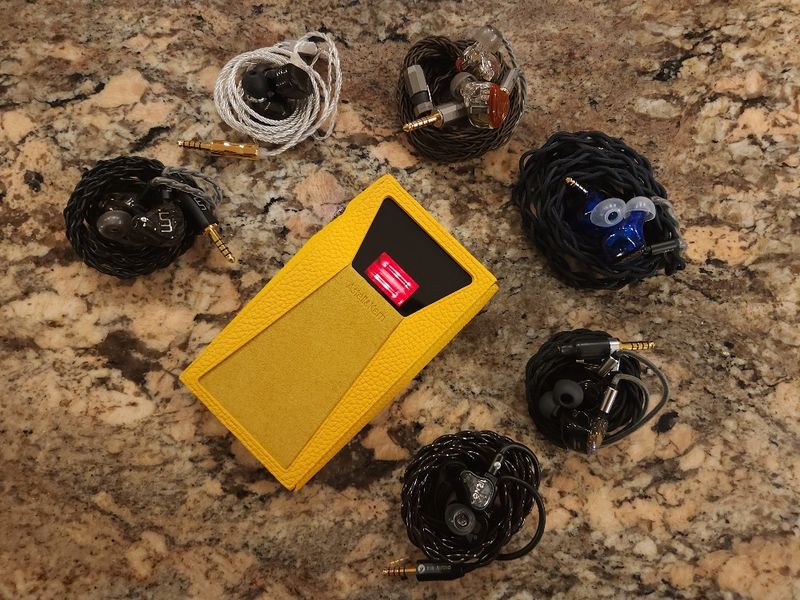
Besides being a portable DAP, you can expand 3kT functionality as a transport to drive an external DAC/amp, to use external AMP, or to turn the DAP into a wired/wireless usb DAC. And of course, you don’t have to be limited to wired headphones and can take advantage of a Wireless Bluetooth connection.
Wireless/Bluetooth.
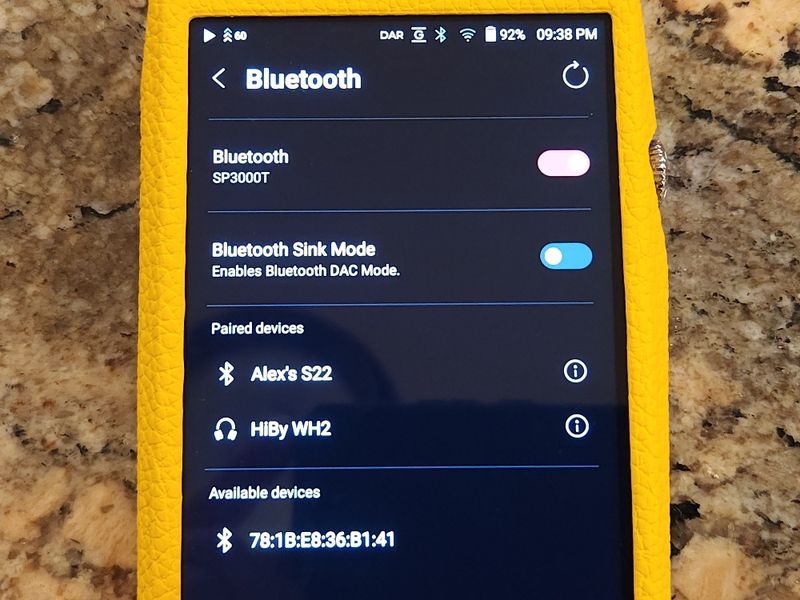
I tested 3kT BT Tx with Hiby WH2 TWS, confirmed operation within 35ft, LDAC pair up was selected automatically, and full remote control supported. 35ft operation in open space was an improvement over 3k where I only was able to get 25ft. Either one is fine for TWS or other wireless headphones, but it was nice to see the improvement in 3kT with its optimized wireless antenna performance.


3kT also has Bluetooth Sink Mode (BT Rx) when the Wireless Bluetooth DAC module is enabled so you can use 3kT as a wireless DAC/amp. I was able to pair up with 3kT from my Galaxy S22 without a problem. Once paired up, when you start playing a song it is displayed on a 3kT “BT Sink Mode” screen where you can play/pause and skip it. Also, you can control the volume from the smartphone or directly from 3kT.
USB Audio Out.
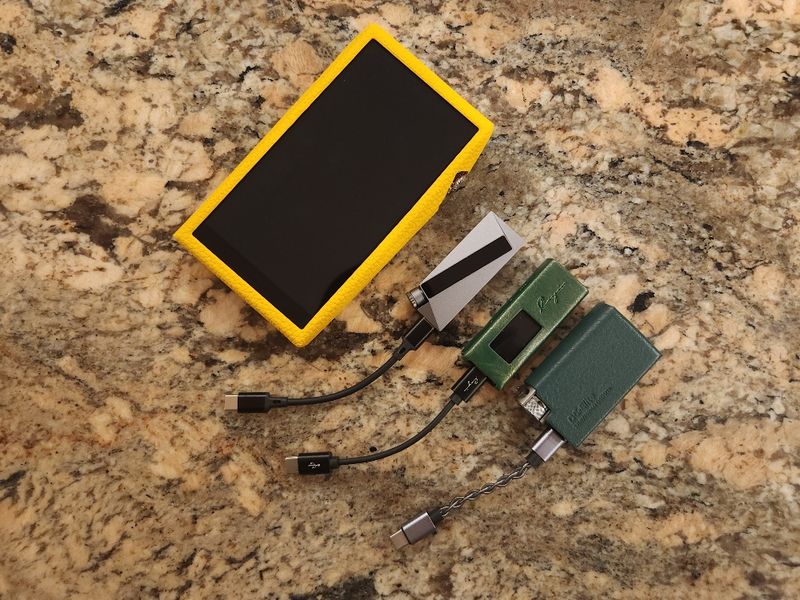
I tested and verified this one with various popular USB DAC dongles, such as DC Elite, RU7, and W4, and found it to work without a problem. I didn’t have to select anything under USB settings. Once connected, the volume was fixed at max 150, thus it is helpful to have external dongles with their independent volume control. The sound quality was no different when connected to my Galaxy S22 phone.
USB DAC.
Testing USB DAC was straightforward. Once connected to my Win10Pro laptop, 3kT gave me a message in the Notification bar to click if I wanted to connect as a media device or to switch to DAC mode. Clicking on it switches to DAC mode and gives you an option to enable DAR. I was able to control the volume either from my laptop or 3kT. While using it as a DAC, the sound quality was similar between playing songs from my laptop or locally from the DAP.
Optical Out.
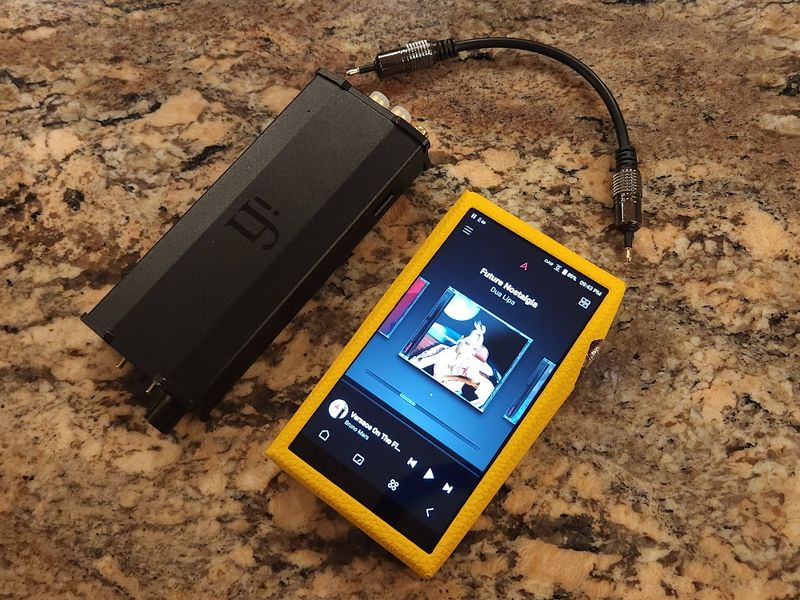
I was using iFi micro iDSD BL for this testing, nothing needs to be selected or enabled, just connect the optical cable to the 3.5mm port and start playing. Optical output was detected automatically, 3kT volume was set to max 150, and I was controlling the output from micro iDSD. Other than that, no surprises using 3kT as a transport to drive the external DAC/amp where I’m hearing a typical micro iDSD tonality.
Line Out.
I didn’t spend too much time testing LO but did confirm it functions the same as with any other A&K DAP where you select it from the Notification bar, choose the voltage output for unbalanced/balanced in Settings, and then activate it when adjusting the volume to choose either volume adjustment or a fixed LO output.
Wi-Fi Streaming.
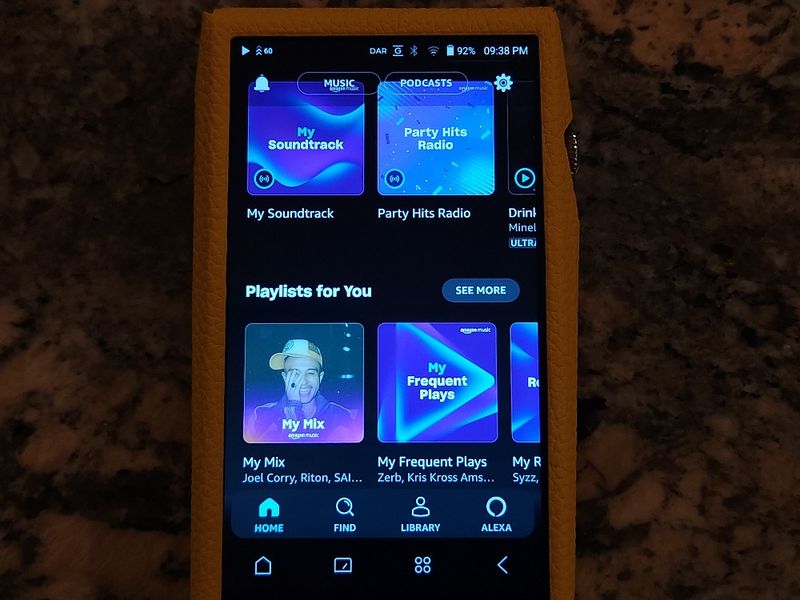
As I already mentioned, while 3kT has a closed Android system, you have a whitelist of available popular streaming apps to install. These are full app versions that run as fast and feel no different than running in other Android DAPs. Also, you no longer have to rely on a floating “back” button since this one is fixed at the bottom. Furthermore, while running streaming apps, you can swipe down the notification bar to see the app’s playback controls.
Conclusion.
After covering SP3000T in the CanJam NYC’24 report, I got asked similar questions as I had back after my SP2000T review. When people see the same baseline model number, they associate it with the original DAP and assume “T” is the upgraded version allowing them to switch between the original SP3000 tuning and the new SP3000T tube coloring. SP3000T did inherit some hardware specs of SP3000, such as AKM dac/modulator chip combo, faster Snapdragon SoC, display, battery, and even the same next-gen UI. But overall, A&K created a different beast with a unique complementary tube-based musical sound personality where the implementation of a dual amp design with a triple output mode is not a gimmick.
Perhaps SP3000T doesn’t have the same black background as in SP3000 and doesn’t handle as gracefully sensitive IEMs when in Tube mode. But SP3000T, especially in Tube High Current mode, adds a sweet analog texture to the sound, especially in mids, to give it more musicality without compromising on retrieval of details or adding a tube-related distortion. Tube mode was a big surprise since it expanded the soundstage and added an extra dimension to imaging, along with the improvement in vertical dynamics where you notice more movement in transient changes of sound peaks, making it less compressed and with some improvements in layering and separation of the sounds.
My favorite setting was in Hybrid mode with High Current since it gave the sound a more holographic soundstage/imaging, analog warmth, improved dynamics expansion, and a bit faster sound pace in comparison to the more laidback pure Tube mode. Also, it brought the SP3000T’s technical performance closer to its older SP3000 sibling. But a more important point here, you are no longer bounded by one fixed sound tuning of the source. Instead, you have a source with a dual amp design and a triple mode output, including variable current adjustment of the tubes, where you can finetune the sound for the best pair-up synergy with your IEMs and full-size headphones.

 Twister6 Reviews
hmm, i’ll have to purchase the same tubes and put them in my CDM! haha
LikeLike
Ike, yeah bud, these miniature JAN6418 tubes are quite popular lately.
LikeLike
Which is better sq sp3kt or taipan+osprey stack🤔?
LikeLike
Interesting comparison. Wish you would have asked this question before I sent 3kT back. But by memory, D16/PB5 stack will have a warmer tonality. PB5 is a warm amp.
LikeLike
Hi, thank you so much for review.Can you please compare SP3000T and SE300?
LikeLike
Sorry, don’t have SE300 for comparison, and it will be misleading to do any comparison by memory.
LikeLike
Ok, thank you for reply!
LikeLike
How does it compare to N8II and N30LE?
LikeLike
I don’t have access to SP3000T or N30LE anymore. The comparison between SP3kT and N8ii was covered in my SP3000T review, and the comparison between N8ii and N30LE is covered in my N30LE review, so you can get an idea of how N30LE will stack up against SP3kT.
LikeLike
Wow! So glad I found you. I am getting the 3kT and like jazz, classical, rock and pop vocals. Question: Jewel or the Bird. TIA PS: I have been in the pursuit for a decade and yours are the best reviews also I think cables, power and interconnects make a BIG difference as well with IEMs.
LikeLike
For the type of music you are listening to I recommend the Bird. Jewel has a reference tuning, while the Bird will give the sound an extra body and smoother tonality.
LikeLike
Thanks for another awesome review. I have the Cayin N8ii and use is with the tube setting just about 100% of the time. Is the 3KT enough of a difference and/or improvement for me to purchas? Thanks
LikeLike
In my humble opinion it is. Here you will find different tubes, different tube settings (current adjustment is wicked), and even a hybrid mode between solid state and tubes. These daps are complementary in tuning.
LikeLiked by 1 person