
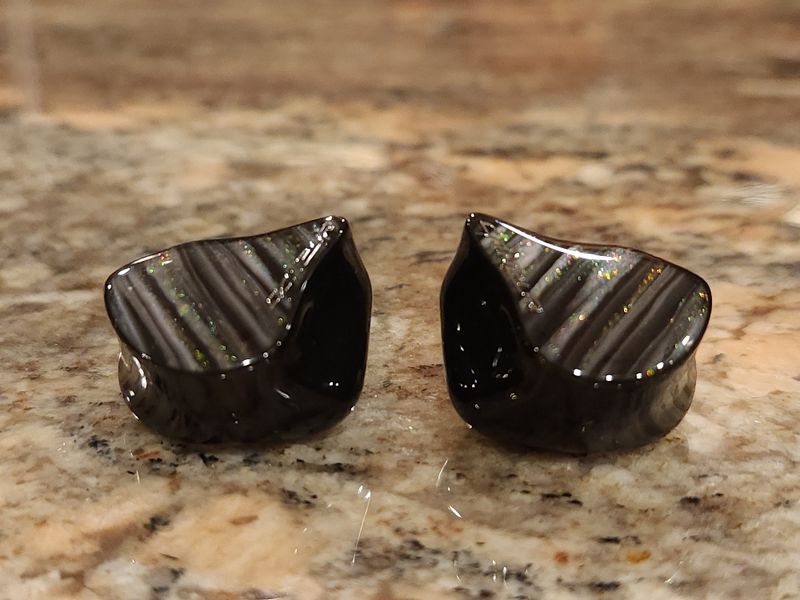
Comparison.
The comparison was done using CP622B with a stock cable, stock silicone eartips, and P6 Pro source, volume matched in every comparison.
Canpur IEMs comparisons.
CP622B vs CP54E (5BA, 4EST) – I don’t have 54E with me now, but when I tested them last year, I felt that 622B and 54E were both on a flagship level, just targeting a different audience with a different tuning. From my last year’s notes, the soundstage of 54E is still as wide, but I found it to have more depth than width, something that was more noticeable after switching from 622B with its big holographic soundstage. The tuning of 54E is W-shaped, including a more elevated sub-bass rumble with a stronger mid-bass punch when compared to a deep 622B rumble with a softer mid-bass. Their mids are quite similar and both have a natural detailed tonality with a decent retrieval of details and neutral lower mids which brings more attention to upper mids. The treble of 54E is clear and detailed but has just a little less airiness in comparison to 622B. 622B has a bigger soundstage expansion, thanks to its BC drivers, a little more clarity and resolution in mids, and a more extended airier treble. 54E has a deeper and more elevated bass with a natural and still detailed tuning of mids and treble. Due to their difference in bass and treble, I found these two to have more complementary tuning.

CP622B vs CP74E (7BA, 4EST) – This is from my recent notes when I had 74E with a final tuning on loan for testing. The first noticeable thing here is the presentation of the sound with 622B having a more holographic soundstage and imaging, pushing mids/vocals further out in space, more out of your head, while 74E spreads the soundstage wider and also brings the sound closer to the listener. In terms of tonality, both have a very similar tuning of lower and upper mids, with a natural detailed tonality. But the bass and the treble extension are different. 622B has a more elevated and deeper sub-bass, and as a result, its mid-bass doesn’t have as fast or as articulate punch. In contrast, the 74E sub-bass is a bit lower in quantity, bringing more focus to the mid-bass which punches through with more speed and faster attack. With treble, they both have a clear, detailed, and natural presentation of the treble, but 622B dual-BC drivers add more air with additional crunch, extending it further, and making the 74E treble a bit smoother in comparison.

Other IEMs comparisons.
CP622B vs Elysian Audio Annihilator 23 – As I started listening to 622B, Anni’s tuning came to mind, though not exactly because of the treble. They both have quite an expanded soundstage, spherically spaced and spreading in all 3 directions, though 622B has more holographic imaging. That is probably expected due to its dual Sonion BC drivers. Both have a very similar bass and lower mids, just with 622B having a bit more weight in sub-bass and having a perception of a touch more body in lower mids. I’m emphasizing here “perception” because while 622B stays balanced throughout the upper mids and treble, Anni scales up with a more forward presentation of the upper mids and treble. Many audiophiles bring up Anni’s treble as one of its strongest tuning points, and indeed, it has a more forward presentation which gives the sound a more revealing tonality up top, a higher resolution in mids, and a more U-shaped sound signature. In contrast, 622B tuning is more balanced, more natural, and less aggressive in treble which gives the sound a smoother tonality. One thing to note, Anni has a lower sensitivity and is harder to drive, and I had to add about 15 more clicks in volume when switching from 622B to Anni which made me question if 622B spec with lower 100dB sensitivity is for real.
CP622B vs EE Odin – Both have pretty big spherically shaped soundstage expansion, perhaps with Odin having a bit more out-of-the-head depth. But when it comes to imaging, I do feel that 622B is more holographic based on the way how sounds are positioned in space. The quantity of Odin’s bass is slightly scaled down, especially in comparison to 622B’s more elevated and deeper sub-bass rumble. I wouldn’t call Odin’s bass to be neutral, but in comparison to 622B, it does sound more neutral, though Odin’s mid-bass has a faster punch. Also, Odin’s lower mids are noticeably leaner which brings more attention and pushes its upper mids forward, creating a more mid-forward presentation of the sound in comparison to the more balanced and smoother nature of 622B tuning. The neutral nature of 622B’s lower mids gives its sound a more natural smoother sound tonality, while Odin’s leaner mids give its sound a more revealing and brighter tonality, especially since Odin’s upper mids scaled up higher in quantity. Both have a similar treble extension, but, again, Odin’s lower treble has more presence to enhance upper mids with more clarity and higher resolution.
CP622B vs VE Phoenix – I usually start with a soundstage comparison, and here both IEMs approach it differently. I hear a wide-open spherical expansion of 622B versus a narrow and more center-focused soundstage expansion of PHX. Instead of spreading its wings wider, Phoenix goes into more depth and height in comparison to 622B which has a wider soundstage expansion. But surprisingly, even while being center-focused, PHX has decent imaging when it comes to the placement of sounds in space. The bass presentation between these IEMs is flipped. While 622B has a deeper elevated sub-bass rumble and softer rounder mid-bass, PHX has a more polite sub-bass rumble and faster and more tactile mid-bass punch. They also have a different tuning of lower mids where 622B is more neutral with a moderate amount of body, while PHX has fuller body lower mids. As a result, while they both have very similar upper mids tuning and presentation, the fuller body of PHX lower mids gives its vocals a more organic tonality, while 622B has more natural and clear tonality with less coloring. PHX also scales up the quantity of its treble, to compensate for its fuller body mids to give them better definition and retrieval of details. But despite having more presence in mid-treble, the balance of upper mids and treble in 622B makes its treble have the same (or even higher) amount of clarity and resolution. I also find 622B to have more airiness and a bit better extension of treble.

Source Pair up.
In each source pair-up I was using a stock cable and stock eartips. 622B IEMs have lower sensitivity (100dB), but they are not that power-hungry, just need a few extra volume clicks.
w/DAPs:
L&P P6 Pro – this is my baseline sound analysis. Spherically rounded big soundstage expansion, nearly holographic imaging. Balanced sound signature with a neutral tuning and a clear natural tonality.
Lotoo LPGT – very similar sound tuning as I hear with P6 Pro, but LPGT soundstage expansion is a little narrower, and tonality just a bit smoother, more laidback.
Cayin N8ii (Tube, Class A) – the soundstage has a similar spherical shape and holographic imaging which feels even more 3D than with P6 Pro. Here, the tonality is more revealing in mids, not brighter but more crystal clear, with more separated layering of sounds, and more air and crunch in treble. It does scale up the tuning to 622B to the next hi-res level without making it harsh or unnatural.
Hiby R8ii (Class A) – This pair-up has a tonality that is somewhere between what I hear with P6 Pro and N8ii. The soundstage and imaging are similar to the P6 Pro. The tonality is more revealing in mids and with some extra emphasis in treble, more than with P6 Pro but not on the same level as N8ii. Also, the mid-bass here scales up with a stronger impact.
iBasso DX320Max Ti – The soundstage and imaging are huge and holographic, but the tuning is slightly different. The tonality is no longer as smooth as with P6 Pro, but rather more revealing, with lower mids being a bit leaner and upper mids and treble being more revealing, micro-detailed, and crisper. The sound is not fatigued or harsh, just very different, transforming 622B from smooth tonality, balanced tuned IEMs into more revealing U-shaped tuned IEMs, giving 622B tuning a closer resemblance to Annihilator 23.

w/usb-dac dongles connected to Galaxy S22:
iBasso DC Elite – The scale of the soundstage expansion and holographic imaging here is on the level of DX320Max. The tonality in this pair-up reminded me of R8ii, having a stronger impact in mid bass, still neutral lower mids, more revealing upper mids, and extra sparkle in treble to give the sound higher resolution. Relative to my baseline source, DC Elite improves the retrieval of details from 622B.
Cayin RU7 – This pair-up goes back to my “baseline” balanced sound signature with a neutral tuning and a clear natural tonality. It resembled closely a pair-up with P6 Pro. I also noticed the soundstage to have more depth in comparison to width, pushing the sound more out of your head.
L&P W4 – In this pair-up, I hear the weight of the bass scale up a bit and the lower mids of 622B to gain more body, making the upper mids sound smoother and a bit more organic. The soundstage has a spherical round shape, imaging is slightly more center-focused, and change in the bass weight and fuller body lower mids is quite noticeable.

Conclusion.
It thrills me to discover a new brand of IEMs that shows up out of nowhere and captures the attention with quite a mature tuning. That is exactly what happened with Canpur which, due to lack of background info, I consider to be a new manufacturer in my book. There is always a buzz around new FOTM releases people ping me about, asking if I heard it or if I’m planning to review it. That is how I was introduced to Canpur last year, yet, audiophiles on Head-fi and in other communities are still talking about it today.
Considering so many other premium releases saturating today’s IEM market, it is not easy to stand out. But Canpur gave it a shot with their flagship CP622B and succeeded with an all-Sonion driver design, including new dual BC vibrators which I haven’t seen being implemented by others before this release. With a holographic soundstage expansion and imaging (thanks to its BCs), a balanced sound sig with a neutral tuning, and clear natural tonality, CP622B delivers a well-rounded IEM performance I enjoy with every genre of music.

 Twister6 Reviews
Comprehensive review as always. May I ask if the 74E comparisons was with the Socrates or the Eletech custom 74E cable?
Contemplating a purchase. I’ve heard the 622B but not the 74E
LikeLike
It was with 74E own cable, not sure which material, but it looked like copper.
LikeLike
Thank you for another great review. May I ask how you would compare them to the Kinera Loki (international tuning) in regard of resolution, soundstage width/depth and holographic imaging?
LikeLike
I’m yet to hear Loki thus not familiar with its tuning.
LikeLike
Your review is really helpfu, I’m looking for a cable, may I ask the brand of “LL Venom” please, is that Liquid Links?
LikeLike
Yes, Liquid Links. Great cable, though be aware that it is a bit stiff.
LikeLike
how this Canpur 622B comparing to UM Maven II?
LikeLike
622B will have a more elevated sub-bass rumble and more forward upper mids/vocals, with an overall a warmer tonality. Maven II tuning is more balanced, less colored, and has more clarity and higher resolution in upper frequencies.
LikeLike
Thanks Twister6. So in terms of the price performance ratio, is Maven II a better choice?
LikeLike
Yes, Maven II has a great price performance ratio. But relative to which one is better, that is purely subjective and based on your sound preference.
LikeLike