

Is this the mid-fi diva of today?
PROS: Neutral-warm reference sound, musical, good timbre, excellently executed bass switch providing 3 different bass shelves, very snug and comfortable fitting shells, very easy for long listening sessions, nice leather carry case.
CONS: A slightly better lower-treble curve and quantity along with a bit more air up top would’ve gotten it closer to perfection. Not much besides that.
The product was provided to me free of charge for review purposes in exchange for my honest opinion.
About Elysian Acoustic Labs.
Elysian Acoustic Labs started off in 2015 when Mechanical Engineer Lee Quan Min took it upon himself to refurbish an old Ultimate Ears TripleFi10. Upon gaining public interest from local hobbyists, Lee Started providing re-shell services and thus accumulating experience along the way. Elysian Acoustic Labs was incorporated by Lee in 2016 to officially receive re-shell orders. After re-shelling countless IEMs, Lee was more than ready to take on building his own IEMs. The breakthrough happened in the Japanese market one year into actively honing the craft. Elysian participated in the 2019 Fujiya Avic X Foster Alliance Program IEM making competition and earned themselves the revered First Place award. With this opportunity, Lee gathered much understanding of the Foster driver and created his innovative Dive Pass system to control the driver. Since then Elysian has launched several models like the Annihilator, X and Diva, and continue to do so.
Links – Elysian Diva 2023 Official Website | MusicTeck

Technical Specifications.
- Drivers; 6 Balanced Armature Drivers
- 4-way Crossover
- High Quality Internal Wiring from JAPAN
- 3 way bass rotating switch
- Frequency Response – 20Hz-18kHz
- Sensitivity – 100db @ 100mV @ 1khz
- Impedance – 4ohms @ 1khz
- Cable – Effect Audio Ares S
What comes in the box?
- Diva 2023 IEM
- Effect Audio Ares S cable
- Suede case
- Switch tool
- Cleaning brush
- Warranty card

Build Quality, Fit and Comfort.
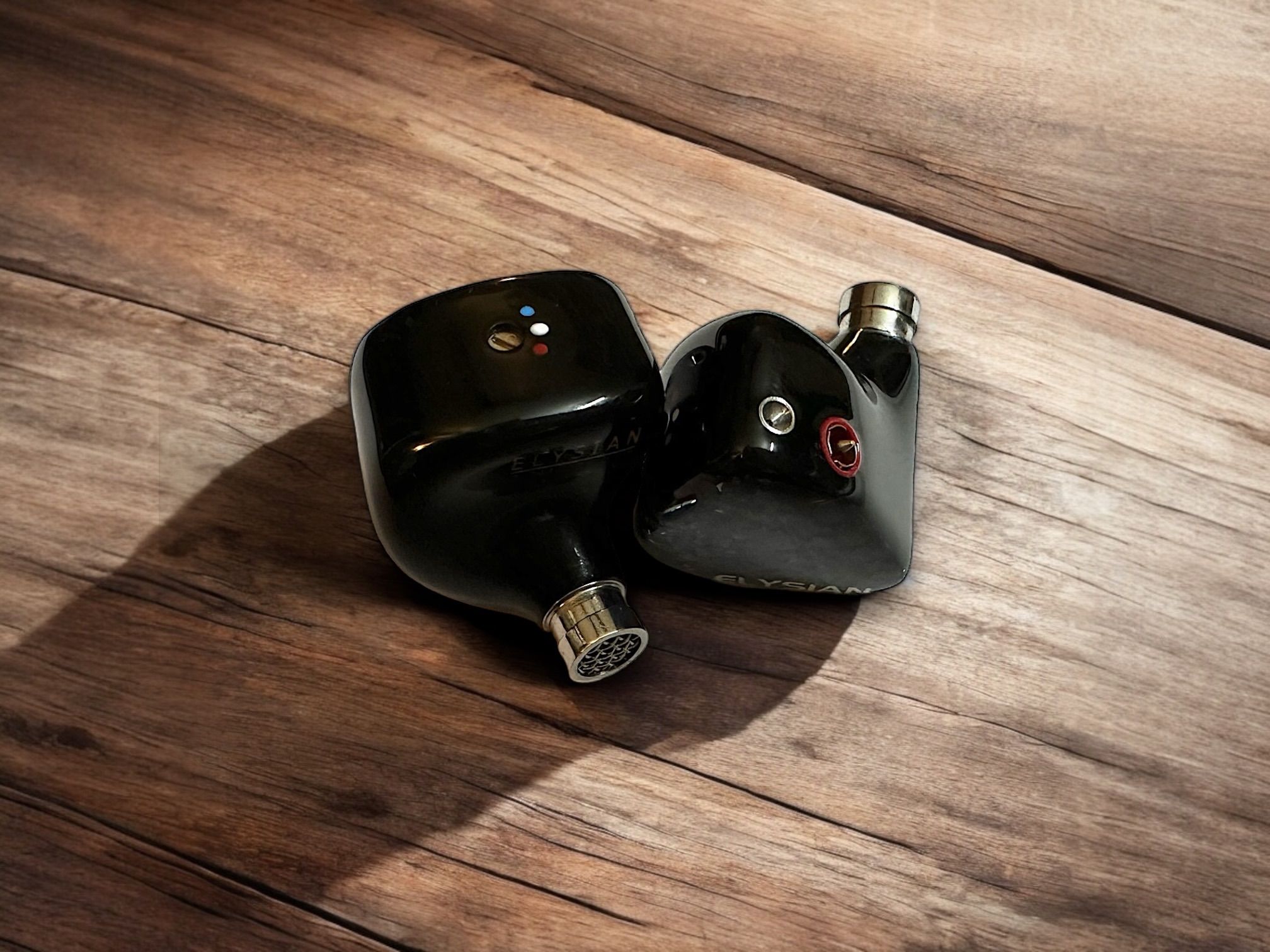
Diva 2023 has quite an attractive design with equally good build quality to go with it. It’s mostly made of resin but has a metal nozzle with a strong lip to hold he ear tips in their place. The bass switch works quite well with definite clicks and the Pentaconn cable connector oozes quality as well. The fit is just wonderful and almost CIEM like; it has excellent noise isolation with comfort levels equalling the nicest CIEMs I have made specifically for my own ears. This is a wear and forget kind of an IEM that stays extremely comfortable for the longest sessions.

Cable – Diva 2023 comes stock with Effect Audio’s Ares S; Effect Audio being their business partner. Ares S is a fairly well known cable by now and a lot has been written about it already, so I’ll just link our review from 2 years back here if you’d like to know more about it. In short, it’s not the most supple copper cable but is well made and conducts cleanly – does its job well while being a pretty decent stock cable for an IEM in this price segment. I personally don’t like Ares S sound performance as much and prefer Eros S and Cadmus pairing with the Diva 2023 more but well, that’s just a preference.
Sound Analysis.
Drivability – Diva has a very low 4Ω impedance, but also low sensitivity of 100dB. It needs more power than the regular IEMs but can be driven using good dongles and DAPs.
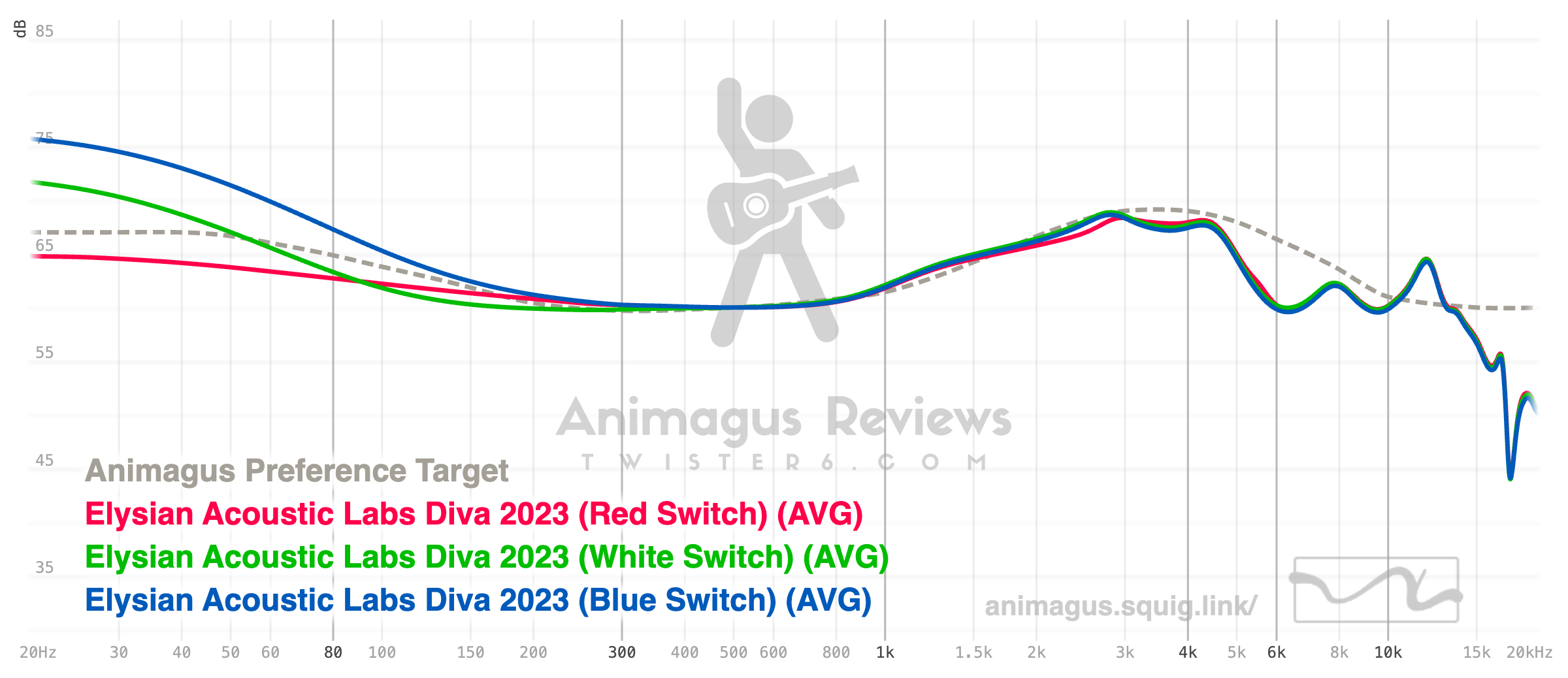
Graphs are measured using an IEC60318-4 (IEC711) setup. You can compare all the graphs on my IEM Graph Database here – Animagus Squiglink.
Diva 2023 has a sub-bass boosted warm take on a reference-neutral signature in stock Red Switch mode and gives you the ability to switch the sub-bass shelf between 4.8db, 11.7db and 15.7 dB via the click switch (accessed using a tiny screwdriver) that has 3 modes indicated with Red, White and Blue dots – a significant tweakability of bass to preference and taste. What’s great is that it only tweaks the bass below 250Hz without affecting the rest of the frequency spectrum. I personally like the balance best at the Red Switch as I like a more neutral approach to hearing music but I highly appreciate having the ability to switch it up when the song demands or to drain out the loud background crowd noise in order to hear the bass clearly when monitoring in a live concert or travelling in crowded environments. It has fairly good technical performance for its price, which we shall discuss in detail in the latter section of sound analysis but first let’s dig deeper in its tonal performance.
Contrary to the misconception some people can have about BA drivers, Diva’s bass is quite impressively natural sounding. Diva’s character of bass goes from just right (in terms of balance) in the RED mode to rumbly, wowing sub-bass in the BLUE mode but what remains the same is the gooey, organic nature of the bass notes, which is primarily due to the warmer lower-treble that takes some attack off the notes and makes the bass come across more soft, rounded and thumpy than sharp and precise. I as an audio engineer generally prefer the latter as I like the notes to have precision and definition to stand out but Diva’s strengths are more in line of a slightly more organic, laid back listen – something that can be exactly what you want at times. It doesn’t have as much slam because its mid-bass isn’t as boosted as the sub-bass but what is impressive across the board is the ease of execution. If only it didn’t have that lower-treble dip, I reckon the bass tonal performance could’ve been exceptional for its asking price but we’ll have to settle for good for now.
Lower to upper midrange is executed very well, almost reference like with about 9dB of ear gain. This results in fairly accurate midrange tonality, with vocals and instruments being presented with excellent timbre. There is hardly anything to complain about the midrange, so I’ll move to something that could’ve been better to make Diva a perfectionist’s IEM – the treble. The dipped 4.5-10kHz range results in a warmer than neutral presentation, one that isn’t dark per se but one that lacks accurate sparkle and sheen. It’s more like vocals and instruments have been made to pass through a soft envelope resulting in softer and rounded edges than accurate attack and tonal precision that I find missing. Most might not even perceive it this way once their ears adapt to its signature or they’re accustomed to warmer signatures in general but it stands out if you pick it up after something more accurate, especially a more reference tuned IEM/headphone. Luckily Diva is airier post 10kHz, including airier than Harman 2019 IE Target, which makes up for the warmer lower-treble and keeps the Diva 2023 from sounding too warm or dark. Again, I would’ve like slightly more air but that’s just me nitpicking for my own preferences. Otherwise, the warmer tonality helps keeping it extremely comfortable and fatigue free even with slightly louder than average volumes and long listening sessions. Its mesmerising tonality in general keeps it very easy to get along with but me being a sucker for accuracy, I still EQ in a bit of lower-treble and smoothen out the air region to get it closer to perfection for my liking.

Technical performance.
Diva 2023’s stage is more intimate than expansive like Custom Art’s FIBAE 5 or Symphonium’s Helios. It has good stage depth but width is rather on the average side. It has a more direct stage presentation that focuses on showcasing the band as a whole rather than focus on the space and layers, but has very good imaging and definition of panned instruments for you to pinpoint the precise location of each sound/intrument. I’d say it has very good detail retrieval, just not on a micro level which can be a con if you consider the price segment and competition. A lot of the complaints can be attributed to the dipped lower-treble range, which has most of tonal characters that influence the perception of all these things. Don’t get me wrong, Diva 2023 is not a bad technical performer, in fact a fairly good one. But the competition is so competitive these days, with us having options in this segment that are borderline TOTL-killers, that it necessitates a critic like myself to get nitpicky.

Comparisons.
Elysian x Effect Audio GAEA.
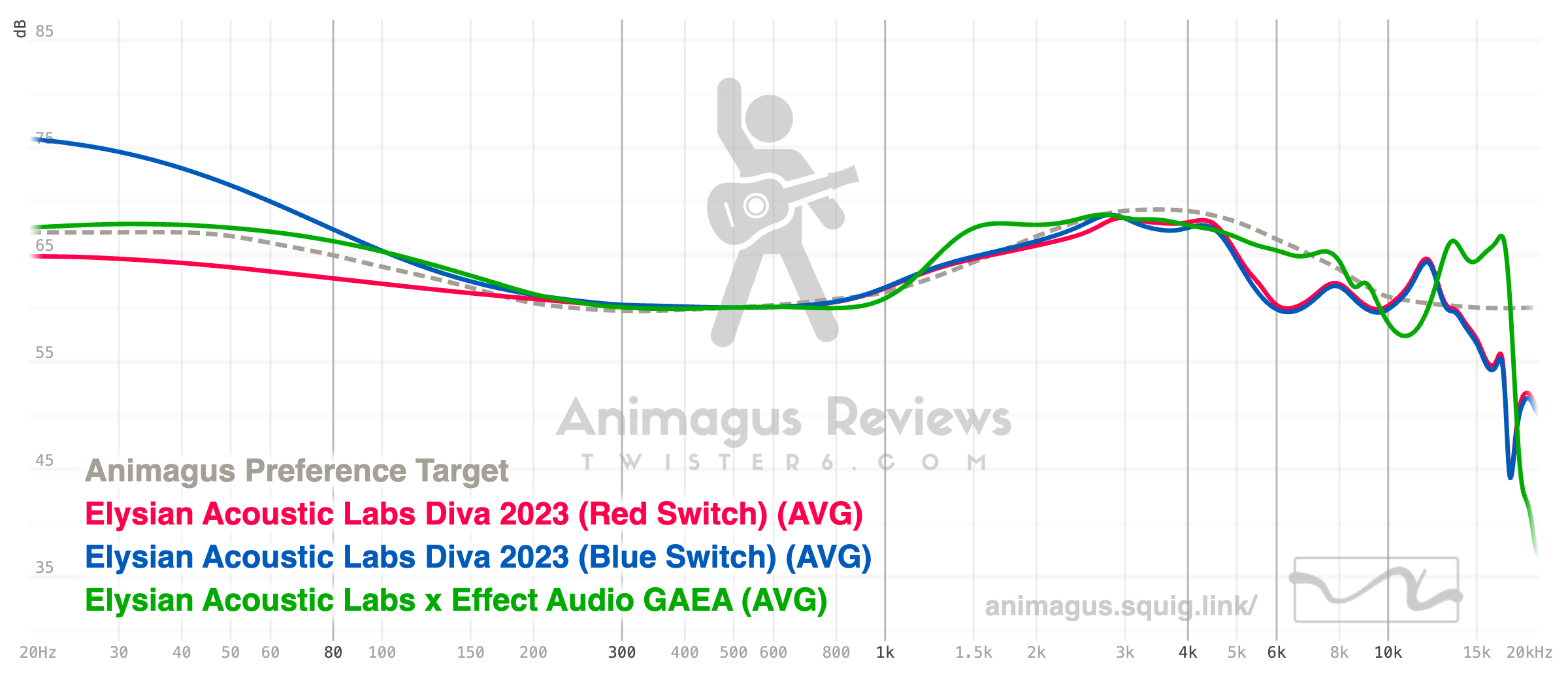
These come from the same house but are tuned to do very different things. GAEA has an exciting and energetic W-shaped tuning tuned to wow quickly in the first listen and present music with pomp and show while Diva on the other hand is tuned to be a warm take on reference tuning with focus on bass performance tweakability from neutral to the kind of rumble that can blows your socks off. GAEA has slightly better detail retrieval, attack and instrument definition owing to a more linear treble tuning while Diva has slightly better imaging and depth layering. Soundstages are almost at par even though Diva’s perception of stage increases/decreases based on the bass mode you have it in because of bass quantity and forwardness.
Kinera Verdandi.

Kinera Verdandi is quite like the Diva in terms of tuning being a warmer tuned IEM but the slightly leaner lower-midrange highlight the bass and treble a bit more than Diva while the Bone Conduction adds in a bit of depth layering and 3D-ness for lack of a better word. When it comes to technical performance, both are equally good in terms of detail retrieval, if not Verdandi having a slight upper hand. Otherwise Diva has a more open stage with more space between panned instruments while Vedandi has better sense of imaging and depth layering.
Custom Art FIBAE 5.
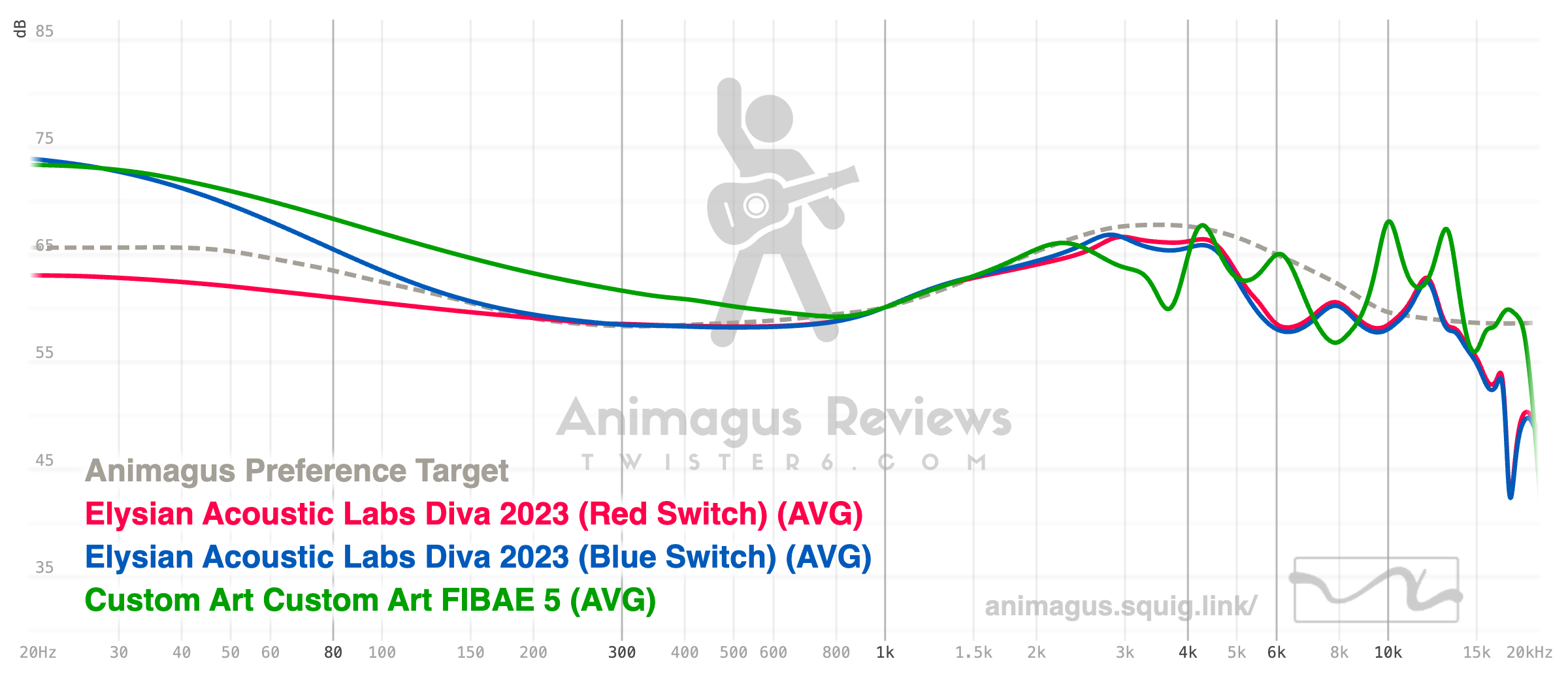
FIBAE 5 is world’s apart in tuning and significantly coloured compared Diva. Where Diva goes for a warmer reference like signature, FIBAE 5 goes for a very vibrant and energetic V-shaped tuning that promotes a big band playing in a big arena like listening experience with much more mid-bass, a fuller lower-midrange and much more sizzle and sparkle up top. FIBAE 5 has a much more open and wide soundstage as well as better detail retrieval owing to its much brighter signature but where Diva excels is tonal accuracy, better bass punch and dynamism along with fairly good staging and imaging to go along with it all.
Custom Art FIBAE 7U.
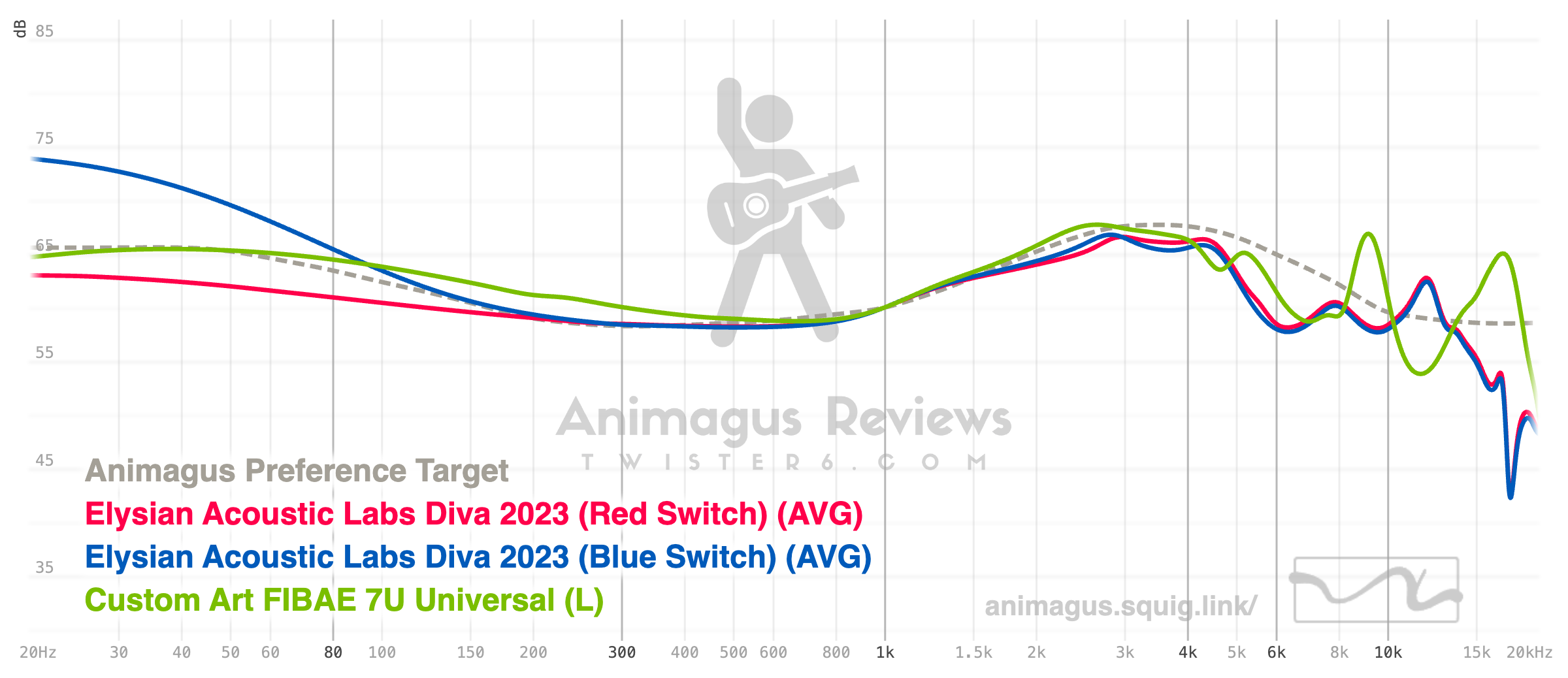
FIBAE 7U (F7U) too has slightly warmer than neutral lower-treble tuning too but with more mid-bass and along with the mid-treble and upper-treble boosts comes across more vibrant than Diva. Most are slightly different takes on reference tuning where Diva falls in the warmer than neutral category and F7U in the more coloured W-shaped side. Diva overall comes across having more natural tonality and more natural bass punch and dynamism. On the other hand, F7U is sharper with its bass presentation and has better note attack and precision, which sometimes can be preferable depending on one’s preferences. F7U like most Custom Art models has a open and spacious soundstage, which is significantly more spacious than Diva and also has better detail retrieval and left to right separation but Diva has better imaging, better depth layering and excellent customisability of bass to one’s preference.
Symphonium Helios.

Again, like the F7U, Helios is a more vibrant W-shaped, sub-bass boosted reference style tuning while the Diva is a more neutral-warm take on reference style tuning. Helios has better bass transient presentation while Diva has more punch and rumble, especially in the Blue switch mode. Both have a more or less accurate midrange presentation but Helios has more linear lower-treble while is airier up top. This results in Helios having better detail retrieval, imaging and separation but even more, a better sense of space in its stage. Diva comes across softer in its presentation, having slightly more natural tonality with a slightly intimate stage but one that has good technical performance for its tonal signature. Where it completely destroys the Helios is with its extremely snug and comfortable fit that allows for an extremely easy listening experience for the longest sessions.
Conclusion.
Having taken Diva 2023 through its paces with some of the most prominent and successful IEMs in its segment, I can say that Diva 2023 is a strong performer for its class and better than maybe 90% of the IEMs I’ve tried under $1500 but just not one that stands out shining the best for me personally. In general what one would choose/prefer out of the competition depends more on one’s liking and preferences than there being a single stand out winner anyway. Even though I have my gripes with its dipped lower-treble and lack of airiness up top, there is no denying that the rest of it is very well done. It not only has a pleasing tonality but the versatility of its bass performance with its switch greatly increases its value proposition. The build and overall performance makes it quite a safe recommendation for fans of neutral-warm and bass boosted signatures, especially because it has fairly competent technical performance to go with it. If you fall in this category, this is a great IEM to have! Give it a shot!
Gear used for testing and review.
- DAPs – iBasso DX260
- Dongle – iBasso DC06 Pro
Artists I like and listen to.
- Rock – Foo Fighters, Linkin Park, Switchfoot, Imagine Dragons, Daughtry, Green Day, MuteMath, X Ambassadors, Dave Matthews Band, Vertical Horizon, Our Lady Peace, Lifehouse, Fall Out Boy, Breaking Benjamin, Muse, ACDC, Audioslave, Rage Against the Machine, Biffy Clyro, I Am Giant, Normandie, Paramore, Slash & Guns N Roses, 3 Doors Down.
- Pop Rock – John Mayer, Coldplay, Paul McCartney, James Bay, Hunter Hayes, Niall Horan, Keith Urban, The Bros Landreth, Bryan Adams.
- Progressive Rock/Metal – Porcupine Tree/Steven Wilson, Karnivool, Tool, Dead Letter Circus, Periphery, Lamb of God.
- Pop/Soft Rock – Ed Sheeran, Adele, Taylor Swift, OneRepublic, The Script, Gavin James, Magic Man, Maroon 5, Bruno Mars, Charlie Puth, Dua Lipa, The Weeknd, Oasis, Panic! At the Disco, TwentyOne Pilots.
- EDM – Chainsmokers, Zedd.

 Twister6 Reviews