
Sound Analysis.
Drivability – Easily drivable by just about any source.
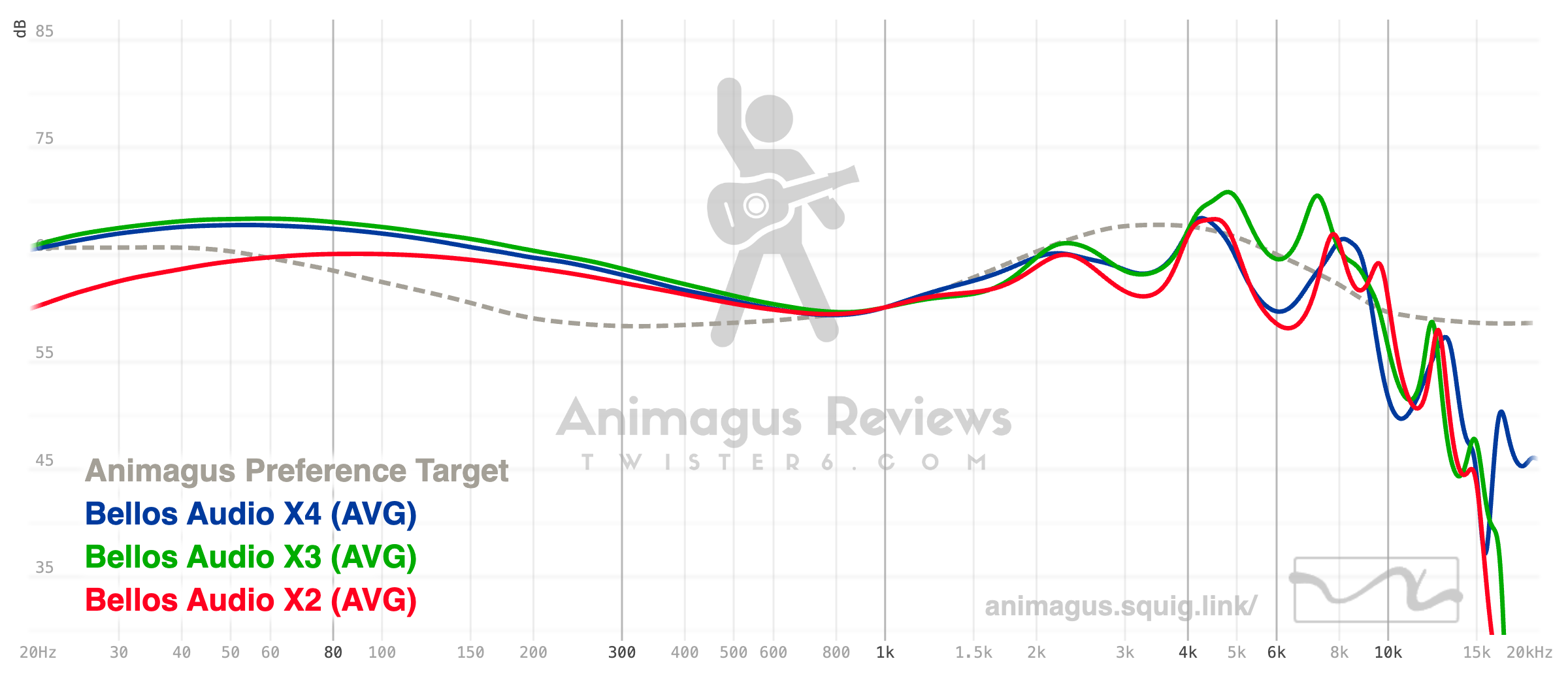
Graphs are measured using an IEC60318-4 (IEC711) setup. You can compare all the graphs on my IEM Graph Database here – Animagus Squiglink.
As you can see from the graphs above, all three – X4, X3 and X2 are varying degrees of warm, fuller sounding, slightly V-shaped style signatures, which is kind of the Vlad and Bogdan Belonozhko brothers house sound as similarly seen in the FiR Audio lineup. X4 comes across as the most balanced out of the three, X3 a brighter leaning V-shaped signature while the X2, an X4 with lesser bass. These aren’t studio reference grade signatures but coloured signatures that are tuned to present the music with an easy to listen character for easy monitoring on stage and similar easy listening as EDC. They are the kind of IEMs that tend to make most things sound good – a bit like how live PAs sound, unlike the more neutral and revealing scene of studio monitors in a studio room. Be it you monitoring live or listening to your music, you can take it that your songs will generally sound good on them. There are pros and cons to that kind of tuning but that is a massive topic for another day.
Let’s dig in deeper…
Bass – X4 and X3 have about a 7.5dB shelf that prioritises mid-bass boosting over sub-bass while the X2 not having the dynamic driver that the other two have, has lesser of a bass shelf, especially lesser sub-bass rumble. The extra boosting of mid-bass in all 3 IEMs takes away from clarity but adds in the warmth that makes the bass notes more upfront and better audible in very noisy environments, especially stage monitoring for musicians, especially bass players. This style of bass presentation is more boomy and rumbly than a studio monitor like character that has quick and precise transients. X3 having brighter lower treble and X2 cleaner, lesser boosting in sub-bass enhances better perception of bass transients but at the cost of things sounding slightly sharper in X3 while the music having lesser rumble in X2. I personally like X4 for the overall balance.
Midrange – When it comes to midrange, they’re all again different degrees of the same. They all have similar boosted fullness in lower-midrange, similar rise of the ear gain upper-midrange peak but slightly different gain in upper-midrange. Overall the upper-midrange is on the recessed side of reference neutral. The dip at the highly important 3kHz region takes it away from absolute natural tonal accuracy but this in turn adds in tasteful colour that helps boost volume levels without guitars or vocals every sounding shouty. The vocals and guitars lack the forwardness, snap and bite as a result but the warmer tone makes them much more easy on the ears at louder volumes that are required at times when monitoring live. As can be seen in the graph above, X2 has a slightly bigger dip while X4 and X3 are fairly similar – resulting in X2 sounding softer than the other two when it comes to guitar and vocal forwardness.
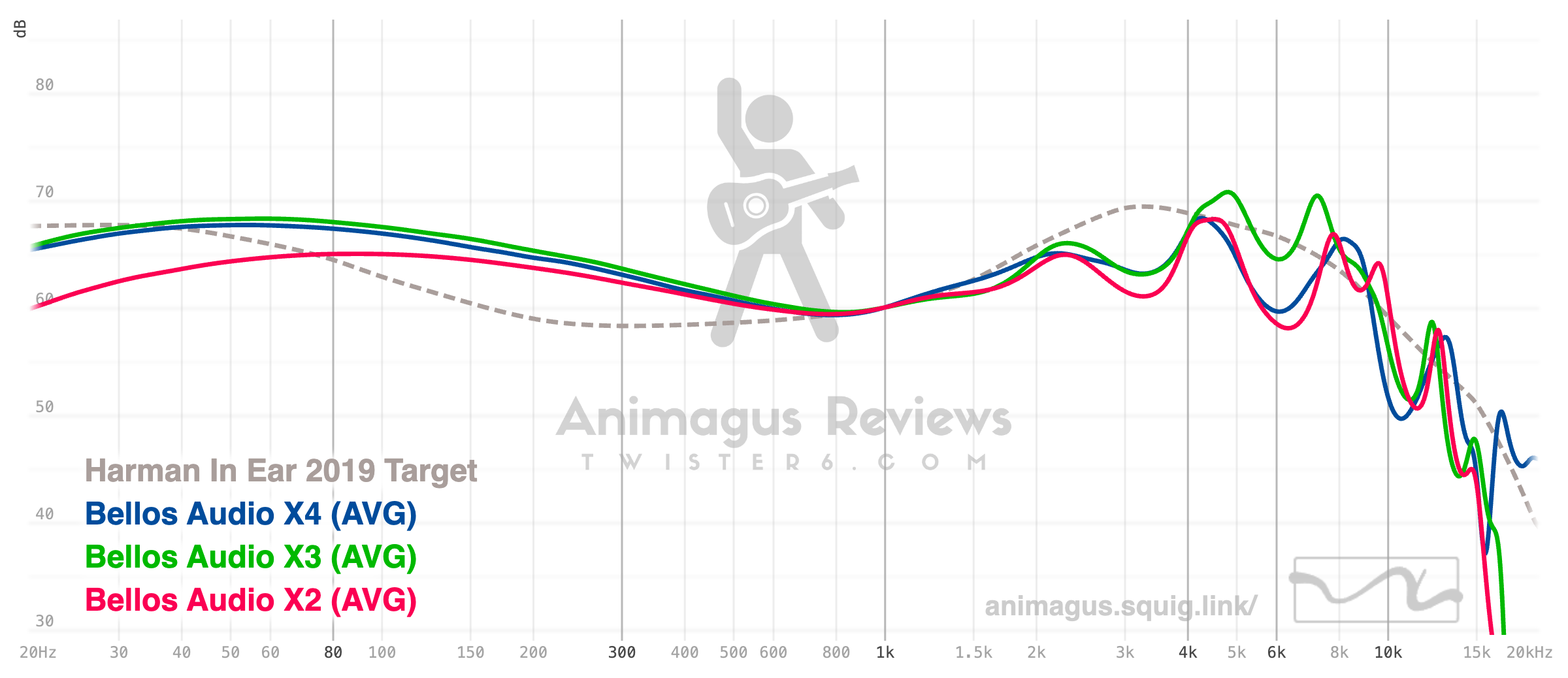
Treble – X4 and X2 have a dip at 6kHz which takes away some presence and bite while the X3 has a prominent peak in the region which makes it come across brighter than the two in comparison. This peak in X3 can help make it come across more vibrant than the other two in most cases but also strident at times with the wrong type of music. All three otherwise have a good 8-10kHz peak that helps balance the warmth and fullness from the lower-range fairly well and even though none of them have good upper-treble air or extension (X4 is slightly better than the other two), the mid-treble peaks help maintain enough balance for them to not sound too warm or dark. The lack of upper-treble air does hamper the tonal and technical performance, especially maintain tasteful vibrancy with warmer mixed songs as well as perception of an open stage and competent detail retrieval for their respective price segments, but the tonality is otherwise pretty fine for the major part and falls just warmer than the Harman target’s upper-treble curve (as seen in the graph below). I personally find the Harman target to be rather warm post 10kHz, so I of course would’ve liked more upper-treble for my preferences and I do use some EQ correction when using all 3 to fit my personal liking as the slightest of EQ can take these IEMs from good to great.
Technical performance.
Let’s break down the technical performance as a comparative chart for absolute ease of understanding –
Resolution – X4 > X3 > X2
Micro-detail retrieval – X3 > X4 > X2
Stage width – X4 > X2 > X3
Stage depth – X2 > X4 > X3
Left to right separation – X4 = X3 = X2
Imaging – X4 = X3 > X2

Difference between X4 CIEM vs UIEM.
Absolutely nothing based on my personal CIEM vs the X4 UIEM I have. They sound identical. CIEMs and UIEMs tend to sound different because of the different fit and insertion depth between them and since there is no difference here as the insertion depth and fit are both controlled by ear tips in both cases, there is no difference in sound.
Which is why I highly recommend just going for the CIEM as I don’t think there’d be much or any fit issues because of their hybrid CIEM design. After all Bellos Audio is a brand whose main USP is the proprietary CIEM design and fit.

IEM suggestions for musicians.
As most of the regular readers know I’m a professional producer and audio engineer, I like to recommending IEMs as per the use case and preferences rather there being a one size fits all. So, here are my suggestions for different musicians and different use cases –
Singers – X4 for the most balanced sound and feel. X3 if you like more forwardness and spank in your vocals when monitoring. X2 if you’re a tenor, alto or soprano singer and don’t like much low end fullness in the mix to disturb you in your performance.
Guitarists – X4 is you’re an electric guitar player that likes a full range mix. X3 if you’re an acoustic guitar, mandolin or banjo player who likes to hear extra sparkle of the strings. X2 if you’re a guitar player who doesn’t want too much of bass rumble intruding in your monitor mix.
Bassists – X4 for all bass players. X3 only if you play funk and want to hear extra snappiness in your mix for a better performance.
Drummers – X3 if you like a V-shaped signature to extra highlight your cymbals. X4 for a more balanced approach.
Orchestral players – X4 for basses, cello and violas while X3 for violins, upper horns and cymbalists.
Audio Engineers (or musicians who are obsessive about tonal accuracy) – Sadly Bellos Audio don’t have any reference tuned IEMs in their lineup but X4 is the one I’d recommend as the best choice amongst the three for this use case.
Page 3 – Comparisons of X4, X3 and X2 with several competing IEMs and Conclusion.

 Twister6 Reviews