
Sound Analysis.
I analyzed Astro sound performance paired up with A&K SP3000T (in hybrid mode with the high-current setting), Hiby R8ii in Turbo mode, and iBasso DX320 w/AMP14 NuTube amp card while playing a variety of test tracks, such as Agnes Obel’s “The Curse”, Sandro Cavazza’s “So much better” (Avicii remix), C-Bool “Never go away”, Ed Sheeran “Shape of you”, Alan Walker “Darkside”, Galantis “Hunter”, Iggy Azalea “Black widow”, Indila “Boite en argent”, Dua Lipa “Love Again”, Counting Crows “Big yellow taxi”, Bob Marley “Jamming”, David Elias “Vision of her”, and Michael Jackson “Dirty Diana”. By force of habit and manufacturer suggestion, I had Astro on burn-in for at least 100 hours before I started to collect my impressions. I was using a stock Time Stream cable and Symbio F foam eartips.
Before I dive into the sound analysis, let me bring up two very important factors in the sound shaping of Astro, eartips and source selection.
I noticed how silicone eartips can give you a healthy boost in treble which some could find a bit too intense. Switching to foam eartips is suggested if you prefer a more natural upper frequencies tonality. I picked Symbio F over the included stock Foam eartips because they reduced lower treble peaks to my ears. Of course, this is a subjective opinion relative to my ear anatomy and sound preference.
Source selection is another very important and critical factor that will affect Astro’s sound signature. With some of the sources, I found the bass to have too much weight, and along with the lift in treble, it pushed vocals presentation further to the back, creating a deeper V-shaped sound sig. With other sources, the bass impact was slightly reduced, creating a more forward presentation of the mids, still having a V-shaped sound sig but noticeably milder which brought the sound sig closer to balanced and gave mids more clarity. As a result, you can read multiple reviews of Astrolith, and feel like they are talking about different IEMs. I would like you to be aware of this when reading my sound impressions, and also to pay close attention to my Source Pair up section of the review. Also, very important, you can be rest assured, that there is no hissing with any of the sources I tried.
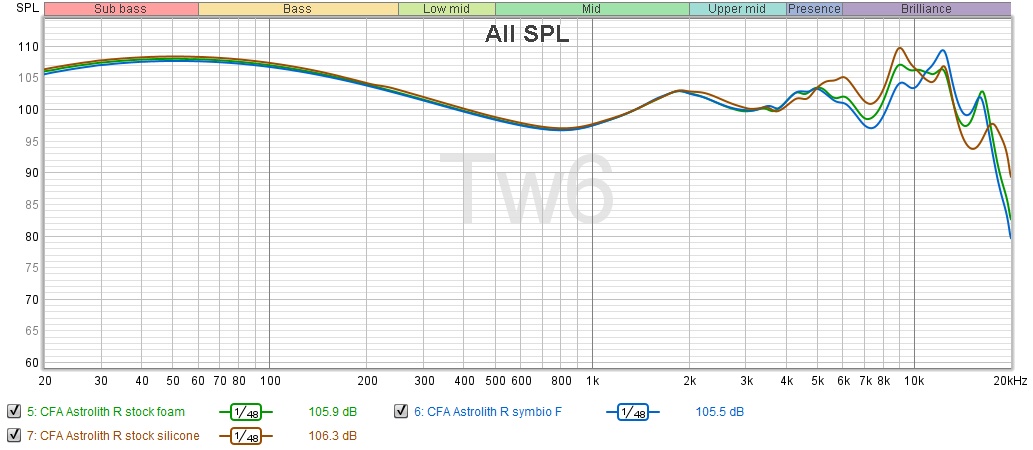
In pair-up with sources selected for my sound analysis, I hear Astro to have a mildly V-shaped sound signature with a full-bodied natural detailed tonality. It is easy to separate the sound into deep lows with powerful physical bass and detailed organic mids along with a crisp hi-res treble. I found this separation to be unique in that both drivers are not necessarily aligned in unison harmony, but they work together in a very complementary way. Thanks to the treble presence, the retrieval of the details and the level of sound clarity are surprisingly good considering the enhanced bass and fuller body mids without a hint of veil or muddiness, even though the vocals are pulled slightly back.
In more detail, I hear a deep extended visceral sub-bass rumble and a powerful bloomy mid-bass punch. The bass sounds and feels “physical” like it is coming from a large DD driver but without the added air pressure. It can trick your mind because the bass has the weight and the physical presence of the dynamic driver and at the same time a faster speed typical of a planar magnetic driver performance. The decay of bass notes will vary depending on how well your source is capable of driving these PM drivers. As a result, the decay of the notes could have more control and less bleeding into mids, or the opposite with a bit of an overwhelming bloom. One thing to note, I can usually separate the sub-bass and mid-bass while here it felt like it was blending in together as one powerful force that hits you hard and fast.
As I already mentioned, the pair-up synergy of the source will shape the sound signature by going from mildly to deeper V-shaped which will affect not only the presentation but also the quality of the mids. But regardless of the pair-up, in every case, you will hear a thicker fuller body lower mids that give vocals their organic natural tonality and coloring. However, there is also plenty of natural clarity thanks to the treble presence. The mix of the fuller body lower mids and clear natural upper mids with a modest pinna gain creates an organic musical harmony that stands its ground next to the powerful bass. Please, keep in mind that you need to take your time to match Astro with the right source if you want to bring vocals forward.
While mids quality and presentation were affected by the bass weight as a result of pair-up synergy with different sources, I found the quality of treble to be directly related to the selection of eartips. Silicone eartips, regardless of the shape or core diameter, made the treble too crisp and borderline fatigue to my ears. However, foam eartips took away the fatigue and harshness, kept the crisp resolution and micro-details, and improved the clarity of upper mids. I wasn’t too crazy about Comply foam eartips since they affected the treble extension. I did enjoy stock foam eartips that tamed down the treble glare, but personally preferred Symbio F which extended the treble and gave it a bit more air along with the enhancement of non-fatigue crisp details.
From a technical perspective, when it comes to layering and separation of the sounds, also affected by a pair-up synergy with different sources, there is no congestion, muddiness, or veil. All sounds are easy to distinguish, though don’t expect a very precise separation between the instruments and vocals with layers of air in between. Also, the faster speed of the sound creates more noticeable dynamic transient changes between the peaks of the instruments and vocals.
The soundstage is very big, with plenty of height and depth, though I find it to have an even wider left/right expansion. Thus, it creates an oval-shaped sound spacing that spreads the sounds wider and brings you closer to the performer on stage. As already mentioned, the sounds are easy to distinguish in the mix with a convincing positioning of instruments and vocals in space, and the imaging was more natural rather than holographic.
I found Astro to work great with everything in my collection from EDM, to pop/rock, classical, jazzy, and instrumental music. But I have to say, it was VERY addictive with EDM tracks, almost too addictive.

Eartips Selection.
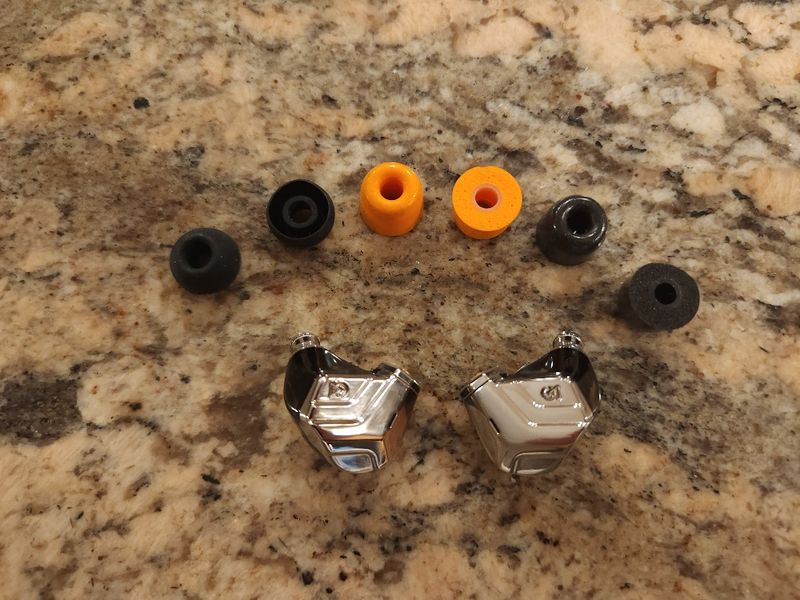
The selection of eartips is crucial to any universal in-ear monitor and will affect the sound, especially the bass impact depending on the seal. Due to a large opening of my ear canals, I usually go for the largest size eartips to get a better seal. Also, please keep in mind, that eartips impressions are subjective and will be based on the anatomy of your ears. My suggestion is to build up your eartips collection and try each one with every new IEM you get to find the pair which yields a perfect sound for your ears.
Unlike my other IEM reviews with a more detailed listing of each eartips pair-up, this one is going to be very short because I found the quality of Astro’s treble to be directly related to the selection of eartips. Repeating what I already stated in my sound analysis, silicone eartips, regardless of the shape or core diameter, made the treble too crisp and borderline fatigue to my ears. However, foam eartips took away the fatigue and harshness, kept the crisp resolution and micro-details, and improved the clarity of upper mids. I wasn’t too crazy about Comply foam eartips since they affected the treble extension. I did enjoy stock foam eartips that tamed down the treble glare, but personally preferred Symbio F which extended the treble and gave it a bit more air along with the enhancement of non-fatigue crisp details.
Cable pair up.
I’m aware that some people are skeptical about cable contribution to the audio chain. It’s not my intent to start an argument here. Instead, I would like to share what I hear during my testing. What makes sense to me is that a metal wire is a material with physical properties of resistivity, conductivity, and purity, all of which act as a filter between your source and earphones. Variations of these physical properties can affect the conductivity of analog signal, resulting in a sound change, from a subtle to a more noticeable level. If the talk about cables upsets you, please skip this section. Otherwise, enjoy these short impressions.
w/Eletech Euclid (silver/gold) – added a little more weight to the bass which pushed vocals slightly back, and I also noticed the soundstage to be slightly narrower and more focused.
w/Eletech Aristotle (copper) – very similar to a stock cable, just vocals placement is a touch further back.
w/EA Code 24C (copper) – the bass has more bloom, more weight, and more power, yet remains well-controlled.
w/EA Code 24 (SPC) – very similar to stock cable, just with a touch wider soundstage expansion.
I don’t have too many mmcx cables, thus was relying on EA and Eletech with their interchangeable connectors to switch from 2pin to mmcx. Of course, you are welcome to experiment, but based on what I’m hearing, cable finetuning of the sound here was not as drastic as eartips rolling or pairing up with different sources. Also, I heard that Ken is working on a new cable which should be an upgrade option when compared to Time Stream with Astro.

Page 3 – Comparison, Source Pair up, and Conclusion.

 Twister6 Reviews
hi how you compare this with bonneville ? 🙂 it can be say one is better of the other or are just different tecnology.
LikeLike
Sorry, I’m not familiar with Bonneville.
LikeLike
Incredible review, so thorough!
Going for a demo today of Astro and R8ii vs Trifecta, with my ode to Laura I purchased following another of your reviews.
LikeLike