
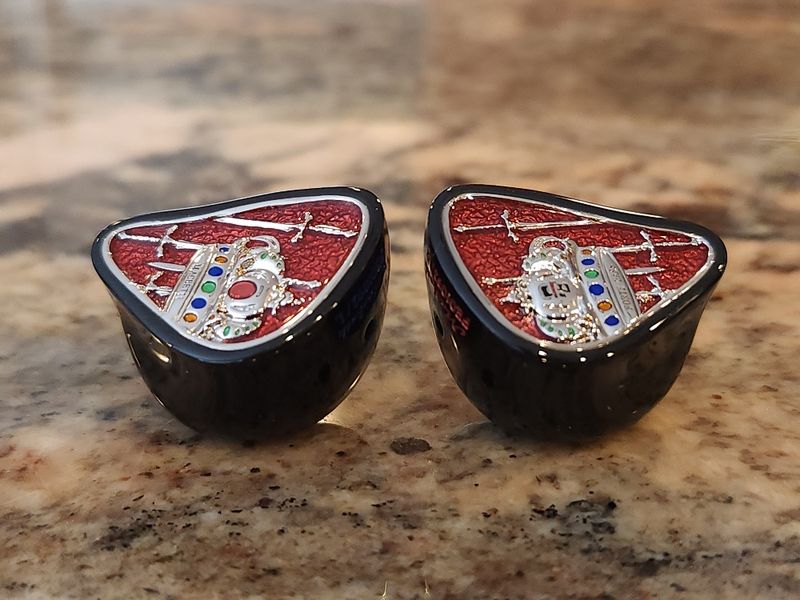
Sound Analysis.
I analyzed MB sound performance paired up with L&P P6 Pro while playing a variety of test tracks, such as Agnes Obel’s “The Curse”, Sandro Cavazza’s “So much Better” (Avicii remix), C-Bool’s “Never Go away”, Ed Sheeran “Shape of you”, Alan Walker “Darkside”, Galantis “Hunter”, Iggy Azalea “Black widow”, Indila “Boite en argent”, Dua Lipa “Love Again”, Counting Crows “Big yellow taxi”, Bob Marley “Jamming”, David Elias “Vision of her”, and Michael Jackson “Dirty Diana”. By force of habit, I had MB on burn-in for 100 hours before I started to collect my impressions. I was using a stock Eletech copper cable and W1 eartips.

MB has a balanced sound signature with a clean and clear detailed tonality. The resolving tuning of these IEMs has natural transparency without too much coloring and with an impressive level of detail retrieval. All the 11 drivers of its tribrid design are tuned and work together in perfect unison harmony, even considering the enhanced bass performance (deeper rumble) and extra energy in treble. The tuning is just so effortless, natural, clear, and detailed, and still punchy, articulate, and energetic.
The soundstage is big, spherically shaped, and evenly expanded in all 3 directions, creating a big open sound. But what impressed me the most here was the holographic imaging and how accurately and convincing (in a natural and non-exaggerated way) sounds are positioned in space where you can pinpoint every instrument and vocal. As a result, you can hear precise layering and separations of the instruments and vocals, with plenty of air in between the layers, without any congestion, and with plenty of clarity. The sound is very open and spacious, reminding me of a semi-open-back performance of full-size headphones.
In more detail, the bass has the speed, accuracy, and articulation you would expect from a faster BA driver. But at the same time, it has the rumble, the weight, and the extension you would expect from a more traditional rounded DD driver. I can even hear some hints of analog texture in the rumble. The bass is not exaggerated but has a noticeable presence with a deeper, extended, sub-bass rumble that blends in perfectly with a punchy mid-bass. The bass is articulate and well-controlled thanks to a decent speed of the attack and shorter decay of notes well-separated from the mids. Perhaps it doesn’t have the fullness or bloom of DD driver bass, but it sounds very natural and quite atypical for BA drivers, especially the way how well the low-end rumble and impact blend in together. Usually, the presence of elevated rumble can slow down the attack of bass notes, but it wasn’t the case in MB tuning.
Mid-range has a bit north of neutral lower mids which do contribute to the natural body of the sound without adding too much thickness or warmth. Upper mids have plenty of presence with clear, detailed, natural tonality. There is just enough pinna gain to bring vocals forward without being too much in your face. The coloring of mids is closer to neutral since there is not too much warmth to make them organic, and they are certainly not thin or analytically tuned. Overall, mids have a natural clear detailed tonality with the help of the lower treble presence to enhance the resolution.
The treble has plenty of clarity and crunch without any harshness to my ears, though the amount of crunch will change depending on the pair-up (or if you switch your source from Class AB to A). I found the treble to be carefully tuned to avoid any sibilance or harshness, making sure it is not over-cooked with too much sizzle while still infusing the sound with extra energy to enhance the resolution and retrieval of details. I had quite a few extended listening sessions with MB and found its treble to be non-fatigue despite being on a more revealing side. It is well defined (in the lower treble) and relatively extended, though the amount of airiness will vary depending on eartips selection. Overall, treble has plenty of control without any exaggerated brightness or shimmer, and I would describe it as having a natural rather than analytical clarity. Just, please, be aware, that pair-up synergy will have a noticeable effect on the quantity of treble crunch.
Also, I found Macbeth to work great with any genre of music I threw at it, though I did enjoy it with a volume a few notches below my usual listening level which usually helps to “relax” the treble presence. It doesn’t matter if I was playing EDM, Top 40, Pop, Classical, or Instrumental tracks, this IEM has an effortless and pleasantly addictive tuning, with a perfect balance of enhanced (but not exaggerated) natural bass, clean and clear natural detailed mids, and a crystal-clear non-fatigue treble.

Eartips Selection.
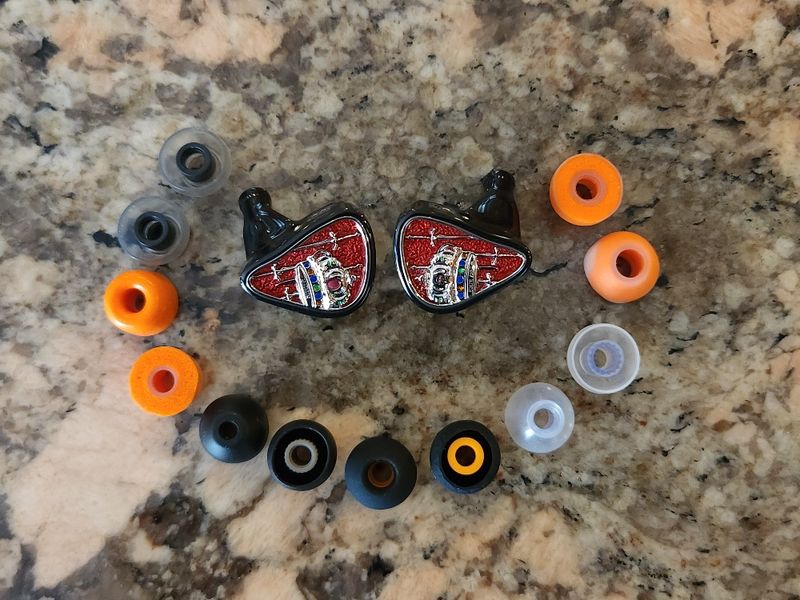
The selection of eartips is crucial to any universal in-ear monitor and will affect the sound, especially the bass impact depending on the seal. Due to a large opening of my ear canals, I usually go for the largest size eartips to get a better seal. Also, please keep in mind, that eartips impressions are subjective and will be based on the anatomy of your ears. My suggestion is to build up your eartips collection and try each one with every new IEM you get to find the pair which yields a perfect sound for your ears.
Eletech Baroque (stock) – a little smoother sound with scaled-up sub-bass rumble, stronger mid-bass punch, a little warmer mids, and still crystal-clear treble.
SpinFit W1 – big open soundstage, deep punchy bass, clear natural detailed mids, crystal clear non-fatigue treble, a bit more airiness in sound.
Azla Crystal – a touch more body in mids and a bit smoother treble.
Final Type-E – treble has a bit too much crunch to my ears with an extra crisp shimmer.
Symbio W – similar to Crystal with a touch more body in mids and a bit smoother treble.
Symbio F – to my big surprise, these foamies delivered a more mid-forward performance of MB, pushing mids/vocals more forward which had the effect of scaling down the weight of the bass.
Except for Type-E which made treble a bit too crisp, to my ears all other eartips worked quite well with MB. W1 gave a touch more airiness, but everything else was also pretty good.
Cable pair up.
I’m aware that some people are skeptical about cable contribution to the audio chain. It’s not my intent to start an argument here. Instead, I would like to share what I hear during my testing. What makes sense to me is that a metal wire is a material with physical properties of resistivity, conductivity, and purity, all of which act as a filter between your source and earphones. Variations of these physical properties can affect the conductivity of analog signal, resulting in a sound change, from a subtle to a more noticeable level. If the talk about cables upsets you, please skip this section. Otherwise, enjoy these short impressions.
Stock vs Eletech OTL (Ode to Laura) – adds more rumble to the sub-bass which also resonates into the lower mids with more body, lifting it above the neutral level. I also felt like the soundstage got a bit wider. But the main change I heard was more weight in bass and more body/texture in mids with additional coloring.
Stock vs Eletech TFO (The Fifth Ode) – adds more rumble to the sub-bass which adds more weight to the bass, but mids remain similar, less colored, and very detailed, just with additional texture. One noticeable change here is the next level of holographic soundstage expansion.
Stock vs Eletech SOA (Sonnet of Adam) – true to its mid-forward sound enhancement performance, you will hear MB’s mids more forward and even a bit more revealing. It’s almost like a pinna gain boost switch that scales up mids without any additional coloring. At the same time, it gives you a perception of a slightly scaled-down bass.

Stock vs LL Venom – very similar sound change as I hear it with TFO, more sub-bass rumble, still very clear, clean, detailed mids, and a bigger soundstage expansion. TFO adds a bit more texture to the mids, but other than that the changes are similar.
Stock vs PWA FT – I hear the sound changes are similar to OTL, you get more sub-bass rumble, and fuller body mids, though the soundstage expansion remains the same. The weight of the bass does scale up, and you get more coloring in mids, but not as much as with OTL which does color the mids more.
Stock vs EA Code 24 – the imaging of the sound becomes even more holographic, very 3D-like. The bass scales up just a bit in the rumble and mid-bass punch. Mids are clear and natural, a touch more forward. The treble is similar, with the same level of natural crunch. The biggest difference to my ears with C24 was even further expansion of the imaging.
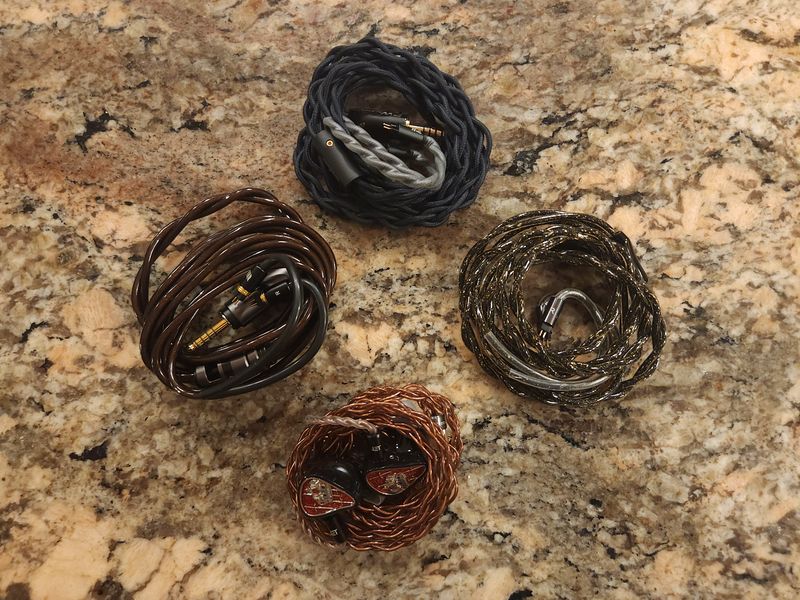
Quite a few people who attended the SoCal show had a chance to hear a limited Eletech/Forte Ears Ambition cable which has been highly praised and recommended as an ultimate upgrade cable. I personally don’t have experience with this cable and have seen it listed on the Musicteck page as “only crafted on demand” due to its design complexity. To my personal preference and based on other cables I tried with MB, I have no immediate plans to switch from the stock cable. For example, each of the Eletech upgrade cables I tried did a unique finetuning of MB tonality and technical performance. But I enjoyed the bass as it is and didn’t want to add any more rumble or reduce the perception of it due to mids being more forward. For audiophiles who already have a collection of other fine cables, I strongly encourage them to experiment with cable rolling. There are some IEMs where cable upgrade is almost a must. But here, if you think you are missing something with the stock cable and need to upgrade the cable to make these IEMs sound right (or better), then maybe MB sound tuning is not for you to begin with. Again, this is just my subjective opinion.
Page 3 – Comparison, Source Pair up, and Conclusion.

 Twister6 Reviews
Great review
LikeLike
i skipped Macbeth mainly becos of the bass. Its not enuff for me.
LikeLike