
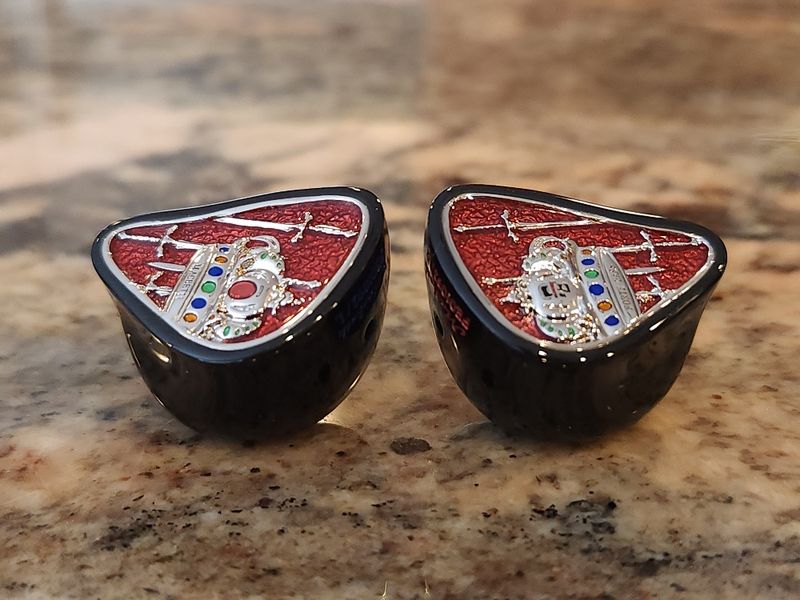
Comparison.
The comparison was done using MB with a stock Eletech copper cable, W1 eartips, and P6 Pro source, volume matched in every comparison.
MB vs Elysian Anni 23 – both have a very similar imaging, but the soundstage width spreads L/R wider in MB which I assume is due to its dual Sonion BCDs. I went back and forth many times between these IEMs and compared their FRs, trying to compare the bass. Despite Anni having DD bass and MB having BA bass, these IEMs have very similar bass quality and quantity. However, due to a difference in their upper mids and treble tuning, the perception of the bass quantity in Anni is scaled down. The upper mids of MB sound smoother, more natural, and a bit less forward in comparison to the more revealing, more forward, and more transparent upper mids of Anni. And the same with mid-treble, Anni scales up in quantity which gives its treble more crunch while MB has more natural clarity. I wouldn’t call their tuning complementary, but it offers a different flavor, and switching from one IEM to the other was just like flipping a crossover switch to boost upper mids and treble in Anni and going back to enhance the bass and add natural coloring in MB. Another difference worth mentioning, Anni is a lot more demanding to drive, requiring about 15 more volume clicks.
MB vs VE Phoenix – quite a few differences and similarities between these fine IEMs. The first thing you will notice is MB soundstage is a lot wider and with more holographic imaging. PHX has an average soundstage width and center-focused imaging while MB expands a lot wider and with a more holographic/spread positioning of sounds. The bass presentation also varies where PHX has more focus on punch with a little relaxed rumble and longer decay of bass notes flowing into thicker fuller body mids. On the contrary, MB has faster and tighter bass with more sub-bass rumble, more precise and stronger mid-bass punch, and shorter decay of notes that give the bass more control. MB lower mids are noticeably more neutral in comparison as well. But when it comes to upper mids and treble they are quite similar in tonality and presentation. But because of the thicker and fuller body lower mids in PHX, its mids are more colored and more organic in comparison to the leaner and more revealing mids/vocals of MB.
MB vs UM MM – Another very interesting comparison I had in mind as soon as I started to listen to MB. Both have a holographic level of imaging, while MM soundstage spreads even wider, feeling it wrapping around you. The bass difference is very apparent with MM having a more laidback presentation with less rumble and punch while MB scaling it up with more speed, punch, and control. Lower mids are not too far off, closer to neutral, perhaps with MM having a touch more body. Upper mids are where I hear more difference where MB sounds a bit leaner, revealing, and slightly more forward while MM is more natural, less forward, and drawing its clarity and resolution from mid-treble enhancement. In comparison, MB draws its “hi-res power” from lower treble enhancement. So, in comparison, MB sounds tighter, faster, and a little leaner and more detailed, while MM sounds smoother and more laidback.

MB vs EE NOVUS – I had a few requests for this comparison and since I had NOVUS on loan from Musicteck, I figured why not include it in this review. Starting with my usual soundstage analysis, both have very similar holographic imaging, courtesy of 2x Sonion BCD drivers, but MB spreads the sound wider from Left to Right. With bass, there is more weight in Novus, scaling up from sub-bass rumble to mid-bass punch. I find MB bass to be faster, tighter, and more articulate, while NOVUS has a typical DD bass with more bloom and also scaled-up weight. In mids, NOVUS also has more body in lower mids and more forward upper mids presentation. In contrast, MB’s lower mids are more neutral which gives its upper mids less coloring, more transparency, and higher resolution. The treble is very similar between these two. But due to scaled-up weight in bass and thicker lower mids, NOVUS sounds warmer and more organic while MB sounds more resolving and less colored.
MB vs AME Mousa – Both IEMs have a very similar soundstage expansion and imaging, again, thanks to dual Sonion BCD drivers which do their magic. In terms of tuning, Mousa has more elevated bass which scales a little more in sub-bass and a lot more in mid-bass relative to MB. Both have a fast articulate bass, but Mousa does scale up in the weight of the bass, and its thicker lower mids also make the decay of bass notes longer. In contrast, MB bass is more balanced with its mids and has a tighter performance with more control due to a short decay of notes. Also, MB’s lower mids are more neutral which brings more focus to the upper mids/vocals in comparison to Mousa with thicker lower mids that add more body to the sound and pull the upper mids/vocals slightly back. The treble in MB is a bit crisper and airier while Mousa’s treble is a bit smoother. The main difference here is more elevated bass and thicker mids in Mousa. Btw, both use the same stock Eletech copper cable.
MB vs Aroma Fei Wan – Another interesting comparison I was asked about. The soundstage width of MB is wider and the imaging is more holographic. FW soundstage is above average but doesn’t have the same L/R spread as MB, and FW imaging is a little more center-focused. While both have a similar sub-bass rumble, FW mid-bass has more weight, being more elevated in comparison to MB. Also, MB bass is faster, tighter, and more articulate, with shorter decay of bass notes. FW has thicker body lower mids in comparison to more neutral MB lower mids, and as a result, FW mids are more colored and not as resolving as MB’s upper mids. FW treble is also noticeably brighter, crisper, and could even get a bit harsh with some of the tracks, while MB treble is crisp and detailed and never crosses the threshold of being harsh or fatigued. Overall, FW sound has more fun coloring while MB has more natural revealing clarity.

Source Pair up.
In each of these source pair-ups, I was using a stock Eletech copper cable and W1 eartips. With a 7.3ohm impedance and 104dB sensitivity, MB is very easy to drive. I found the source selection here to have a noticeable effect on the revealing factor of the treble sound.
– DAPs –
L&P P6 Pro (baseline) – a balanced sound signature with a clean and clear detailed tonality. Big open soundstage with holographic imaging. Enhanced (but not exaggerated) bass tuning, clean and clear natural detailed mids, and a crystal-clear non-fatigue treble.
Lotoo LPGT – similar tuning to P6 Pro, except for a little crisper treble that makes upper frequencies a bit more revealing with extra crunch.
A&K SP3000T (hybrid/tube) – very holographic open sound expansion, clean and clear tuning with a more transparent tonality. I was a bit surprised here because I expected in hybrid/tube mode to hear more organic tonality, while it was the opposite, making MB sounds closer to Anni 23 (on P6 Pro) by boosting upper mids and mid-treble.
Sony WM1ZM2 – big soundstage expansion and close to holographic imaging. The pair-up synergy is also very close to P6 Pro except for a bit crisper mid-treble, but unlike LPGT where it also made upper mids a little more revealing, to my surprise the mids with 1ZM2 remained natural and detailed while only treble was a bit enhanced.
Hiby R8ii (turbo, class A) – also, a very similar tuning to P6 Pro, except with a touch crisper treble, just a touch more. I enjoyed this pair-up, but make sure to use Class A because in Class AB treble had more crunch.
Cayin N8ii (tube, class A, P) – loved this pair up. Similarly to P6 Pro, you have a balanced sound signature with a clean and clear detailed tonality, big open soundstage expansion with holographic imaging, deep punch bass, and clear detailed mids which are a bit more forward than P6 Pro, and crystal-clear non-fatigue well-controlled treble. Class A was a must here as well.
Cayin N7 (class A) – enjoyed this pair-up as well, but had to switch to Class A to give the treble a more natural tonality. Also, with N7, I hear the bass to scale up a bit more in weight which I like. But another thing that I noticed, the soundstage width got a touch narrower, having more depth/height than width. It gave the sound a more center-focused imaging.
iBasso DX320 w/amp14 – another pair-up that I loved with a balanced sound signature, an elevated bass rumble, and a stronger mid-bass punch. I dare to say, the bass in this pair-up has bloom and texture very typical of a DD performance. Mids are clean, clear, natural, and detailed. The treble is well controlled, with a natural crunch and non-fatigued clarity.

– dongles –
iBasso DC Elite – huge soundstage expansion, deep sub-bass rumble, punchy mid-bass, clear natural detailed mids, and a crunchy treble. A bit more energy in treble here.
L&P W4 – very similar sound tuning as I hear it with P6 Pro, just a touch more crunch in treble with W4.
Cayin RU7 – this pair-up reminded me of N8iii, very balanced, natural, and detailed, with more control in treble.
Here, I really enjoyed pair-ups with P6 Pro, N8ii, and DX320/amp14, and also liked R8ii, N7, and RU7.

Conclusion.
As I already mentioned in the intro of this review, it always surprises me when I discover a new brand with its first product having a very mature level of design and tuning. Today’s IEM market is quite competitive and saturated. Thus, I think it is a big deal to debut a new pair of IEMs and generate so much positive buzz as Forte Ears Macbeth did during and after the recent SoCal CanJam show. The tuning is just so effortless, natural, clear, and detailed, and still punchy, articulate, and energetic. Of course, everything still comes down to a personal sound preference. If you want a warmer tonality or more bass-dominated slam, these will not be your forte (no pun intended). But if you are after a balanced sound signature with a clean and clear detailed tonality, this is a great set of IEMs with natural transparency and an impressive level of detail retrieval and resolution your ears will thank you for. Forte Ears will be on my radar since I’m curious now about what else Riccardo is planning to surprise us with in the near future.

 Twister6 Reviews
Great review
LikeLike
i skipped Macbeth mainly becos of the bass. Its not enuff for me.
LikeLike