
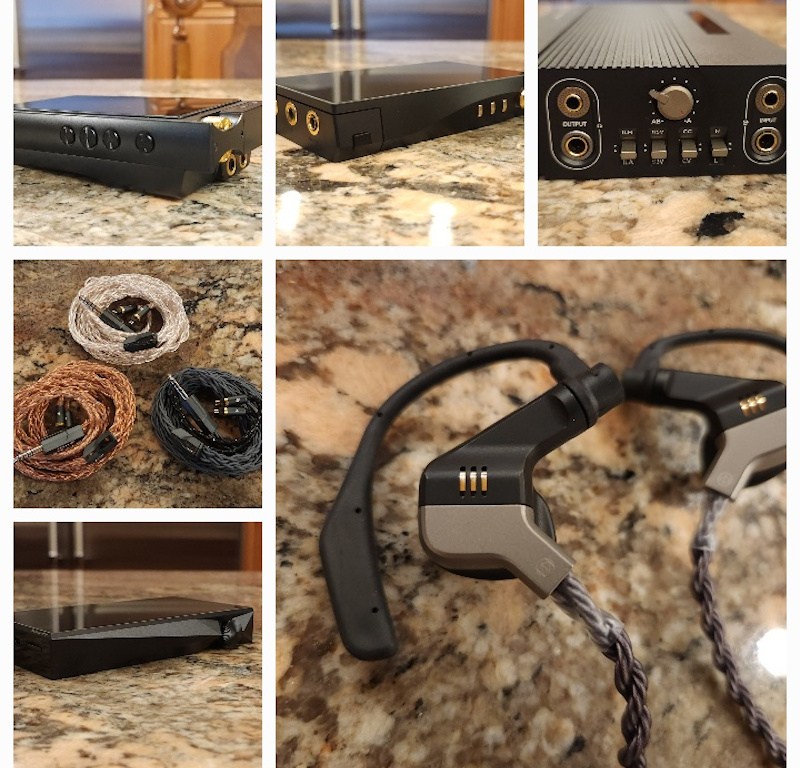
DAPs and AMPs.
Lotoo LPGT2 (GT2)
Lotoo is one of those manufacturers who don’t like to spoil us with new releases every year, or two, or five. We had to wait 6 years for the new version of their popular LPGT flagship DAP, LPGT2 which is labeled as “GT2”. One of the main reasons a DAP can have this kind of longevity and relevance after half a dozen years on the market is by keeping it pure and basic, without relying on different versions of Android OS or SoC processors which do get dated. Some manufacturers cave in under the Android streaming pressure, with the example being WM1ZM2 which never regained the glory of its original version. However, it looks like Lotoo decided to stay closer to its original hit, finetuning it to the next level, focusing mainly on the audio performance rather than drastic functionality changes.
The new device is still under the same optimized Lotoo OS (Unix) with its super-fast turn-on time, the same processor and DSP, and the same interface. As they say, if it ain’t broke, don’t fix it, especially if you are planning to stay true to a pure audio-playback performance without adding Android into the equation. But it doesn’t hurt to finetune it, such as moving up to a 4” screen from an old 3.77” to give a bit extra real estate space, while still maintaining Corning Gorilla Glass 5 with 9H+ hardness and DLC coating. The big change here is going from AK4497EQ DAC to the latest AKM chipset with AK4191EQ (modulator) and 2x AK4499EX (DACs). The AK4137EQ upsampling chip remained the same. The output power was also beefed up using 4x BUF634A headphone amps, scaling up 4.4mm BAL output from 500mW to 1,000mW corresponding to a new super high gain in addition to low/high gain.
To keep up with more power-hungry AKM DAC chips and higher output power, the battery was scaled up from 5,400mAh to 8,300mAh to maintain a similar playback time. GT2 with its aluminum alloy body is still built like a tank, but with new additions, the weight went up from 311g to 388g, which is reasonable. I assume the biggest challenge here was relative to the size of the new DAP while adding new chips, a higher capacity battery, and a bigger display without making it too oversized. Many of today’s flagships are growing in size and crossing the threshold of portable into transportable. LPGT is one of the smallest flagships on the market, but you have to be realistic, GT2 needed to expand to fit all the new hardware. So instead of growing taller and wider, GT2 got thicker with a slap-on “backpack” ergonomically designed so you can still maintain a comfortable grip. Lotoo cleverly partitioned and separated analog and digital printed wiring boards with extra shielding and a battery slice in between. I only spent a few days with GT2, and it did take me a little bit of time to get used to the new chassis. But at the end of the day, I found more appreciation for the direction of its updated design, making the DAP thicker rather than “bigger” while also hiding the headphone ports so they don’t stick out from the top.


As already mentioned, lots of functionality remained the same, thus you should expect the same built-in PMEQ/ATE with their typical presets and hardware-based oversampling using the AK4137EQ chip. Also, expect the same support for high-resolution formats up to DSD512 and PCM up to 768kHz. You can still use GT2 as a wired or wireless (BT) DAC paired up with your smartphone, tablet, or laptop if you want to stream. But now, similar to their flagship desktop Mjolnir, GT2 also supports LTTP – Lotoo Tele-Transport Protocol which enhances the wireless transmission. LTTP is Lotoo’s proprietary protocol featuring adaptive bandwidth and high-precision clock management to enable high-resolution & lossless wireless audio transmission up to 96k/24bit for hi-res audio and 48k/24b for lossless audio. Under this protocol, they can ensure a max transmission rate of 1.5Mbps and dynamically adjust the bandwidth based on file format and wireless interference.


LTTP is a separate dongle with interchangeable usb-c and lightning plugs you attach to the smartphone, tablet, or laptop, and pair up from GT2 through a menu on the second page of the main screen as you swipe right-to-left. I received one of these LTTP dongles for testing with GT2 and my smartphone (Galaxy S22) and compared the sound performance of BT/LDAC vs LTTP and direct-wired connection. When going from BT/LDAC to LTTP it was quite noticeable to hear an improvement in soundstage width and imaging, especially imaging which is more center-focused with LDAC and more expanded with LTTP. Tonality improvement sounded like a very faint layer of the veil was lifted off, and the sound was more dynamic, more layered, and had a bit more air between the layers. A wired connection playing the same song locally on GT2 gave a wider soundstage expansion, the same imaging, and maybe a bit higher resolution. But based on what I heard with a dongle I received for my short testing, LTTP wireless connection sounds closer to wired in comparison to BT/LDAC.
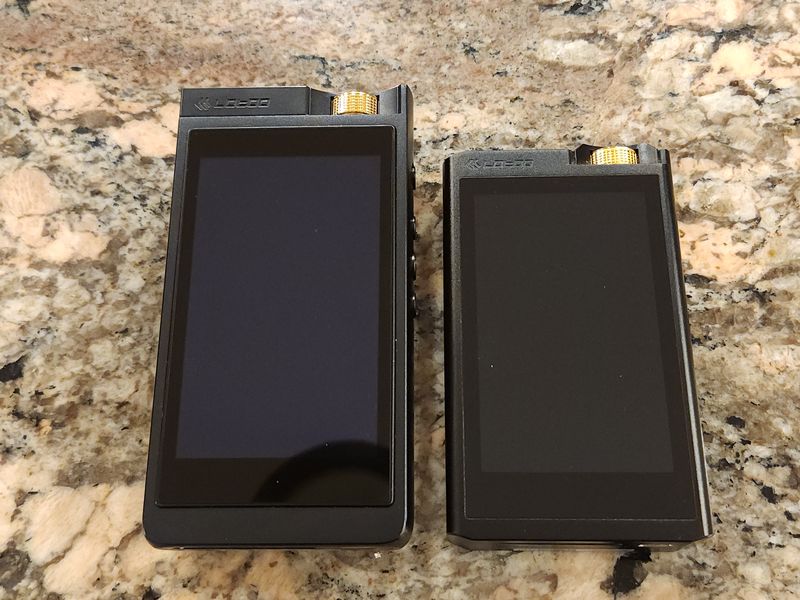
In my comparison of GT2 vs GT (original LPGT) using Jewel, the first thing that stood out was the holographic soundstage expansion of GT2. GT has a decent natural soundstage expansion without too much exaggeration, but in comparison to GT2, GT sounds more confined, making GT2 sound wider and taller with more holographic imaging. Then, you will also notice more transparency in GT2 sound coloring. Both DAPs have a rather neutral, natural, reference tonality, one of the reasons I have been using GT for years to analyze the sound of IEMs. GT2 has even more transparency, with zero coloring, keeping the sound neutral which also makes it more resolving, and more dynamic, with improved layering in comparison to GT.
I was going back and forth many times between these DAPs, volume matched, using the same track and the same IEMs, and it is hard to miss how much more dynamic and layered the sound of GT2 is, making GT sound a bit more compressed and with less air between the layers. I also noticed how GT2 in super high gain improves IEMs/headphones’ bass performance with a more authoritative tighter slam and faster attack and shorter decay of notes in comparison to a softer bass performance of the same IEMs/headphones with GT.
Due to a limited time with GT2, like everything else in this report, in addition to LPGT vs GT2, I only had a chance to compare GT2 to SP3000/SP3000M since they share the same AKM flagship chipset. Here, while SP3000 has a bit more holographic soundstage expansion, more than SP3000M and GT2, GT2 still has more authority in bass slam, hitting a bit harder and with a tighter performance of bass notes. But the tonality was not too far off, with SP3000 being just a bit less colored and more revealing while SP3000M and GT2 had a bit smoother tonality in mids.


Cayin N6iii
This was another surprise release, also quite overdue. I had to go back and search for my original N6ii review and found it was published 5+ years ago. Despite being an Android DAP, N6ii stayed in the spotlight for years thanks to its modular design with 6 DAC/amp cards including the original one which came with N6ii, followed by 4 optional DAC/amps, and one special LO-only DAC card. I’m glad they continued with the modular design idea and moved forward with the next-gen N6iii release. Also, I was pleased to see they kept the price at the mid-fi level while offering many improvements keeping N6iii competitive with other higher-end DAPs. Furthermore, the chassis is bigger and a bit heavier but still relatively compact and pocket-manageable despite a bigger screen and a much higher-capacity battery.


Some improvements, like moving up to Snapdragon 665 (from the original 425) and offering 6GB RAM and Android 12 (vs original 4GB of RAM and Android 8.1) along with the latest BT/wireless protocols are expected in the 2024 release. But other improvements like moving up to a 5” display (from the original 4.2”), offering 128GB of internal storage (vs original 64GB), and a higher capacity 9,000mAh battery (vs older one 5,900mAh) are very nice touches. A new lower profile and more seamless integration volume wheel with a format/bitrate light indicator also add a premium touch to the design. And I was very pleased to see a quick-lease latch mechanism with a Gen2 audio motherboard card.
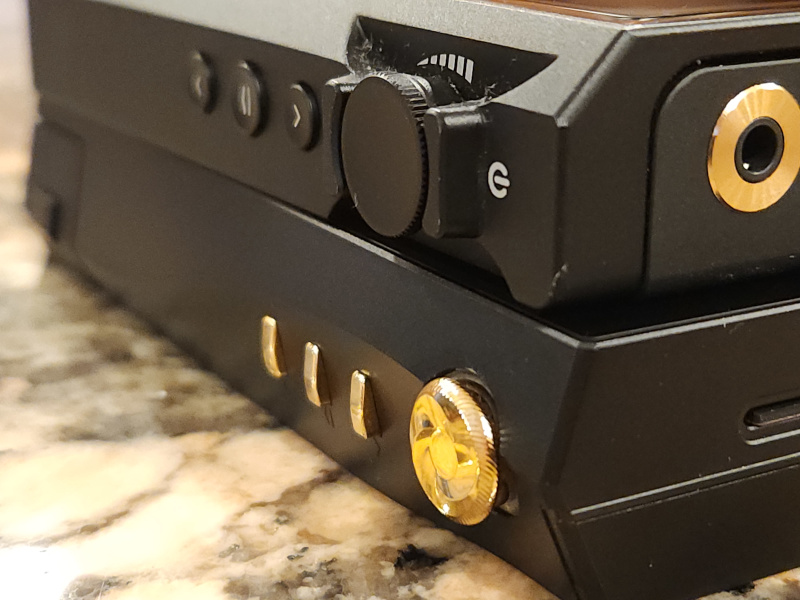
As I always mention in my Cayin reviews, their new products always implement and integrate audio tech drawn from their previous releases, with N6iii being no exception, implementing what they have learned from N7, N8ii, and N30LE in a new modular motherboard design. These new Gen2 cards will not be backward compatible with Gen1 because the audio motherboard PCB was increased by over 30% to give more room for the components. Also, there will be a new naming implemented with new motherboards, such as the first stock card being C201 where “C” corresponds to Cirrus Logic DACs, having 8x CS43198 DACs in a full-differential parallel matrix. Another highlight of this new C201 card design is high-precision cascaded volume control using 4x Nisshinbo NJU732x ICs typically found in high-end audio equipment and 4x Ti OPA1622 high-current output headphone amps with two pairs configured in parallel to produce 700mW of output power from balanced output.


When it comes to a modular DAP, you can only describe the sound based on the currently equipped audio motherboard card with its DAC/amp design. Meaning, that when a new module is released, it will be like upgrading your DAP with a new sound performance which you can switch on the go, literally, thanks to its quick release mechanism. Based on my limited time spent with N6iii and its C201 stock module, with many IEMs, I was able to hear a big expanded 3D soundstage with very holographic imaging, mostly likely due to headphone amp design with its parallel op-amp config. The sound was very dynamic and layered, the bass was very precise and punchy, and the tonality was naturally resolving in the upper mids and lower treble.
Of course, just like with most of the other gear I’m covering in this report, I didn’t have a chance to spend enough time on a more detailed sound analysis and comparison, but I can certainly hear N6iii w/C201 to enhance the bass performance of many IEMs I tried it with, to enhance the resolution of upper frequencies, and to expand the soundstage and imaging to a holographic level. Also, I was very impressed with a super black background and not even a hint of hissing or any background waterfall noise when testing with very sensitive IEMs.
While I was impressed with this DAP and C201 sound tuning, I also can’t wait to see what other audio motherboard cards they are going to come up with, keeping my fingers crossed for a discrete R2R design!
Astell & Kern SP3000M
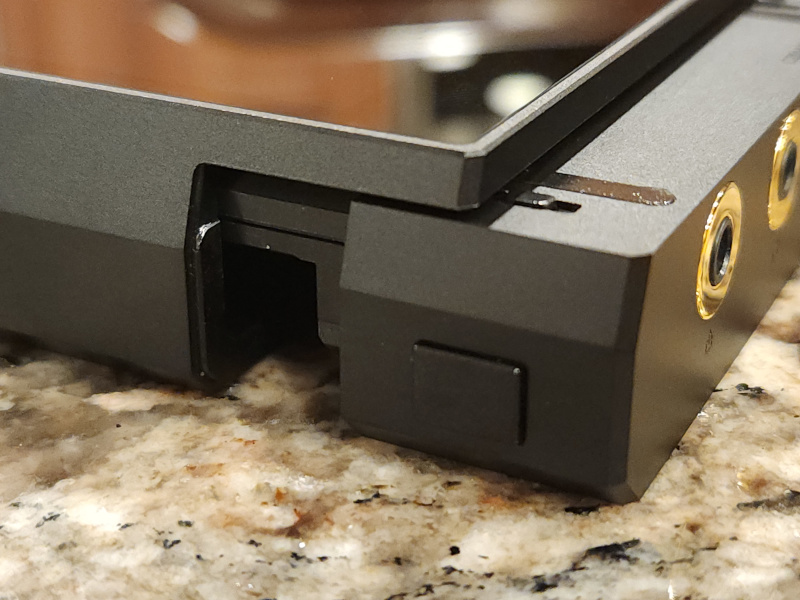
Revisiting SP1000 vs SP1000M from 6+ years ago, Astell & Kern surprised everybody again by introducing a mini-version of their flagship SP3000 DAP, SP3000M. While flagship audio players are getting bigger and bulkier, A&K went in the opposite direction, miniaturizing their 140x82x18mm, 493g stainless-steel SP3000 with 5.5” display into 120x69x18mm, 237g aluminum SP3000M with 4.1” display. They kept the same internal HEXA design with 2x AK4191EQ modulators and 4x AK4499EX DACs, the same Qualcomm 6125 Octa-core processor, the same PCM/DSD and Wifi/BT support, and only reduced the battery capacity from 5,050mAh to 4,200mAh, removed 2.5mm and SPDIF functionality (from 3.5mm) while still keeping 3.5mm and 4.4mm ports, and used a different volume wheel without LED and a separate power button. You need to cut some corners when you shrink the footprint and reduce the price, but in my opinion, a smaller pocket-friendly footprint justifies these changes. The only other change I was a bit surprised about is DAR implementation which moved from hw to sw in SP3000M.


But the same internal design doesn’t always guarantee identical sound performance as we have learned back from SP1000 vs SP1000M days. Different factors contribute to the sound from the material used in the chassis to discrete filter components, such as capacitors, since a smaller footprint reduces the size of a circuit board and the real estate for miscellaneous components on it. One thing I did notice right away while testing SP3000 vs SP3000M Line Out going into the C9ii amp, the sound tonality and technical performance were very close. Also, both have a very black background.
As I compared both, starting with DAR being off, 3kM has a wide soundstage with expanded imaging and a touch more body in mids while 3k soundstage/imaging expands wider, a bit more holographic, and (3k) sound has a bit more transparency with less coloring. If we add SP3000T into this comparison, 3kM and 3kT (OP mode) sound similar with DAR off, perhaps with 3kM being just a bit more resolving and dynamic, including a slightly wider soundstage expansion. 3k difference in comparison to 3kM is not exactly night and day, but you can certainly hear more transparency which could improve the resolution, while 3kM has a bit smoother tonality in mids.
There is a bigger gap in sound performance with the DAR filter being enabled, perhaps due to a different implementation since it is done in software in SP3000M. But I found this difference to vary from IEM to IEM and also depending on DAR PCM vs DAR DSD, with some having a soundstage more intimate with SP3000M (DAR DSD), while others have it as expanded or even more holographic (DAR PCM). As I was finalizing my thoughts, A&K pushed a new fw upgrade for SP3000M which improved imaging with DAR PCM enabled. Another thing to note, SP3000M needs at least 100-120 hours of burning because out of the box, the sound was warmer and more congested, opening up nicely after 4+ days of continuous playback in the loop.
Also, the battery life will vary. In my best-case test scenario with Wifi/BT and DAR off, playing local hi-res files in a loop, I got about 9.5 hours of continuous payback. When I enabled Wifi and DAR, streaming hi-res songs from Amazon HD, the total playback went down to 6.5 hours. Then, running the same test while streaming and having DAR turned off, I got 8 hours and 50 minutes of playback time. This suggests that the extra 2+ hours of battery time was due to the sw-implemented DAR filter. In my opinion, just keep the DAR filter off with SP3000M for the best sound/battery performance.


Luxury & Precision EA4
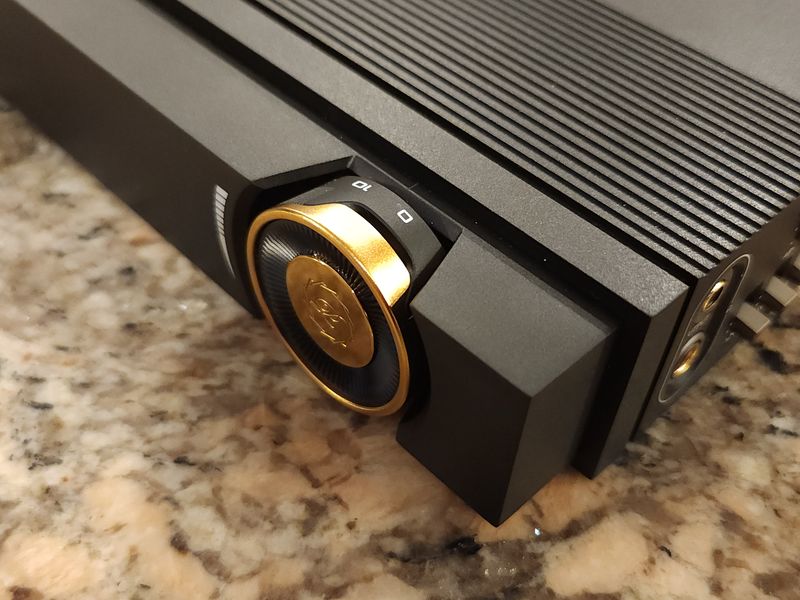
EA4 came as a bit of a surprise to me because Luxury & Precision is better known for its DAPs and DAC/amp dongles. EA4 is their flagship portable/transportable High-Power dual-NuTube Tube Amp. And when we talk about high power, the spec of EA4 is a very impressive 6.5W @32ohm, scaled down to 1.2W @300ohm. The unit is portable since it is battery-operated (6x Panasonic 18650 low internal resistance batteries) and you can move it around, but it is not exactly pocket-friendly, making it more transportable. This fully discrete power amp has both 3.5mm and 4.4mm inputs and outputs, offering both Tube Preamp and Headphone amplifier functions, CNC machined metal tube shielding and protective cover, along with custom-designed tube vibration-damping design. It even has the same high-end volume potentiometer as used in their flagship LP6 7th anniversary edition DAP. But what makes it stand out are all the sound-shaping options available at your fingertip, literally.
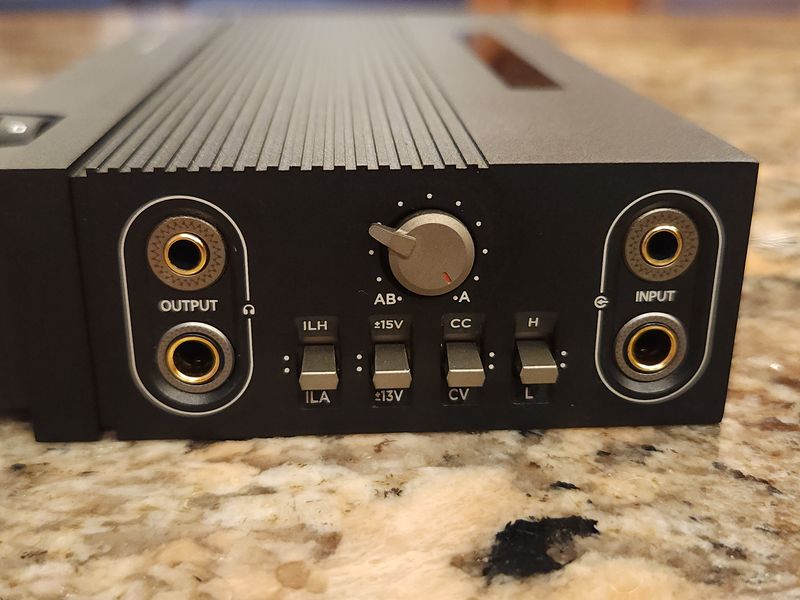
You get a rotary switch to adjust from Class AB to A headphone amp modes with 11 static current levels. You can also select between 13V and 15V power supply voltage levels for the headphone amp. There is the ILA/ILH dual mode which in conjunction with high and low gain for the tube creates four different sound variations. If that is not enough, you can also switch between Constant Voltage (CV) which applies a fixed voltage and Constant Current (CC) modes to supply constant current. All these sound-shaping options allow you to finetune the pair-up synergy with your IEMs and headphones to your exact liking. Regardless of these options, the EA4 has a very big expanded soundstage with holographic imaging and offers a distinctly analog smooth textured sound with precise layering and separation and lots of air between the layers.


I was curious about the effect of all the available sound-shaping options and did a quick test connecting P6 Pro LO to EA4 while monitoring with Jewel. Please keep in mind, that all these sound impressions are relative to Aroma Jewel. Below, I was only changing one option at a time while documenting the state of other settings.
ILA vs ILH (Class A, 13V, CV, LG) – ILA has a warmer smoother tonality while ILH boosts the output and makes the sound less colored and more detailed.
13V vs 15V (Class A, ILA, CV, LG) – going from 13V to 15V added some body to the sound, also making it more dynamic.
CV vs CC (Class A, ILA, 13V, LG) – switching from CV to CC made the sound smoother, and a bit more laidback with a slightly longer attack/decay of the notes.
LG vs HG (Class A, ILA, 13V, CV) – obviously, high gain boosts the output, but here it also added more punch to the sound.
Class A vs Class AB (ILA, 13V, CV, LG) – typical of A vs AB changes, A has a fuller body with more laidback tonality while AB has a bit more transparency with a faster attack of the notes.
Conclusion.
There is not much to write in the conclusion except to be grateful for the opportunity to hear all these new IEMs, cables, DAPs, and amps, and to look forward to spending more time with some of them in the near future for more detailed analysis and a separate review if I get a chance. And of course, Big Thanks to Andrew/Musicteck for this golden opportunity where instead of me going to CanJam, the CanJam came to me! The next CanJam I’m looking forward to attending in person should be NYC ’25!
Page 1 – Brise Audio, VE, Nostalgia, BGVP, Effect Audio
Page 2 – Lotoo, Cayin, Astell & Kern, Luxury & Precision

 Twister6 Reviews