
The product was provided to me free of charge for review purposes in exchange for my honest opinion.
Manufacturer website: iBasso. Available for sale directly or through authorized retailers like Bloom Audio.
Intro.
Between their regular DX and supercharged MAX series, as well as dongles and IEMs, every year iBasso spoils us with new releases. Last year they were especially busy, delivering a lot of new audio toys, except for a new flagship DAP. Instead, we got a separate flagship-level D16 DAC/amp and PB5 NuTube amp duo. Driven by D16/PB5 popularity, we will soon see a D17 DAC/amp model with a combined R2R DAC and dual-NuTube amp. But my wishful thinking was to have D16 in a standalone DAP footprint as an all-in-one portable source with the same natural tonality of a 1-bit discrete DAC design. I didn’t expect this wish to come true around Christmas when iBasso released their latest DX340 modular DAP.
I received DX340 for review a few weeks ago, already finished the recommended burn-in, and put it in my ever-growing review queue. But at the same time, I got flooded with questions, many asking about the comparison and pair-ups with other iBasso DAPs/DACs/amps. My usual detailed testing and write-up takes time, especially with other reviews in the queue. But it also takes time to reply to the same questions from my readers, thus I decided to write a short First Look review of DX340 DAP. Again, this is not a substitute for the full write-up, that one will be coming soon with a lot more info. Today, I will share my initial thoughts about the design update and sound impressions of this latest flagship DAP release from iBasso.
First Look at the Design.
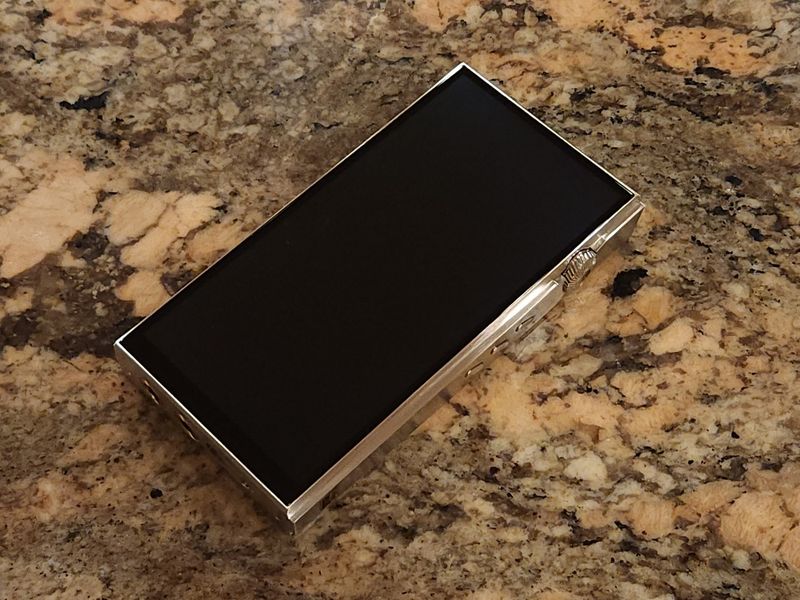
Starting with exterior dimensions of 150mm x 77.5mm x 19mm and a weight of 486g, DX340 is shorter than DX320, with the same width, and just a bit thicker. It is heavier due to a solid 316 Stainless Steel chassis, unlike the aluminum chassis of DX320. The build is premium-solid and feels even more solid than the liquid-metal construction of the DX320 Edition X. Of course, the MAX series is solid too, but that one fits the category of a transportable solid brick while the DX340 has an elegant more pocket-friendly sculptured design. And speaking of which, all iBasso DAPs, from DX180 to DX260 and DX340, now follow a similar chassis design, just scaling up in size as you go up the model number.


As a quick overview, the left side doesn’t have any controls. On the right side, like in 180 and 260, you will find 3 identical skewed playback buttons with a precise tactile response and a volume/power wheel above it. DX340 wheel has a watch-crown design with guards from the top and bottom, sticking out just a bit for easier access and control with a thumb, and having a precise 100-step click action to adjust the volume. It also doubles as a power button when you press it, with a typical short press to turn the display on/off and a long press to bring up the power off/restart message window. The wheel movement felt solid.
The top of the chassis has access to a 3.5mm Coax SPDIF output, a USB-C port for charging and digital inputs and outputs, and a spring-loaded microSD card to expand the internal storage. At the bottom is where the modular AMP goes in, with the included stock AMP15 secured in by 2 torq screws. Per AMP15, you will find 3.5mm and 4.4mm ports, each doubling as PO and LO, and a separate DC-in 12V input with a rubber cover (which I removed right away).
The back panel feels like either glass or plexiglass and has a unique “industrial” asymmetric design, similar to 180 and 260, with a metal insert piece in the upper left corner. Similar to 180 and 260, you should be able to remove that piece held down by two torq #4 screws, slide up and flip open the back panel after you remove the amp module to access the battery underneath which is user replaceable. I did remove that piece to access the back panel, it is feasible but was not exactly easy.


First Look Under the Hood.
In the heart of DX340, just like in D16, you have a 1-bit discrete DAC design under the control of an updated custom FPGA-Master 3.0. The original FPGA-Master in the DX320 design was implemented as an audio system controller to offload SoC processing by directly requesting audio data, as well as syncing and generating all audio clocks to reduce the jitter. In the D16 design, FPGA-Master 2.0 added the functionality to generate PWM signals driving discrete PWM-DACs for decoding of audio signals. As part of the 1-bit discrete DAC design, iBasso implemented 16 sets of cascaded 8E (8-Elements) PWM-DACs for a total of 128 Discrete PWM-DACs elements operating in FIR (Finite Impulse Response) mode. In the DX340 design, the updated FPGA-Master 3.0 code was optimized further, adding a new exclusive Harmonic Setting adjustment.
You still have a dual boot system design with access to either a full Android OS which includes WiFi, BT, and Google Play store with apps, or a stripped-down local playback-only Mango OS (Unix) which focuses strictly on audio performance without a waste of OS resources on other tasks. You can boot DX340 in either of these modes. Relative to DX320 with its Android 11, Snapdragon 660, 6GB of RAM, and 128GB of ROM, the DX340 steps up to an optimized Android 13, Snapdragon 665, 8GB of RAM, and 256GB of ROM. Another big change was in a smaller direction going from the DX320 6.5” LED display to a gorgeous 6” AMOLED display in DX340, with a new OLED display being on par with today’s smartphones.
You still have a dual battery design with a separate analog battery, 2100mAh, and a digital battery, 4000mAh. I didn’t have a chance to run a battery test yet, but according to iBasso, DX340 gains one extra hour of playback time. Also, similar to the DX320, you just need one USB-C charger for both batteries at the same time, unlike the MAX series where you need a separate AC/DC charger for an analog battery. As part of a new design, the stock AMP15 module comes with its own separate DC-in (12V) input for independent power-up of the internal amp section using the included external AC/DC 12V wall supply. Under this operation, you still need to charge the digital battery, but the analog one will be bypassed with an amp section in AMP15 being directly powered by an external supply. As a result, when powered from an internal analog battery, the max BAL output will be 1.2W. Bypassing it with DC-in will boost it to 2.15W, also improving the audio performance due to the amp voltage increase from 6.23Vrms to 8.3Vrms.
And speaking of amp modules, iBasso already announced three new upcoming AMP modules, AMP16 with dual Raytheon JAN6418 tubes and 22.5V high voltage power supply for the anode, AMP17 with Gallium Nitride + Transistor, and AMP18 Ultimate Transistor amp card with 80 individual transistors. From the pictures iBasso shared of these upcoming amps, they all going to have a DC-in port option on each corresponding card. The included AMP15 and upcoming AMP16/17/18 will only be compatible with DX340. Also, iBasso will release faceplate adapters for their previous AMP12/13/14 to use with DX340.


 Twister6 Reviews