
Sound Analysis.
I analyzed DX340 sound with Aroma Jewel while playing a variety of my favorite test tracks, such as Agnes Obel’s “The Curse”, Sandro Cavazza’s “So much better” (Avicii remix), C-Bool “Never go away”, Ed Sheeran “Shape of you”, Alan Walker “Darkside”, Galantis “Hunter”, Iggy Azalea “Black widow”, Indila “Boite en argent”, Dua Lipa “Love Again”, Counting Crows “Big yellow taxi”, David Elias “Vision of her”, and Michael Jackson “Dirty Diana”. As recommended by the manufacturer, I kept 340 on burn-in for almost 150 hours using the provided balanced burn-in cable before I started sound analysis.
As a disclaimer, I prefer to describe the DAP sound based on the comparison to other DAPs and pair-ups with different IEMs/headphones since the DAP by itself doesn’t have a “sound”. What we hear is how it sounds through connected IEMs/headphones or the difference in sound relative to other sources using the same pair of IEMs/headphones. As a result, this section of the review usually has a shorter summary of what I find in the follow-up sections. Of course, this is my subjective opinion, describing how and what I hear.

While listening to DX340 and switching between different Harmonic Adjustment Settings, here is how I hear this DAP with its default stock AMP15 card. Just to add, as I usually say, nothing is night and day, but to my ears these changes were noticeable.
- H1 (original, no harmonic adjustment applied) – big, expanded soundstage with holographic imaging, more transparent (less colored) neutral sound tuning with improved retrieval of details. The overall presentation of the sound is faster and punchier.
- H2 (natural, with a slight adjustment on both the odd and even harmonics) – big, expanded soundstage with slightly more center-focused imaging, adding a little more coloring in mids which gives the sound a more natural body and smoother tonality. The sound presentation is a bit more relaxed. In this setting, I hear more sub-bass rumble which adds more weight to the bass.
- H3 (even+, with an increase of the even harmonics) – big, expanded soundstage with close to holographic imaging. I do hear more coloring in the sound, but it is not as smooth as the H2 (natural) setting. The sound is faster and more articulate but not as fast as the original, being somewhere in between H1 and H2 settings. The bass performance is close to H1.
- H4 (odd+, with an increase of the odd harmonics) – it kind of reminded me of H3 but with more sparkle in treble and a touch more center-focused imaging while the soundstage itself was rather wide.
- H5 (all, combines both the H3 and H4) – in a way, it does sound like a combination of H3 and H4 where the soundstage was very expanded and imaging was quite holographic, the sound was faster, on the level of H1, and the treble had a bit more sparkle.
It all comes down to a personal preference and the pair-up synergy with what you are listening to. I found H1 and H2 to be my favorite settings, with H1 being closer to iBasso house tuning of more neutral resolving transparent tonality and H2 giving you a tuning enhancement with a smoother natural tonality, more laidback sound presentation, and a bit more weight with a deeper sub-bass rumble. In my testing, I ended up going back more often to H2 because of its addictive analog sweetness in mids and extra texture and weight in the sub-bass.
Another thing to note, you have access to both DAC (high/low LO voltage) and AMP (high/mid/low) gain settings. If you are using notoriously sensitive IEMs from Campfire Audio and Vision Ears, keep the DAC setting on high and switch the AMP setting to low which can significantly reduce the waterfall hissing.
Comparison.
In this test, I was using Aroma Jewel, and DX340 was set to H2 harmonic setting which I found to bring in a deeper sub-bass rumble and more natural smooth tonality in mids. As mentioned above, switching to H1 will give the sound more transparency, but I enjoyed the H2 setting more. In my First Look, I decided to focus on the comparison with other iBasso DAPs/DACs/amps, and I was using DX320X, the liquid metal edition version.
DX340/amp15 vs DX320/amp14 – in this particular comparison, both 340 and 320 have a smoother tonality, but 340 adds more weight and analog sweetness to give mids a little more weight. I assume the difference in tonality of mids is due to a difference in DACs between these DAPs. Both have a very similar expanded soundstage and similar resolution and retrieval of details. But 340 has better articulation of notes with sharper transient edges, having a faster on/off transition, which creates the perception of a blacker background and the improvement in vertical dynamics. What impressed me the most here, while both have a smoother tonality, 340 has a blacker background and better control of notes. Each DAP achieves a smoother tonality by having in DX340 a combination of a warmer DAC (1-bit discrete) and more neutral amp (AMP15) and in DX320 a more revealing/neutral DAC (ROHM) and warmer amp (AMP14). I haven’t tried 340 w/AMP14 since it will require a new adapter bracket, but I would assume this should add more warmth and body to the sound, maybe closer to the DX340/PB5 combo.
DX340/amp15 vs DX320/amp11mk2s – here, we changed DX320 tonality back toward its baseline tuning, using a more revealing/neutral DAC (ROHM) with a more neutral amp (AMP11mk2s). In comparison to this more revealing, less colored, and a bit colder sound of DX320, the DX340 sounds more analog, smoother, warmer, and with a fuller body. DX320 has a super black background, maybe even darker than 340, though 340 is not too far off. They both have a big, expanded soundstage and imaging, and fast transient response of notes on/off, making the sound more articulate. Aside from the tonality difference which is driven by their DAC’s sound sig, I also noticed DX320 to have more punch in the bass. Not sure if this is due to higher Vrms of AMP11mk2s (320) in comparison to AMP15 (340). For example, while using Jewel, I hear bass notes having more weight with 340 and more punch with 320. Also, maybe this could explain why 340 gains more bass punch when using AMP15 w/DC-in which increases Vrms.


DX340/amp15 vs DX340/D16 (via coax) – the tonality difference between DX340/amp15 and /D16 is not too far off, both being smooth, textured, and still articulate. I did notice relative to Jewel a touch more warmth in mids with DX340 while D16 had a bit more transparency, but the difference is not night and day. Where I do hear more difference is in the technical performance of D16 having a faster and stronger mid-bass punch and a bit more expanded soundstage. In comparison, DX340/amp15 bass has a similar sub-bass texture and a more relaxed mid-bass punch. DX340/amp15 soundstage is pretty wide but in a natural way, while it felt like D16 was stretching a little wider, giving you a more 3D holographic positioning of sounds. Now, here is something interesting. I compared the Coax output of DX340 vs DX320 while connected to D16, and I do hear a smoother sound with D16 connected to DX340 and a sharper and brighter tonality when D16 is connected to DX320. Using DX180 coax out, the D16 also had a bit sharper and more revealing tonality in comparison to a smoother, more laidback, more analog tonality when using DX340 as a transport while driving the D16 from its coax output.
DX340/amp15 vs DX340/amp15/PB5 (via LO) – DX340 LO is not fixed at max 2Vrms (when DAC gain is set to high), it is variable so when connecting the external amp, you need to raise the volume of the DAP to adjust the LO. With LO connected and enabled in settings (switched from PO), I set DX340 DAC gain to High and raised the volume to 100 to get the max 2Vrms output while PB5 was in low gain. Again, perhaps the tonality change is not very drastic between DX340/amp15 and DX340/PB5, with the addition of PB5 I do hear more texture in the sound and more rumble in the sub-bass, there is an improvement in vertical dynamics due to better layering and separation of the sounds, and I also hear the improvement in the soundstage width expansion where it feels like it wraps around and behind me. The changes in technical performance here were noticeable. This also makes me excited to wait for the availability of the AMP14 bracket to try it with DX340 and the upcoming AMP16 with dual Raytheon JAN6418 tubes.

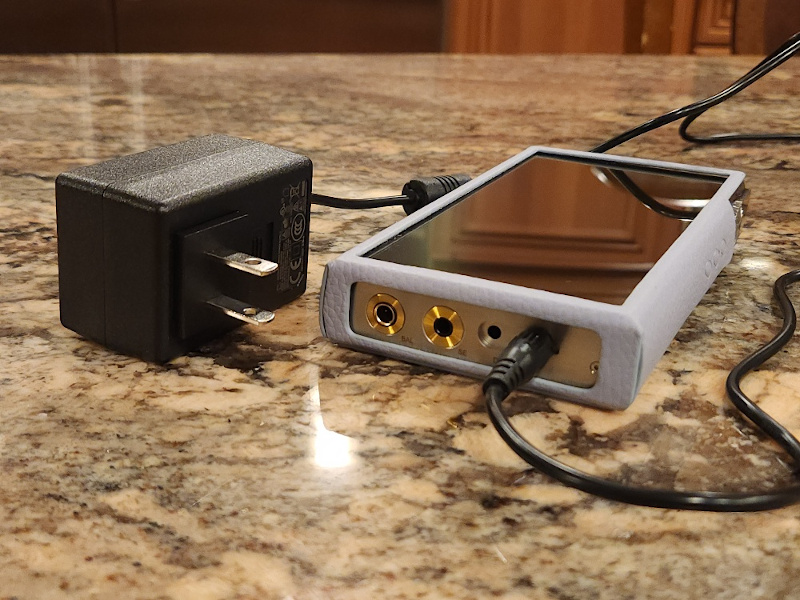
And last, but not least, I couldn’t wait to hear the impact on the sound while using the external 12V DC-in in comparison to its internal battery, boosting the amp-card output power with the corresponding voltage change from 6.23Vrms (batt) to 8.3Vrms (DC-in).
DX340/amp15 battery vs DC-in – as soon as I plugged DC-in, using the provided AC/DC supply, my first reaction was “Wow!”. Two things that stood out for me right away were the velvety texture of the bass rumble and the stronger mid-bass punch. It is not the same as the bass being boosted with EQ. And it is not a placebo effect since I went back and forth many times, even doing a blind test (thanks to my wife). Fueled with a more powerful amp output, the performance of Jewel’s DD driver scaled up, improving the quality of the bass with more texture, more layering, more weight, and more authority. The bass is still well-controlled, with no spillage into mids, but as a result of the improvement in bass quality, I hear a little more body and texture in mids as well. Another noticeable improvement was the soundstage expansion. It is still wide/deep/tall, but now it feels like the sound wraps more around and behind me. The changes were quite noticeable and more than just a subtle improvement.
Conclusion.
Throughout the years, iBasso has demonstrated steady finetuning improvements with every new release in their entry-level, mid-fi, and summit-fi DAP series. Especially with flagships, when you put so much effort into perfecting the design, it is not easy to make a big jump. But it looks like DX340 was able to accomplish that by combining its flagship modular DX320 DAP with its flagship D16 DAC/amp using a 1-bit discrete DAC under the new FPGA-Master 3.0 control inside of an all-new solid stainless-steel chassis with a beautiful OLED display. To top it all, we now have a new series of AMP modules with an option for external 12V DC input that bypasses the internal analog battery and drives the amp card with higher voltage. The optimized Android 13 while still supporting dual Android/Unix boot-up, along with more RAM and ROM is just a cherry on top.
Keeping the modular design and announcing three upcoming AMP cards with a new tech that promises to change the sound characteristics of DX340 adds more excitement to this release because it will be like getting a new flagship-level DAP for the price of an amp-card upgrade. I’m also happy to see that despite all these updates and improvements, DX340 is priced only $100 more than its previous DX320 flagship, still being cheaper than some other manufacturer’s flagships, and always with an impressive price/performance ratio.

 Twister6 Reviews