

The sub-$500 star!
PROS: Benchmark boutique design and build quality for the price, highly attractive, extremely comfortable ear pads and headband design, easy clamp force, warm-neutral, natural tonality, good technical performance for the price – open sounding soundstage as well as good detail retrieval, L-R separation and layering.
CONS: 1.5kHz upper-midrange dip, I would’ve like a bit more upper-treble extension.
The product was provided to me free of charge in exchange for my honest opinion.
About Meze Audio.
Meze Audio started with Antonio, their founder, searching for a pair of headphones that he could relate to, in the same way he felt connected to his Fender Stratocaster guitar – an object to pour his passion for music in. An object full of personality and life, which also incorporates the attributes of high-end technology. Meze Audio was founded in 2011 in Baia Mare, Romania. They started small, acquiring knowledge by experimenting with parts already on the market, searching and researching for the right materials and engineering solutions in the quest for the perfect sound and feel. Their breakthrough year was 2015, when, after many years of development, they launched the 99 Classics, which won them awards and nominations that were beyond their expectations. Today all Meze’s models – headphones and earphones, are developed in-house from the ground up, in the spirit of their original ‘no-compromise’ vision. We’ve previously reviewed Meze’s Elite Tungsten, 109 Pro and Empyrean headphones as well as their IEMs – Advar and Rai Penta.
Official website – Meze 105 AER ($399).
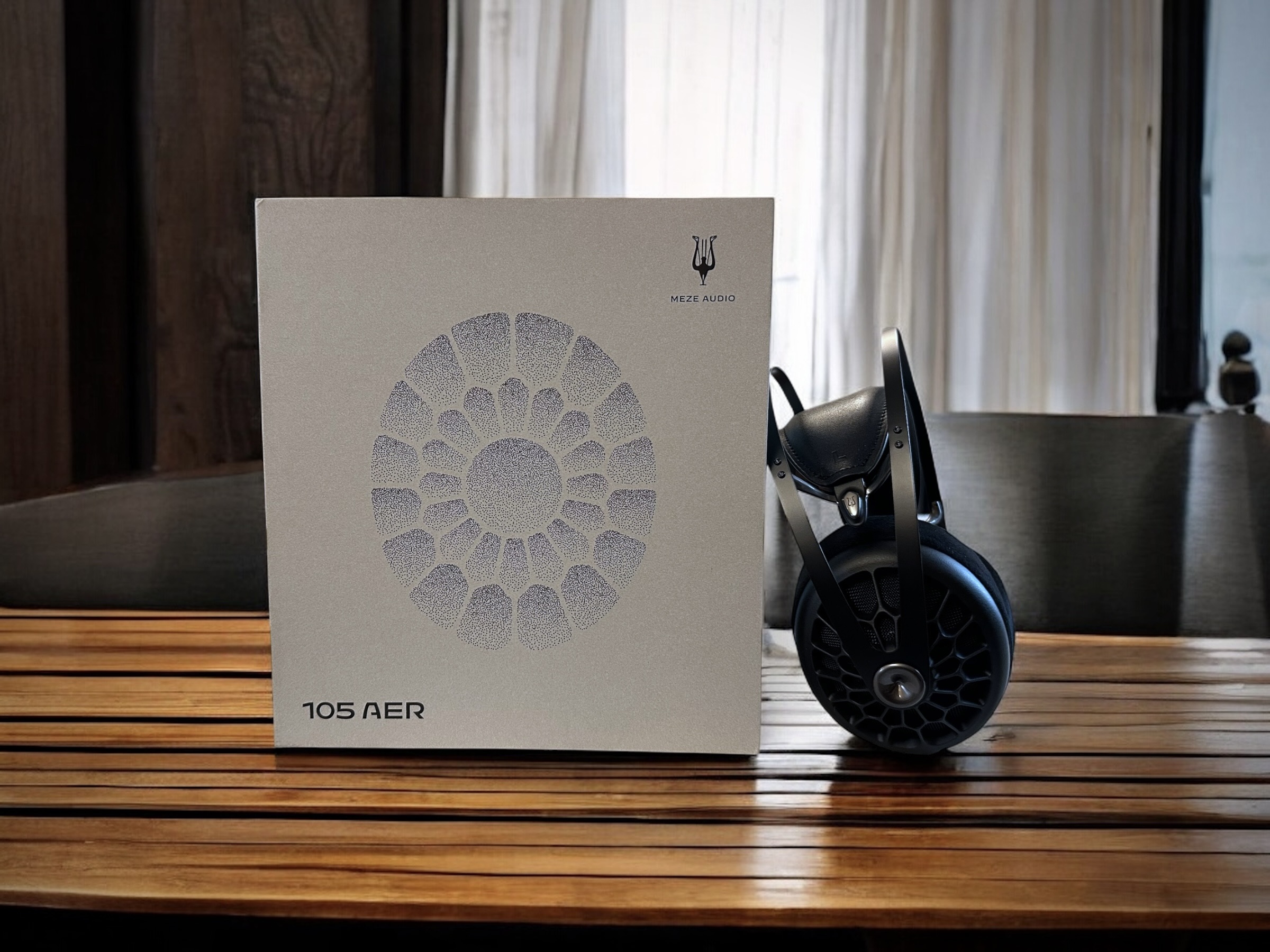
Introduction
Meze Audio is no stranger to crafting headphones that combine luxurious aesthetics with a signature house sound that prioritises musicality. The 105 AER represents Meze’s venture into a more compact, lightweight design without sacrificing their reputation for premium build quality and immersive sound. Positioned as an accessible yet high-performance option, the 105 AER promises to deliver a refined listening experience, bridging the gap between portability and audiophile-grade performance.
So, let’s take a in-depth look into the whole package to see if those promises are met.

Tech in Meze 105 AER.
Driver Design.
Meze’s 50 mm dynamic driver architecture has proven to be remarkably reliable and versatile. To keep 105 AER as accessible as possible, the driver membrane and frame underwent slight modifications. Meze took this opportunity to introduce a unique new headphone voicing that fits all musical genres.
W-Shaped Dome.
Made of a carbon fiber-reinforced cellulose composite, the dome can reproduce high-frequencies with incredible detail, clarity, and definition. More durable than conventional alternatives used in dynamic drivers, yet lightweight, this composite helps reduce resonances that may lead to harmonic distortion.
Ultra-Thin Torus.
The torus surrounding the dome is made of PEEK (Polyether Ether Ketone), a semicrystalline polymer with excellent mechanical properties. PEEK’s high tensile strength and stiffness ensure the driver membrane maintains structural integrity under high stress, while its lightweight nature allows for quicker movement in response to audio signals. This enhances clarity and detail, making every note and nuance in your music come alive. Additionally, PEEK boasts superior internal damping characteristics, which reduce unwanted resonances and vibrations. Stiffness and durability are also enhanced through the grooves on the torus, which are precisely positioned at a 45.5° angle.
Stabalizer.
The copper-zinc alloy stabilizer, positioned around the membrane, improves the absorption of vibrations to further reduce distortion.


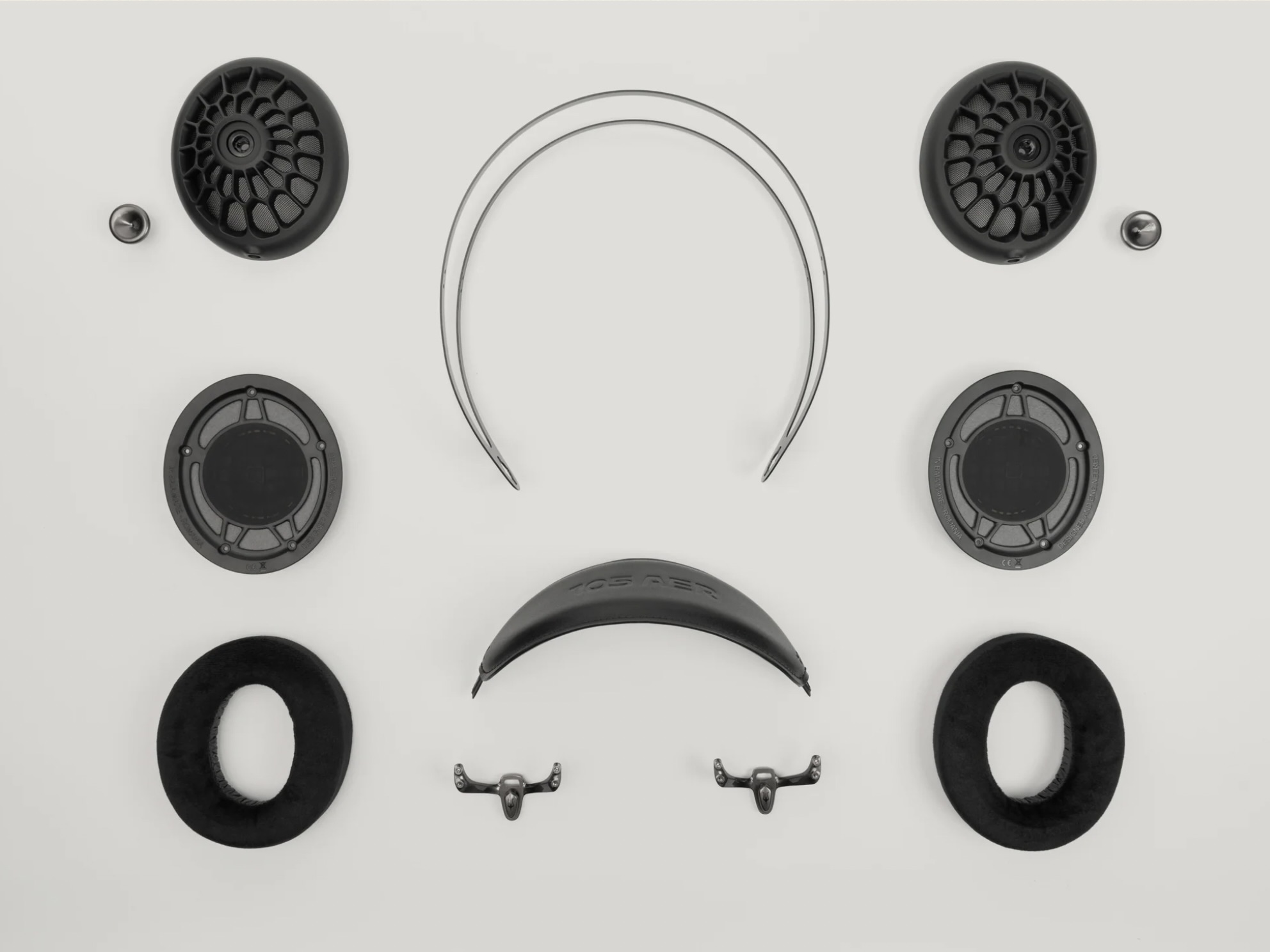
Meze say they design products that last. They believe that a longer product lifespan means a smaller footprint. Following this philosophy, the 105 AER can be taken apart and serviced endlessly if needed, extending the product’s life beyond limit.
Unboxing & Accessories
The unboxing experience of the 105 AER is classic Meze – understated elegance with a focus on practicality. The headphones come housed in a sturdy, hard-shell carrying case that exudes durability while offering ample protection for on-the-go use. Inside, you’ll find:
- A detachable cable with a 3.5mm jack (dual 3.5mm connections at the earcups).
- A 6.35mm adapter for desktop setups.
- A cleaning cloth to maintain the pristine finish of the headphones.
- A user manual and warranty card.
The attention to detail in packaging aligns with Meze’s premium ethos, but some might find the lack of a balanced cable a missed opportunity for advanced users.

Build & Design
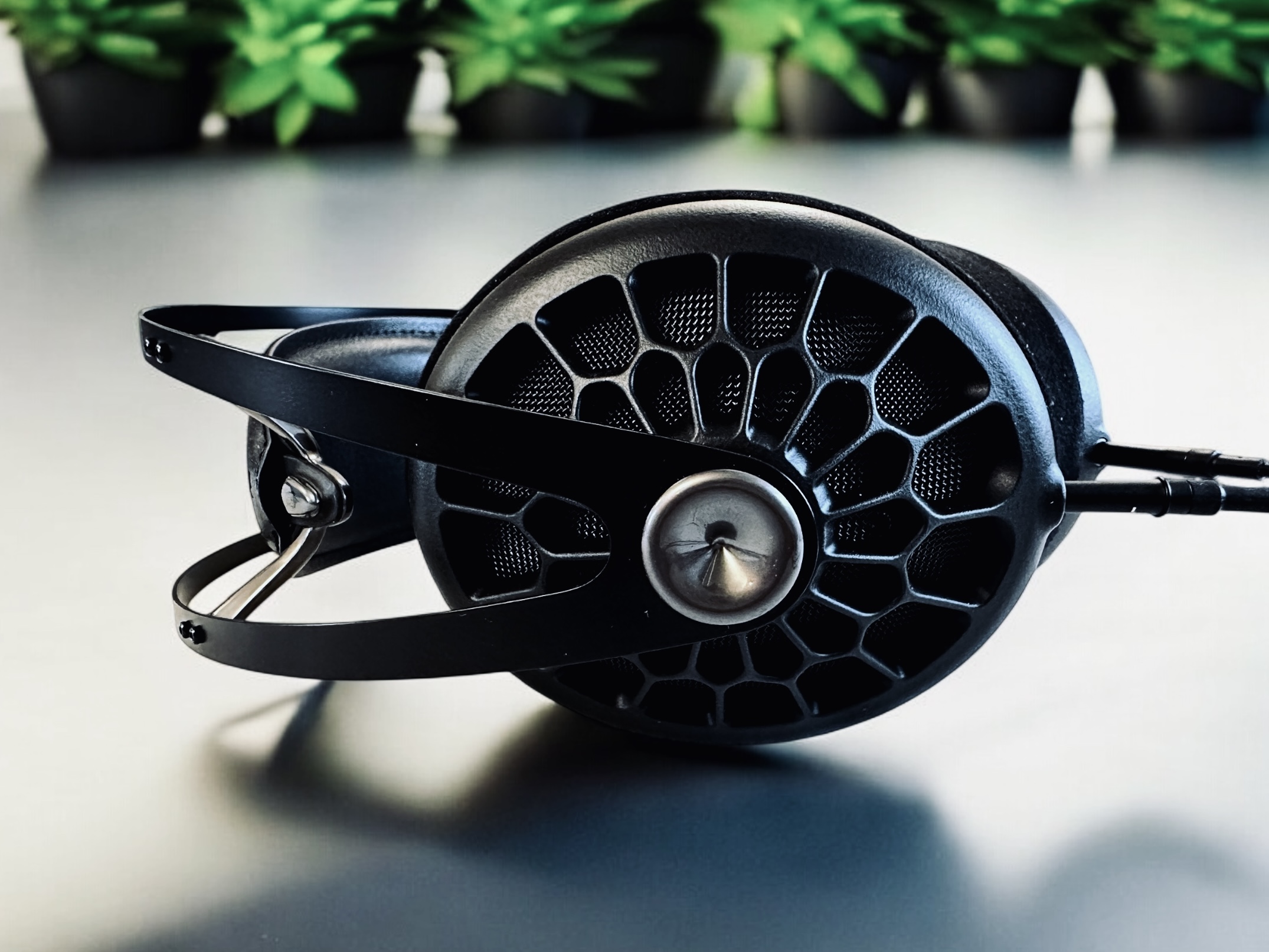
The 105 AER stands out with its minimalist and lightweight design. True to its name – AER – likely a nod to “air”, these headphones are a featherweight 250g, making them perfect for long listening sessions without fatigue. The headphone is crafted using premium materials – cast zinc alloy hardware with PVD coating, stamped manganese spring steel headband, ABS-PC ear cups, velour ear pads, and a soft PU leather headband, maintaining a premium feel while keeping the weight down. The self-adjusting headband wrapped in vegan leather ensures a snug yet comfortable fit, while the velour earpads are plush and breathable, ideal for extended wear. Visually, the 105 AER is a stunner, with a matte black finish accented by subtle metallic details. It feels modern yet timeless, much like other Meze offerings. The earcups swivel slightly to ensure a secure fit, though the clamping force might feel a tad light for those who prefer a firmer grip.
Sound Analysis.
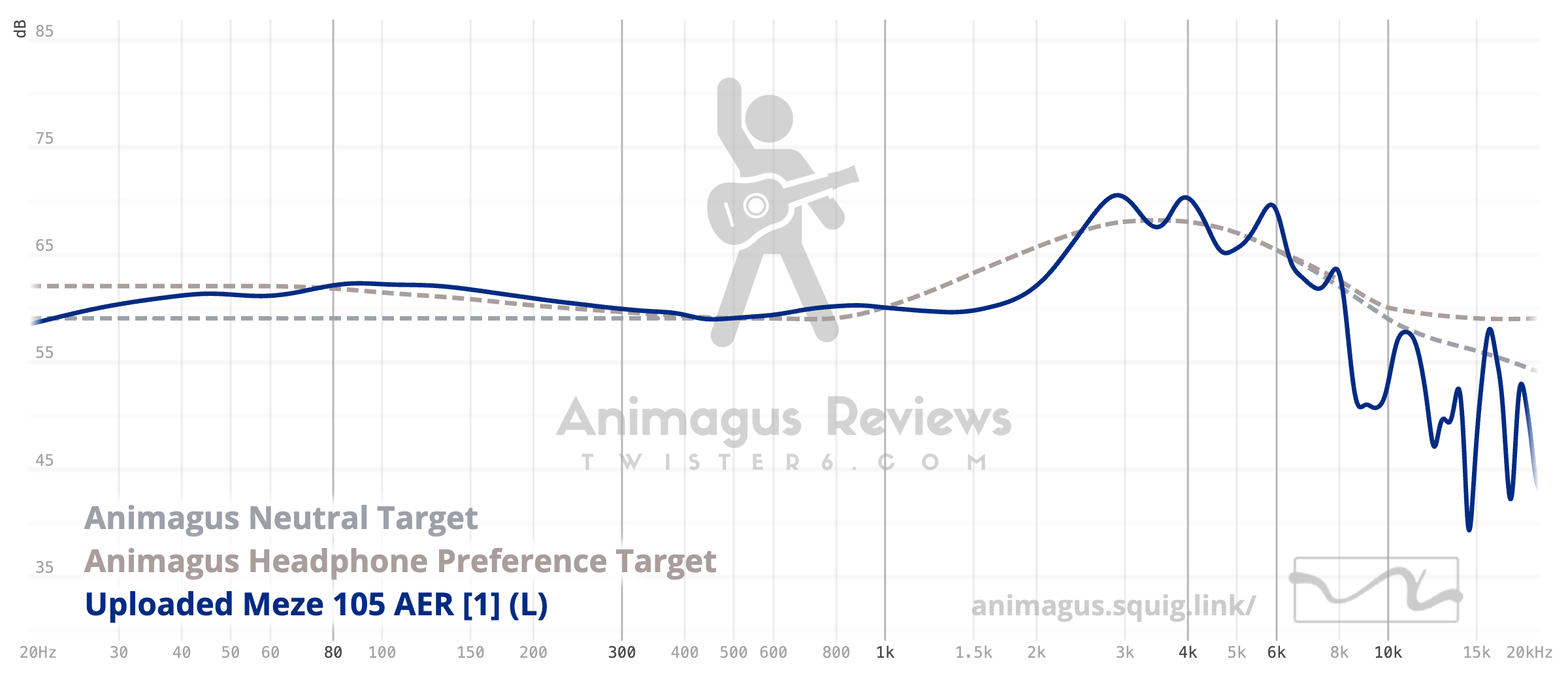
Graph borrowed from Mark’s (Super Review) database for illustrative purposes as I don’t own a headphone measurement setup. You can compare all headphones on his headphone measurement database here – Super Review Headphone Squiglink. All my IEM measurements can be found on my IEM Graph Database here – Animagus Squiglink.
The Meze 105 AER delivers a warm, balanced sound signature, emphasising natural tonality and musicality. This comes close to HD6XX series of headphones style of tuning with slightly better sub-bass extension, a bit more emphasis in the mid-bass region and slightly more lower-treble than HD6XX as well as neutral, with significantly better technical performance over the 3 blob soundstage of the HD6XX series headphones. The bass is tight, textured, and controlled, with a mid-bass focus with good extension down low in sub-bass, the mids are ‘almost’ reference like forward (with a slight dip around 1.5kHz) – offering a rich and quite natural sounding timbre that shines with vocals and acoustic instruments and the treble is smooth and non-fatiguing, providing sufficient detail without sharpness or harshness. This is an inviting, fatigue-free tuning that suits a variety of genres and excels in long listening sessions.
Let’s dig in deeper…

Bass – The 105 AER offers a bass response that is balanced and articulate. Sub-bass extension is respectable, providing a satisfying rumble when called for, though it stops short of being overwhelming. The mid-bass is where the 105 AER shines, delivering punchy yet controlled dynamics that work well across genres. Bass heads might find it a touch reserved, but for those who appreciate detail over sheer quantity, the 105 AER delivers with aplomb. I would’ve been okay with slightly lesser mid-bass but it’s just a nitpick.
Mids – The mids are a highlight, showcasing 105 AER ability to portray vocals and instruments with excellent warm and natural timbre. Male and female vocals come across with good clarity and warmth, while stringed instruments are rendered with lifelike texture. There’s good forwardness in the upper mids that adds reference like quality to the presentation without veering into harshness, making the 105 AER particularly enjoyable for acoustic, jazz, and vocal-centric tracks. My only complaint in the mids is the 1.5kHz wide band dip in the upper-midrange, which is quite like a lot of the HifiMan headphones, and takes some directivity away from imaging and as a result, the 105 AER away from an accurate reference-like ear gain and tonality. It does makes it a more easy to listen to the headphone at louder volumes but also smudges the precise localisation of each instrument a little. The 2.75kHz, 4kHz and 6kHz peaks do stray a bit above reference but don’t sound shouty because of the mid-bass boost adding in enough warmth.
Treble – The treble is smooth and yet detailed that ensures fatigue-free listening. While it doesn’t push the boundaries of airiness, the 105 AER’s treble is extended enough to retain a sense of sparkle and clarity. I personally would’ve like a bit more gain in upper-treble with it extending a bit more linearly from 8kHz till 20kHz but it is no slouch. High-frequency details are present but not reference like, making this a treble-tuning that’s easy on the ears but not without sacrificing resolution.
Technical performance – The soundstage of the 105 AER is moderately wide, offering more depth than width. While it doesn’t create a vast, out-of-head experience, the imaging is precise, with well-defined instrument placement. The layering is commendable, ensuring complex tracks don’t feel congested and this sounds like a significant upgrade over $200-300 Sennheiser HD6XX series of headphones.
Pairing & Synergy
The 105 AER has an impedance of 42Ω and a sensitivity of 112dB SPL/mW, making it an easy-to-drive headphone. It pairs well with portable devices, though it scales nicely with higher-quality sources. When tested with the Hiby R6 Pro 2 and iBasso DX240, the AER benefited from a clean FR and improved soundstage depth, enhancing its already musical character. Pairing with a neutral amp like the DROP THX AAA 789 Linear Amp as well as the Topping A90 drove it even better with the stage sounding a little expanded, keeping the presentation clean and balanced – something I particularly like.
Mono 3.5mm Copper PCUHD Premium Cable.
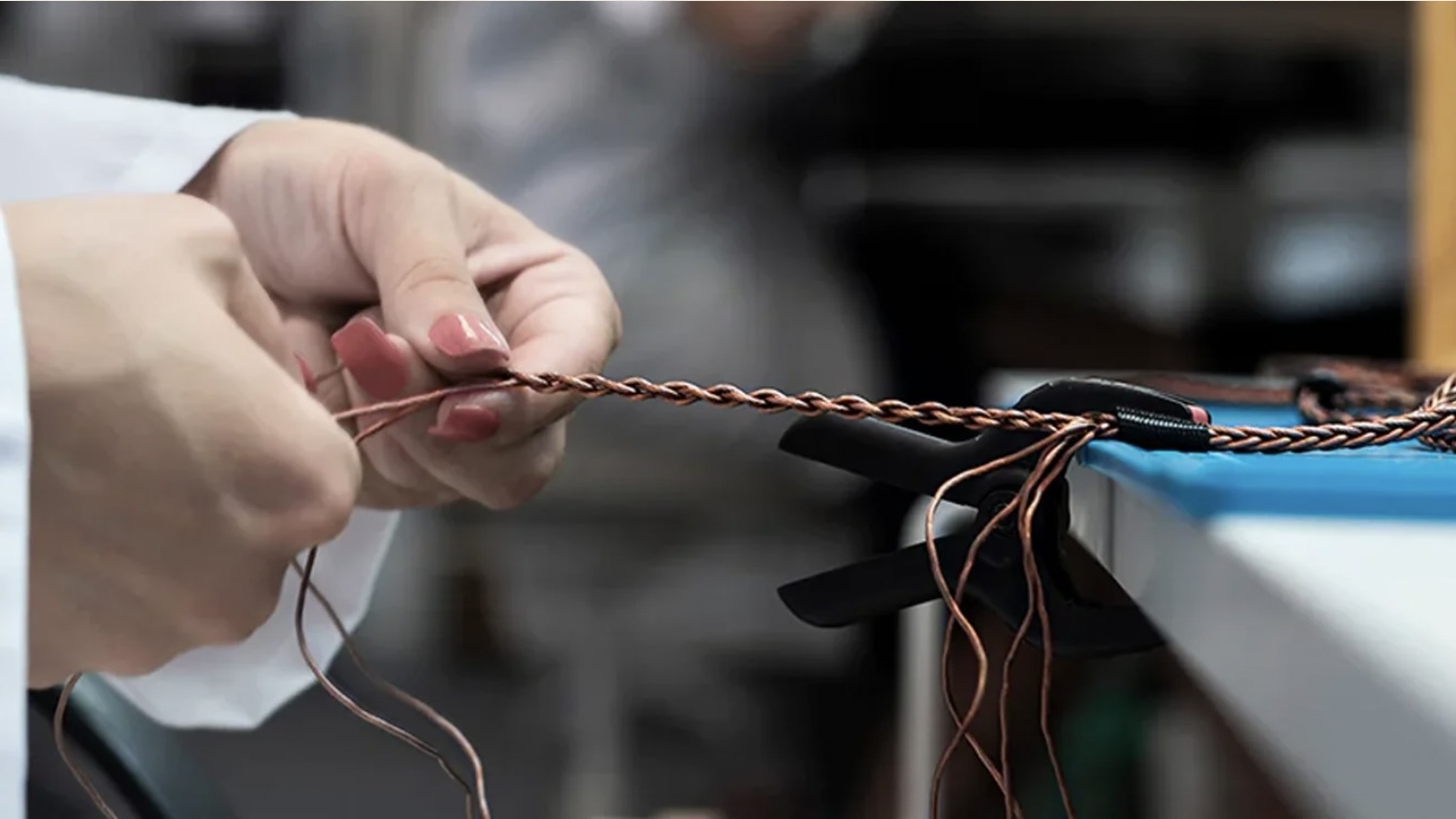
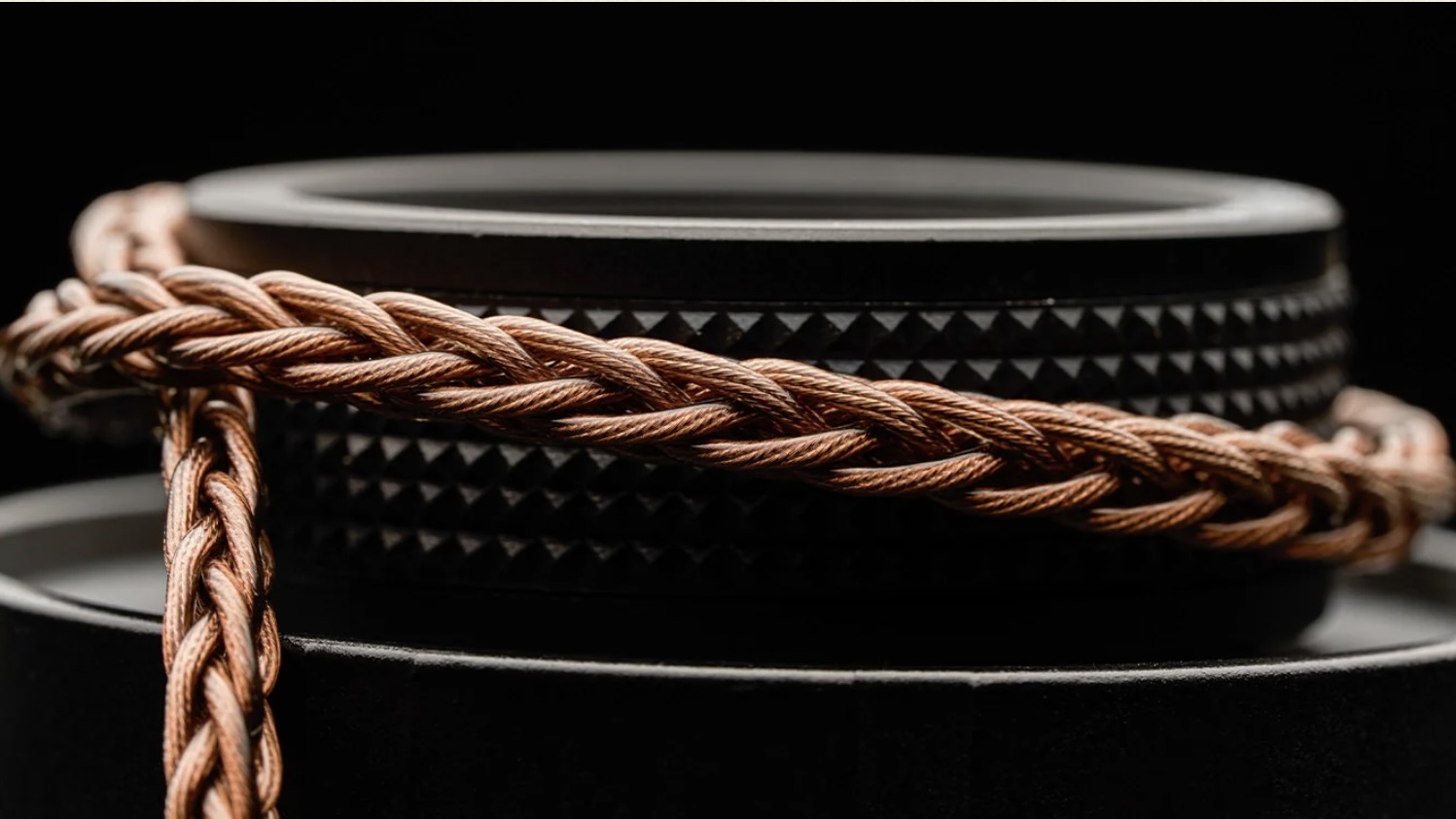
Meze’s Furukawa PUCHD balanced cable is hand-braided from scratch by them in Romania and is exceptional quality. Furukawa PCUHD copper offers increased flexibility and is highly resistant to damage. Featuring a proven twisted design, each cable is made of 140 conductors with 0.04mm in diameter, in an eight-wire to four-wire braid configuration. The components – 3.5mm connectors, y-split and 4.4mm balanced jack are very well built to last and the cable rolls up to a nice tiny roll because of being nicely supple.
Sound differences – Changing to the PUCHD cable from the stock cable does bring notable changes – but whether they justify the upgrade depends on what you’re looking for and the depth of your pocket because $249 for an extra cable for a $399 headphone is not cheap. The most immediate noticeable difference is in the background blackness and resolution. With the PUCHD cable, subtle details in recordings become slightly more pronounced, lending a greater sense of nuance, particularly in micro-dynamics. However, these changes are more about refinement than transformation – so those expecting a drastic overhaul might find the improvements incremental rather than night and day.
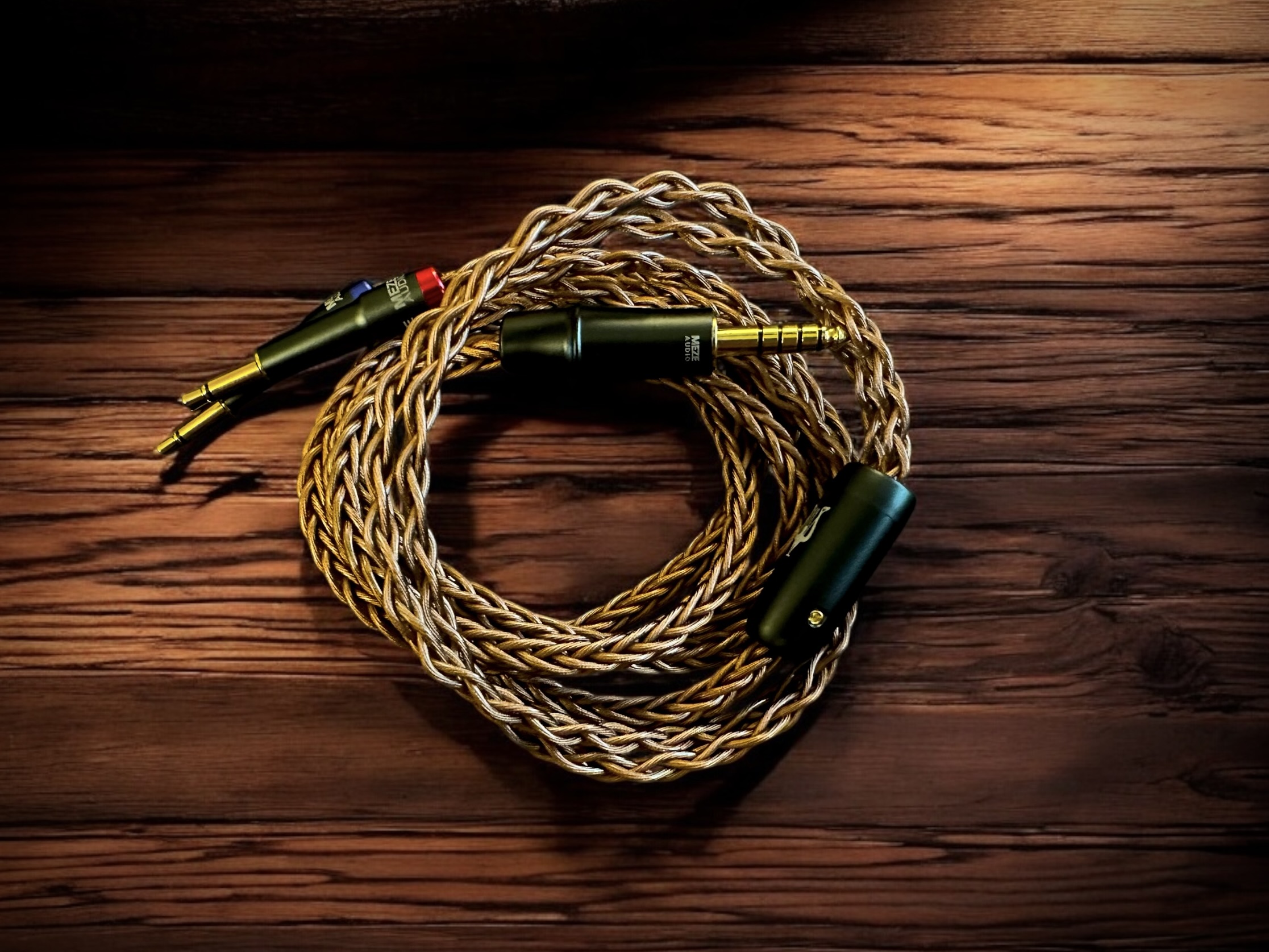
Bass tightens up slightly, especially in the sub-bass region, but the overall tonality remains the same. The low end doesn’t gain extra weight but does feel a touch more controlled, which benefits genres that rely on precision rather than sheer impact. If you’re after a bass boost, this cable won’t deliver that, but it does improve texture. The midrange clarity is where the most noticeable benefit lies. Instruments and vocals gain a bit more separation, and the overall presentation feels a shade more transparent. Treble response shows a slight improvement in smoothness and extension, however, those who prefer a more energetic treble presence might feel the difference is more about refinement than added sparkle. Perhaps the most appreciable upgrade is in soundstage and imaging. The PUCHD cable widens the stereo field slightly and adds a bit more depth, making instrument placement more precise. The effect is subtle but noticeable in well-recorded tracks with complex layering.

Final Thoughts – The PUCHD balanced cable does enhance aspects of the Meze 105 AER’s performance, particularly in soundstage, resolution, and refinement. However, the changes lean towards subtle improvements rather than a fundamental shift. If you’re seeking more precision and a slightly blacker background, it’s a worthy upgrade. But for those expecting a dramatic transformation, the differences might not be as pronounced as expected – as it is with most cable upgrades. So you always need to ask yourself if squeezing out the last 5-10% performance justifies spending the asking price of a particular cable. If yes, then this Furukawa PUCHD cable from Meze is wonderful! The balanced connection over the stock 3.5mm SE cable of course gives you the ability to use the 105 AER with powerful DAPs and balanced amps but if you have a much lower budget for a balanced cable, there are quite a lot of options available in the market that will help you get on to using the balanced outputs without spending a bomb on the premium cables.
Comparisons
Meze 109 Pro.
Both headphones are premium and lightweight, but the 105 AER edges ahead in portability due to its smaller size and lighter construction. The 109 Pro has a more energetic and dynamic tuning, with greater emphasis on top end sparkle and sizzle. The 105 AER feels warmer than neutral while the 109 Pro slightly more V-shaped in comparison, with tighter bass and slightly less emphasis on low-end impact. The 109 Pro’s midrange is a touch leaner, while the 105 AER adds a layer of sweetness to vocals and instruments. While the 105 AER delivers a more impactful bass, the 109 Pro’s bass is tighter, faster, and more controlled, making it better suited for genres like jazz and classical. The 109 Pro focuses on clarity and neutrality in the mids, while the 105 AER emphasises lushness and warmth, excelling with emotional vocal performances. 109 Pro has much more sizzle and air, creating a sense of airiness and openness but also comes off significantly brighter and sizzlier that requires a slight adaptation period. The 105 AER’s treble is more forgiving, ideal for long sessions, especially with less-than-perfect recordings. The 109 Pro offers a wider and deeper soundstage, giving a more grandiose, out-of-head experience. The 105 AER has a slightly intimate presentation in comparison, with excellent depth but less overall width. The 109 Pro shines with cinematic, orchestral, and vocal-rich tracks. The 105 AER is a better all-rounder, particularly for mobile or casual listening.
Ollo S5X.
Both are lightweight and comfortable, but the 105 AER’s plush earpads and self-adjusting headband make it better for long-term casual use, while the S5X is more utilitarian in design. The Ollo S5X is tuned for studio reference use, offering a flat, neutral signature that priorities accuracy over musicality. The 105 AER is more engaging and coloured, with a warmer tilt in the bass and a slightly livelier midrange. The S5X provides a lean and precise bass response with minimal coloration. The 105 AER, while not bass-heavy, offers more body and texture, making it more versatile for casual listening. S5X’s mids are clean and uncoloured, ideal for critical listening and mixing. 105 AER adds more richness and warmth, making vocals and instruments sound more engaging but slightly less neutral. S5X extends further in the treble, offering more air and sparkle, which can be beneficial in a studio environment. The 105 AER has a smoother treble, making it more forgiving for non-audiophile-grade recordings. S5X presents a more accurate and neutral stage, designed for precise imaging. The 105 AER offers a more immersive and layered sound, prioritizing musicality over technicality.
Recommendation – Choose the S5X for studio work and critical listening. The 105 AER is better for everyday use and enjoying music with a touch of warmth and character.
Sendy Audio Aiva.
Both headphones are well-built, but the 105 AER’s lighter weight and superior ergonomics make it more comfortable for extended wear. The Aiva’s planar drivers add heft, which may lead to fatigue over time. Aiva is known for its V-shaped tuning, with a focus on punchy bass and sparkling treble. The 105 AER, by contrast, leans toward a balanced and slightly mid-centric tuning, offering a more relaxed and natural sound.cAiva provides a more pronounced sub-bass and mid-bass impact, making it better suited for electronic and bass-heavy genres. The 105 AER’s bass is more reserved, focusing on speed and texture over quantity. The 105 AER has fuller and more natural mids, bringing vocals and acoustic instruments to life. The Aiva’s mids are recessed in comparison, taking a backseat to its bass and treble. Aiva’s treble is brighter and more extended, offering a crisp, energetic sound. The 105 AER opts for a smoother and less fatiguing treble, appealing to those sensitive to high frequencies. Aiva creates a slightly wider and more spacious soundstage, but the 105 AER excels in depth and layering, offering a more cohesive presentation.
Recommendation – The Aiva is ideal for energetic and bass-driven genres. The 105 AER suits a broader range of music, especially rock, acoustic, jazz, and classical.
Hifiman Sundara.
105 AER’s lighter build and plush earpads are a clear advantage over the Sundara, which doesn’t feel as premium or secure on the head. There is absolutely no competition when it comes to build and looks as 105 AER is several leagues above in premium looks and feel. Sundara almost feels cheap in front of it. The Sundara offers a more neutral-bright tuning with excellent detail retrieval and airy treble. The 105 AER, is more warm-neutral, leans warmer and is more mid-centric, with a more forgiving treble. Sundara’s bass is tight and linear, with less mid-bass emphasis. The 105 AER adds more warmth and body, making its bass feel more engaging but less neutral. The Sundara’s mids are clean and accurate but slightly lean, especially with male vocals. The 105 AER’s mids are fuller and more intimate, giving vocals and instruments a richer tonality. Sundara’s treble is brighter and more extended, offering greater air and sparkle. The 105 AER’s treble is smoother and more forgiving, making it less fatiguing over long listening sessions. Sundara delivers a wider soundstage with better instrument separation, while the 105 AER focuses more on depth and cohesive imaging.
Recommendation – Sundara is better for those seeking clinical detail and a spacious presentation. The 105 AER is more versatile and comfortable for casual listening, with a warmer and more inviting signature.
Conclusion
The Meze 105 AER is a testament that Meze Audio has been hard at work wanting to provide their exceptional and characteristic build, design and sonic performance along with portability at a price point which they couldn’t do with their previous TOTL models. Its lightweight build and very well done warm-musical tuning make it a good choice for listeners who value comfort and musicality over aggressive technical performance. While it doesn’t aim to compete with flagship headphones in sheer resolution or soundstage, the 105 AER carves out a niche as a versatile, everyday companion that delivers an engaging and fatigue-free listening experience – something that can be a great product for almost everyone. With a modular design and build specifically for easy repairability if ever needed, the value for money proposition is excellent. For those seeking a very well made, premium headphone with Meze’s signature touch, the 105 AER is a strong contender that doesn’t disappoint and I’m happy to say that this would be one of my default recommendations under $500 as a versatile headphone for every day use.
Gear used for testing and review.
- Desktop setup – Universal Audio Apollo X4 + DROP THX AAA 789 Amp
- DAPs – iBasso DX300 | iBasso DX260
- Phone – Apple iPhone 14PM + iBasso DC06 Pro/Tanchjim Space
Artists I like and listen to.
- Rock – Foo Fighters, Linkin Park, Switchfoot, Imagine Dragons, Daughtry, Green Day, MuteMath, X Ambassadors, Dave Matthews Band, Vertical Horizon, Our Lady Peace, Lifehouse, Fall Out Boy, Breaking Benjamin, Muse, ACDC, Audioslave, Rage Against the Machine, Biffy Clyro, I Am Giant, Normandie, Paramore, Slash & Guns N Roses, 3 Doors Down.
- Pop Rock – John Mayer, Coldplay, Paul McCartney, James Bay, Hunter Hayes, Niall Horan, Keith Urban, The Bros Landreth, Bryan Adams.
- Progressive Rock/Metal – Porcupine Tree/Steven Wilson, Karnivool, Tool, Dead Letter Circus, Periphery, Lamb of God.
- Pop/Soft Rock – Ed Sheeran, Adele, Taylor Swift, OneRepublic, The Script, Gavin James, Magic Man, Maroon 5, Bruno Mars, Charlie Puth, Dua Lipa, The Weeknd, Oasis, Panic! At the Disco, TwentyOne Pilots.
- EDM – Chainsmokers, Zedd.

 Twister6 Reviews