
Eletech
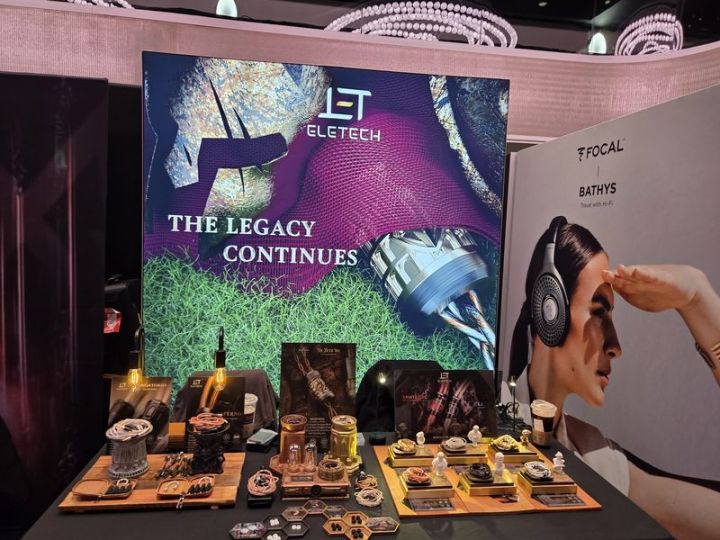
As always, the Eletech booth display presentation is hard to miss at any CanJam. It captures your attention regardless of whether you are a cable believer or not, with some stopping by just to admire it. Not just the cables, but also their highly regarded Baroque eartips bring people to the booth. Of course, it is always a pleasure to talk to Eric, one of the main guys behind Eletech, to catch up with the latest developments, prototypes, and audiophile gossip around the world. Just like myself, Eric hasn’t missed a single CanJam NYC show yet.
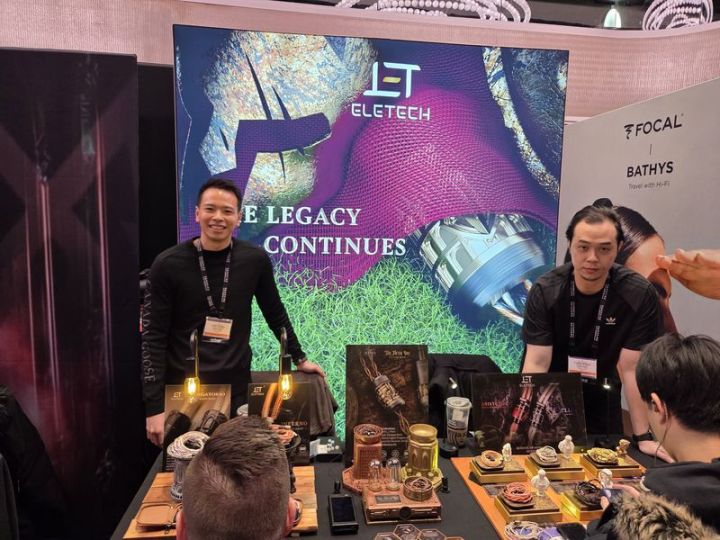
One of the highlights at the Eletech table was their latest popular thicker 18AWG wire releases, Aristotle (copper) and Euclid (silver/gold) in addition to their limited-edition 5th anniversary The Fifth Ode cable. I have reviewed Aristotle and Euclid last year, and to recap:
Aristotle is a unique copper cable that adds more rumble to the sub-bass and tightens the mid-bass, cleans up mids with more transparency (less coloring) and some improvement in layering and separation of the sounds, and gives treble more airiness which improves the resolution. This cable has a very distinct sound characteristic with a slightly U-shaped tuning, giving more emphasis to the bass and more air/sparkle to the treble, while keeping the mids clean and clear. It also keeps the soundstage wide/expanded.
In contrast, Euclid cable adds a bit of rumble to the sub-bass, but not as much as with Ari. Also, gives mids a smoother and more analog organic tonality, noticeable in vocals and instruments with additional warmth without any muddiness or reduction in the retrieval of details. Plus, it gives the treble a little more crunch and airiness, more crunch than Ari. This cable also has a distinct sound characteristic with warmer and smoother mids and more crunch in treble. The combination of changes in mids and treble gives the sound a more resolving natural tonality with improved resolution and no harshness. The effect of the lusher tonality of mids gives the sound a more center-focused and slightly out-of-your-head soundstage expansion.
To commemorate Eletech’s 5th Anniversary, Eric and his team came up with an exclusive limited release of The Fifth Ode (TFO) cable. While the original Ode to Laura (OTL) used 3 different premium OCC copper materials, the TFO release uses a triple bespoke premium blend of OCC Copper, Gold-Plated Copper, and Graphene OCC. With four 22 AWG gauge wires, Kevlar infused, cryogenically treated, and EMF shielded, the cable also features their FlexiMax insulation, keeping wires relatively supple and microphonic free. As expected, The Fifth Ode stands out with a new customized Y-Split and Plug eye-candy design!
Between OTL and TFO, I hear a similar bass enhancement with more speed and articulation, while everything else has been scaled up. Starting with the soundstage and imaging, both have a very wide soundstage expansion, but while OTL has an improvement of 3D imaging depth, TFO also improves the imaging width. It is a very noticeable change in imaging of the sound that becomes holographic in width/depth relative to the placement of the sounds in space. The mids of TFO still have a natural analog texture similar to OTL, but the tonality of TFO mids is more revealing, being a bit less warm in comparison to OTL. The treble of OTL also has a touch more sparkle and airiness. Another thing that I noticed was a blacker background which could be the result of EMF shielding introduced in TFO.
While I was already familiar with the above cables, what got my attention at the table was Eletech’s new prototype with a temp name of “Evo”, being a part of the Evolution as a successor to Illiad and Aeneid from the Parnassus Series. I don’t know the final name, or the wire materials used in this fine cable, but after testing it, I found this to be a warmer-tuned cable while still offering lots of natural clarity. Eric mentioned that this cable will use exotic materials, which, in my book, usually spells out brighter or more revealing tonality. But to my surprise, the cable sounded warmer and smoother with plenty of resolution.


Forte Ears
A 2024 newcomer who ended up being “crowned” with the Watercooler award was Forte Ears Macbeth. The company was founded by Riccardo Yeh, a former International Sales Director at HIFIMAN, who later assumed the marketing position at Eletech, and then decided to put his love for Western opera and his passion for the emotional impact of music into his own IEM brand and his debut model. This IEM debuted as a “Romeo” prototype at last year’s CanJam NYC and became one of the big releases of 2024, which gained quite a following and, as already mentioned, received the Watercooler award at this year’s CanJam show.

Macbeth has a balanced sound signature with a clear detailed tonality, enhanced (deeper rumble) bass, natural, detailed mids, crystal-clear treble, a big open soundstage with holographic imaging, a very artistic and beautiful faceplate design, and came bundled with a brand name Eletech copper cable in an opera-inspired premium packaging. The tribrid design of Macbeth features 5 BA covering lows, mids, and highs, 2 Bone Conduction BCD drivers focusing specifically on mids and upper mids, and 4 Electrostatic ESTs covering super-highs.


The Macbeth featured an exclusive “Diablo” customized bass driver (from Sonion), but some of the purists who prefer DD bass drivers have been asking Riccardo to consider beefing up the bass in his next Forte Ears release. Their prayers have been answered with the prototype “Faust” at the show, Forte Ears’ next release. I had the pleasure of listening to the Faust (btw, not the actual product name, just a placeholder) and found it to have a big, expanded soundstage with holographic imaging. It has a deep punchy bass, tastefully elevated without overpowering the mids. Lower mids are neutral, just a touch of body, upper mids are clear, detailed, and a bit more forward, treble is clear, crisp, and non-fatigued. Relative to MB, bass is more elevated, more physical, definitely DD quality, and the upper mids have a bit more clarity as well with treble having more sparkle, but there was no harshness to my ears.


DUNU
Dunu table was busy as usual, and they were still featuring the latest Glacier tribrid with DD/4BA/4EST driver config as their current flagship. I covered these IEMs in my CanJam report last year, a very solid build shell using stainless steel with a mirror-finished surface. They do have some nice heft to them and were sitting comfy in my ears using large-size Azla Crystal eartips I had on hand. I hear them having a very big holographic soundstage expansion and imaging, a deep powerful bass, neutral, thinner lower mids, clear revealing micro-detailed upper mids, and crystal-clear treble. Overall, I found Glacier to have a rather revealing U-shaped sound tuning with a big powerful bass and brighter treble.

Another product highlight at the table was Dunu’s latest flagship planar headphones, Arashi, featuring a wrinkle-resistant large-size multi-layer composite diaphragm with a lightweight patented voice coil and high-efficiency dual-sided magnetic circuit matrix. While they were 500g in weight, they felt very comfortable on my head with a balanced distribution of the weight. I had P6 Pro with me to audition them, which in theory should be sufficient for 97dB/26ohm cans. The sound was very open and dynamic, felt like I was inside of the music with the sound surrounding me all around. These have zero isolation, felt like I wasn’t wearing them since I could hear every sound nuance around me while the music was idling. I found the tuning to be more mid-forward, with a rather neutral bass, thinner lower mids, revealing forward upper mids, and a bit spicy treble. Maybe it needs a more powerful high-current desktop source to drive them or maybe it just needs more coloring.



Moondrop
Of course, I’m familiar with the Moondrop brand name, but I don’t have as much experience with their products. I don’t recall them having a dedicated booth in the past NYC CanJams, though they could have been represented by some of their distributors. The first IEM that caught my attention at the table was their latest flagship Meteor. After visiting their website, I saw a $2.4k Psyche which I assume should be considered as their flagship, but it wasn’t mentioned or displayed at the show, and the rep pointed to Meteor as their current $549 Tribrid flagship with an interesting driver config of DD (13mm) covering lows, 2BAs covering mids, and 4x miniature planar drivers covering highs. According to Moondrop, this particular IEM has a new XTM frequency crossover tech to accommodate all 7 drivers under the hood.


I found Moondrop Meteor to have a big, expanded soundstage, with a bit of center-focused imaging, a natural warmer-tuned balanced tonality, and a decent level of detail retrieval with an overall slightly laid-back presentation of the sound. It has a deep sub-bass rumble and a punchy mid-bass with a nicely balanced non-overwhelming low-end. Mids sounded natural, and organic, with a fuller body and a great retrieval of details, and the treble was also clear and detailed. I enjoyed its punchy bass and natural, detailed, balanced tuning.


Moondrop Dusk is another well-known tribrid IEM model with dual DD, 2xBAs, and 2x planar drivers under a three-way frequency crossover. While waiting to hear it, a few people stopped by and asked about the “DSP cable” for Dusk. As I learned later, this IEM comes with 2 cables, one is a standard 3.5mm SE terminated and another one is USB-C with 5 different tunings and a customizable PEQ via Moondrop Link 2.0 app. If I’m not mistaken, this cable could be used with other Moondrop IEMs with custom EQ settings.
I tested the Dusk with its default non-DSP cable, actually had to borrow a Meteor 4.4mm cable, and found its tuning to have a wide soundstage, though there was more depth/height than width and a bit more center-focused imaging. The bass was deep and punchy, mids were less colored, more neutral, natural, and transparent, which helped with the retrieval of the details. The treble had a nice natural sparkle. Dusk was less colored than Meteor.

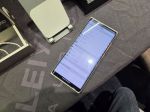
While at their booth, I noticed a smartphone which I assumed at first someone left at the table, until I realized it was Moondrop’s own MIAD01 smartphone model. As a smartphone, for $459, it featured a complete spec with a 6.7” AMOLED hi-res display, 12GB DDR4 RAM, 256G ROM, and microSD support of up to 2TB (a smartphone with microSD card, which is very rare nowadays), 5000mAh battery, front/rear cameras. It uses MediaTek MTKD7050 SoC, comes with a dedicated Dual Cirrus Logic MasterHiFi series DACs (the DAC model wasn’t specified), and both 3.5mm and 4.4mm headphone jacks.
MIAD01 smartphone is very lightweight, the OS is responsive and snappy, and from listening to a few of the preloaded songs, the sound was a bit more on the revealing, brighter side. But I didn’t have a chance to play with settings and wasn’t 100% sure if I needed to reset anything to a default sound. Overall, if you think about it, this is a $450 Android DAP, but unlike other WiFi-only DAPs, you have access to GSM, WCDMA, LTE, or 5G networks (depending on the model) with a sim card to be independent of wifi and to be able to stream your music on the go like from any other regular smartphone. Here, you are combining a fully functional smartphone and Android DAP in one device.

Tanchjim
Another debut at CanJam NYC, or at least the first time I have seen their dedicated booth at the show, was by the Tanchjim. I wasn’t too familiar with their products either, so I decided to start with their two top models as recommended by the rep.
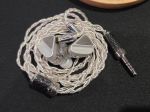
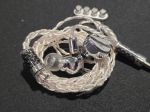
Tanchjim Force has a 2DD design, with the price not being finalized yet, though I have been told it will be higher than their $260 Origin and lower than $300. This particular release was done in collaboration with Effect Audio using their silver cable (or maybe they meant a silver-plated cable considering the price of the IEM). After listening to Dusk, the Force reminded me of its tuning at a cheaper price. I heard a big, expanded soundstage with holographic imaging. The tuning is W-shaped balanced, maybe even leaning more toward the U-shaped, and the overall sound is fast, articulate, and punchy. Here you have a punchy mid-bass with a nice sub-bass rumble, mids are neutral, clear, and detailed, and the treble is crisp but in a natural way. There is not as much body to the sound, one of the reasons I thought the sound sig was leaning more toward the U-shaped, but the overall tuning wasn’t too bright or harsh either.
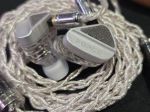
Tanchjim Origin was another IEM model at their table I was suggested to take a listen. This single 10mm DD IEMs in a stainless-steel shell with 3 replaceable nozzle filters (corresponding to standard, dynamic, and light modes) were compact and had a durable build. The tuning was more U-shaped, brighter than their Force IEMs, especially up top, with a big open soundstage and nearly 3D imaging. It also had a deep punchy bass, thinner lower mids, more revealing brighter upper mids, and a crisp airy treble. It was a bit too revealing for my taste, but still a pretty good tuning. I believe it will be available in a special Origin ASANO-TACH edition as well.


Page 1 – Intro and Overview of the Showroom.
Page 2 – Effect Audio/Elysian Acoustics, Empire Ears, Azla.
Page 3 – Bloom Audio, Campfire Audio, 64audio, ddHiFi, Lunch Break.
Page 4 – Eletech, Forte Ears, Dunu, Moondrop, Tanchjim.
Page 5 – Noble, Shanling, Audio-Technica, DITA, Kotori Audio.
Page 6 – Musicteck (UM, Softears, qdc, FlipEars, Alpha Omega, Epic Audio, and more).
Page 7 – Final thoughts.

 Twister6 Reviews