
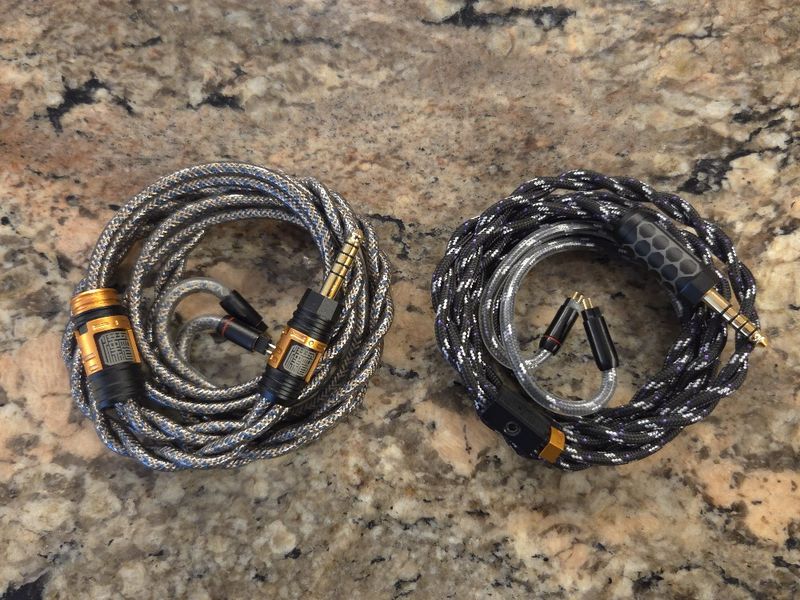
BONUS: HanSound Quentin
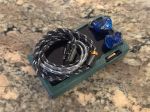
While being their “entry” level copper cable, it doesn’t mean HanSound cut corners in the design and manufacturing of this cable. Perhaps the packaging is more basic, with just a small compact storage box and leather organizer strap. Don’t expect to find a free interconnect cable here either. But the design is as complex. It uses a coaxial structure of multi-strand and multi-sized Litz Type 4 with Pure Copper OCC conductors and high conductivity graphene yarn shielding for better noise isolation. Per the HanSound description, the positive electrodes were made by applying two thicker conductors and using DuPont Hytrel Elastomer insulation, while the negative electrodes use a thinner superfine conductor that wraps around the positive electrode, all part of the coaxial structure.
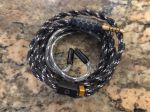
The cable uses 2 wires, each one with a coax structure as described above and 21AWG in gauge, sheathed in a black braided fabric with 3-dot silver and 1-dot purple accent. Wires are twisted, going down to a custom housing of a 4.4mm BAL plug. In the other direction, they go up through a matching compact black metal Y-split (the same graphics design as the plug housing) and retractable copper finish chin-slider. The connector housing is compact as well, right side marked with a red circle, and the connector itself is fixed at 2pin.
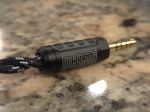

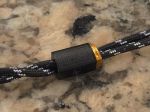
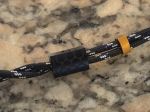
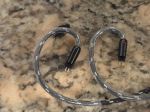
Comparisons.
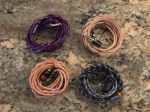
In this comparison, I was using Aroma Jewel and P6 Pro. Worth noting that the other 3 copper cables have thicker wires, while Quetin is softer and more pliable by design.
Quentin vs EA C24C – I hear the imaging to be more 3D, while soundstage remains the same. Going to Quentin brings the mids more forward, gives extra clarity, and improves layering/separation of the sounds. Between these two cables, bass enhancement is nearly the same, adding more weight to sub-bass rumble and having a similar mid-bass punch. The treble perception with Quentin has a more revealing airy effect, but that could be due to the mids being more forward. The biggest and most noticeable change here is in the mids with Quentin bringing them more forward, giving them more clarity, improving resolution, and expanding the imaging to a 3D level. Both have a modular connector system, and C24C also adds a modular plug.
Quentin vs Eletech Aristotle – similar to C24C comparison, Quentin brings mids more forward, adding extra clarity, improvement in retrieval of details, making vocals more revealing, while Ari pulls mids back, colors them with more warmth, making them smoother with a laidback presentation. Besides resolving and revealing mids, Quentin also has more treble sparkle, which could be the result of the changes in mids. And similar to the C24C change, I found Quentin to have a more 3D imaging of mids in comparison to Ari. Worth mentioning, both cables have a modular connector system to accommodate different IEMs.
Quentin vs PlusSound Copper XL – I hear a very similar soundstage expansion and imaging, especially 3D imaging of mids with Jewel. The bass is very similar as well, the same sub-bass rumble and the weight of the mid-bass punch. The mid-bass with Quentin has a bit shorter decay, giving them more control, but that could be due to changes related to mids. Unlike C24C and Ari, Copper XL has a similar, more forward presentation of mids like with Quentin. But unlike Quentin, with Copper XL the mids are warmer and smoother, while with Quentin mids are more resolving, more transparent (less warmth/coloring), and more layered and separated. Also, Quentin adds more non-fatigue treble sparkle.
Conclusion with Sound Analysis.
I was glad I got a chance to rediscover HanSound Audio cables, and to see they are still going strong with new original releases. It was also very impressive to see how much effort they put into their latest releases, flagship or not. Especially with Kunpeng, everything from the design of the wires and custom hardware to the packaging and a complete set of premium accessories, including a matching interconnect cable. It’s a beautiful cable, and many audiophiles will enjoy it not only for its aesthetic appeal with eye-candy design, but also for its sound performance.
You do have to be realistic since everything will depend on the pair-up synergy and cable’s finetuning of the baseline signature of the IEMs. As I always say, there is no magic “EQ” silver bullet or fairy dust behind the cable. If you are not happy with the sound of your IEMs, get another pair of monitors with a different sound signature. Nevertheless, based on the unique sound characteristics of Kunpeng, in many pair-ups I tried, it enhanced the black background of the sound, made mid-bass faster, stronger, tighter, punchier, and brought mids more forward while enhancing the resolution of the sound with improved retrieval of details.
Repeating myself, it is not always about finding which cable is better, but rather finding which cable is going to pair up better with your IEMs. Especially when dealing with L-shaped or U-shaped tuned IEMs, it’s a bit tricky with cable rolling because sometimes you have to accept compromises when trying to make the sound more balanced. Kunpeng didn’t just bring the mids forward, and made them less colored and more detailed, it also enhanced the bass punch to make sure the low end doesn’t lose its power and presence. These unique sound characteristics could enhance the performance of many popular IEMs.
Quentin also has a distinct sound characteristic with bass enhancement typical of many other copper cables, but unlike other copper cables, where typically bass and treble are affected, Quentin also brings forward the mids and improves their resolution, layering, and retrieval of details. Kunpeng exceeds it with a blacker background, more transparency in mids, making it even less colored, more resolving, with more air between the layers of the sounds. Kunpeng also makes the bass notes more tactile, faster, and tighter. Of course, you have to keep in mind that changes will vary depending on the pair-up.
I’m sure the question will come up, if Kunpeng is worth 4x the price of Quentin. As many are aware, you have to remember the law of diminishing returns as you go up in pricing, though you also have to consider the cost of a material, using Copper Litz wires vs a combination of Pure Silver, Gold-Silver Alloy, and Palladium-Plated Silver. You wouldn’t expect to go to a store and pay for your wife’s or gf’s jewelry the same for either a copper or precious metal necklace. Plus, Kunpeng comes with a premium leather case and organizer and a bonus free interconnect cable. Overall, I was impressed with both of these products.

 Twister6 Reviews
Hi, II was thinking in get the Quentin, but I was all in because I thought that ads colour and warmth. Would you recommend for those characteristics better the Aristotle or Raphael?
Thank you. Big fan of your reviews, btw!
LikeLike
Quentin is great, but not exactly a “warm” cable, so if you want more coloring and warmth, Ari or Raphael would be the way to go. Ari will add more sparkle in treble while Raphael will be smoother up top. Sounds like you want more warmth, so go with Raphael
LikeLiked by 1 person