
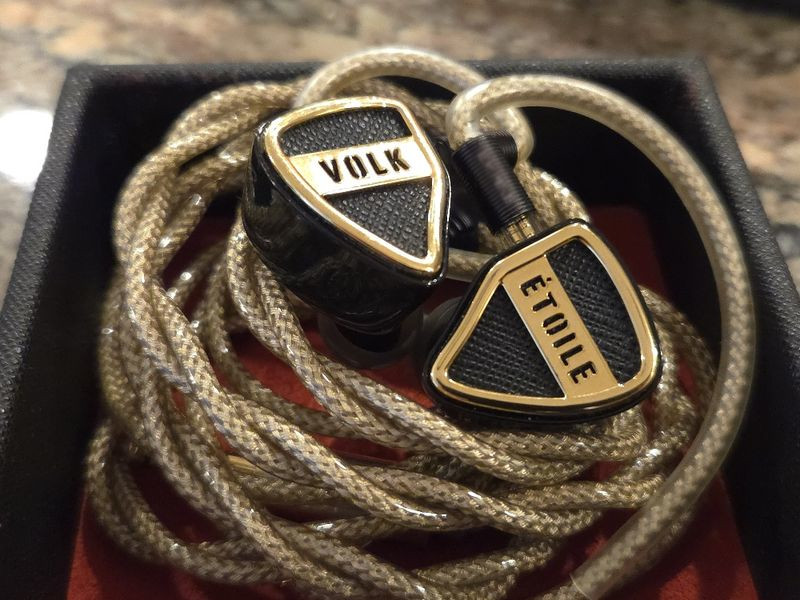
A Volkome addition to the pool of flagship IEMs.
Disclaimer: I received the product on a short loan for review purposes in exchange for my honest first impressions.
Available for pre-order on Musicteck.
Intro.
For anyone familiar with Head-Fi, CanJam Shows, or who considers themselves a portable gear audiophile, you will know exactly who Jack is. And if you don’t, then you don’t know jack! He has been the face of Empire Ears, which evolved from EarWerkz, for a long time. However, in the future, I will need to be more specific when referring to Jack’s IEMs. Why? Two months ago, just before CanJam NYC, he surprised me by sharing that he is branching out and embarking on a new journey to start his own company, Volk Audio. Co-developed with Michael Graves, a five-time GRAMMY Award-winning sound engineer from Osiris Studios in Los Angeles, Jack and Michael decided to create a new set of IEMs, Etoile, designed as near-field reference monitors tuned to mirror the mastering environment of a sound recording studio.
During the CanJam NYC show, I had the opportunity to hear the final tuning of the Etoile prototype, although I wasn’t allowed to share my impressions publicly. Then, once the cat was out of the bag right before CanJam SGP, I was excited to read people’s thoughts from the show. A week later, after the show, Jack pinged me to ask if I wanted to hear the final Etoile for a day, yes, literally for a day. I received these IEMs on Friday afternoon and had them packed and shipped back on Saturday morning. Below are my impressions based on a brief 2-3 hour listening session, where I also took FR measurements and captured a handful of pictures of this debut IEM release from Jack’s Volk Audio.
Unboxing, Accessories, and the Design.
I can’t describe the unboxing experience yet since I haven’t seen the complete production packaging. However, based on my previous experiences with EE releases, I’m confident it will not disappoint. Etoile arrived in a handcrafted square storage box, wrapped in Italian-sourced midnight Saffiano leather with Royal Red Alcantara lining. This presentation is quite luxurious, especially with the contrast of red lining that makes the IEMs stand out when you lift the cover. Along with Etoile and its cable, two sets of eartips were included: silicone (S/M/L) and Symbio F orange foamies (S/M/L). The Symbio F eartips are always a welcome addition, as they create a custom-like seal with greater transparency without excessive high-frequency absorption.

The included cable had final design wires, although the hardware was temporary. The wires feature five different materials: Solid Core 5N OCC Silver, Solid Core 4N Silver, Silver-Plated over 6N OCC Copper, Gold-Plated over 4N Silver, and Palladium-Plated over 4N Silver. The final hardware will utilize CNC-machined 6061-T6 aluminum in an anodized black finish, with 24k gold-plated accents on the Y-split and 4.4mm housing barrel. As expected, the cable will have standard 0.78mm 2pin connectors.

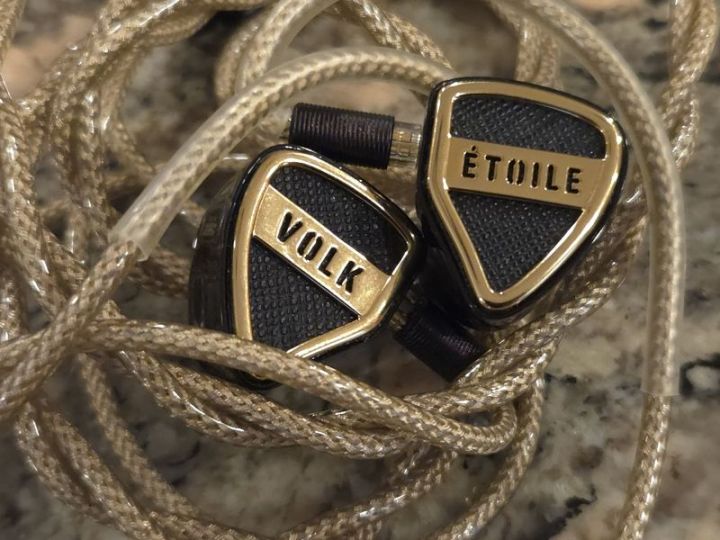
The faceplate design of the Etoile features a 24k gold-plated frame encasing the Saffiano leather material, the same as the storage box. The left earpiece is labeled “Etoile,” while the right has “Volk.” The shells are lightweight and fit comfortably in my ears. The nozzle is neither too long nor too short, and its angle does not create any pressure in the ear canal. I noticed a 3-port vent on the side of the shell for the dynamic driver, designed to relieve pressure and reduce driver flex. However, this will vary depending on the choice and size of eartips and the ear canal seal. The nozzle has a proper lip to keep the eartips secure and has a 5-bore opening at the tip, corresponding to the crossover partitioning and internal sound tubes.
Inside, you will find a 10-driver quadbrid architecture with the following partitioning under a 6-way crossover. The M10 (Meister 10) 10mm dynamic driver features a proprietary Japan-made N52 coil system that covers the sub-bass and bass frequencies. Next, there are four balanced armature (BA) drivers for the mids, followed by four electrostatic (EST) drivers for the highs, and one M8 (Meister 8) 8mm magnetostatic proprietary tweeter driver that covers specific narrow-band highs.
From what I have been told, the production is limited to 350 units, each individually numbered.

Sound Analysis.
The sound analysis of the Etoile was done using P6 Pro, SP3000M, M8T, and DX340 w/amp16 while playing a selection of test tracks, including Agnes Obel’s “The Curse,” Sandro Cavazza’s “So Much Better” (Avicii remix), C-Bool’s “Never Go Away,” Ed Sheeran’s “Shape of You,” Alan Walker’s “Darkside,” Ariana Grande’s “Break Up With Your Girlfriend,” Galantis’s “Hunter,” Iggy Azalea’s “Black Widow,” Indila’s “Boite en Argent,” Dua Lipa’s “Love Again,” Counting Crows’ “Big Yellow Taxi,” David Elias’s “Vision of Her,” and Michael Jackson’s “Dirty Diana.” I’m sure this IEM had many hours of burn-in time before my analysis, considering it was used before and during the recent CanJam SGP show.

To my ears, Etoile has a balanced sound signature with a natural and very detailed tonality. However, unlike other balanced-tuned IEMs, Etoile does not attempt to be W-shaped. Instead, it strives to maintain a linear, balanced, engaging, fuller-bodied tuning with a surprisingly resolving and detailed natural tonality.
I usually listen to new IEMs before taking FR measurements to confirm my observations. After about 10 to 15 minutes of listening to Etoile, I went straight for the measurements out of curiosity to see if my impressions matched the data. Why? Because it sounded different and rather unique. Lately, it has become quite common for many IEMs to maintain neutral and lean lower mids, which enhances the perception of separation between the elevated bass and the more prominent upper mids, with boosted pinna gain.
In Etoile, the bass weight primarily comes from the sub-bass lift, which is not overwhelming but still produces a decent rumble. However, despite the greater emphasis on sub-bass extension, unmistakably a result of the dynamic driver performance, the mid-bass exhibits a snappy decay, providing the bass notes with more control as they blend into the neutral lower mids, followed by fuller-bodied mids, not the same as fuller-bodied lower mids. The bass tuning also ensures that the sound is neither too fast nor too laid back, maintaining an average speed. Overall, the Etoile sets itself apart with a fuller-bodied, natural tonality in the mids, which does not muddy the sound or render it thicker or warmer, thanks to the neutral lower mids. This is why I wanted to see how the frequency response of these IEMs looks.
Fuller body mids are a tricky aspect of the tuning because they can easily render the mid-range thick, warm, congested, and less resolving. Etoile does not exhibit a typical pinna gain boost in the upper mids; instead, it presents natural, clear, and detailed mids with a noticeable resolution enhancement from carefully tuned lower and mid-treble peaks. The treble displays good extension and moderate airiness, contributing to the sound’s natural clarity. I perceive everything in perfect balanced harmony, without any exaggeration or boost. As a result, the fuller body mids enhance the musicality of the tuning without coloring the tonality or detracting from clarity or detail retrieval.
Don’t expect an overly wide soundstage. It is wide and offers more depth and height relative to the width, expanding naturally without pushing the sound too far from your head or wrapping around you. Based on the placement of instruments and vocals, the imaging is accurate and nearly holographic, filling the designated soundstage space. The layering and separation of sounds are also very good, despite having a bit more fullness in the mids, which, as I mentioned before, does not cause muddiness or congestion.
During my 2-3 hour listening session, I found the tuning of the Etoile to be non-fatiguing, and I couldn’t pinpoint a single genre of music in which these IEMs didn’t sound good. I tested many tracks, ranging from classical and instrumental to pop, rock, and EDM. The Etoile could keep up with any genre, although switching between the Odin and the Etoile took a few seconds for my ears to adjust to the fuller-bodied sound. Additionally, based on my brief experience with them, I found a noticeable dependency on source pairing, as they synergized better with sources with discrete DACs and/or NuTube/Raytheon tube amps.
Conclusion.
It’s probably too early to conclude, as I would like to spend more time with Etoile, trying it with various sources, different ear tips, and possibly even different cables. However, even after 2-3 hours of listening, I greatly enjoyed the unique tuning of these IEMs and how they stand out from the crowd. Initially, I approached these IEMs with curiosity and caution, as they could sound similar to Jack’s previous projects. The whole point of branching out is to try something new and different, something that people won’t label as “another version of the same thing.” From what I heard, when Jack and Michael attended the recent CanJam SGP show, others were also curious to hear about Volk Audio and how it would compare to other EE IEMs.

My concerns quickly faded as I listened to Etoile, especially after I got Odin out for reference. In this comparison, Etoile’s lower mids are not as lean, its upper mids are not as forward, and its treble is more relaxed. Continuing along the same EE comparison path, relative to Raven, Etoile’s mid-bass is less elevated, the mids are fuller, and the treble is less aggressive, more relaxed, and more natural. None of this makes any of these IEMs better or worse than the others, but if one can trace the evolution of tuning from Odin to Raven, Etoile has taken a different tuning approach. I was pleased to see Volk Audio not as a side project of Empire Ears, but as a brand developing its unique balanced sound signature and natural, fuller-bodied tonality that remains quite resolving and detailed. I look forward to spending more time with Volk Audio Etoile whenever I can.

 Twister6 Reviews